The Question Every Retail Trader Hits Eventually
You have a clear strategy in your head. BANKNIFTY crosses the 9 EMA on a 15-minute chart, RSI is above 55, you sell a strangle 200 points wide. Simple enough to describe. But turning that into automated execution?
That's where the path splits.
Some traders spend weeks learning Python, setting up VPS servers, debugging API calls at 9:14 AM. Others click through a visual builder, backtest in 10 minutes, and deploy by afternoon. And a third group routes TradingView alerts through webhooks to their broker.
None of these are wrong. They solve different problems at different cost-to-complexity ratios. This guide helps you pick the right layer for where you are — and where your strategy actually needs to go.
Layer 1: No-Code Strategy Builder — Rules Without Syntax
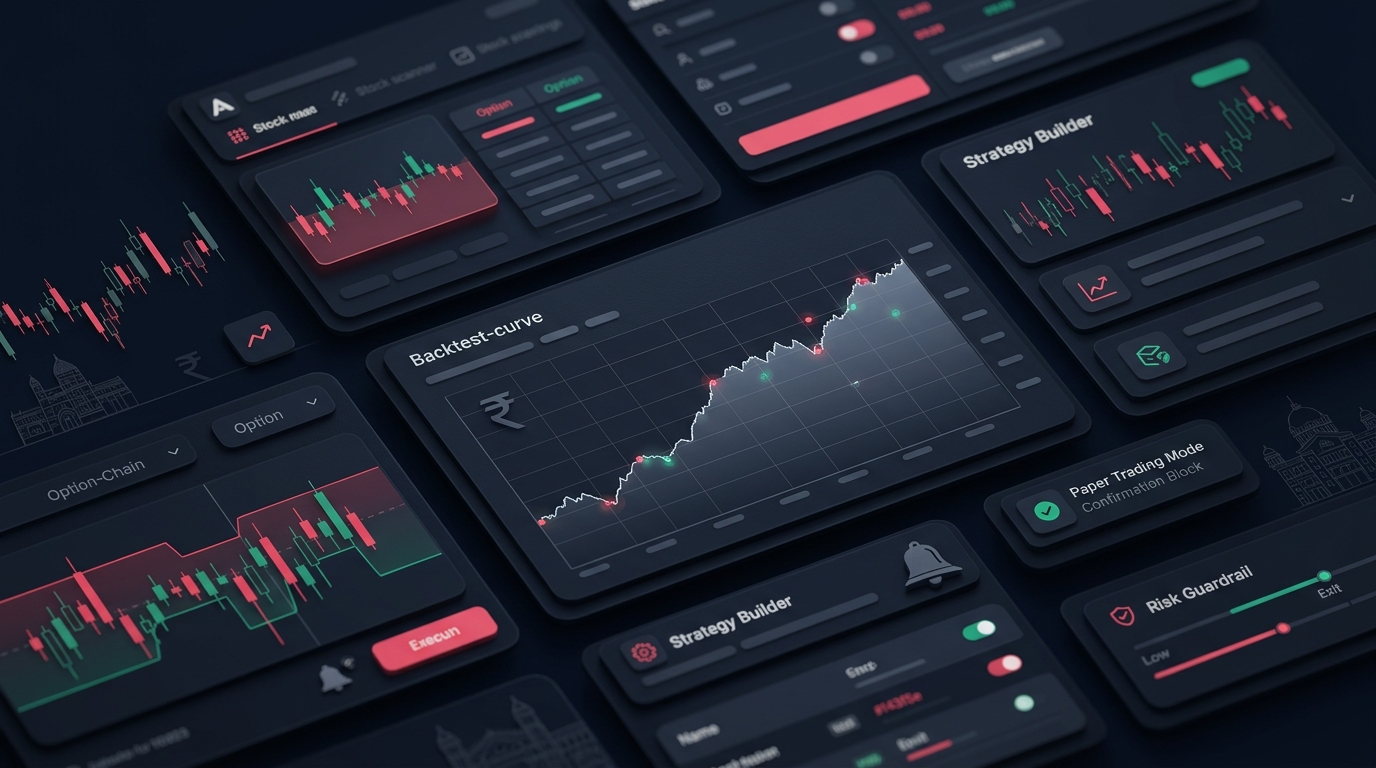
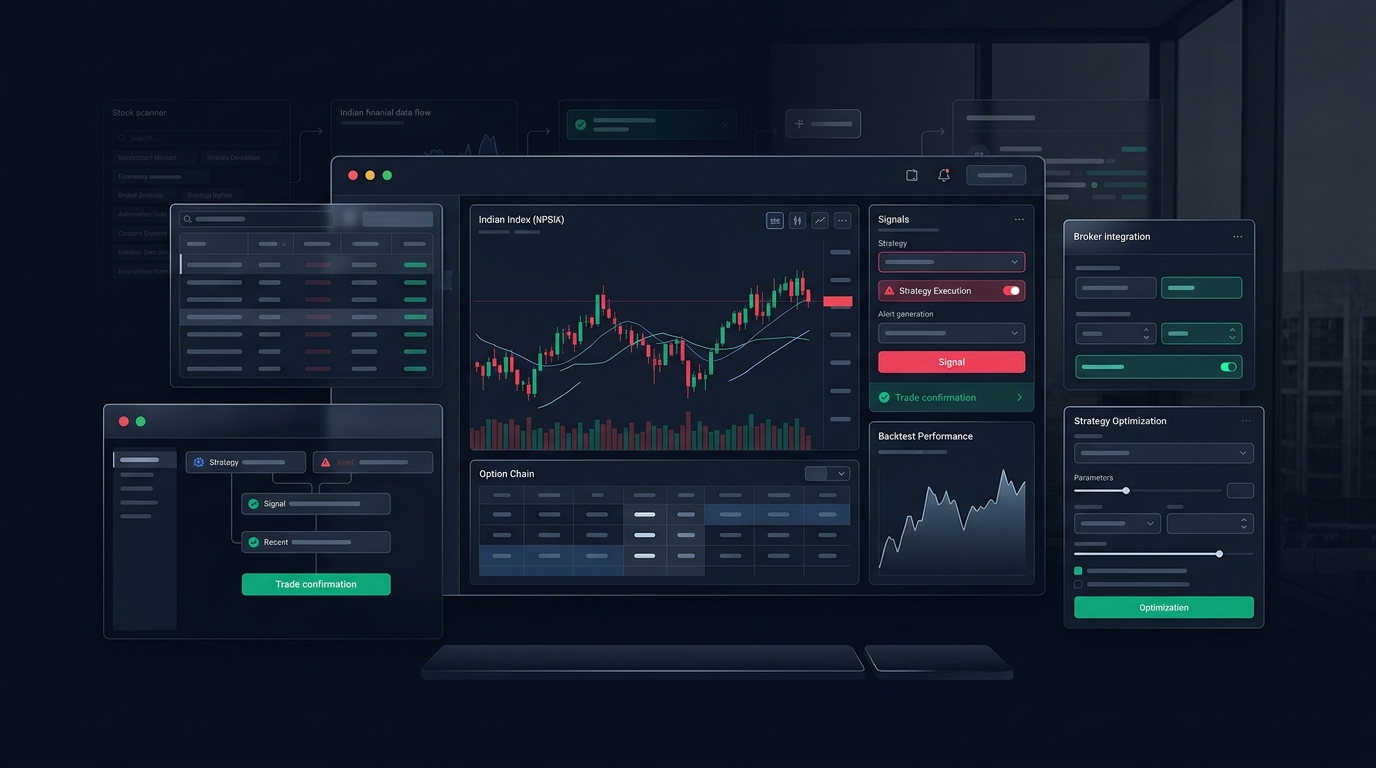
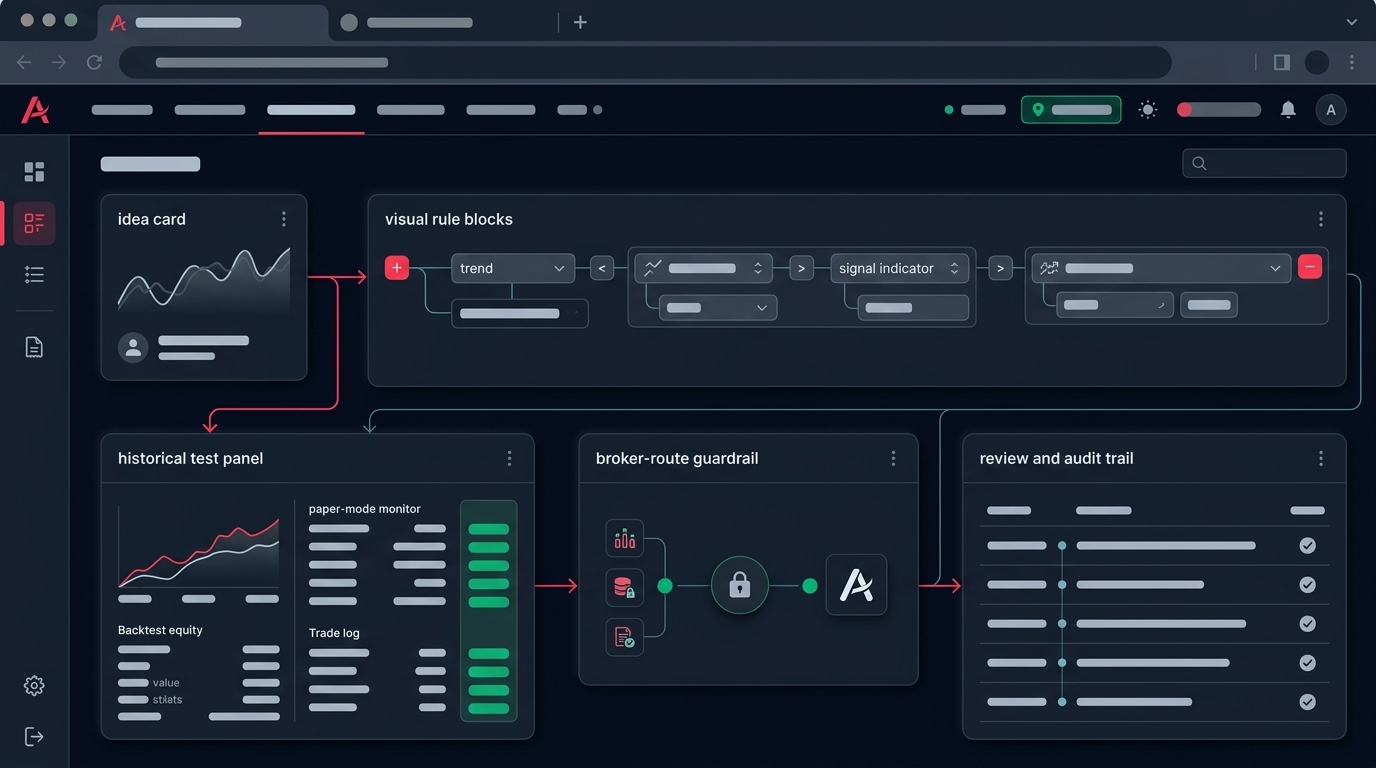
A no-code approach lets you define your entry conditions, exit rules, position sizing, and risk limits through a visual interface. No Python. No terminal. No static IP. You express logic the way you'd write it on paper, and the platform translates it into execution.
This is now a real and mature approach for Indian retail traders. Algo trading accounts for a large portion of NSE's F&O volume — and not all of that is institutional quant code. A significant portion runs on structured, rule-based systems built on platforms designed for exactly this.
When no-code is the right fit:
- Your strategy uses standard indicators — EMA, RSI, ATR, OI data, option greeks
- Entry and exit conditions can be expressed as IF-THEN rules
- You want to backtest the strategy quickly before committing real capital
- You're running intraday or expiry-day NIFTY/BANKNIFTY strategies without exotic custom signals
- Your time is better spent on strategy logic than on infrastructure
The honest limitation: no-code builders work best within the indicator library and condition types the platform supports. If your edge depends on a custom signal that doesn't exist in that library — say, a proprietary volatility ratio you built from raw tick data — you'll hit a ceiling.
But for most retail traders, the ceiling is much higher than they think. Standard technical conditions, option strike selection rules, delta/theta thresholds, time-based exits, and market-condition filters can all be built without writing a single line of code.
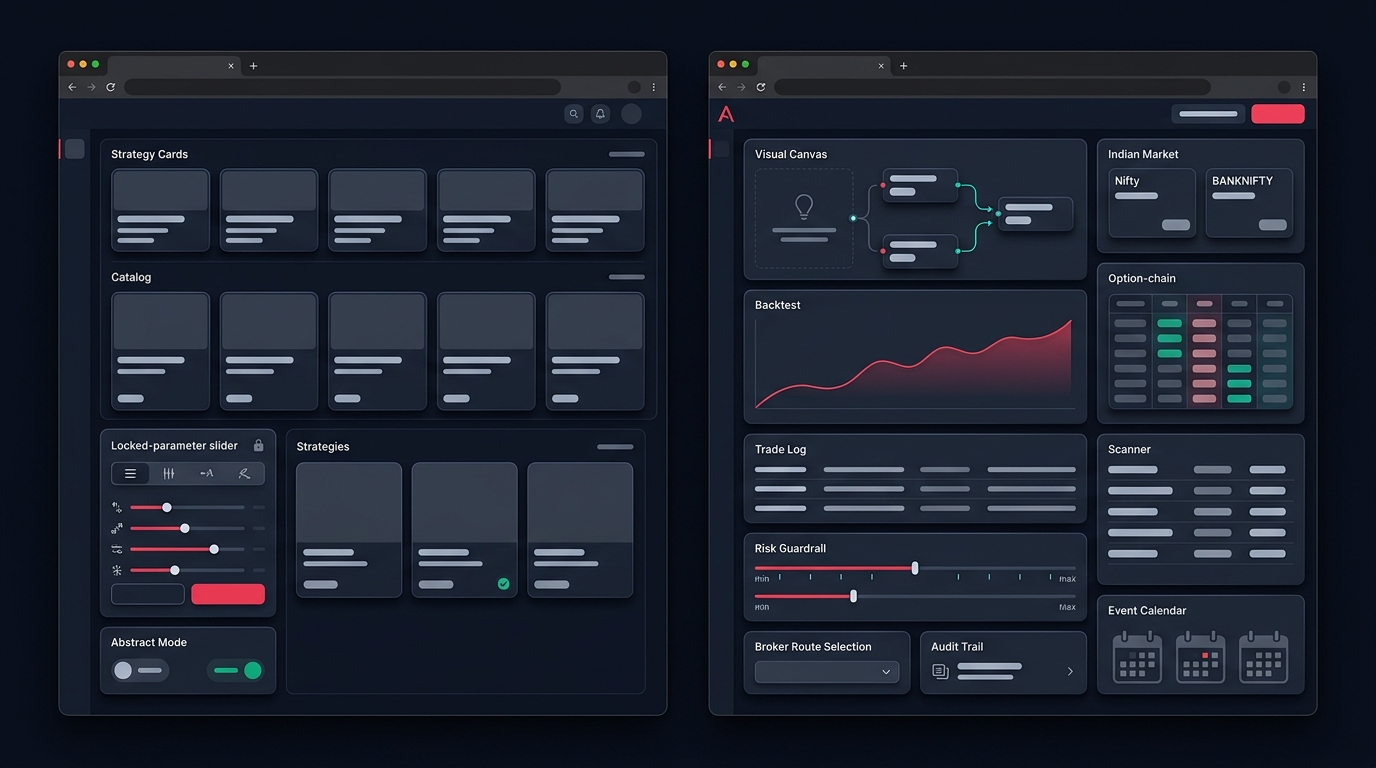
Anadi Algo's strategy builder is built around this workflow — letting you define and test rule-based strategies without turning every idea into a coding project.
Layer 2: TradingView Webhooks — Bridging Signals and Execution
Webhooks sit between no-code and full Python. You build your signal logic in TradingView using Pine Script (which is its own language, but simpler than Python), configure an alert, and that alert fires a JSON payload to an endpoint that places the order through your broker API.
This is a popular setup among Indian traders who are comfortable with TradingView but don't want to manage Python servers and broker SDK integrations themselves.
When webhooks make sense:
- Your signal generation already lives in TradingView and you trust it
- You want multi-timeframe confluence alerts that are difficult to replicate in a visual builder
- You need custom Pine Script indicators you've already built
- You want to route those signals into your broker without building the full execution stack yourself
The practical complexity: you need to understand JSON payloads, webhook URLs, authentication tokens, and what happens when an alert fires twice during a volatile candle close. These aren't insurmountable, but they require more operational awareness than a pure no-code setup.
If you're looking at this path, it's worth reading about TradingView webhooks to understand where the edge cases hide before going live.
Layer 3: Python Algo Trading — Full Control, Full Responsibility
Python gives you complete control over every part of the stack. You query any data source, build any indicator, write any order logic, handle any edge case exactly the way you want. No platform constraints.
This is genuinely powerful — and genuinely expensive in terms of time and operational overhead.
What "full control" actually means in practice:
- Your own data pipeline (historical + live)
- Broker SDK integration and session management
- Error handling for dropped connections, duplicate orders, stale prices
- A server that stays running during market hours
- Monitoring, logging, and alerting when something goes wrong
For most retail traders, this overhead is a distraction from the actual problem: finding and validating an edge. The infrastructure work is real work that doesn't directly improve your strategy.
When Python is genuinely necessary:
- You need custom signals that can't be expressed with standard indicators — proprietary ML models, alternative data, multi-instrument correlations
- You're running a high-frequency or latency-sensitive strategy where execution speed matters at the millisecond level
- You're building something institutional-grade with multiple strategies, portfolios, and complex risk constraints
- You want to contribute to open-source algo infrastructure or build algo tools for others
If none of those describe you, Python is probably over-engineering. The traders who do best with it aren't necessarily better at trading — they're better at software engineering. Those are different skills.
The Decision Framework: Which Layer Fits You
Ask yourself three questions:
1. Can your strategy be expressed in IF-THEN rules using standard indicators? If yes, a no-code strategy builder will get you there faster and with less ongoing maintenance.
2. Does your signal already live in TradingView and you only need execution wired up? Webhooks are the right bridge. Understand the failure modes before going live.
3. Does your edge require something genuinely custom that no existing platform supports? Then Python is justified — but scope the infrastructure cost honestly before you start.
Most retail traders should start at Layer 1, validate their edge with real options backtesting, and only move up the stack if they hit a specific limitation that forces them to. Don't build a Python system because it feels more serious. Build it when the problem actually requires it.
If you're still figuring out where to start, early access to Anadi Algo gives you the full workflow — from strategy rules to backtesting to live execution — without the infrastructure overhead.
Quick Decision Checklist
Use this before choosing your approach:
- Strategy uses standard indicators (EMA, RSI, OI, greeks): start with no-code
- Signal already works in TradingView Pine Script: explore webhooks
- Need custom ML signals or alternative data: Python is justified
- Running intraday NIFTY/BANKNIFTY expiry strategies: no-code or webhooks, not Python from scratch
- Want to validate the edge before building infrastructure: backtest first, always
- Spending more time on infrastructure than on strategy logic: wrong layer, step back
The tool should serve the strategy. If you're spending more time debugging broker API sessions than refining your entry rules, you've picked the wrong layer for where you are right now.