Most retail traders in India lose money in their first six months of live algo trading not because their strategy is bad, but because they jumped from a paper trading screen to real capital without a transition plan. Paper trading shows you what could have happened. Live trading shows you what actually happens when slippage, broker latency, partial fills, and your own emotions enter the picture.
This post is a practical checklist for that transition. No theory. No promises. Just the checks you should run before you risk a single rupee.
Why paper trading alone is not enough
Paper trading is useful, but it has structural blind spots:
- Orders get filled at the exact price you wanted. In live markets, especially in options, the spread can eat 2-5% of a trade before you start.
- There is no broker rejection. Live, you will hit margin issues, freeze quantity limits on NIFTY/BANKNIFTY, and rate limits.
- There is no emotional cost. Losing ₹3,000 on paper feels nothing like watching ₹3,000 disappear from your real account in 90 seconds.
- Strategy logic that depends on the latest tick may behave differently when there is a 200-400 ms gap between your signal and the broker confirming the order.
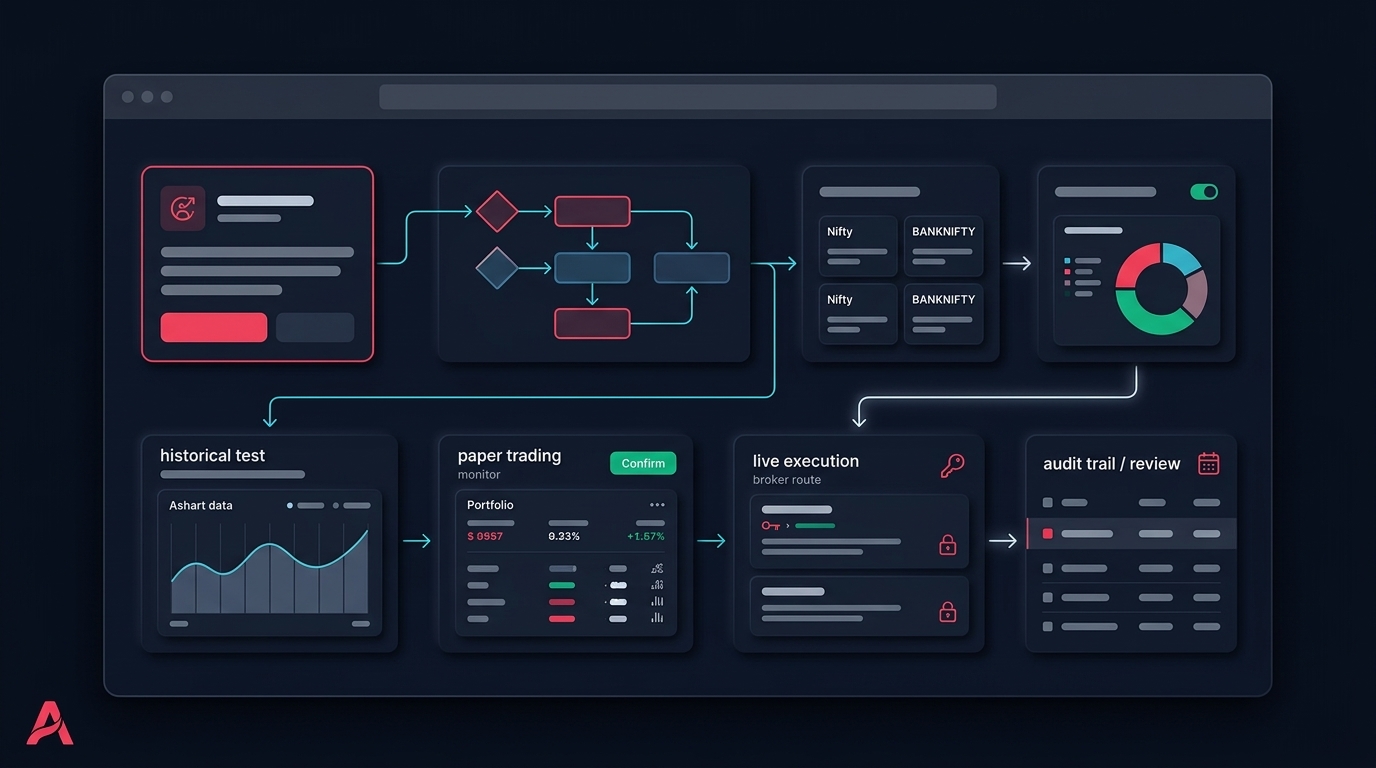
So treat paper trading as the first filter, not the final verdict. The goal is a structured ramp: backtest, paper, micro-live, scaled live.
Stage 1: Backtest before you paper trade
Before paper trading even starts, your strategy should clear a basic backtesting bar. Otherwise you are just observing noise on a demo account.
Look for:
- At least 100 trades in the backtest sample. Anything less is statistically thin.
- Performance across different market regimes — trending, sideways, high volatility (think March 2020, October 2024, post-budget weeks).
- A maximum drawdown number you can actually stomach. If your backtest shows a 22% drawdown, ask yourself honestly whether you would keep running the strategy after losing ₹22,000 on a ₹1 lakh account.
- Realistic cost assumptions: brokerage, STT, exchange fees, GST, and at least 0.05-0.10% slippage on liquid instruments. More for illiquid options strikes.
If the strategy only works without costs, it does not work.
Stage 2: Paper trading — what to actually measure
Paper trading is not "did I make money this week?" It is a structured data collection exercise.
Run paper trading for a meaningful window
Two days is not enough. Two weeks is the bare minimum, four weeks is better. You want to see the strategy hit at least one losing streak and one drawdown phase. If you only paper trade in a friendly market, you are setting yourself up for a shock when conditions change.
Track these numbers, not just P&L
- Number of signals fired vs. signals you would have actually traded
- Average slippage estimate (compare signal price vs. realistic fill price 1-2 seconds later)
- Maximum consecutive losses
- Win rate, average win size, average loss size — and the ratio
- Largest single-day drawdown
- Time of day distribution of trades (a strategy that fires only in the first 15 minutes behaves very differently from one that trades all day)
Check signal quality, not just outcomes
A strategy can have a good week with bad signals (lucky) or a bad week with good signals (unlucky). Look at whether each entry made logical sense given your rules. If you find yourself constantly thinking "this signal looks weird," your rules need work before you go live — not your position size.
Stage 3: The pre-live checklist
Before flipping the switch on a real broker connection, walk through this list. Skip nothing.
Broker and execution checks
- Broker API credentials tested with a manual ₹1 quantity order on a liquid stock, then squared off
- Daily token regeneration flow understood (most Indian brokers expire tokens daily)
- Freeze quantity limits known for the instruments you trade (NIFTY, BANKNIFTY, FINNIFTY each have different limits)
- Order types your strategy uses are actually supported by your broker (some do not support SL-M on options, some have restrictions on AMO orders)
- Margin available is at least 1.5x what your worst-case position would need
Risk guardrails
- Maximum loss per day defined and enforced in code, not just in your head
- Maximum loss per trade defined
- Maximum number of trades per day capped
- A kill-switch you can hit from your phone if something goes wrong
- What happens if your internet drops mid-trade — do you have an exit plan?
A clear risk management layer is the difference between a bad day and a blown account.
Strategy hygiene
- Entry and exit rules are deterministic — same input, same output
- No "I will exit when it feels right" logic
- Stop-loss is built into the strategy, not assumed at the broker level
- Position sizing is rule-based, not discretionary
Operational checks
- Logs are being written somewhere you can actually read
- Notifications set up for entry, exit, and errors
- You know how to stop the strategy mid-day without leaving an open position
- You have manually traced through what happens at 3:20 PM and 3:30 PM
Stage 4: Micro-live — the transition that protects you
This is the step most retail traders skip, and it is the most important one.
Run the strategy live with the smallest possible quantity for at least 10 trading sessions. One lot of NIFTY. One share of a stock. The capital at risk should be small enough that a total loss does not affect you.
The goal here is not profit. The goal is to compare:
- Signal time vs. actual order placement time
- Expected fill price vs. actual fill price
- Backtest/paper P&L vs. live P&L for the same signals
- Any broker-side issues (rejections, partial fills, margin blocks)
If live results diverge from paper results by more than 15-20%, stop and investigate before scaling. The divergence is data, not failure.
Stage 5: Scaling up — slowly
Once micro-live results match expectations within a reasonable range, scale in steps. A common approach: 1x → 2x → 5x → target size, with at least a week between each step. If a step performs worse than the previous one, drop back.
This is where having a workflow that supports both paper trading and broker execution under the same rules — rather than rebuilding the strategy when you go live — saves you from translation errors. Anadi Algo's AutoTrade is built around this idea: the same strategy you tested moves to live execution with the guardrails attached, not bolted on later. If you want to try this end-to-end flow, you can request early access.
The honest summary
Paper trading proves your strategy logic compiles. Micro-live proves it survives contact with the real market. Scaled live is what builds (or destroys) capital.
Most blowups happen because someone skipped the micro-live stage — either out of impatience or because their platform made it hard. Don't be that trader. The market will still be there next month.
One-page checklist to save
- Backtest with realistic costs and at least 100 trades
- Paper trade for 2-4 weeks across different market conditions
- Document signal quality, slippage estimates, and drawdown
- Set up risk guardrails and kill-switch in code
- Test broker connection with a manual ₹1 trade
- Run micro-live for 10+ sessions at minimum size
- Compare live vs. paper results — investigate any large divergence
- Scale in steps, not jumps
- Drop back at the first sign of underperformance
Treat the move from paper to live as a process, not a moment. That single mindset shift separates traders who last from traders who don't.