Most retail traders decide size by feel. The setup looks clean, conviction is high, so the quantity goes up. The next trade looks ordinary, so size drops. That is sizing by confidence, and it is the fastest way to turn a decent strategy into a drawdown machine — especially once you automate it and the system repeats your worst habit at speed.
Before you connect any strategy to a broker API or webhook, your position size needs to come from a number you set in advance: your risk budget. Not your mood.
Size from risk budget, not conviction
The core rule is simple. Decide how much money you are willing to lose on a single trade before you look at how good the setup feels. That amount is your risk per trade, and everything else is derived from it.
Confidence is not a measurable input. You cannot backtest "I felt sure about this one." A fixed rupee or percentage risk, on the other hand, is testable, repeatable, and survives automation. When a machine is placing orders for you, it needs a formula, not a feeling.
A common starting point for retail traders is risking a small, fixed slice of capital per trade — often around 1 percent or less. On ₹5,00,000 capital, 1 percent is ₹5,000 of risk per trade. That number is your budget. The job of position sizing is to never quietly exceed it.
The three numbers to fix before you automate
Position size is not a guess. It falls out of three inputs you must define explicitly.
1. Risk per trade
This is your risk budget in rupees. Keep it small enough that a string of losses does not break you. If you risk 1 percent per trade, ten losses in a row is roughly 10 percent of capital — uncomfortable, but survivable. Risk 5 percent per trade and the same losing streak is account-ending.
2. Stop distance
This is the gap between your entry and your stop-loss, per unit. Without a defined stop, you cannot size a position correctly — there is no denominator. If your strategy does not have an invalidation level, you are not ready to automate it. Fix the stop first.
3. Position size formula
Put them together:
Quantity = Risk per trade ÷ (Entry price − Stop price)
Say you risk ₹5,000, enter a stock at ₹500, and set a stop at ₹485. Risk per share is ₹15. Quantity = 5,000 ÷ 15 = 333 shares. Your capital deployed is about ₹1.66 lakh, but your actual risk is capped near ₹5,000. That distinction — capital deployed versus money at risk — is the one most retail traders skip.
Notice what changes when the setup is "tighter." A stop ₹5 away lets you buy more shares for the same ₹5,000 risk; a stop ₹30 away forces fewer. The market structure sets the size, not your enthusiasm.
Why options and index lots break the simple formula
The clean formula assumes you can buy any quantity. In Indian F&O, you cannot. Index and stock derivatives trade in fixed lots set by the exchange, so you round to whole lots — and one lot may already carry more risk than your budget allows.
This is where retail sizing quietly goes wrong. A trader wants to risk ₹5,000 on a NIFTY or BANKNIFTY position, but a single lot's stop distance implies ₹12,000 of risk. The honest answer is "this trade is too big for my account," not "I'll widen the stop" or "I'll skip the stop." Forcing the trade breaks the budget.
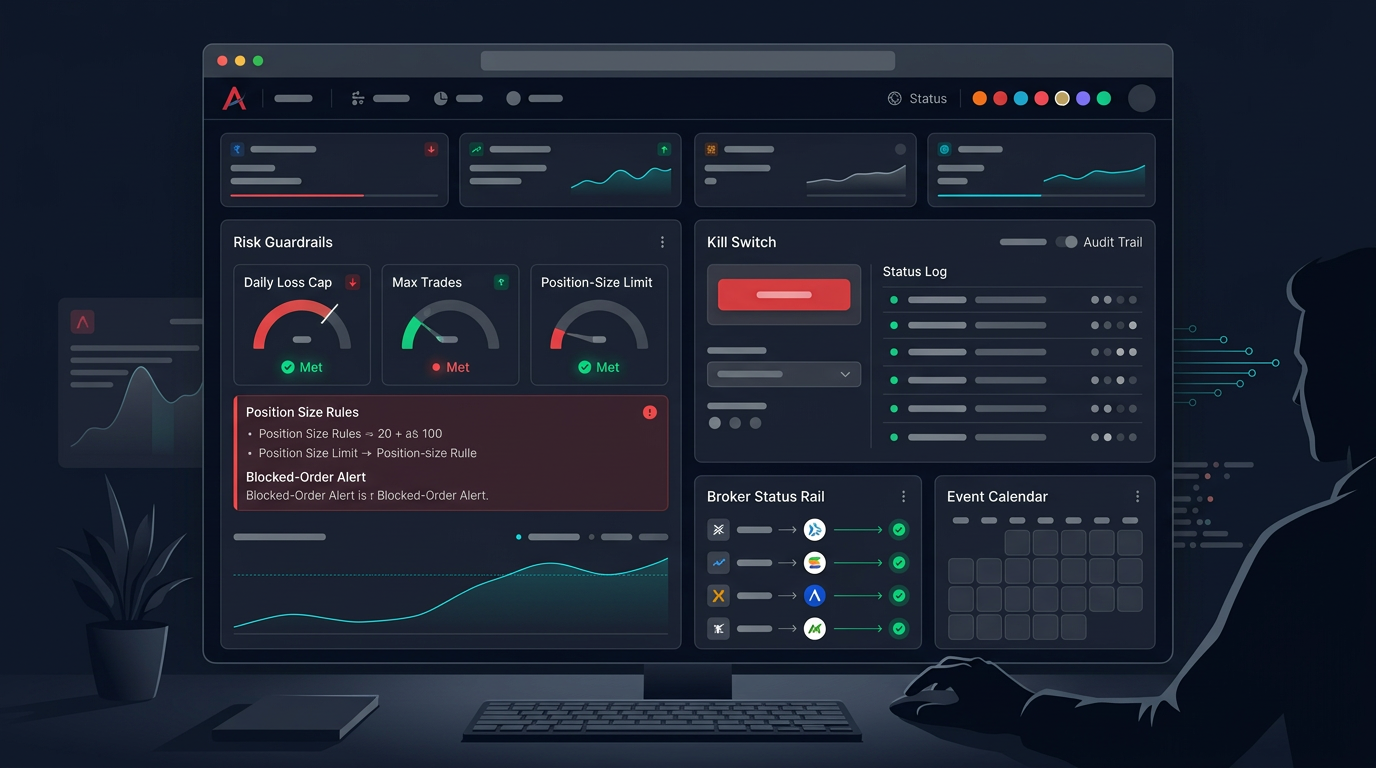
For option selling, it gets worse, because your loss is not capped at the premium. Margin tells you what the broker blocks; it does not tell you your real downside on a gap. Size option-selling positions against a worst-case move, not against margin availability. This is exactly why risk management tooling — stop-loss, daily limits, and a kill-switch — should be in place before you scale, not added after the first bad day. Validate the loss profile with options backtesting so you are sizing against realistic adverse moves, not best-case ones.
Put the sizing rule inside the strategy, not your head
A sizing rule that lives only in your head does not survive automation. The strategy itself has to know how big to trade.
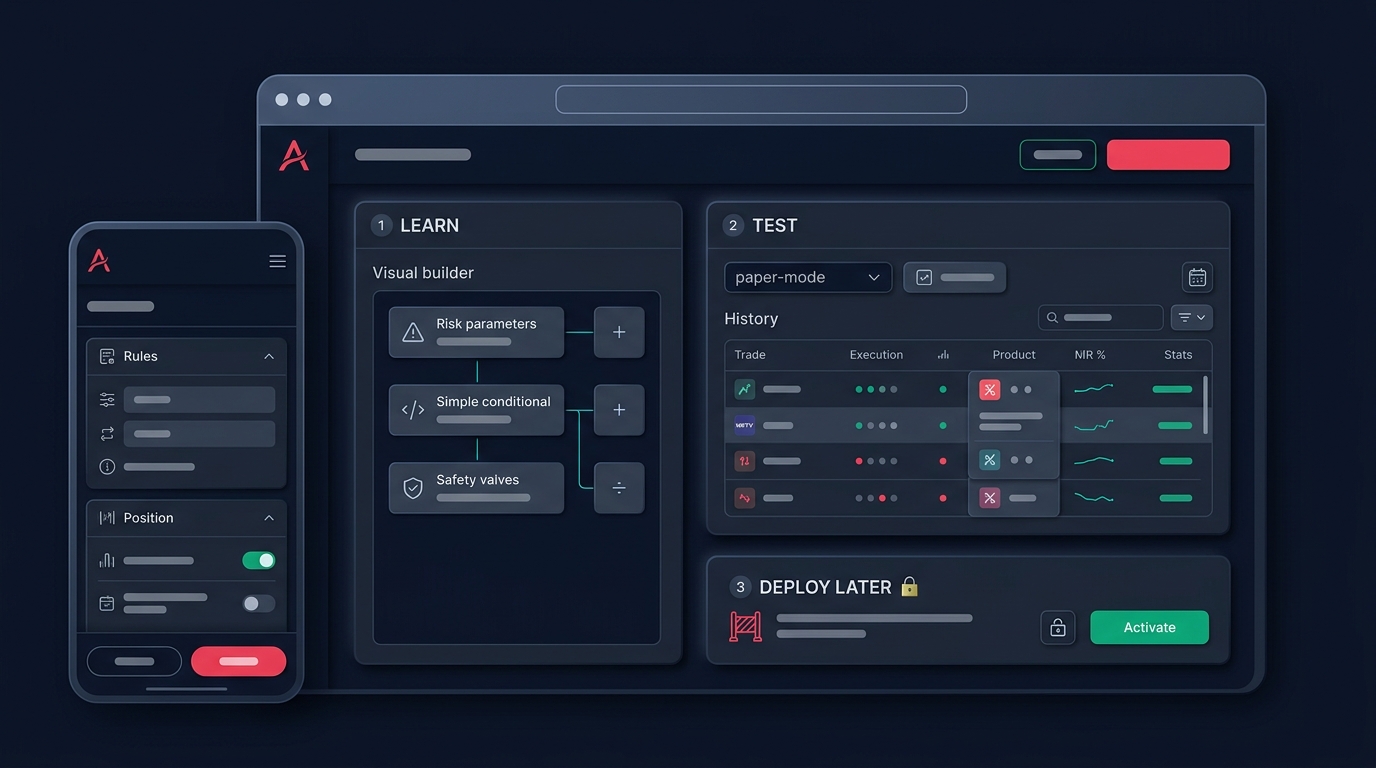
When you define a strategy in a no-code strategy builder, the sizing logic — risk per trade, stop distance, max quantity — should be an explicit part of the rules, alongside entry and exit. If the sizing block is vague, the parsed strategy will either over-trade or refuse to size at all. Make it concrete: a fixed risk amount, a defined stop, and a hard cap on quantity per signal.
Then prove it in paper trading first. Run the automated strategy on live data without real money and watch the quantities it generates, not just the entries. If paper mode is throwing 8 lots at a noisy intraday signal, that is the bug to fix before a single rupee is live.
Sizing mistakes that survive into live trading
- Sizing on capital, not risk. "I'll deploy 20 percent of capital" ignores stop distance entirely. Two trades with the same capital can carry wildly different risk.
- Averaging down without a budget. Adding to a loser feels like conviction; it is just an unplanned size increase that blows past your risk per trade.
- No portfolio-level cap. Each trade risks 1 percent, but ten correlated NIFTY positions fire at once and you are suddenly risking 10 percent on one move. Cap total open risk and daily loss, not just per-trade risk.
- Letting margin define size. Available margin is not permission. It is the most expensive position size you could take, not the one you should.
- Widening the stop to fit the lot. This silently doubles your risk. If the lot is too big, the trade is too big.
A pre-automation sizing checklist
Before you let any system place orders for you, confirm:
- Fixed risk per trade is set in rupees or as a small percentage of capital.
- Every signal has a defined stop, so size has a real denominator.
- Quantity is derived from the formula, then rounded down to whole lots for F&O.
- One-lot risk is checked against your budget — if it exceeds it, you skip the trade, not the stop.
- A daily loss limit and total open-risk cap exist above the per-trade rule.
- Option-selling size is set against a worst-case move, not margin.
- The whole thing is paper-traded and the generated quantities are inspected.
Sizing is the one risk control you set before the market opens and the machine never argues with. Get it from a budget you can defend, write it into the strategy, and test it cold. If you want to build and validate sizing rules this way before going live, you can request early access and start in paper mode.
Position sizing is not the exciting part of algo trading in India — but it is the part that decides whether your edge gets a chance to show up at all.