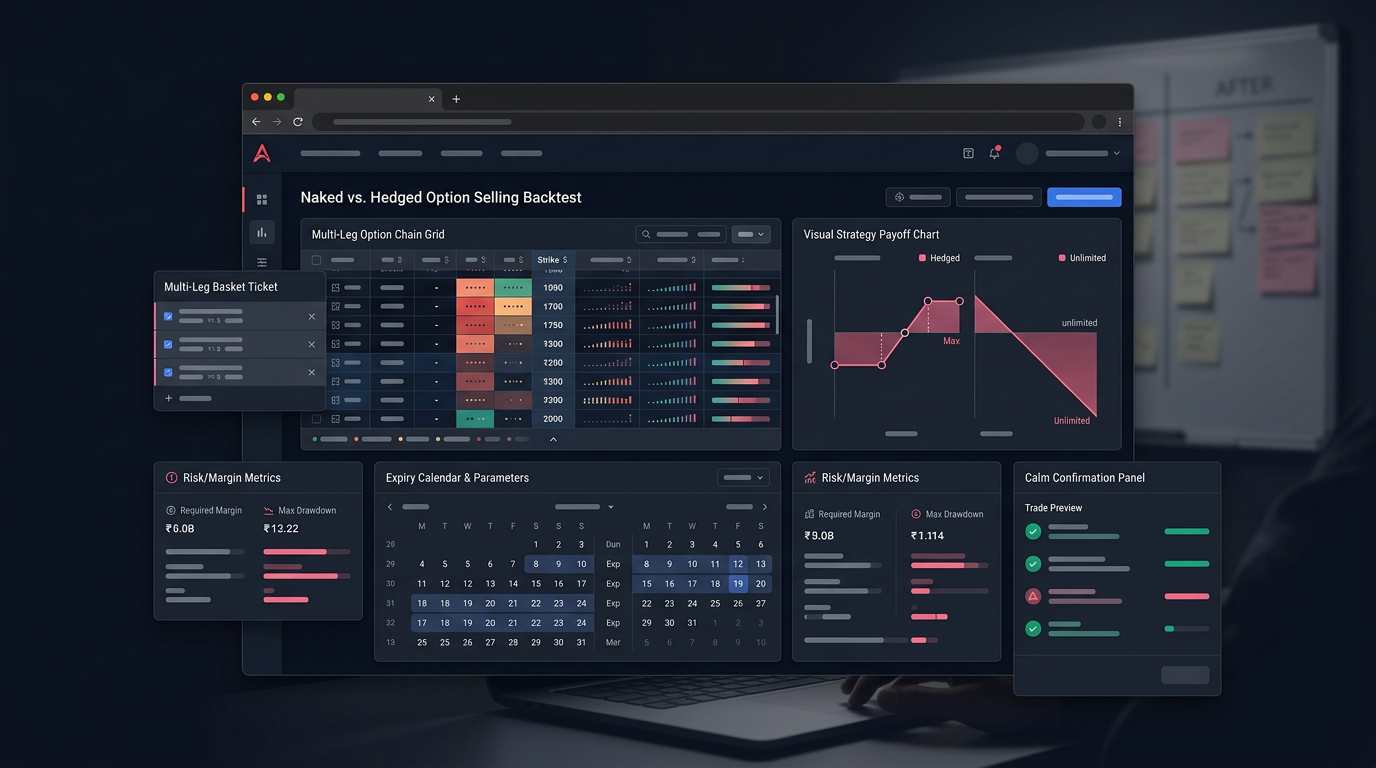
Two traders can share the exact same view — "Nifty stays range-bound into expiry" — and run two very different systems. One sells a naked option and collects full premium. The other sells the same option but buys a further out-of-the-money wing to cap the loss. Same thesis, same underlying, same expiry.
On a payoff diagram the difference looks small. In a backtest, it changes almost every number that matters. This post walks through what actually shifts when you move from naked selling to a hedged, defined-risk structure — and which of those changes your backtest needs to model honestly.
The two structures in one line
Naked selling: sell an OTM call or put (or a straddle/strangle), collect the premium, carry undefined risk on the wrong side.
Hedged selling: sell the same option, then buy a cheaper, further-OTM option as protection. This turns a naked short into a credit spread, iron fly, or iron condor. The wing you buy is insurance — it costs premium but it draws a hard floor under your loss.
That single protective leg is the whole story. Everything below is a consequence of it.
What a naked-selling backtest quietly hides
Naked option selling backtests love to look good. High win rate, smooth equity curve, steady theta collection. The problem is that the equity curve is the wrong thing to stare at.
- Max loss is undefined. A naked short put has no floor until Nifty hits zero. Your backtest may never have sampled a day bad enough to show it, but the exposure is real.
- Margin is high and moves around. Naked short margin is SPAN plus exposure, and it expands exactly when volatility rises — the worst moment to need more capital.
- Gap risk is under-sampled. Most historical windows don't contain a Budget-day or global-shock gap. One 1.5% overnight move against a naked short can erase months of premium. Backtests routinely underestimate this; it deserves its own line in your risk management review.
- Win rate flatters you. Winning 85% of trades means nothing if the 15% includes one uncapped tail. The distribution, not the average, is where naked selling lives or dies.
What changes the moment you hedge
Add the protective wing and the same strategy backtests as a different animal.
Margin drops, often sharply
Exchanges margin a defined-risk spread on its capped loss, not on open-ended exposure. A naked short leg that blocked, say, ~1.2–1.5 lakh per lot might become a spread needing a fraction of that. That is the single biggest structural change — and it cascades into every return metric below.
Max loss becomes an actual number
"Undefined" turns into "spread width minus net credit, times lot size." You can write it down before the trade. Your backtest can now report a true worst-case per position instead of a theoretical infinity, and your position sizing can key off a real figure.
Return on capital gets reshaped — both ways
This is the part traders miss. Hedging lowers the credit you keep (you paid for the wing), so per-trade profit falls. But it also lowers the margin blocked, so return on capital can actually rise. Whether net or gross wins depends on the width and how far out the hedge sits. Backtest both — don't assume the hedge always costs you.
Drawdown and worst-day compress
The naked curve has smooth gains punctuated by cliffs. The hedged curve gives up a little slope in exchange for a floor on the cliffs. Max drawdown shrinks, the worst single day is bounded, and recovery time after a bad expiry usually shortens — because no single trade can dig an unbounded hole.
The metrics to compare side by side
Run naked and hedged versions of the same rules over the same dates and lay these next to each other. The direction of change matters more than the exact values.
| Metric | Naked short | Hedged (defined risk) |
|---|---|---|
| Max loss per lot | Undefined | Capped (width − credit) |
| Margin per lot | High, volatility-linked | Lower, fixed to width |
| Credit collected | Full premium | Premium minus wing cost |
| Return on capital | Can be high | Often comparable or higher |
| Worst single day | Can be severe | Bounded |
| Max drawdown | Larger | Smaller |
| Win rate | Slightly higher | Slightly lower |
| Risk of ruin | Non-trivial | Structurally limited |
Notice the trade-off is not "hedged is strictly better." Hedged usually shows a marginally lower win rate and lower gross credit. What you buy is a hard ceiling on damage and a calmer capital footprint. That is a risk decision, not a profit upgrade — keep the framing conservative.
Backtest assumptions that matter more once you hedge
A hedge adds a second leg, and that leg introduces its own modelling problems. If your backtest ignores them, it will over-credit the hedged strategy.
- Fill the cheap wing honestly. Far-OTM options are thin. The bid-ask on your protective leg can be a meaningful share of its price. Assume you buy at the ask, not the mid.
- Check liquidity of the hedge strike. A wing with no volume is a wing you can't exit cleanly. Backtests that assume perfect fills flatter multi-leg trades most.
- Add costs per leg. More legs mean more brokerage, STT, and slippage. A two-leg spread doubles the round-trip friction versus a naked short. Model it, or your defined-risk edge is partly imaginary.
- Model both legs' exits. If you close the short but the wing expires worthless (or vice versa), the backtest must handle legs independently, not as one blended payoff.
Getting these assumptions right is the whole point of a serious options backtesting pass. A hedged system that survives realistic fills and per-leg costs is far more trustworthy than a naked one that only looks smooth because the tail never showed up in-sample.
A practical comparison checklist
Before you trust a hedged-vs-naked conclusion, confirm you have:
- Run both structures on identical dates, including at least one trending-up, trending-down, and sideways regime.
- Reported max loss as a real number for the hedged version and flagged the naked version as undefined.
- Compared return on capital, not just per-trade profit — the margin change is where hedging often earns its keep.
- Priced the protective leg at the ask and added per-leg costs.
- Checked worst single day and max drawdown, not only the win rate and total return.
- Stress-tested a gap scenario the historical window may not contain.
If you want to build these comparisons inside one workflow — set the structure, estimate margin, see max loss before execution, then follow the position on a hedge desk rather than bolting protection on late — that is exactly the kind of controlled process Anadi Algo is built around. You can try it in early access and run your naked and hedged versions against the same assumptions.
The takeaway is simple: hedging doesn't just change your payoff diagram. It changes your margin, your max loss, your drawdown, and your return on capital — so backtest the whole structure, not just the direction you got right.