Most retail algo traders treat "Nifty Bank F&O" as a ticker. It is actually a contract specification — and that specification quietly decides how your strategy behaves on expiry week, how your backtest fills look, and how often your risk engine gets surprised.
NSE's own Nifty Bank F&O page is dry reading. Three-month trading cycle, near/next/far month contracts, new strikes introduced on the trading day after near-month expiry, expiry on the last Tuesday of the expiry period with a rollback to the previous trading day if that Tuesday is a holiday. None of that sounds like a trading edge. But every one of those lines maps to a rule you either encode in your system or discover the hard way at 15:10 on an expiry day.
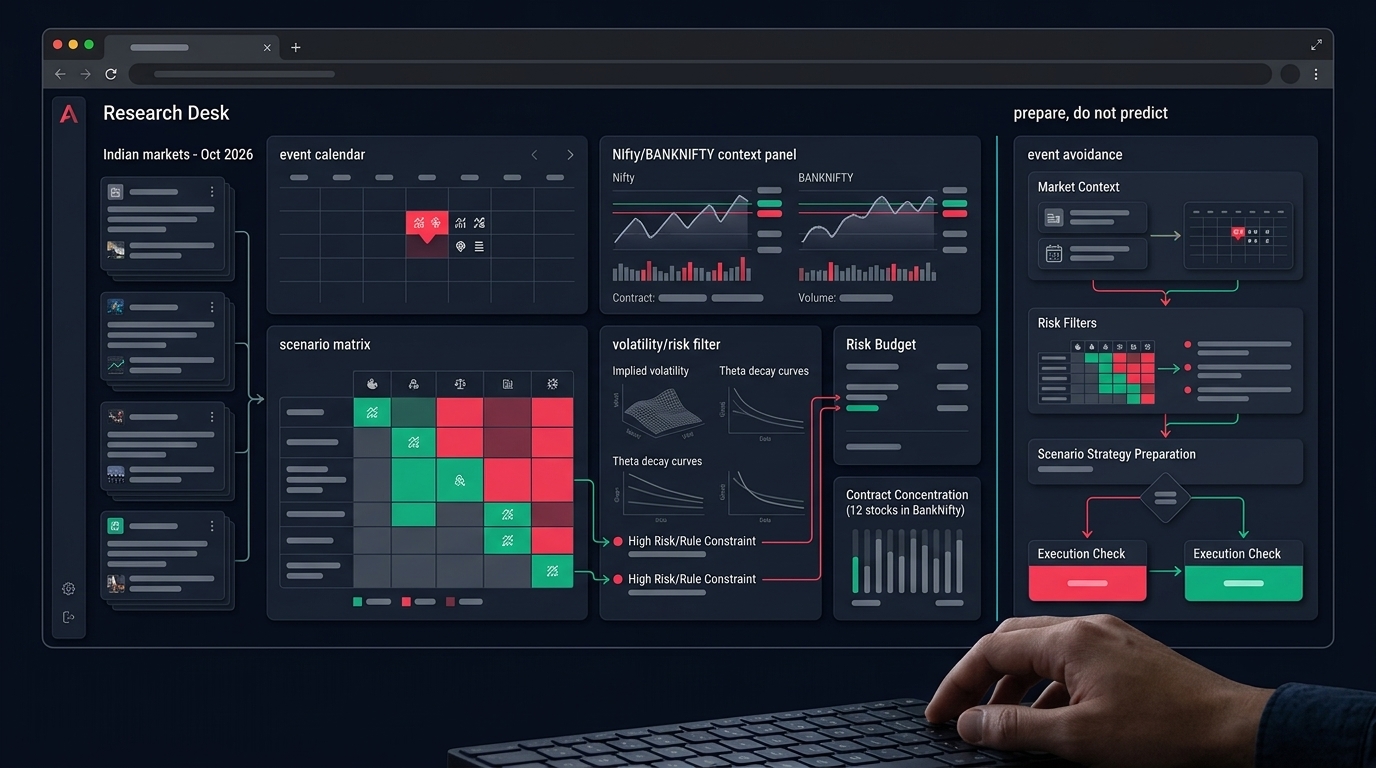
This post walks through what the contract structure actually implies for process, using the market context around early October 2026. No calls, no levels, no predictions — just the checks worth wiring into your workflow.
The Contract Spec Is a Risk Document
Start with what NSE publishes rather than what traders repeat on Twitter.
BANKNIFTY futures run a maximum three-month trading cycle: near month, next month, far month. When the near month expires, a new far-month contract appears the following trading day. For options, the same event triggers introduction of fresh strikes on both call and put sides.
Read that again as an algo problem. On the trading day after expiry, your instrument master changes. New strikes exist that did not exist yesterday. A contract you were quoting is gone. If your strategy resolves strikes by offset ("ATM plus 300"), it will quietly point at a different liquidity profile than it did last week, because the strike ladder around the new series is freshly populated and the depth is not yet there.
Three concrete failure modes come out of this:
Stale symbol resolution. Your system cached the expiring contract's token. The day after expiry it either errors or — worse — resolves to a far-dated contract with a wide spread.
Offset drift. Strike-offset logic assumes the ladder is liquid at that distance. On a fresh series day, the far wings may have near-zero OI. Your "ATM plus 300" leg becomes a theoretical fill in the backtest and a 4% slippage event live.
Rollover gaps in your data. If your backtest stitches continuous futures without handling the roll, you inherit a synthetic jump that your strategy may read as a signal.
The fix is boring and permanent: resolve contracts fresh each session from the broker's instrument dump, validate that the resolved strike has non-trivial OI and a tolerable spread before the order goes out, and treat the day after expiry as a separate regime flag in your backtesting rather than just another Wednesday.
Monthly Expiry Changed the Shape of the Week
Since SEBI's October 2024 expiry rationalisation, Bank Nifty no longer carries a weekly expiry. It expires monthly. Public sources describing the current structure differ slightly on the weekday — NSE's derivatives page states the last Tuesday of the expiry period for BANKNIFTY futures, while some educational write-ups still reference the last Wednesday from the earlier rationalisation round. That disagreement is itself the lesson: do not hardcode the expiry weekday. Pull the expiry date from your broker's contract master or the exchange calendar every single session, and let your code handle the holiday rollback rule rather than assuming it.
The deeper change is structural. One expiry a month instead of four or five means:
- Theta decay is spread across a longer window, so short-premium strategies built on weekly decay curves do not transfer by simply changing the expiry field.
- Expiry-day gamma concentration now lands on roughly twelve sessions a year instead of fifty-plus. Rarer, but each one carries more open interest into the final hours.
- Mid-series days — the bulk of the month — behave differently from the last three sessions. A single set of parameters across the whole series is usually hiding two different regimes.
If your strategy was tuned on pre-2024 weekly Bank Nifty data, that tuning is describing a market that no longer exists. Re-fit on post-rationalisation data only, and say out loud how many expiry events that leaves you. Twelve expiries a year means a two-year sample gives you about twenty-four observations of your expiry logic. That is not a statistically comfortable number, and it should change how much confidence you put in expiry-specific parameters.
Twelve Stocks, One Sector, Concentrated Risk
Bank Nifty tracks around twelve large-cap banking names — typically HDFC Bank, ICICI Bank, SBI, Kotak, Axis, Bank of Baroda, PNB, IndusInd, Federal Bank, IDFC First, Bandhan, and AU Small Finance Bank, with composition reviewed periodically by the index provider.
Compare that to Nifty 50's spread across thirteen-odd sectors. Bank Nifty is a single-sector, concentrated index, and the top three or four constituents dominate the weight. That has direct consequences for algo risk:
Single-stock news becomes index news. One large private bank reporting a sharp jump in NPAs or an unexpected management change can move the index several hundred points without any broad market move. Your index strategy inherits single-stock event risk whether you modelled it or not.
RBI policy is a scheduled volatility event. Rate decisions, liquidity measures, and credit-growth data hit all twelve constituents in the same direction at the same time. There is no internal diversification to dampen it.
Correlation spikes exactly when you need diversification. A Bank Nifty position and an HDFC Bank position are not two trades. During sector stress they are one trade with double size.
Practical check: before any Bank Nifty options entry, know whether a constituent's results, an RBI announcement, or a sector-wide regulatory item falls inside your holding window. This is where index context matters more than a single chart — the Indices view with sector heatmap exists precisely so you see whether banking participation is broad or driven by one or two heavyweights before you act on a derivative of the whole basket.
Reading the Chain Without Fooling Yourself
The standard retail reading of a Bank Nifty option chain goes: peak call OI is resistance, peak put OI is support, PCR tells you sentiment, max pain tells you where price "wants" to go.
These are observations about current positioning. They are not forecasts, and treating them as forecasts is how people build systems that work for six weeks and then stop.
A more defensible way to use chain data in an algo:
Use chain data as a gate, not a signal
Instead of "enter when PCR crosses X," use chain state to decide whether to allow a trade that your price logic has already generated. Examples of gates:
- Reject entry if the chosen strike's bid-ask spread exceeds a fixed percentage of premium.
- Reject entry if OI at the chosen strike is below a floor you set per underlying.
- Reduce size if IV percentile sits in the top band of its recent range, since the premium you pay or receive is not comparable to a mid-range IV day.
- Block new positions if your selected expiry is inside its last N sessions and your strategy was not validated on expiry-week data.
Log the inputs, not just the outcomes
If you want to know later whether chain conditions mattered, you need the chain snapshot stored alongside every fill: strike, expiry, OI on both sides, IV, spread, underlying price, time of day. Without that log, any post-hoc claim about "PCR filters improved results" is unverifiable.
Most retail setups log only entry price, exit price, and P&L. That is enough to compute returns and nothing else. Adding six fields at order time converts your trade history into something you can actually research.
This is the workflow logic behind Anadi's options workspace — chain inspection, OI analysis, IV and theta views, basket preview, and margin estimate sit in the same place as the trade action, so the inputs that justified a position are visible before execution rather than reconstructed after a loss. The same instinct applies to scanner-driven entries: the stock scanner produces candidates, Action Center carries blocked reasons and F&O eligibility, and the chain is where an index or stock-F&O idea gets validated before it becomes an order.
Margin and Basket Risk on a Concentrated Index
Bank Nifty's volatility relative to Nifty shows up in margin. Higher expected movement means higher SPAN and exposure requirements per lot, and margin requirements can change intra-series when volatility regimes shift.
Two checks worth automating:
Estimate margin with existing positions considered, not in isolation. A hedged basket requires far less margin than the sum of its legs, but only if the exchange recognises the hedge. If one leg fails to fill, your margin requirement can jump immediately. Preview the basket margin before sending, and define what your system does if a leg is rejected — square off the filled leg, or hold and alert? Decide before it happens, not during.
Set a basket-level stop, not just per-leg stops. On a multi-leg structure, individual leg stops can trigger in sequence and leave you with a residual position you never intended. A basket-level loss limit on the combined position is closer to how the risk actually behaves. Pair it with a daily loss limit that halts new entries entirely — concentrated-index strategies tend to lose on correlated days, not scattered ones.
If you are building or re-testing these structures, the BANKNIFTY strategy builder and multi-leg backtest path are where the assumptions get tested before capital is involved. Run the same structure through paper trading across at least one full expiry cycle before it sees real size — with twelve expiries a year, that is a one-month commitment, not a year-long one.
A Workflow Checklist for Nifty Bank F&O Algos
Nothing here predicts anything. All of it reduces the number of ways your system can surprise you.
Before the session
- Pull the instrument master fresh; never reuse yesterday's tokens
- Read expiry date from the contract master, not from a hardcoded weekday
- Flag today's regime: fresh series, mid-series, or expiry week
- Check the calendar for RBI announcements, constituent results, and sector-level regulatory items
- Confirm holiday rollback handling if expiry falls on a non-trading day
Before each entry
- Validate the resolved strike exists and has OI above your floor
- Check bid-ask spread against your maximum as a percentage of premium
- Estimate basket margin with current positions included
- Confirm the underlying's index and sector context, not just the chart
- Verify no scheduled event sits inside the intended holding window
At order time
- Log chain snapshot: strike, expiry, both-side OI, IV, spread, spot, timestamp
- Record which rule generated the entry and which gates it passed
- Attach basket-level stop alongside any per-leg stops
After the session
- Tag trades by regime so expiry-week results never blend into mid-series results
- Count how many expiry events your parameters are actually fitted on
- Review any leg rejections and whether the fallback behaved as designed
- Check whether slippage on wing strikes matched backtest assumptions
The honest summary: Bank Nifty's contract structure is public, stable, and documented on NSE's own page, yet most retail algo failures around it come from assuming something the spec never promised — a weekly expiry that no longer exists, a strike ladder that is always liquid, a token that stays valid across a roll, or a backtest sample that is larger than twelve observations a year.
Treat the spec as part of your risk framework. Use market context to prepare the checks, not to chase a view. If you want to build and validate these rules without writing code first, get early access and test the structure on historical series before it touches live margin.
One last thing worth saying plainly: none of the above tells you what Bank Nifty will do. It tells you what your system will do when Bank Nifty does something unexpected. That is the part you control.