Most traders open the NSE Bank Nifty F&O page once, note the lot size, and never look at it again. That is a mistake. The contract specification page is not trivia — it is a risk document. It tells you when volatility concentrates, when liquidity migrates between contracts, and when your backtest assumptions quietly stop matching the live market.
Today is August 17, 2026 — a Monday sitting between two Tuesday expiries. If you run algos on NIFTY or BANKNIFTY options, this is exactly the kind of week where calendar awareness matters more than any indicator. Let's walk through what the current contract structure actually says, why it shapes expiry volatility, and how to turn it into filters your system can act on.
What the current Bank Nifty F&O structure looks like
Per NSE's contract specifications, the structure as of now:
Futures. BANKNIFTY futures run a three-month trading cycle — near month, mid month, and far month. A new contract enters the day after the near-month contract expires. Expiry falls on the last Tuesday of the expiry month. If that Tuesday is a trading holiday, the contract expires on the previous trading day.
Options. Nifty Bank index options have three monthly expiries plus three quarterly expiries on the March, June, September, and December cycle. There are no weekly Bank Nifty contracts anymore. The weekly slots belong to Nifty 50, which carries four weekly expiration contracts alongside its monthlies.
Parameters that change without ceremony. Lot size, quantity freeze limits, and tick rules are all published by the exchange and revised through circulars. None of them are constants you should hardcode. If your order-slicing logic assumes last year's freeze quantity, it will either reject orders or slice them wrongly — and you will discover this live, at the worst time.
Why does this matter for a volatility discussion? Because the calendar decides where option activity has room to concentrate. When Bank Nifty had weekly expiries, positioning reset every few days. Now, a full month of open interest builds into one monthly Tuesday. That changes the character of expiry week — more accumulated OI meeting one settlement date, with futures rollover happening in the same window.
The Tuesday ladder: how this specific window is structured
Look at the second half of August 2026 as a ladder of Tuesdays:
- Tuesday, August 18 — a Nifty weekly expiry settles. Bank Nifty has no contract expiring, but it does not trade in a vacuum; index option flows on expiry day affect the whole tape, and banking stocks are heavyweight Nifty constituents.
- Tuesday, August 25 — the last Tuesday of August. Bank Nifty monthly futures and options expire, and so does the Nifty monthly for the August series.
That structure — a weekly settlement tomorrow, a monthly settlement next week — is worth encoding as two different market states, not one generic "expiry" flag.
On a weekly expiry day, the short-dated Nifty contracts dominate intraday flows. Premiums on the expiring series decay fast, and price can behave differently around strikes with heavy open interest. On a monthly expiry, you additionally get rollover pressure in futures: positions moving from the August series to September, basis shifting as they do, and liquidity gradually migrating to the next month across the final days.
None of this tells you direction. It cannot. What it tells you is that the distribution of intraday behaviour changes — faster premium decay, different OI dynamics, possible basis noise in futures — and a system tuned on ordinary mid-series days is operating outside its sample when these states are active.
Two scenarios, no predictions:
- Quiet expiry week. If India VIX stays subdued into the monthly expiry, option premiums are thin, moves can stall around high-OI strikes, and short-option strategies face small credits against the same tail risk. The danger is not volatility — it is overtrading thin premium.
- Event-loaded expiry week. If a macro event, global cue, or policy headline lands in expiry week, accumulated monthly OI can unwind fast. Gaps and sharp intraday reversals become more likely, and stop-loss slippage on short options can exceed anything the backtest showed.
Your job is not to guess which scenario plays out. It is to make sure your system behaves sanely in both.
Contract spec drift: the silent backtest breaker
Here is the part most expiry articles skip. The Bank Nifty contract has changed repeatedly over the last few years — weekly contracts existed and then didn't, expiry weekdays moved, lot sizes were revised. Every one of those changes creates spec drift: a gap between the market your backtest modelled and the market your live system trades.
Concrete failure modes:
- Days-to-expiry logic goes stale. A strategy that computes DTE assuming a weekly Bank Nifty cycle will misclassify almost every session under a monthly-only regime. Theta assumptions, entry windows, and exit timing all inherit the error.
- Backtests on old regimes mislead. A Bank Nifty short-straddle backtest built on the weekly-expiry era is testing a product that no longer exists. Its trade frequency, premium levels, and drawdown profile do not transfer to a monthly-only world. This is one of the classic traps we cover in options backtesting — the data can be clean and the conclusion still wrong, because the contract itself changed underneath it.
- Holiday-shift rules get ignored. Expiry moves to the previous trading day when the scheduled Tuesday is a holiday. A hardcoded "expiry is Tuesday" flag misses those sessions entirely — your system trades an actual expiry day thinking it's a normal one.
- Weekday assumptions linger in code. If any module still references Thursday behaviour from the old regime — session filters, "avoid expiry afternoon" rules, data labelling — it is now filtering the wrong days and leaving the real expiry days unguarded.
The fix is boring and effective: treat the expiry calendar as configuration, not code. Maintain expiry dates, lot sizes, and freeze quantities as data your system reads, sourced from the exchange, reviewed when circulars change. Then your strategy logic asks "is today an expiry day for this instrument?" instead of assuming it knows.
Risk filters worth encoding this week
Turning all of the above into machine-checkable rules:
State flags, not vibes
Define at least three distinct states: weekly index expiry day (Nifty settles, Bank Nifty doesn't), monthly expiry week (the final days before the last Tuesday), and monthly expiry day itself. Each state can carry its own permissions — which strategies run, at what size, with what stop discipline. A single "expiry = risky" flag is too blunt to be useful.
Days-to-expiry as a sizing input
As DTE shrinks, gamma on near-the-money options rises and small index moves produce large premium swings. You don't need to predict the move — you need position sizing that acknowledges the leverage has changed. Many traders simply reduce lots or widen the strategy's risk budget allocation as the monthly Tuesday approaches. Whatever your rule is, it should be a rule, written down, applied by the system — the kind of guardrail covered in risk management basics.
Liquidity and spread checks before every entry
In the final days of a series, futures liquidity starts migrating to the next month, and far strikes on the expiring options can thin out. Before any automated entry: check bid-ask spreads on the exact strikes you'd trade, confirm the OI on those strikes is real and current, and verify which futures month your execution actually routes to. A signal that was profitable at a two-rupee spread can be a loser at a ten-rupee spread — same setup, different market.
Event overlay
Expiry risk compounds with event risk. Before the week starts, list the scheduled events — policy announcements, major results, global data — and decide in advance which ones flatten or pause your system. A weekly market outlook review on Sunday is for exactly this: preparing filters, not hunting trade calls.
Rollover-week futures hygiene
If your algo trades Bank Nifty futures, expiry week means basis behaviour changes as rollover proceeds. Log the basis your fills actually get versus what the backtest assumed. If a strategy's edge quietly depends on stable basis, rollover week is where that dependency shows up.
From calendar to workflow
Knowing the calendar is step one. Wiring it into a daily workflow is what actually protects capital.
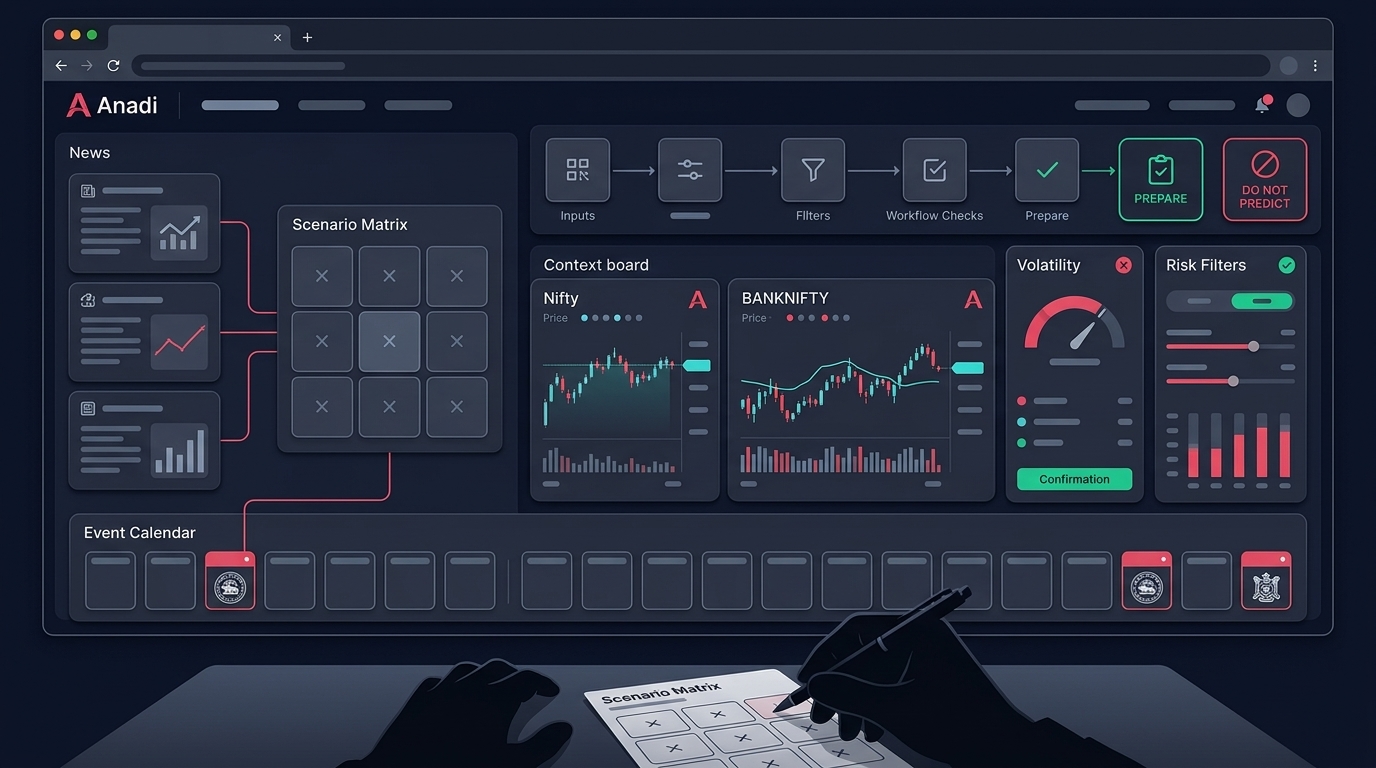
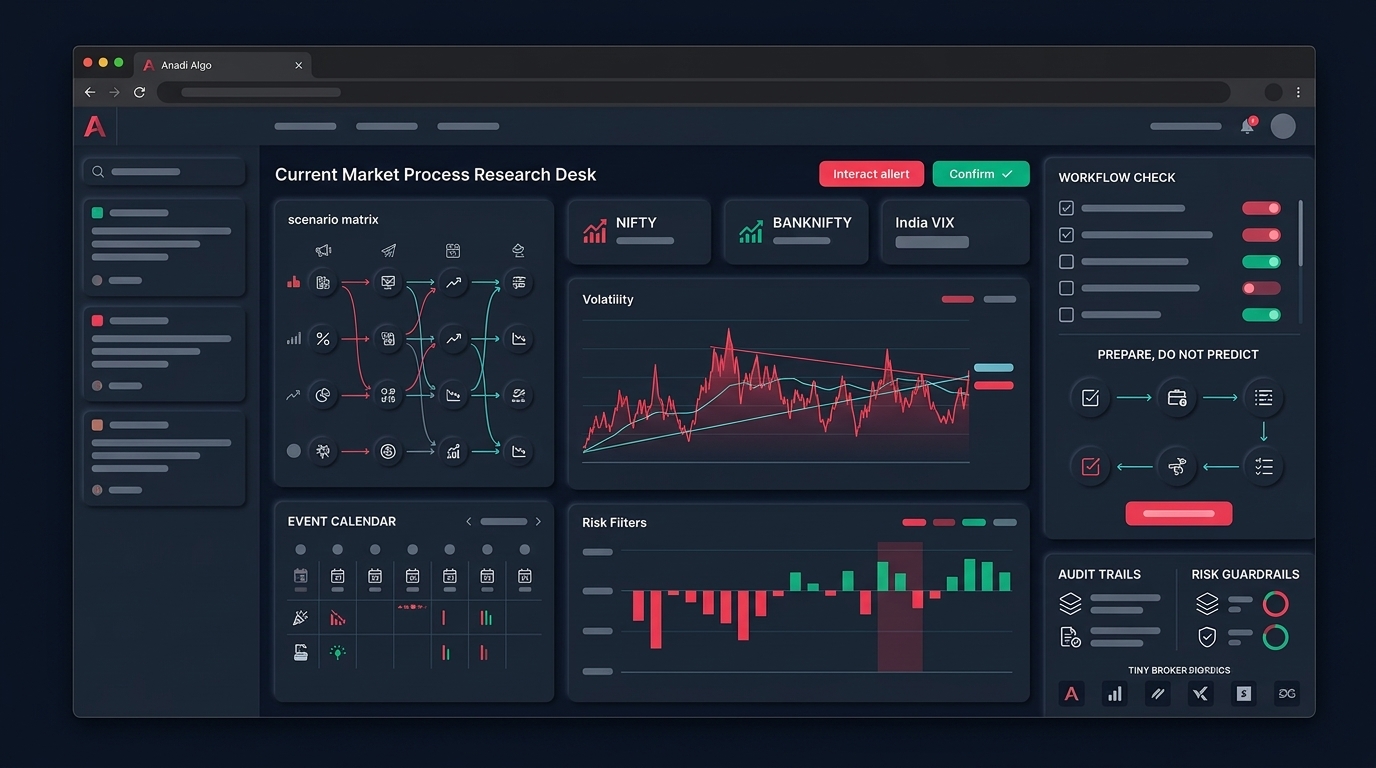
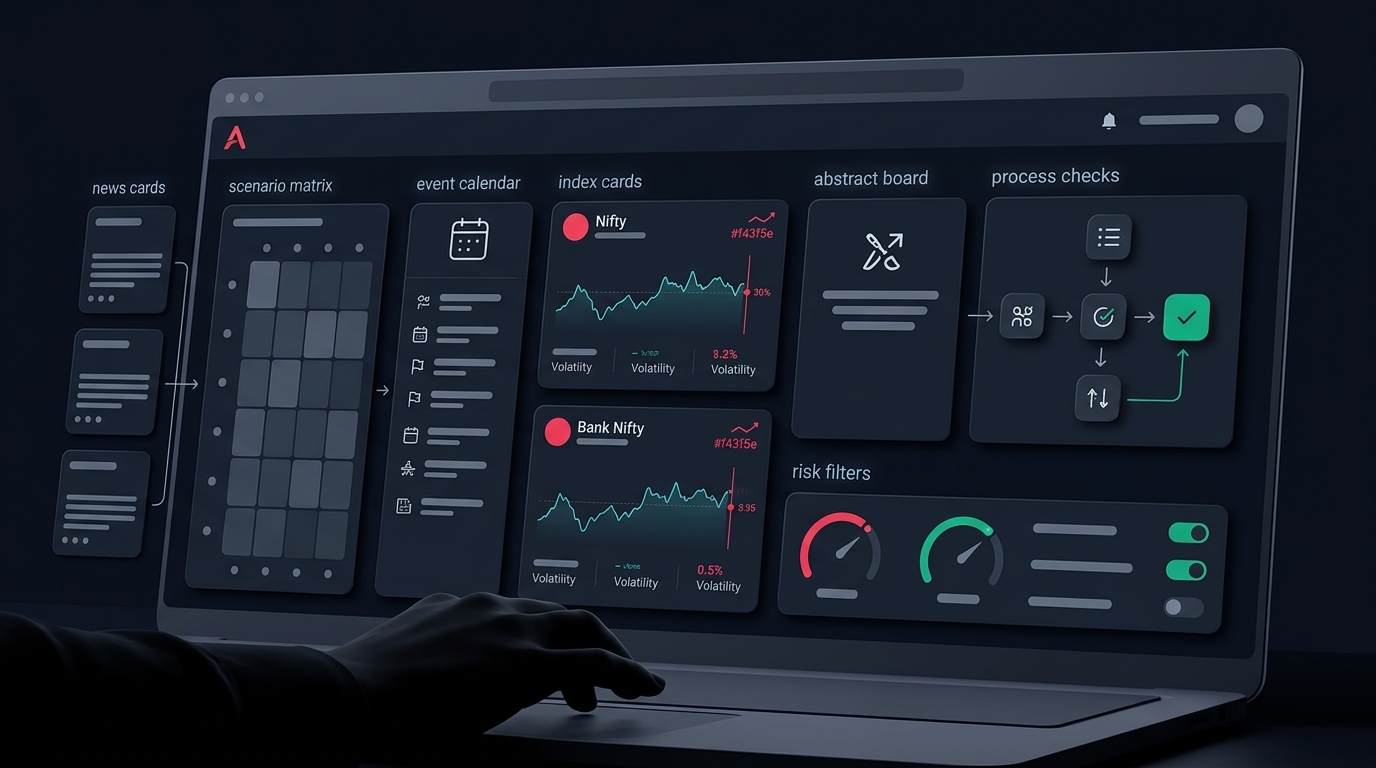
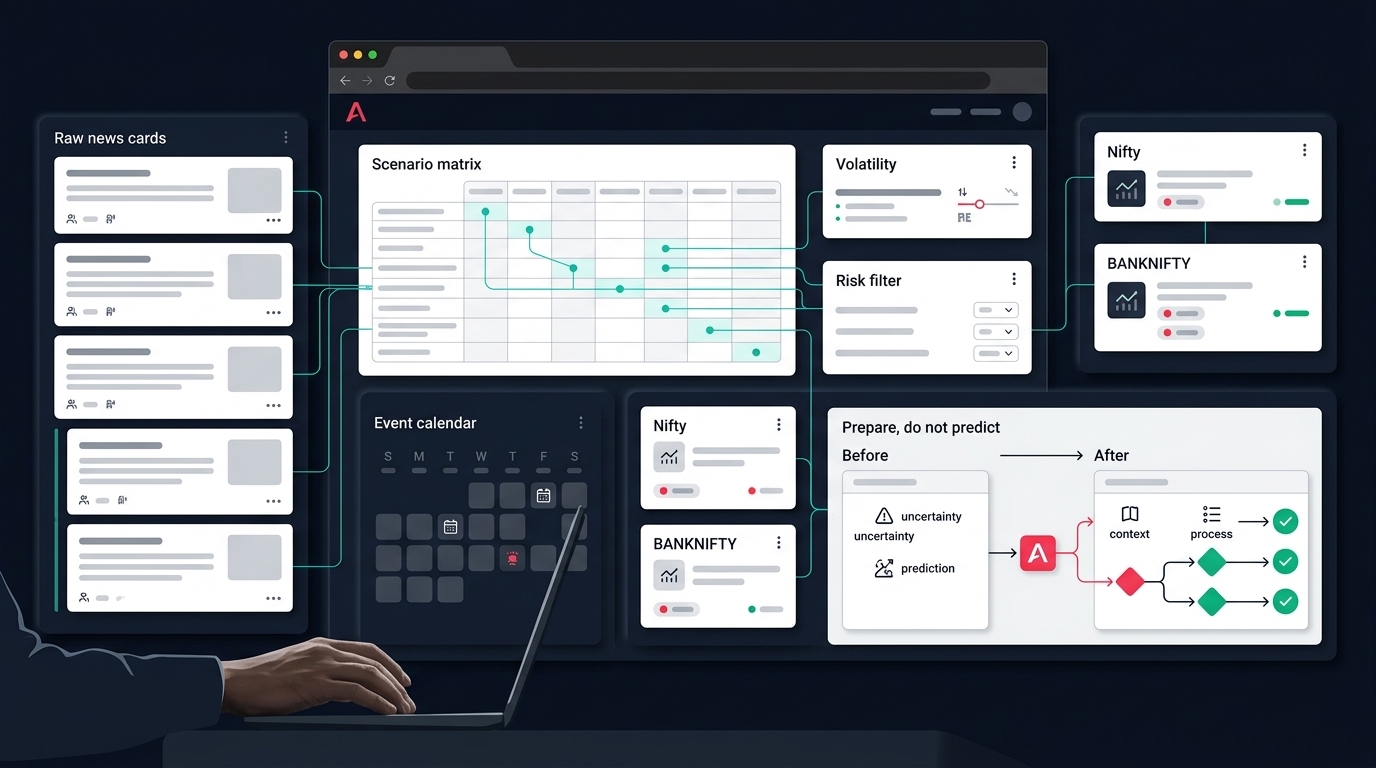
A reasonable sequence for a week like this one: start with index and sector context — is banking participating, or is the index move being carried by two heavyweights? Then, before acting on any signal, inspect the option chain for the specific expiry you trade: strike-wise OI, change in OI, IV on your strikes, and spread quality. Then preview the full structure — every leg, net margin, worst-case loss — before anything reaches the exchange.
This is the workflow problem Anadi's options workspace is built around: chain inspection, OI analysis, IV and theta context, basket preview, and margin estimation sit in one place, so risk is visible before execution rather than discovered after it. Similarly, if your entries come from a scanner, the gap between "signal fired" and "trade taken" is where expiry-week discipline lives — checking freshness, checking whether price has already run past the level, and letting blocked-entry reasons stop late chases that expiry-day speed makes tempting.
And before the next monthly cycle, backtest your expiry-week behaviour separately from ordinary sessions. If you build Bank Nifty systems, a BANKNIFTY strategy builder workflow lets you define the rules explicitly and test how they performed specifically in past expiry weeks — with the honest caveat that the pre-2026 contract regimes limit how far back the comparison stays valid.
If you want this kind of calendar-aware workflow — scanner, chain, margin preview, and risk checks in one place — you can request early access to Anadi Algo and test it against your own process first.
The expiry-week checklist
Before Tuesday, August 25, run through this:
- Verify the calendar. Confirm the exact expiry dates for every instrument you trade from the exchange, including any holiday shifts. Don't trust a hardcoded weekday.
- Check contract parameters. Current lot size, freeze quantity, and which futures month your orders route to.
- Split your states. Weekly expiry day, monthly expiry week, and monthly expiry day get separate flags and separate permissions.
- Reduce blind size near expiry. Make DTE an input to position sizing, not an afterthought.
- Gate entries on liquidity. Spread and OI checks on the exact strikes, every time, at the moment of entry.
- List the events. Decide now which scheduled events pause the system, so the decision isn't made mid-panic.
- Log everything. Fills, slippage, basis, rejections. Expiry weeks are where live data teaches you what backtests can't.
Expiry volatility is not something to predict. It is something to be structurally prepared for — and the preparation starts with reading the contract page most traders skip.