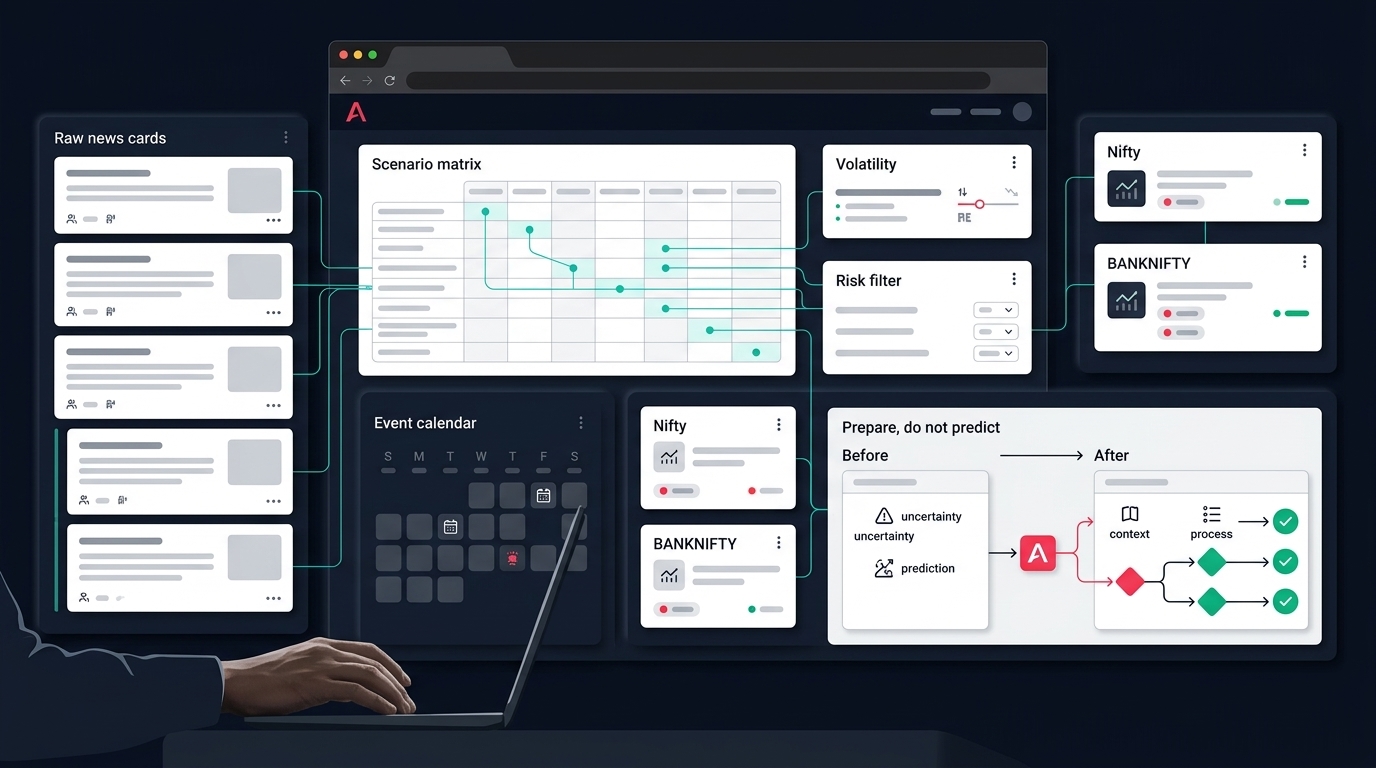
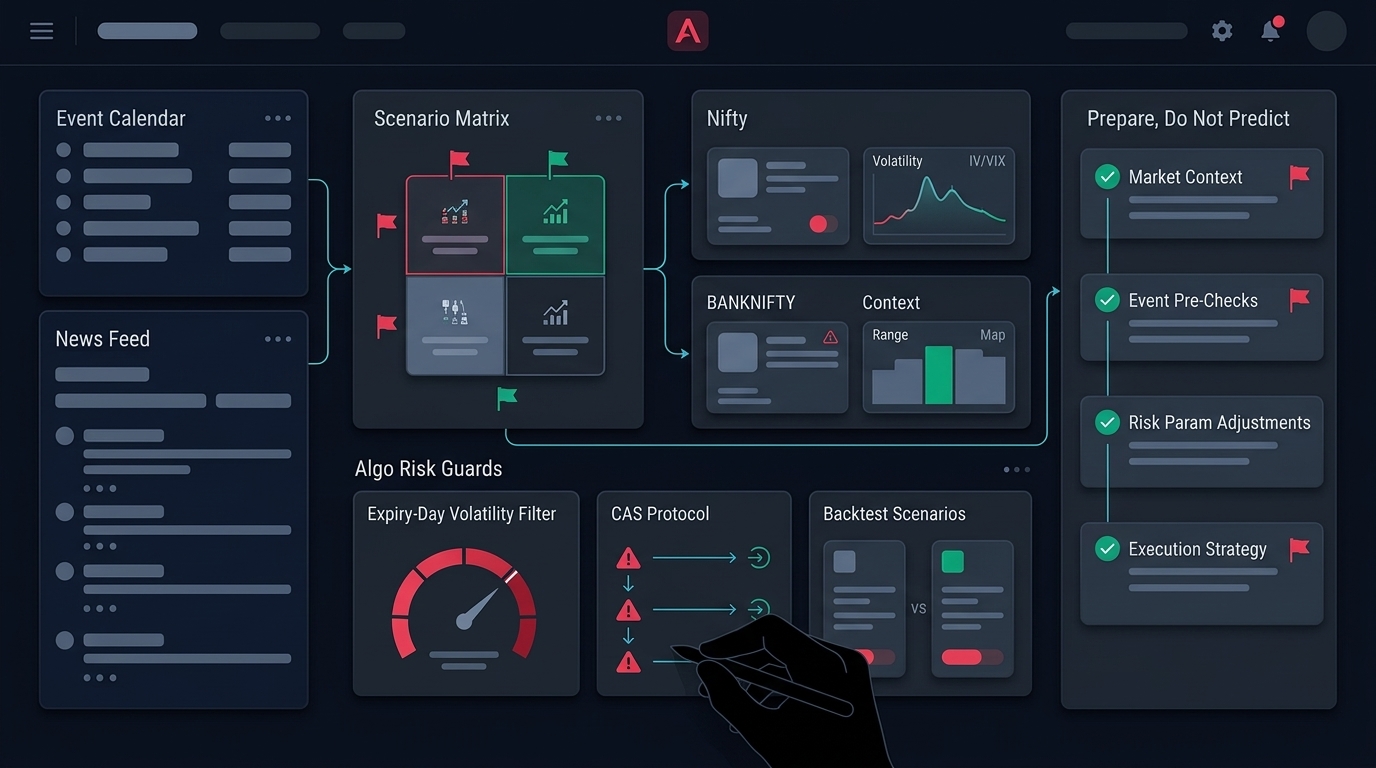
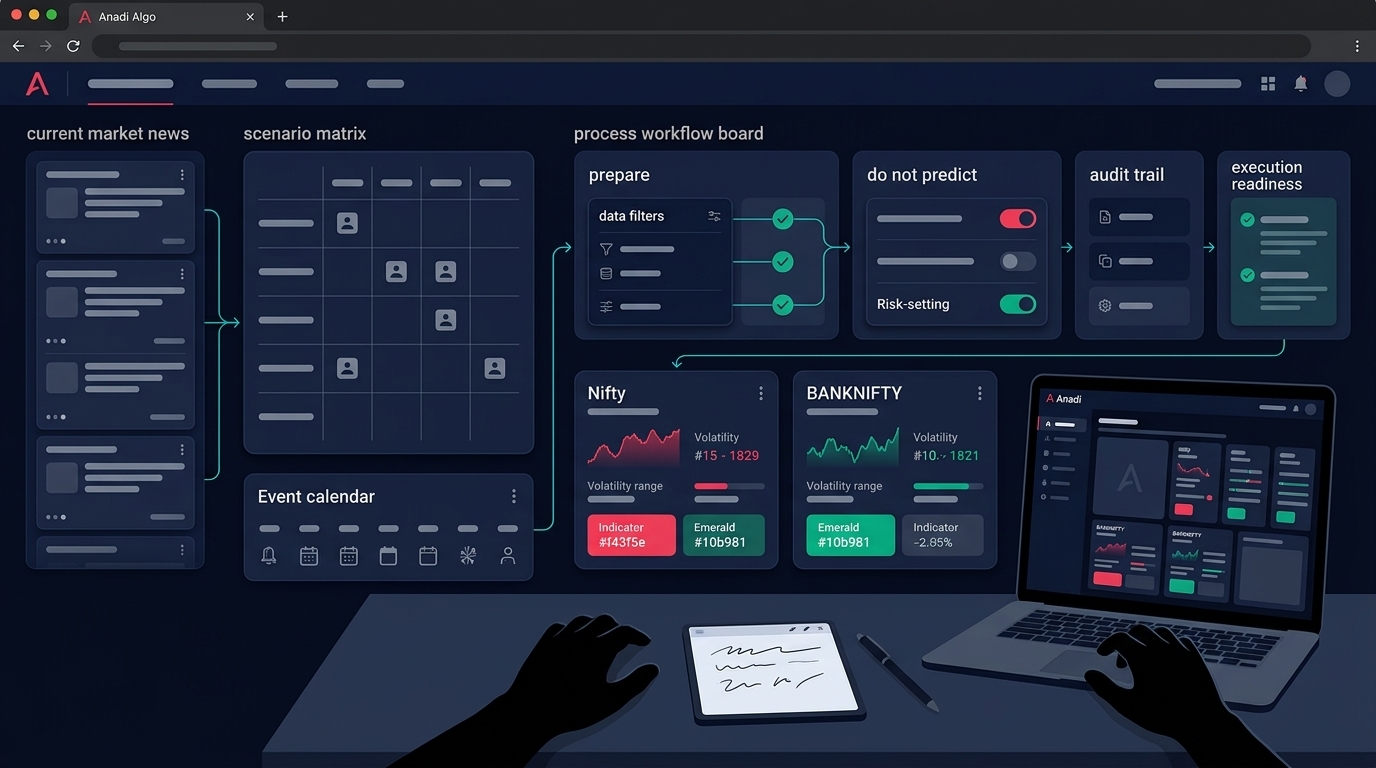
Today is Monday, October 19, 2026. If you run anything automated on Bank Nifty — a scanner that routes into options, a short-premium basket, an intraday futures system — the most useful thing you can do this week is not finding a new level. It is confirming that your code and the exchange still agree on what the contract actually is.
That sounds boring. It is also where a surprising number of live algo failures start.
The contract spec page is a data dependency
Here is a real, current example of why this matters.
NSE's own Nifty Bank F&O product page states that BANKNIFTY futures contracts expire on the last Tuesday of the expiry period, and that if the last Tuesday is a trading holiday, contracts expire on the previous trading day. The page points to circular NSE/FAOP/68747 for details.
Meanwhile, plenty of widely-read explainer pages and learning hubs still describe Bank Nifty as expiring on the last Wednesday of each month, carried over from SEBI's October 2024 expiry rationalisation.
Both pages are confidently written. Both rank well. They do not say the same thing.
You do not need to resolve that argument by reading blogs. You need to resolve it by reading the exchange page and the referenced circular, and then making your system match it. If your calendar says "last Tuesday," October 2026's last Tuesday is the 27th — next week, not this one. Verify that against the exchange and your broker's instrument master before you let it drive a single order.
The general rule for anyone automating: expiry day-of-week is an input, not a constant. It has been revised more than once in recent years. Any system that hardcodes a weekday somewhere in its logic is carrying an unversioned assumption that no one is testing.
What actually breaks when day-of-week moves
Blast radius is wider than people expect, because "expiry" leaks into a lot of places:
- DTE calculations. Anything that sizes, hedges, or exits based on days-to-expiry silently shifts by a day.
- Square-off timers. Intraday systems that behave differently on expiry day now apply expiry-day rules on the wrong date — or miss them entirely.
- Event filters. A rule like "no new entries on expiry day" becomes a rule that does nothing useful.
- Backtest labelling. Historical samples get tagged with the wrong expiry bucket, which quietly corrupts every expiry-vs-non-expiry comparison you have ever run.
- Rollover logic. Futures roll dates drift, and basis comparisons get made against the wrong contract.
The failure mode is not a crash. It is a system that keeps running and keeps being slightly wrong. That is strictly worse, because nothing alerts you.
Four contract facts that quietly shape algo risk
Beyond the expiry weekday, the Bank Nifty spec contains four mechanics worth encoding explicitly rather than assuming.
One: the futures trading cycle is three months. Near month, next month, far month. A new contract is introduced on the trading day following the expiry of the near-month contract. So liquidity does not migrate on a schedule your intuition picks — it migrates around a specific exchange event.
Two: new strikes appear after expiry, not before. On expiry of the near-month contract, new contracts at new strike prices are introduced for both calls and puts on the following trading day. Practically, that means the strike ladder your algo reads on the first day of a fresh series is not the ladder it read the previous week. If your code caches a strike universe, that cache is stale by definition on roll day.
Three: holidays override the rule. If the scheduled expiry day is a trading holiday, expiry moves to the previous trading day. This is where a lot of homegrown calendars fail, because they implement the weekday rule but not the holiday fallback. One holiday in the wrong place and your "expiry day" logic fires a day late, on a day with no contract left to manage.
Four: Bank Nifty currently trades monthly expiries only. Weekly Bank Nifty contracts were discontinued under the 2024 expiry rationalisation. That is a structural change to how the chain behaves, not just a calendar change. With no weekly reset, open interest structure is stickier and positioning accumulates over a longer window instead of being flushed every week.
Bank Nifty is not Nifty with bigger numbers
This is the second place where copied assumptions cause damage: treating the Bank Nifty chain exactly like the Nifty chain with a multiplier.
Bank Nifty tracks roughly a dozen large-cap banking stocks. It is a single-sector index, not a 13-sector one. That concentration shows up in three measurable ways:
- Strike spacing is wider — 100 points versus Nifty's 50. Any strike-selection rule written as "two strikes away" means a different distance in percentage terms on each index.
- Implied volatility runs structurally higher. So an absolute IV threshold tuned on Nifty will almost never trigger the way you intended on Bank Nifty.
- OI concentrations shift harder intraday. A strike that looked like a wall all morning can be overrun on one policy headline.
The drivers are specific: RBI policy and liquidity decisions, credit growth data, quarterly asset-quality disclosures from large banks, and global rate moves. A single large constituent reporting can move the index in a way no Nifty constituent can.
At the time of writing, public option-chain trackers showed Bank Nifty's nearest heavy OI around the 56,000 strike on the call side and 55,000 on the put side, with PCR near 1.06. Treat that purely as an illustration of shape, not a level to trade. Those numbers change intraday, and the useful skill is not memorising them — it is knowing that standing OI tells you where positions already are, while change-in-OI tells you what is happening now. On an index this reactive, confirming against fresh OI buildup rather than yesterday's totals is the difference between reading structure and reading a fossil.
Converting this context into filters, not opinions
None of the above is a view on direction. It converts into process. A few filters that are cheap to implement and hard to regret:
Event-window blocking. Maintain a list of scheduled events that matter to banks — policy dates, major bank results, scheduled macro data — and define a blackout window around each. Not "trade carefully." A hard rule: no new entries from T-minus X minutes to T-plus Y minutes. Automated systems need numbers, not adjectives.
Separate IV regime from IV level. Because Bank Nifty's IV sits structurally higher, an absolute number tells you little. A percentile or rank over a trailing window tells you more about whether current pricing is unusual for this index.
Chase distance limits. On a fast index, the gap between signal price and fill price is where edge dies. If a signal has already moved beyond a defined distance from its trigger level, block it. A good system should be comfortable refusing a trade it generated five minutes ago.
Expiry-proximity sizing. With monthly-only expiry, the character of the last few sessions differs sharply from mid-series. Bucket your rules by DTE rather than writing one rule for the whole month. If you build this in a BANKNIFTY strategy builder workflow, make DTE an explicit condition instead of something your position management implies.
Index context before single-stock action. A banking-sector setup that looks clean in isolation can be fighting the sector tape. Checking index and sector participation first is a filter, not a formality — and it is the whole point of using market context to prepare rather than to chase headlines, which is also how a weekly market outlook should be consumed.
Backtest hygiene for a monthly-expiry index
The 2024 expiry change created a dataset problem that very few retail backtests handle correctly.
If your Bank Nifty option history spans the weekly era and the monthly-only era, you are testing two different instruments and averaging the results. A strategy whose returns came largely from weekly-expiry decay dynamics will look like it still works, because the older sample is carrying it.
Three practical rules:
- Split the sample at the regime change. Report pre-change and post-change performance separately. If the edge only exists in the older half, you have found a historical artifact, not a strategy.
- Label expiry days from the actual calendar, including holiday shifts, rather than deriving them from a weekday rule in code. Derived labels inherit every bug in the rule.
- Check sample count per bucket. Monthly expiry means roughly 12 expiry days a year. A rule tuned specifically on expiry-day behaviour has far less data than it feels like it has, and overfitting risk goes up accordingly. Honest options backtesting means reporting that trade count, not burying it.
Also worth stating plainly: slippage and gap assumptions calibrated on Nifty will understate costs on Bank Nifty. Wider spacing, higher IV, faster moves. If your backtest uses a single flat cost assumption across both indices, your Bank Nifty results are optimistic by construction.
Where a workflow check helps
The reason spec drift survives so long in retail setups is that the checks live in different places — calendar in one script, strike universe in another, risk limits in a spreadsheet. Nothing cross-validates.
A single workspace helps mainly because it forces sequence. Inside Anadi, option discovery, chain inspection, OI analysis, IV and theta context, basket preview, and margin estimate sit in one options workflow, so margin and risk appear before execution rather than after a rejected order. On the equity side, scanner signals route through an action queue that surfaces entry-blocked reasons — chase distance, invalidated price, freshness — instead of handing you a raw list of 80 rows and wishing you luck.
That is the same idea as the spec audit above, applied to signals: make the system state its objections out loud. Pair it with explicit risk management rules — daily loss limit, per-trade cap, max concurrent positions — and most of the remaining failure modes are ones you chose, not ones you inherited.
If you want to test this kind of workflow against your own rules, you can request early access and build the checks before the next series starts.
Pre-series checklist
Run this on roll day, every series. It takes fifteen minutes.
- Expiry date confirmed against the NSE contract spec page and the referenced circular, not from memory or a secondary blog.
- Holiday fallback implemented — if scheduled expiry is a holiday, does your system move to the previous trading day automatically?
- Instrument master refreshed — new strikes introduced after expiry are present; stale strike caches cleared.
- Active contract correct — near-month symbol updated across every module that references it, including scanners and alert feeds.
- DTE buckets re-based to the confirmed expiry date.
- Event blackout windows loaded for policy dates and large bank results in this series.
- IV thresholds expressed as rank or percentile, not absolute numbers copied from a Nifty rule.
- Cost assumptions index-specific — Bank Nifty slippage separated from Nifty slippage in both live limits and backtests.
- Logs checked for any order in the previous series that referenced an expired or wrong-month contract.
The takeaway is simple. Bank Nifty's volatility gets all the attention, but the thing that quietly breaks automated systems is a specification that changed while the code did not. Read the exchange page. Match your system to it. Then go look at levels.