An iron condor is the strategy people reach for when they want to "sell premium safely." You sell an out-of-the-money call spread and an out-of-the-money put spread at the same expiry, collect a net credit, and profit if Nifty stays inside a range. Both your maximum loss and your maximum profit are fixed before you enter. That defined-risk shape is exactly why it feels safe.
A backtest is where that feeling gets tested. Done honestly, it shows you the real risk-reward — not the marketing version. Done loosely, it hides the one number that decides whether the structure is worth trading at all. This post walks through what an iron condor actually risks, why a high win rate can still lose money, and the assumptions a Nifty iron condor backtest has to get right. It is educational, not a strategy recommendation.
What an iron condor actually risks
Strip away the four-leg diagram and an iron condor is one thing: a small, capped credit bet that the market does nothing dramatic.
The numbers that define it are simple:
- Net credit is what you collect upfront — the premium from the two short legs minus the premium paid for the two long hedge legs. This is your maximum profit, earned only if Nifty expires between your short strikes.
- Wing width is the gap between the short strike and the long strike on each side, in points.
- Maximum loss is the wider wing width minus the net credit collected, multiplied by lot size. If both wings are equal, it is simply one wing width minus the credit.
- Breakevens sit at the short call strike plus the credit, and the short put strike minus the credit.
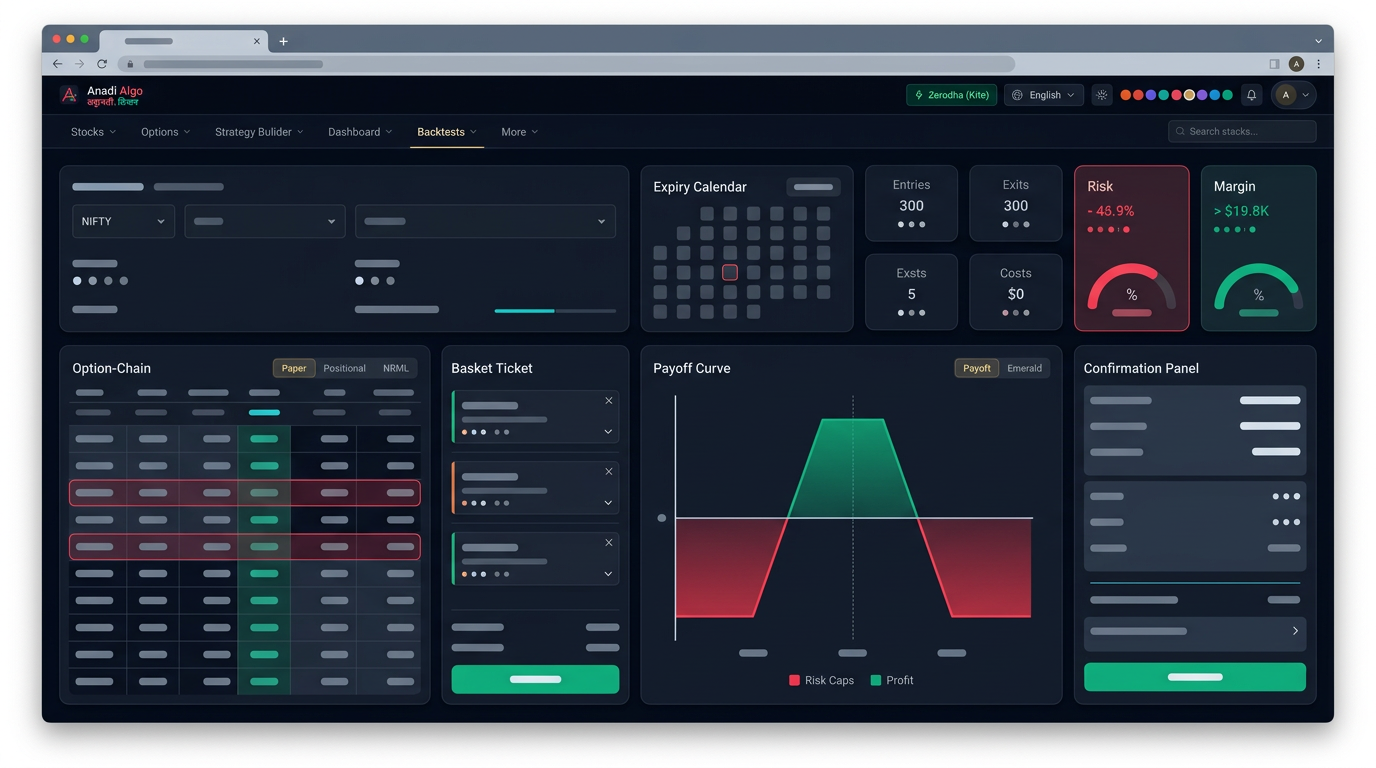
Here is the asymmetry that the payoff diagram makes look friendly. Say you build a Nifty condor with 200-point wings and collect 60 points of credit. Your maximum profit is 60 points. Your maximum loss is 200 minus 60, which is 140 points. You are risking 140 to make 60 — roughly 2.3 to 1 against you. That is normal for a condor, not a mistake. The strategy pays you a small amount often, in exchange for a larger loss occasionally.
So the entire question your backtest must answer is whether "often" is often enough to cover those larger losses, after costs. Everything else is detail.
Why a high win rate can still lose money
This is the trap that catches most retail condor traders, and one piece of public research on Nifty condors states it plainly: the risk-reward is poor even though the probability of profit can sit around 70 to 75 percent. A high win rate and a bad payoff ratio can live in the same trade.
Run the expectancy yourself instead of trusting the win rate. Expectancy per trade is:
(win rate × average win) minus (loss rate × average loss)
Take the example above with a 74 percent win rate. On winners you make roughly 60 points; on losers you lose closer to the full 140. Expectancy is about (0.74 × 60) − (0.26 × 140) = 44.4 − 36.4 = 8 points per trade, before costs. That thin 8-point edge is the whole strategy — and it is exactly the kind of margin that brokerage, STT, and slippage on four legs can erase.
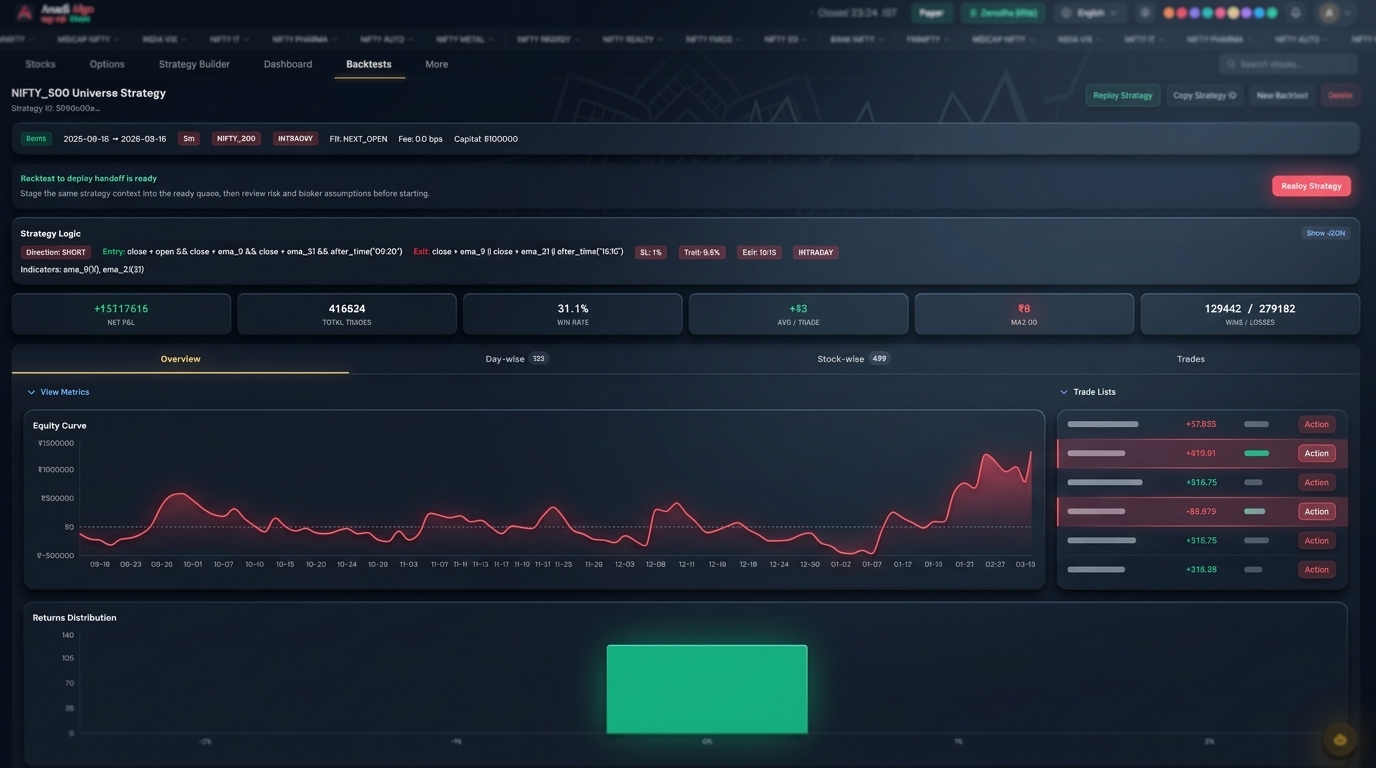
The lesson for the backtest: never judge an iron condor by win rate alone. A condor that wins 80 percent of the time can still bleed if the losing 20 percent are large enough or if your average loss runs past your modeled maximum on gap days. Report expectancy and the full loss distribution, not a win percentage. A serious options backtesting run shows you the tail, not just the hit rate.
Strike distance and wing width are the strategy
With an iron condor, your strike choices are not a setting — they are the strategy. Two dials decide everything, and your backtest should test them as separate variables.
How far out you sell
Selling your short strikes far from spot widens the profit range and raises your win rate, but shrinks the credit you collect. Selling closer raises the credit but narrows the range and lowers your win rate. There is no free version. Backtest a few distances — often expressed as a delta or a percentage of spot — and compare the full expectancy and drawdown at each, not just which one wins more often.
How wide the wings are
Wider wings collect a little more net credit and improve the payoff ratio, but they raise your maximum loss. Narrower wings cap the loss tighter but cost more in hedge premium, thinning the credit. The wing also has to be liquid enough to fill and exit — a far OTM Nifty hedge leg in a thin strike will not behave in live trading the way a mid-price fill suggests in a backtest.
Test these two dials as a grid, per expiry type. A weekly condor and a monthly condor with the "same" structure are different trades because theta and gamma scale differently across the days to expiry.
The range assumption that quietly breaks
An iron condor is a bet on a range. So the most important thing your backtest reveals is what happens when the range assumption fails — because it will.
Three things break it:
- Trend days. One strong directional session can push Nifty through a short strike and toward your long hedge. The defined-risk cap protects you from disaster, but a maxed-out wing wipes out several quiet weeks of small credits.
- Gap opens. Indian indices gap on global cues, results, and policy. A gap can open beyond your short strike, skipping the level where you would have adjusted. Model gap fills as worse than the touch, not at your stop price.
- Volatility regime. Selling a condor into already-crushed volatility collects thin premium for the same risk. A VIX or premium-floor filter changes which days you even enter. Test the filtered result against the unfiltered one on the same sample, so you know the filter is edge and not just two removed trades.
Tie the result to the regime. A condor that prints in a calm range-bound stretch and a condor traded through an event-heavy month are not the same strategy, and averaging them together hides the path that actually forces you out.
Assumptions that decide the result
A condor is a four-leg, thin-edge structure. That makes it unusually sensitive to the assumptions casual backtests skip.
- All-or-none fills. Backtest the basket as one object. If any leg — usually a thin wing — would not realistically fill, treat the entry as skipped or use a worse price. Pretending all four legs filled at mid is the most common way a condor backtest overstates its edge.
- Slippage stacks per leg. Four legs in and four legs out means slippage is paid up to eight times per trade. Assign the ATM-side shorts a smaller slip and the OTM wings a larger one.
- Full costs. Brokerage, STT (heavier on the sell side), exchange charges, GST, and stamp duty apply on every leg, both sides. Run the backtest once with zero costs and once with full costs; the gap is your honest cost drag against that 8-point edge.
- Adjustment and roll rules. If you plan to roll an untested side or exit at a loss multiple, that rule must be in the backtest with its own costs. A condor that "never adjusts" in the test but gets managed live is a different strategy.
- Return on margin. Hedged condors get a margin benefit, so measure returns against the margin actually blocked — not the notional. But model the benefit as present only while both wings are on.
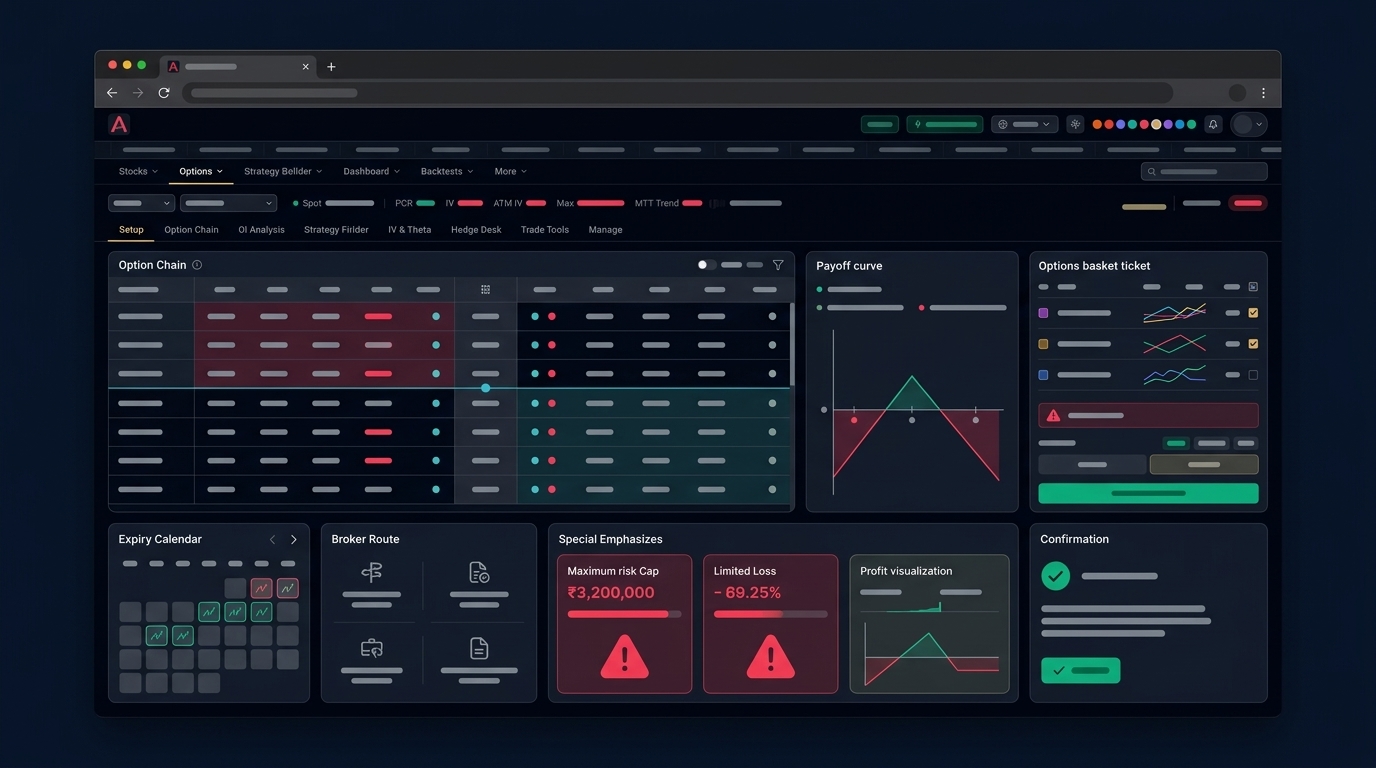
A workflow that shows the basket preview, margin estimate, and net max-loss together before execution — the kind of defined-risk view inside a strategy builder and an options risk management layer — keeps your backtest assumptions and your live trade honest with each other. The point is not the tool; it is that the structure you test is the structure you actually trade.
Iron condor backtest checklist
Before you trust any Nifty iron condor result, confirm you have:
- Computed net credit, max loss (wing minus credit), and both breakevens explicitly
- Reported expectancy and the loss distribution, never the win rate alone
- Tested strike distance and wing width as separate variables, per expiry type
- Compared weekly versus monthly condors instead of assuming they match
- Modeled gap opens and trend days with fills worse than the touch
- Compared a volatility-regime filter against the unfiltered baseline
- Used all-or-none fills and per-leg slippage, with thin wings slipping more
- Included full per-leg costs and compared zero-cost versus full-cost curves
- Written your adjustment or roll rule into the test with its real costs
- Measured return on the hedged margin, not the notional
An iron condor's defined risk is real, but "defined" is not the same as "small." Judge the structure by its expectancy after costs and by its worst stretch, not by how often it wins.
If you want to test these condor rules with conservative, honest defaults rather than spreadsheet guesses, you can request early access and run your own strikes, wings, and filters through a backtest that takes costs and gap risk seriously before any live capital is on the line.