If you have spent any time on Indian algo trading forums, you have run into OpenAlgo. It is a free, open-source, self-hosted trading platform that sits in front of 30+ Indian brokers and gives you a unified API, an options analytics suite, and a strategy builder. It is a serious project and a genuinely good fit for a specific kind of trader.
It is also not the right fit for everyone. Managed algo trading platforms — the kind where you sign up, link your broker, and start building strategies inside a hosted product — solve a different problem. This post compares the two workflows honestly so you can pick what matches your time, skill, and risk appetite.
What OpenAlgo actually is
OpenAlgo describes itself as a self-hosted platform built on Python Flask and React. You deploy it on your own server or cloud, point it at your broker's API, and get:
- A unified API across 30+ Indian brokers (Zerodha, Dhan, Flattrade, Angel One, Upstox, etc.).
- An options analytics suite — option chain, Greeks, OI, max pain, vol surface, GEX.
- A sandbox engine with simulated capital for paper trading.
- Hooks into TradingView, Amibroker, Excel, Google Sheets, ChartInk, Python, Node, .NET, and more.
- A strategy builder, basket execution, and a Telegram alerting layer.
The pitch is ownership. Your code, your strategies, your data, your infrastructure. Nothing leaves your machine, and there is no subscription gate between you and the broker API.
If that sounds appealing, it should. For traders who write code, run their own VPS, and want to control the full stack, OpenAlgo is one of the cleanest open-source options in the Indian market right now.
Where the workflow gets heavier
Self-hosted is powerful, but the word "self" is doing a lot of work in that phrase. Before you commit, walk through what owning the stack actually means on a real trading day.
Deployment and uptime are on you
OpenAlgo runs on Python 3.11 or later and needs a server that is up during market hours. That means picking a VPS provider, configuring firewalls, setting up HTTPS for webhook endpoints, monitoring CPU and memory, and handling broker session expiries. If your server reboots at 9:25 AM and your access token did not refresh cleanly, your strategy does not enter at open. There is no support desk — you debug it.
Broker session and token plumbing
Every Indian broker handles session tokens differently. Zerodha expects a daily login. Dhan uses long-lived access tokens with refresh quirks. Flattrade has its own auth dance. OpenAlgo abstracts the API surface, but the daily token refresh, TOTP entry, and "why did my session die at 11:47" troubleshooting still lands on you. Our own blog post on Flattrade API automation gotchas covers how brittle this part can get if you are not actively watching.
Backtesting fidelity is your responsibility
OpenAlgo's sandbox is an exchange-aligned simulator, not a historical backtester with vetted tick data. If you want to test an options selling strategy against three years of NIFTY weekly expiry data, you need to source the data, normalise it for splits and lot-size changes, and build the runner. Whether you use OpenAlgo or anything else, the data assumptions matter — our post on options backtest data assumptions goes deeper on that.
Updates, security, and dependency drift
Python web stacks evolve. Flask 3.x, breaking changes in WebSocket libraries, security patches for transitive dependencies — none of these patch themselves. When OpenAlgo ships a major release, you decide when to upgrade, test it against your live strategies, and accept the rollback risk. For a hobbyist that is part of the fun. For someone running real capital, it is overhead.
Where a managed platform changes the equation
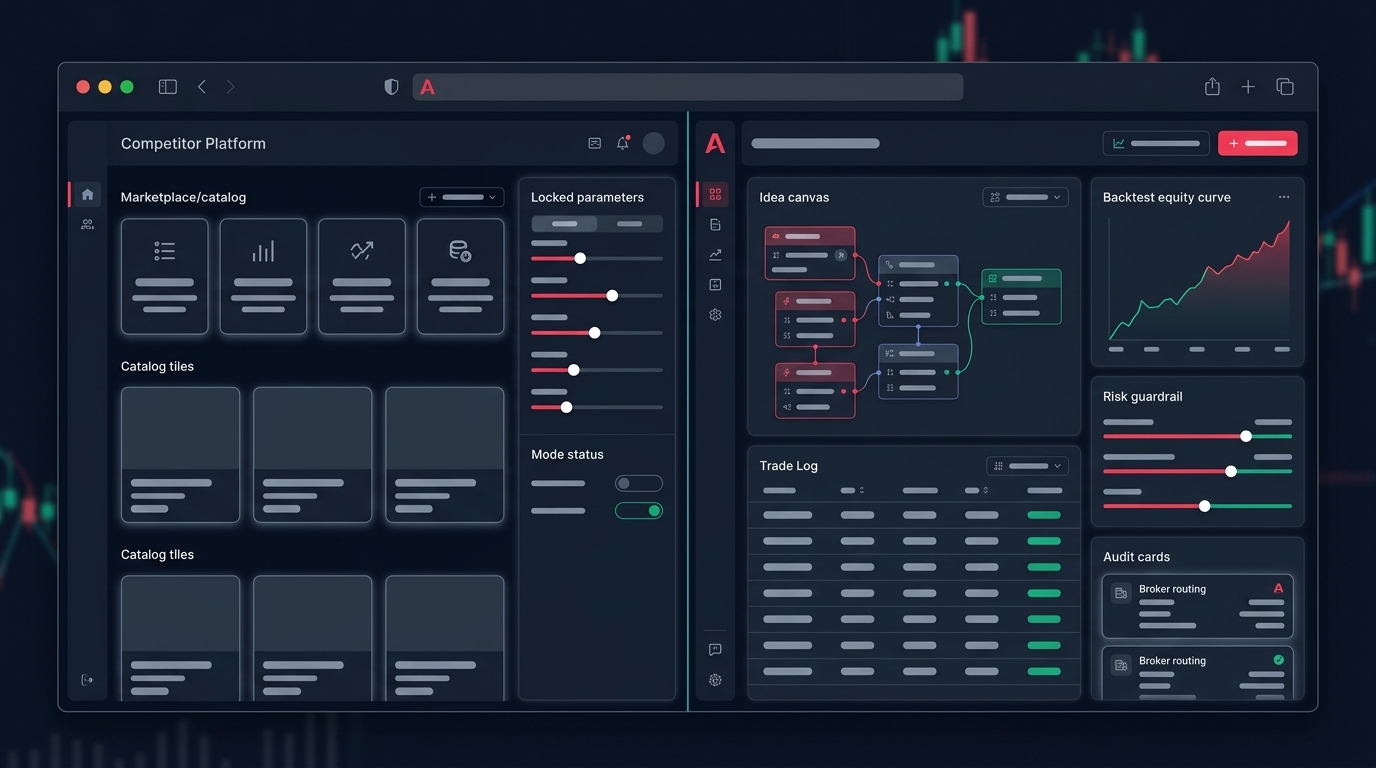
A managed product like Anadi Algo runs the infrastructure for you. You bring strategies and risk decisions; the platform handles broker auth refresh, candle pipelines, order routing, monitoring, and the dashboard that surfaces it all.
The trade-offs are the mirror image of OpenAlgo:
- You do not see the server code, so you trust the vendor on uptime, latency, and order placement integrity.
- You pay a subscription instead of an AWS bill, but you get support, a published roadmap, and a tested upgrade path.
- The strategy builder is opinionated. You get a no-code strategy builder and a curated set of entry/exit/SL primitives instead of an empty Python file.
- Backtesting, scanning, and execution share state, so the strategy you tested in options backtesting is the same logic that fires in live mode — no separate Python script to maintain.
This is not a "better" workflow in the abstract. It is a different one, with less operational load and less low-level control.
A practical decision checklist
Instead of arguing self-hosted vs managed in general, run your own situation through these questions:
How much code do you actually want to write?
If you enjoy Python, can read a Flask traceback, and want to wire up custom indicators in NumPy — OpenAlgo gives you room to play. If your edge is in market understanding and not in software engineering, every hour you spend debugging a token refresh is an hour not spent on the strategy.
What happens on a Monday at 9:14 AM if your server is unreachable?
Self-hosted means you are the on-call engineer. If you cannot SSH in from your phone and restart a service before pre-open, that is a real risk. Managed platforms absorb this; you only need to check that your account is logged in.
How many brokers and venues do you need?
OpenAlgo's 30+ broker coverage is genuinely broad. If you trade across three accounts with three different brokers, a unified self-hosted API is convenient. Managed platforms typically cover the major Indian brokers — check the supported brokers list for whichever platform you are evaluating before assuming parity.
Are you comfortable validating execution yourself?
With self-hosted, you must reconcile orders, slippage, and partial fills against broker statements. Nobody else will catch a quietly failing webhook. With a managed product, the platform should surface these — but you still need to verify it does, because no one cares about your P&L more than you.
What does your time cost?
A self-hosted instance has zero monthly subscription but a non-zero hourly cost in your own time. If a managed plan costs less than the hours you would otherwise spend on plumbing, the maths shifts.
When OpenAlgo is clearly the right answer
- You are a Python-first trader who wants to write custom logic that does not fit a visual builder.
- You have a strict data-residency or privacy requirement and cannot send order data to a third party.
- You already run your own VPS, monitoring, and uptime tooling.
- You want to integrate Amibroker, ChartInk, and Excel into one execution layer without a SaaS in the middle.
When a managed platform makes more sense
- You want to build with a no-code strategy builder and skip the deployment work.
- You need integrated backtesting, scanner, and live execution that share the same strategy definition.
- You prefer paying for support and uptime over running an on-call rotation of one.
- You are still learning algo trading and do not want infrastructure to be your gating problem.
If the second list describes you, Anadi Algo is built for that workflow. You can request a slot via early access and try the managed flow against whatever you are running today.
Takeaway
OpenAlgo is a strong, honest open-source project. Managed platforms are not in competition with that — they serve traders who want less operational surface area, not better software ideology. Pick the workflow that matches the part of trading you actually want to spend time on. If that is strategy and risk, hand the infrastructure to someone else. If that is the infrastructure itself, OpenAlgo will reward the time you put in.