If you have spent any time researching options backtesting in India, you have run into AlgoTest. It is one of the more visible backtesting-first platforms in the market, and its own blog positions it exactly that way: intraday and EOD backtesting, no-code strategy setup, six indices plus roughly 500 stocks, live deployment through a large broker list, a free tier of 25 backtests per week, and paid plans starting around ₹499/month.
That is a real product with a clear centre of gravity: you already know the structure you want to test.
This post is not a "which one is better" post. It is a workflow-fit post. Because the honest answer depends on where your trading idea comes from in the first place.
What backtesting-first actually assumes
A backtesting-first workflow starts with a defined structure. Short straddle at 9:20. Iron condor with 20-delta wings. Weekly strangle with a 30% stop. You pick the legs, set entry and exit times, define the stop, and run it over history.
This is a genuinely good workflow, and if that describes how you trade, a specialised options backtester is often the fastest tool for the job. Nothing in this post argues otherwise.
But notice the assumption baked in: the strategy already exists as a fully specified options structure before you open the tool. The tool answers "did this work?" It does not answer "where did this idea come from, and is the setup even present today?"
For a lot of traders, that upstream gap is the actual problem.
The three workflows people confuse
- Structure-first. You have a fixed options structure and want historical evidence. Backtesting-first platforms are built for this.
- Signal-first. You are hunting for setups — a trendline break in a stock, a wedge on the index, an OI shift on expiry week — and only then deciding whether to express it as a stock trade, a future, or an options structure.
- Execution-first. You already trust the idea and mostly need reliable order routing and monitoring.
Most comparison articles blur these together and then argue about features. They are different jobs.
Where Anadi Algo sits
Anadi Algo is built around the signal-first path, with the structure and execution stages attached to it rather than bolted on separately.
The chain looks like this: scanner signal → validation → explicit rules → backtest → route → live orders → order audit.
Scanner as the starting point, not an afterthought
The scanner surfaces ranked rows with a signal label, timeframe, score, and freshness. Crucially, it preserves named pattern identities — trendline breakout, trendline breakdown, channels, wedges, flags, pennants, triangles, double and triple tops and bottoms, head-and-shoulders — instead of flattening everything into a generic "new high" alert.
That matters more than it sounds. If your scanner flattens a rising wedge and an ascending triangle into the same bucket, your downstream strategy rules cannot distinguish them, and your backtest is testing something vaguer than what you actually watch on the chart.
You can open the instrument chart modal with the pattern geometry drawn on it and check the setup on the selected timeframe before you do anything else.
Action Center: the filter between signal and order
A scanner that fires enough signals becomes noise. The Action Center ranks scanner-backed candidates and shows what most tools hide: entry quality, freshness, blocked reasons, and F&O eligibility.
Blocked reasons are the underrated part. If price has already run past the level, chase distance flags it. If the setup has been invalidated, it says so. This is the discipline layer that a backtest cannot give you, because a backtest never tells you that today's fill would have been 40 points late.
It also enriches eligible symbols with F&O context — future preview, option context, OI pulse, daily OI, VWAP gate, basis, PCR — so the decision of how to express the trade (stock, future, or option) happens with data attached, not by habit.
From idea to testable rules
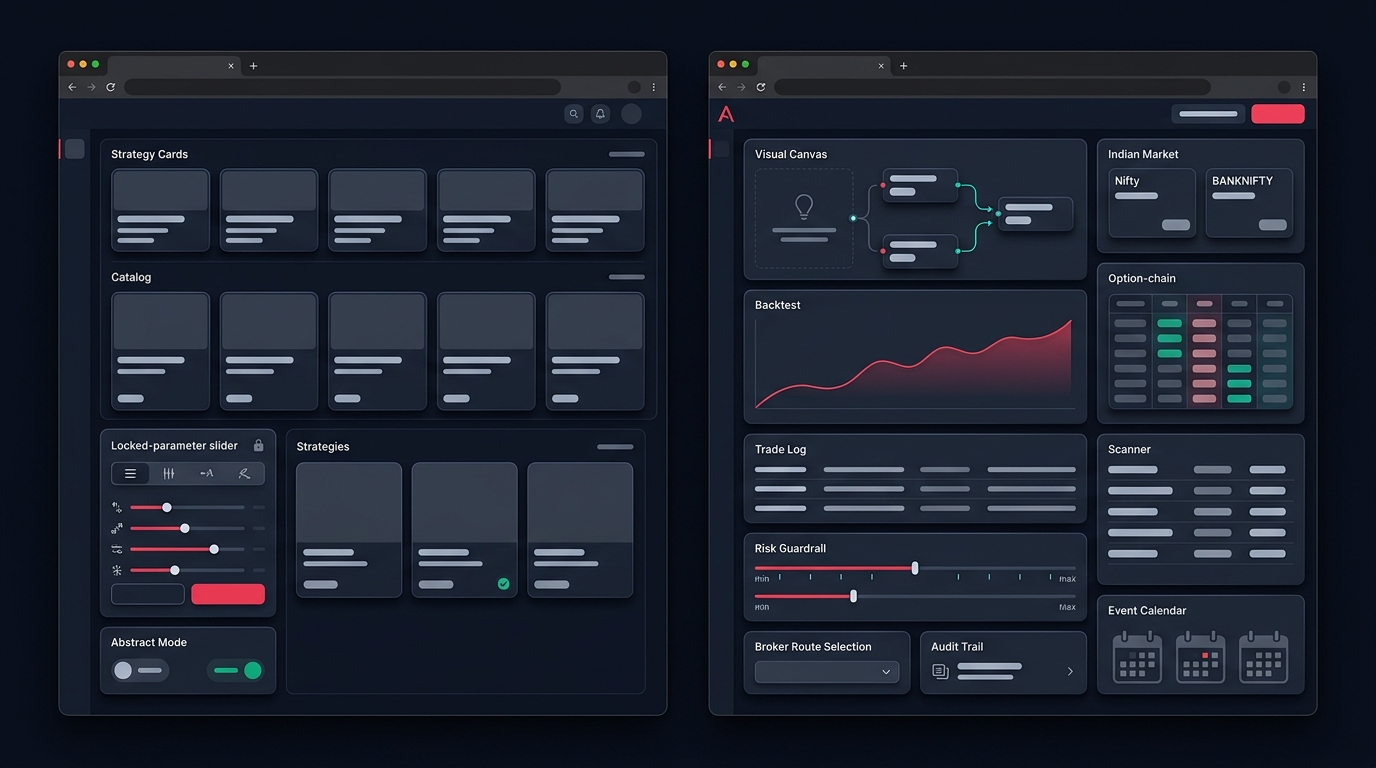
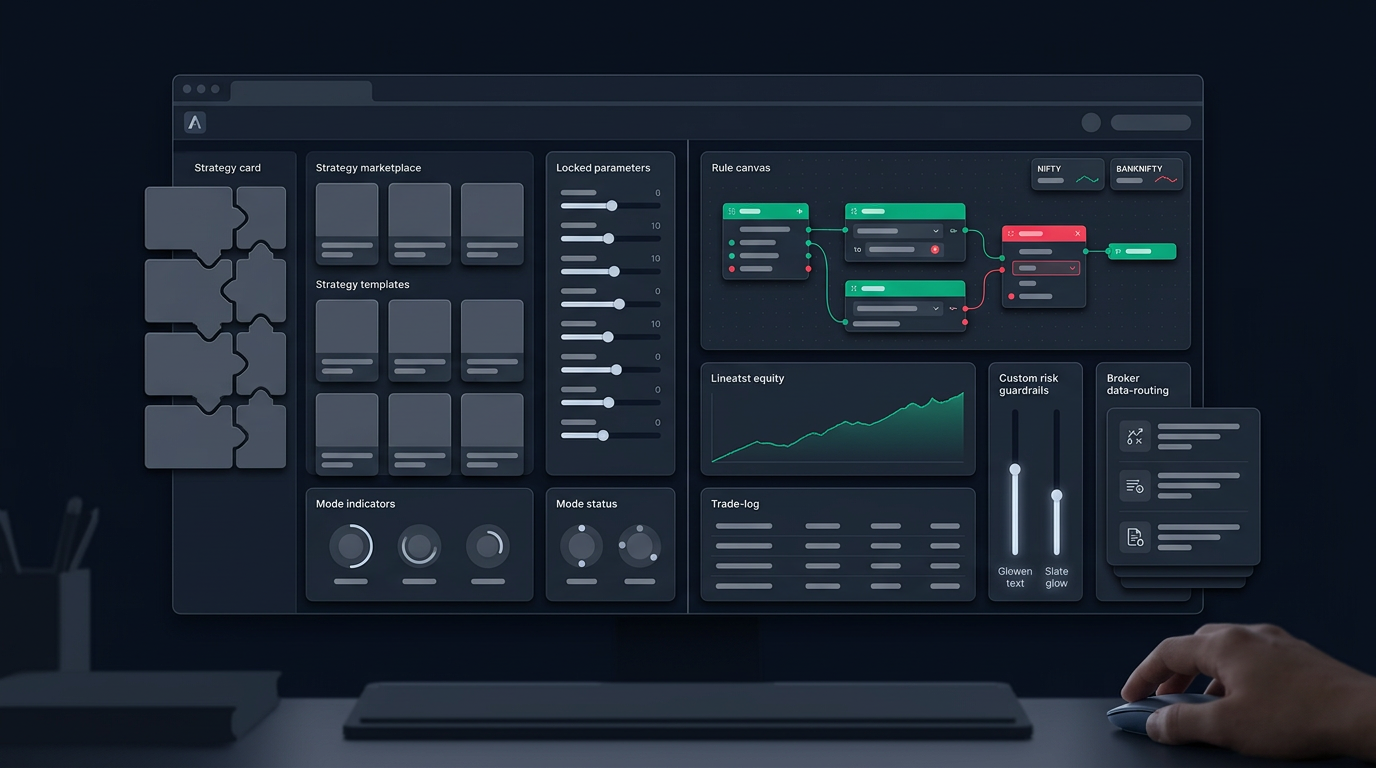
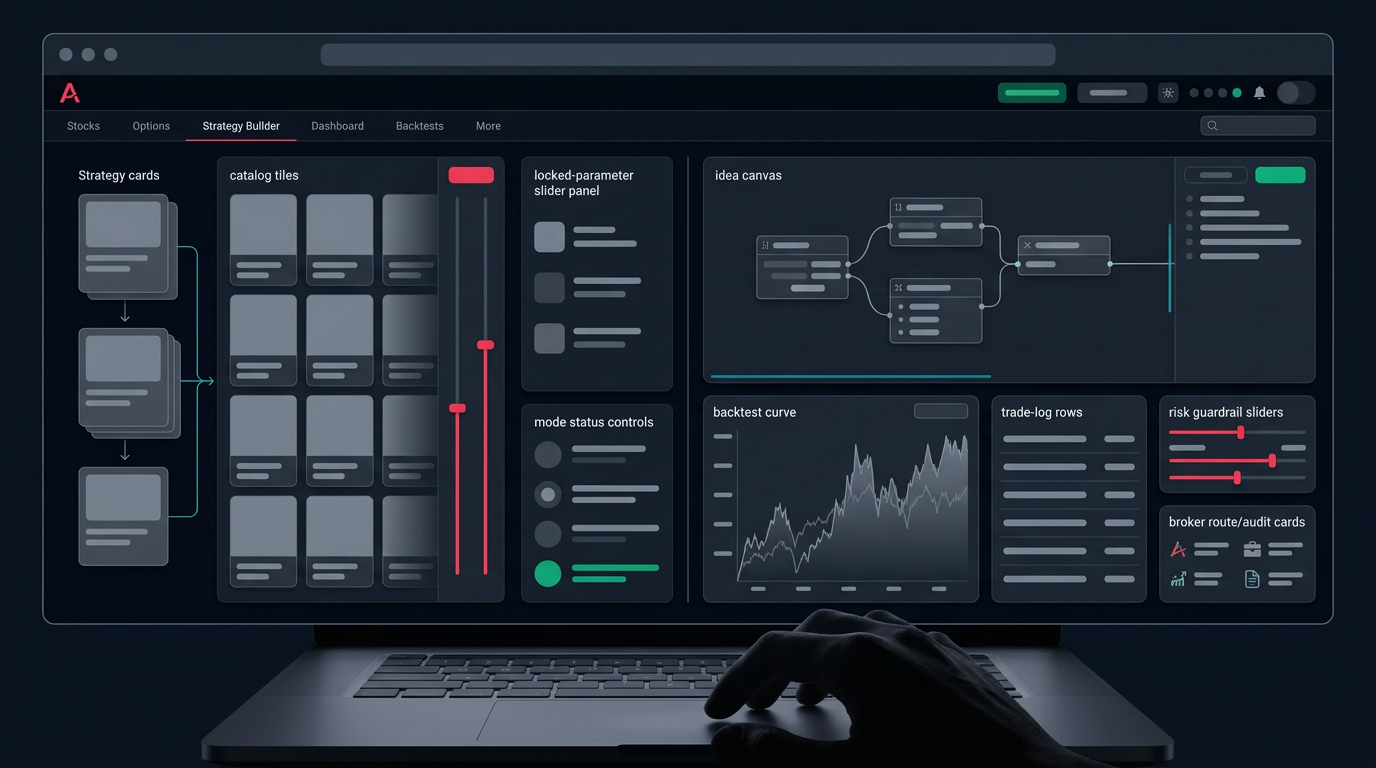
The strategy builder takes a natural-language prompt or raw JSON and parses it into a visual preview with entry, exit, risk, sizing, and universe selector blocks. Starter templates cover momentum breakout, RSI mean reversion, intraday short fade, VWAP bounce, EMA crossover, and gap-down recovery.
The important detail: it can sync the scanner selector timeframe and preserve exact scanner signal IDs like trendline_breakout_up. So the thing you backtest is the same thing the scanner fires, on the same timeframe. That link is where most DIY workflows silently break.
The options workspace
For options specifically, options backtesting sits alongside a workspace covering NIFTY, BANKNIFTY, FINNIFTY and MIDCPNIFTY, with tabs for setup, option chain, OI analysis, strategy finder, IV/theta, hedge desk, trade tools, and manage positions. You can build a quick trade or a basket and get a margin estimate with existing positions considered, before the order goes anywhere.
Orders you can audit
Execution problems show up in the order table before they show up in P&L. The orders page keeps status visibility and cancel workflows with mode-aware filtering, so a partially filled or rejected leg is something you inspect rather than something you infer from a strange P&L number three hours later.
An honest comparison
| Question | Backtesting-first fit | Anadi Algo fit |
|---|---|---|
| I know my exact options structure | Strong | Works, but you skip the discovery layer |
| I need historical evidence for a fixed straddle/condor | Strong | Supported |
| I want to find setups across stocks and indices first | Limited | Core design |
| I want scanner IDs preserved into strategy rules | Not the focus | Core design |
| I want stock / future / option route choice on one screen | Not the focus | Action Center |
| I want pre-trade margin and basket preview | Varies by plan | Options workspace |
| Pricing certainty today | Published tiers | Early access |
Two things worth stating plainly. First, AlgoTest has a longer public track record on options backtesting depth and a published pricing page; Anadi Algo is at the early access stage, so pricing certainty is a real difference. Second, if your workflow genuinely is "same structure every week, just show me the numbers," the broader chain here is overhead you may not need.
How to decide in ten minutes
Run these checks against whichever tool you are evaluating:
- Where does your next idea come from? If it comes from a chart you happened to look at, you need a scanner in the loop. If it comes from a fixed playbook, you may not.
- Does the tested rule match the fired signal? Ask whether the pattern name and timeframe survive from scan to strategy to backtest. If they do not, you are testing a proxy.
- Can you see why an entry was skipped? A tool that only shows entries taken hides your worst habit: chasing.
- Is the instrument choice a decision or a reflex? Check whether F&O context appears before you pick stock vs future vs option.
- Does margin appear before execution? Post-trade margin surprises are a workflow bug, not bad luck.
- Can you audit orders independently of P&L? Status, rejections, and cancels should be inspectable.
- Do your risk management rules — daily loss limit, position sizing, basket stops — live inside the strategy or in your head?
If a platform answers 1, 2 and 3 well for how you trade, the rest usually follows.
The takeaway
AlgoTest is a strong fit if you arrive with the structure already decided and want fast, focused historical validation. Anadi Algo is built for the trader whose problem starts one step earlier — finding the setup, keeping the exact signal identity intact through the strategy rules, choosing the instrument with F&O context visible, and then watching the order fill.
Neither replaces judgement, and no backtest, however detailed, promises future results. Slippage, gap risk, and expiry-day behaviour will still cost you more than your equity curve suggests.
If the signal-to-execution chain is the part of your workflow that keeps breaking, you can request early access and test the path end to end. If it is not, stay with the tool that fits — that is the whole point of comparing on workflow instead of on feature counts.