The Indian market gives you a fresh data point every session — index levels, VIX prints, sectoral rotation, FII–DII flows, global cues, and a never-ending stream of "tomorrow's prediction" posts. For a retail trader running an algo, scanner, or options system, the question is not what some chart says tomorrow will look like. It is whether your process is set up to survive whatever actually happens.
This post is a workflow-first read of the current market context for May 25, 2026, written for traders who want to use the day's information to prepare, not to chase calls. No targets, no stock tips. Just the checks an algo desk should run before the next session.
What "market context" actually means for an algo trader
A discretionary trader uses market context to find a trade. An algo trader uses it for something different — to decide whether a strategy should be allowed to trade at all, and at what size.
That distinction matters. Most retail systems break not because the logic is wrong, but because they were allowed to run in a regime they were never tested for. A trend-following Nifty system that did beautifully through October 2025 can quietly bleed in a sideways May. A short-strangle on Bank Nifty that printed money in low-VIX weeks can take a single bad day in a gap-driven session.
So "reading the market" for an algo trader really means three things:
- Regime tagging — what kind of market is this (trending, choppy, expanding range, news-driven)?
- Event awareness — what scheduled or unscheduled events could blow up assumptions?
- System gating — which of your strategies are allowed to fire, with what risk, in this regime?
Everything below feeds into those three questions.
Reading the current Indian market backdrop
Recent sessions in the Indian market have followed a familiar pattern — Nifty oscillating around large round numbers, Bank Nifty showing relative strength one week and dragging the next, midcaps swinging harder than benchmarks, and India VIX printing in a narrow band that occasionally pops on global news. That is not a forecast; it is a description of the regime most traders have actually been operating in.
Index levels and consolidation behavior
When Nifty spends weeks oscillating in a roughly 600–800 point band with sellers active at the upper end and buyers stepping in at the lower end, you are in a mean-reverting regime on the daily timeframe. Breakouts in this regime fail more often than they hold. That has direct implications:
- Trend strategies running on daily or 4-hour bars need a wider confirmation filter (e.g., close beyond range for two sessions, not one).
- Intraday breakout systems should expect more whipsaws and need tighter re-entry rules.
- Pullback strategies in the middle of the range are usually low edge — most of the meaningful moves happen at the extremes.
Bank Nifty's relative strength or weakness against Nifty is the second piece. When Bank Nifty is leading, financials-heavy intraday systems get cleaner moves. When it lags, the same systems chop. A simple Bank Nifty/Nifty ratio chart on your dashboard is more useful than another moving average.
India VIX and the volatility regime
VIX is the single most important context number for any option seller. A few practical thresholds Indian traders use as rough buckets:
- VIX under 12 — low volatility, premiums thin, short-vol systems work but tail risk is high if it spikes.
- VIX 12–17 — neutral zone, most option-selling backtests are calibrated here.
- VIX above 17 — elevated, premium-rich but directional risk is real.
- VIX above 22 — stressed, most retail short-vol systems should be paused or sized down.
If your option-selling backtest only saw data from a single VIX regime, its live behavior in a different regime is not a reliable extrapolation. This is exactly what VIX regime filters for option selling systems in India tries to make routine: don't run a low-VIX system in a high-VIX week without re-validating it.
FII/DII flows as a context signal
FII selling absorbed by DII buying is a pattern Indian markets have seen for several months now. As a context signal, the absolute number matters less than the consistency. Sustained FII outflows paired with DII support usually produce a controlled, choppy market — not a crash, not a clean rally. That is the worst environment for naïve trend strategies and the best environment for range-bound option systems, provided event risk is managed.
When flows flip — DII buying weakens or FII selling spikes — you should expect cleaner moves in one direction and revisit any system that assumed range-bound behavior.
Event filters to lock in before the next session
Most algo blowups are event-driven, not edge-driven. Build the filter once, run it daily.
Scheduled events
A minimum daily checklist before the system is allowed to fire:
- RBI policy days — pause Bank Nifty option-selling systems through the announcement window, or size them down significantly.
- CPI, IIP, GDP releases — usually pre-market or post-market in India, but always confirm against the day's calendar.
- US Fed meeting nights — Nifty often gaps the following morning; gap-sensitive intraday systems should be flagged.
- Quarterly results for heavyweight names — Reliance, HDFC Bank, Infosys, TCS results can swing the index more than people think. If your scanner picks these names, add an earnings-window blackout.
- Expiry days — weekly and monthly. Index option behavior is structurally different. If you have not validated separately for expiry sessions, see expiry day backtesting for Nifty and BankNifty.
Unscheduled events
You cannot pre-program around geopolitics or surprise central bank actions, but you can build a kill-switch:
- A circuit-breaker on India VIX (e.g., if intraday VIX moves more than X% from open, pause new entries).
- A correlation alert — if Nifty and Bank Nifty move opposite to typical intraday correlation, something unusual is happening.
- A news-aware halt for crude-sensitive sectors when Brent moves sharply (the crude oil and Indian markets playbook covers this in more depth).
The point is not to predict the news. It is to make sure your system stops trading when the market stops behaving the way your backtest assumed.
Strategy-level checks for this regime
Different system types need different sanity checks for a consolidation regime with intermittent volatility spikes.
Option selling systems
- Re-check max drawdown days in your backtest that overlap with weeks of similar VIX and similar range behavior. If the comparable period had a 4–6% drawdown, plan position size around that.
- Confirm your stop-loss is on premium, not just on spot. A premium-based SL is what actually protects capital when IV expands.
- Validate that your strike selection logic still gives the same delta exposure when VIX is at current levels — many retail systems pick "fixed distance" strikes and end up with much higher delta in low-VIX weeks than they realize.
Trend and breakout systems
- Pull a sample of the last 20 breakout signals from your strategy. How many followed through? In a consolidation regime, you should expect significantly more false breaks.
- Consider a regime filter — only allow trend entries if a longer-term filter (50-day ADX, range expansion measure) confirms a trending market.
- Be honest about overfitting. If your strategy was tuned on the strong rally of late 2025, today's regime is different. The how overfitting makes a backtest look profitable walk-through is useful here.
Scanner-based intraday systems
- Scanners pick up the names the market is moving today. That is useful, but raw scanner signals are not trading rules. A signal needs entry, exit, stop, position size, and a filter for when not to take it.
- Watch for over-trading. In a choppy market, scanners produce more signals, not fewer — and most of them lose money if traded without filters.
- Daily review: of the names the scanner flagged yesterday, how many would have actually been profitable trades with your rules? If the hit rate is dropping for two weeks straight, your rules are out of sync with the regime.
Backtesting checks that match the current regime
A backtest that runs from 2017–2024 and shows a smooth equity curve is reassuring but not actionable. The honest question is: how did this same system behave in periods that look like today?
Practical checks:
- Slice the backtest by VIX regime — separate equity curves for VIX under 13, 13–17, and above 17. Look at hit rate, average win, average loss, and max drawdown in each bucket.
- Slice by index range behavior — months where Nifty's monthly range was under 4% behave very differently from months above 8%.
- Walk-forward, not in-sample — re-fit parameters on rolling windows and check out-of-sample performance.
- Stress test slippage — Indian options spreads widen meaningfully in the last 30 minutes of expiry day, around news events, and at strikes far from ATM. Use realistic slippage, not the touch price.
The goal is to know, before the next session, whether the system you are about to deploy has actually been tested in a regime that resembles today.
Live monitoring and execution hygiene
Even a well-tested system fails if execution is sloppy. A few checks worth running today:
- Order book sanity — at the start of the session, confirm the broker connection is alive and the strategy is receiving live ticks, not stale snapshots.
- Duplicate order watch — partial fills, retries, and reconnects can produce duplicate orders. The duplicate orders in algo trading: causes and fixes post covers the common breakages.
- Position reconciliation — at least twice a day, confirm the broker's open position matches what your system thinks it is holding. Drift here is how small bugs become large losses.
- Latency check — measure the time between signal and order acknowledgement. A creeping increase is an early warning of a broker API issue.
- Margin headroom — keep at least one buffer level. A margin shortfall mid-session means forced exits at bad prices.
If you have not built this layer yet, the live monitoring checklist for retail algo traders is a useful starting point.
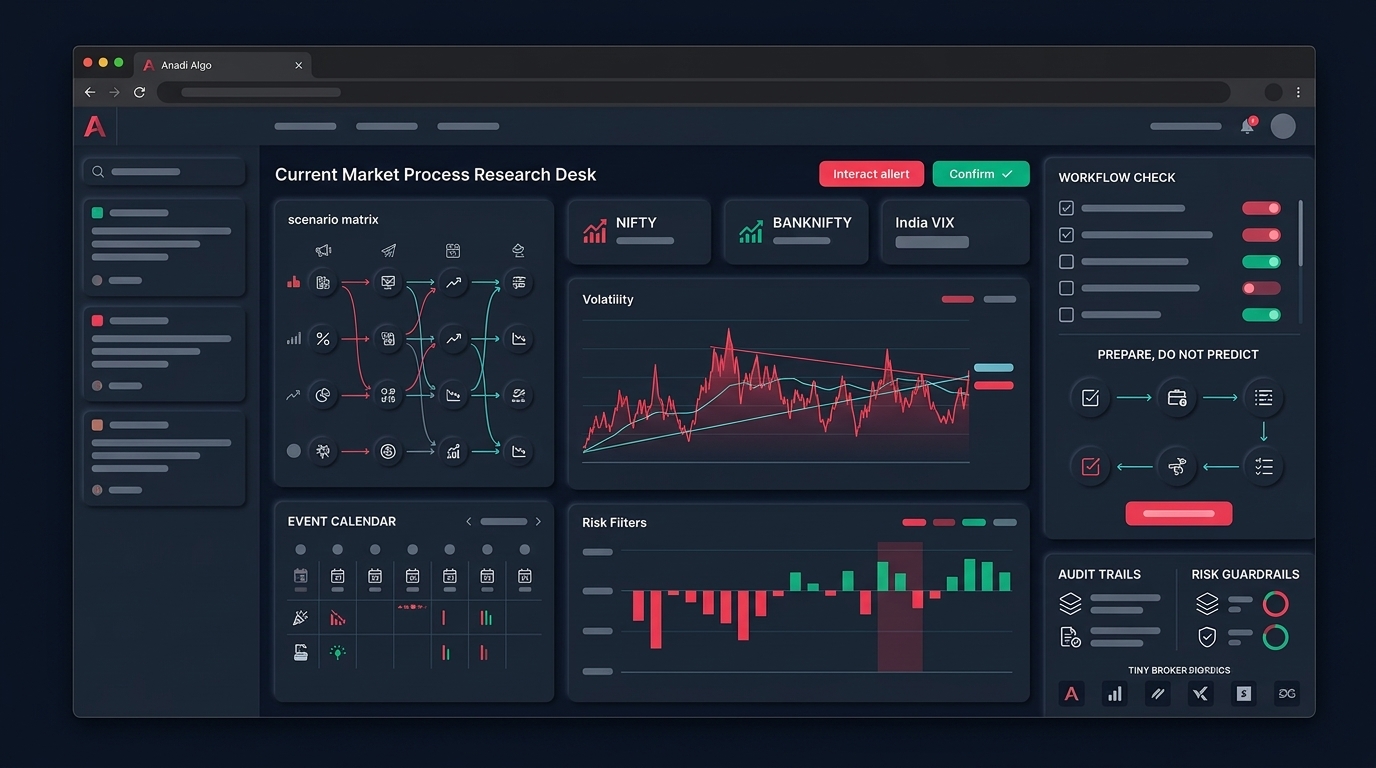
A pre-open checklist you can copy
Print this. Run through it before the system fires on the next session.
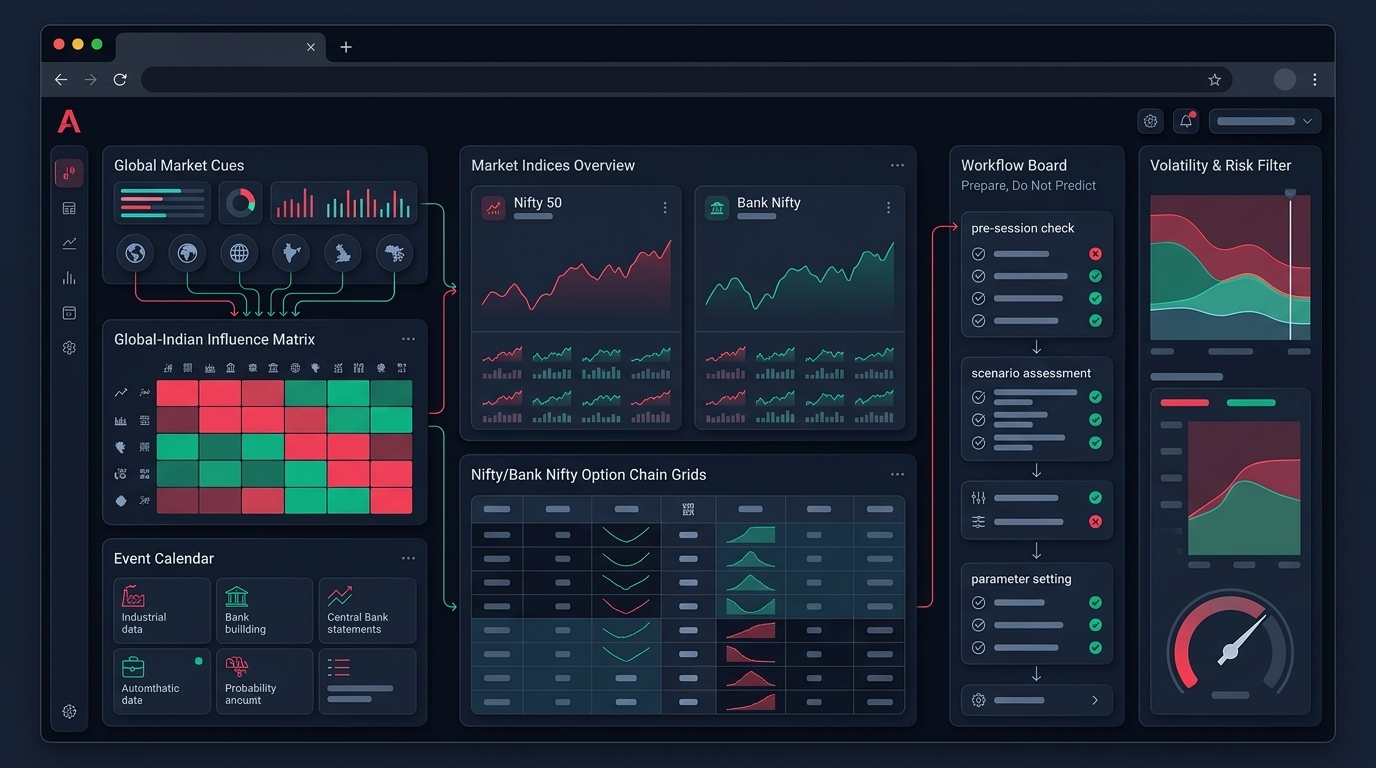
- Index context — Nifty range, Bank Nifty relative strength, midcap behavior. Tag the regime.
- VIX bucket — which volatility regime are we in, and is the system validated for it?
- Calendar — RBI, US Fed, major earnings, expiry. Note any blackout windows.
- Global cues — US close, Asian open, crude, USD/INR. Flag anything outside the normal band.
- Strategy gates — which systems are allowed to trade today? Which are paused?
- Position size — adjusted for current VIX and event risk, not fixed.
- Execution health — broker connection, tick feed, order routing, margin headroom.
- Reconciliation reminders — scheduled checks at midday and end of day.
- Kill-switch confirmation — pause logic for unusual VIX, correlation, or news events is armed.
- Daily journal entry — what regime we said today was, what the system actually did, what surprised us.
You will notice none of this contains a price target, a tomorrow's prediction, or a stock recommendation. That is the point. The trader who survives a long career in Indian markets is not the one who got tomorrow's level right — it is the one whose process kept them alive long enough for their edge to play out.
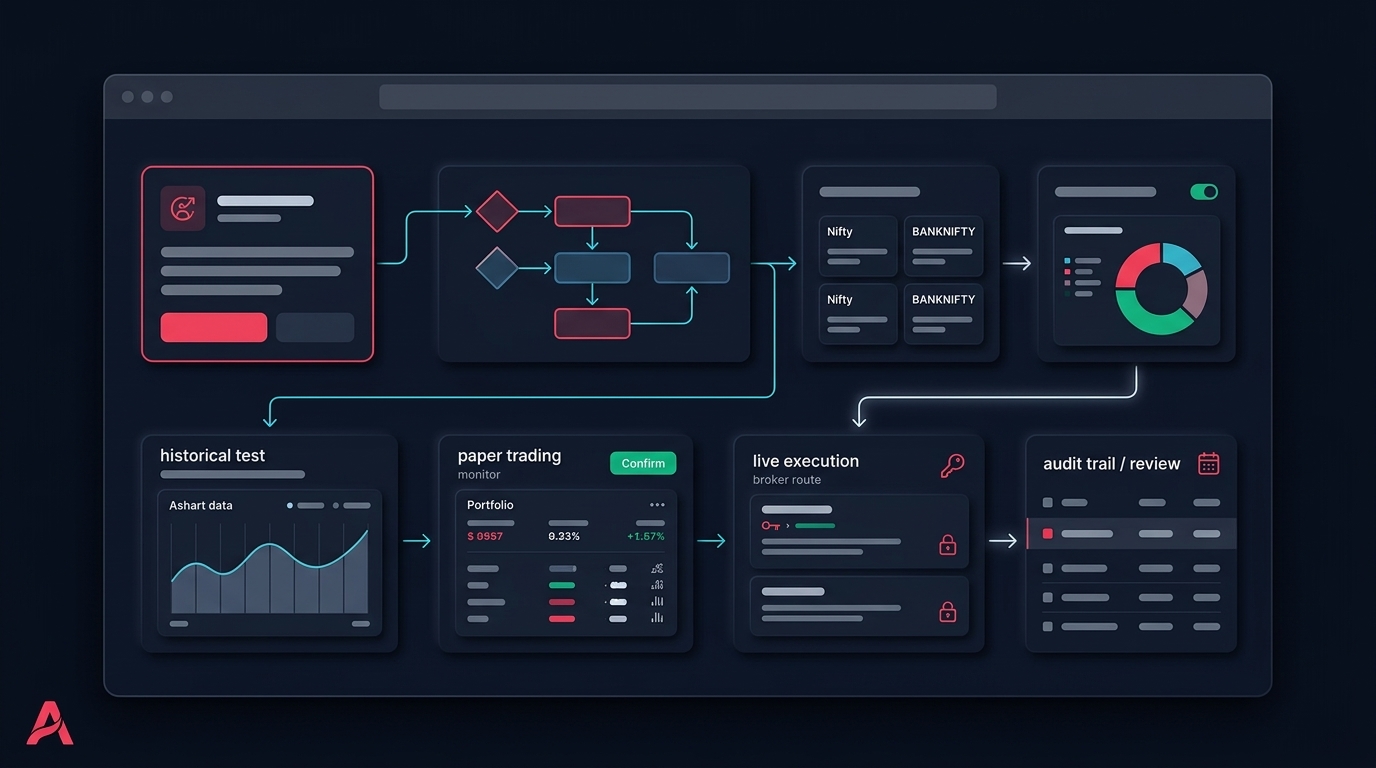
If you want a structured way to build these checks into your own algo trading workflow — including a no-code strategy builder, regime-aware backtesting, and a scanner you can wire into rules rather than gut feel — you can request early access and explore the platform with paper trading before going live.
Markets give you a new puzzle every day. Your job is not to solve tomorrow's puzzle in advance. It is to show up with a system that has rules for the puzzles it has seen, and the discipline to sit out the puzzles it hasn't.