A market breadth and sector rotation indicator published on TradingView — the Market Breadth & Sector Rotation Analyzer by kaathvikishan — has been doing the rounds among Indian traders. Its pitch is simple: before every trade, answer one question — should I take this trade today? It does this by analyzing 33 NSE indices across market cap segments, sectors, and themes.
The indicator itself is open-source, which is good practice. But the more interesting question for algo traders is not "should I install this script?" It's "why does a breadth-and-rotation check before every trade resonate so strongly right now — and how do I build that check into my own system?"
This post breaks down what breadth and rotation actually measure, why they matter in the current Indian market environment, and how to convert them from a chart overlay into concrete risk filters and workflow steps. No predictions, no trade calls — just process.
Why breadth checks are trending again
Look at recent sessions for context. In mid-May 2026, Indian markets saw days where indices recovered sharply in the second half while India VIX cooled — but the recovery was driven by visible sector rotation rather than broad participation. Brent crude staying elevated above the 110 dollar mark kept geopolitical risk in the background, and money moved between sectors session to session rather than flowing into everything at once.
That kind of tape is exactly where breadth and rotation analysis earns its keep. When NIFTY moves 0.8% in a day, that single number tells you almost nothing about how it moved:
- Did 70% of stocks advance, or did five heavyweights drag the index up while most stocks declined?
- Did banks lead while autos and metals bled, or was participation spread out?
- Is the sector that led today the same one that led last week, or is leadership churning every two days?
A trend-following stock algo behaves very differently in these two worlds. In a broad-participation rally, breakout signals follow through. In a narrow, rotation-heavy tape, the same signals fire, look identical on the chart, and then fade because the money that was supposed to follow has already rotated elsewhere.
If your system can't tell these regimes apart, your backtest averages them together — and your live results will swing between "the system works" and "the system is broken" without the system changing at all.
What market breadth actually measures
Breadth indicators answer one question: how many stocks are participating in the move? A few standard measures, all computable from NSE data:
Advance/decline percentage
The simplest one. Advance % is the number of advancing stocks divided by total traded stocks. Readings near 50% suggest a mixed, two-sided session. Extremes — say 80% or more advancing or declining — indicate broad-based pressure in one direction.
The practical reading for algo traders: an index rising on only 40% advancers reflects weak participation. Rallies with 70–80% advancers are generally considered healthier because more stocks confirm the move. That is a statistical observation about participation, not a forecast.
Percentage of stocks above moving averages
What fraction of NSE stocks trade above their 50-day or 200-day moving average? This is a slower regime gauge. When the percentage is high and rising, trend systems have a tailwind. When it sits in the middle and chops, mean-reversion conditions tend to dominate and breakout systems suffer.
New highs minus new lows
How many stocks are making fresh 250-day highs versus fresh lows? Persistent expansion in new highs supports momentum strategies; expansion in new lows while the index holds flat is a divergence worth flagging in your risk layer.
None of these are signals by themselves. They are context variables — inputs to a regime classifier, not entries.
Sector rotation: the second layer
Breadth tells you how many stocks are moving. Rotation tells you where the money is moving. The TradingView indicator's approach of tracking 33 NSE indices — Nifty 50, Bank Nifty, midcap and smallcap indices, sectoral indices like IT, Pharma, Auto, Metal, Realty, FMCG, and thematic ones — is a reasonable framing for this.
For an algo trader, three rotation states matter:
Stable leadership. One or two sectors lead for days or weeks. Stock-level momentum signals inside those sectors have higher follow-through. Signals in lagging sectors are fighting the flow.
Fast rotation. Leadership changes every one or two sessions. This is the regime where scanner signals look great at entry and stall immediately. Money is moving, but it isn't staying anywhere long enough for swing setups to mature.
Defensive rotation. Money moves from high-beta sectors (metals, realty, smallcaps) into FMCG, pharma, and IT while the index stays flat. The index hides what the internals reveal. Long-momentum systems quietly accumulate losing trades here.
You don't need to predict which state comes next. You need to detect which state you're in and let your system respond — fewer signals, smaller size, or a pause.
Why this matters specifically for Indian algo traders in mid-2026
A few things about the current environment make breadth-and-rotation discipline more relevant, not less:
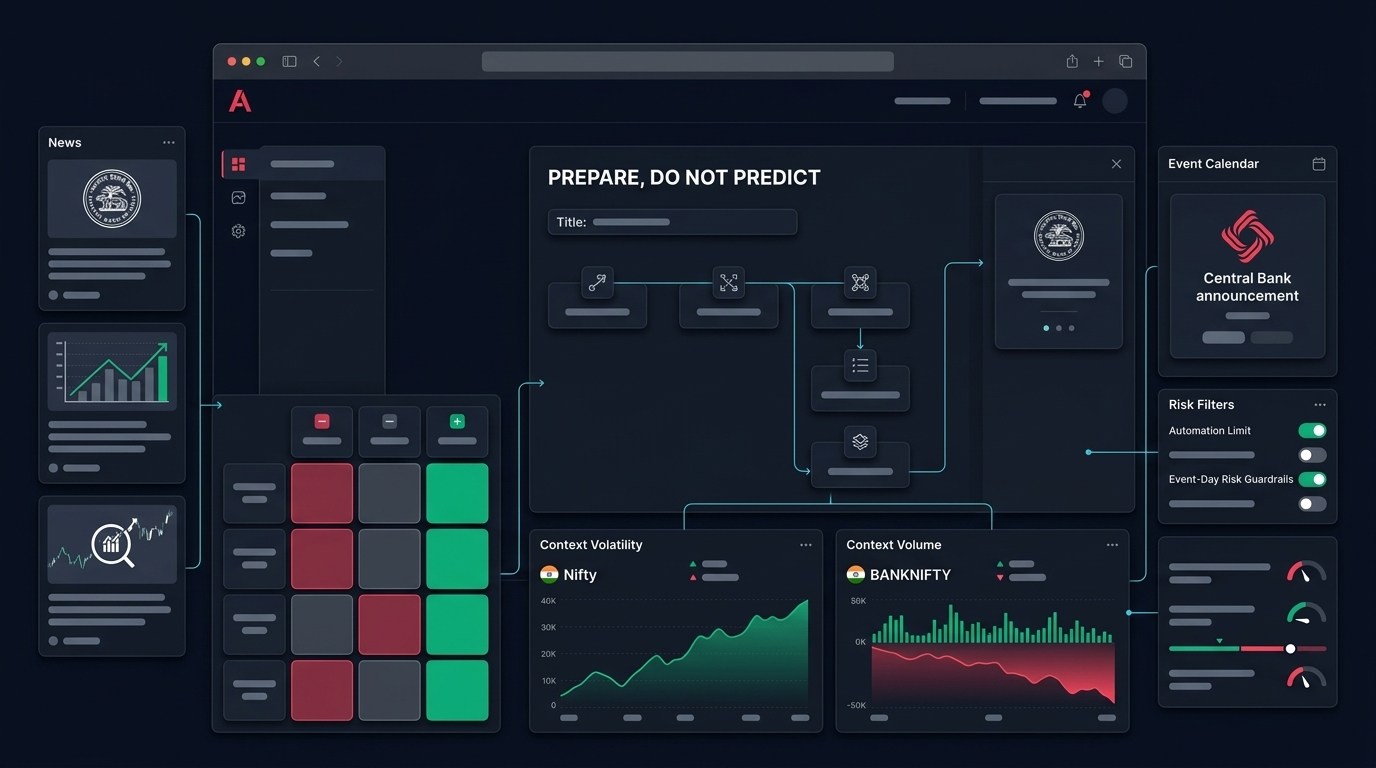
Event density is high. Between RBI policy cycles, global crude and geopolitical noise, and SEBI's tightened algo trading framework that took effect earlier in 2026, retail algo traders are running systems in a market with more compliance structure and more macro cross-currents than a year ago. On event-heavy days, breadth often deteriorates before price does — internals are an early warning that the index alone won't give you.
Index moves are increasingly rotation-driven. Sessions where NIFTY and BANKNIFTY diverge, or where the index closes green on weak advance/decline numbers, have been a recurring pattern. A stock scanner firing twenty signals into that tape will produce a very different outcome than the same twenty signals in a broad rally.
Retail systems are mostly long-biased. Most retail momentum and breakout systems in India are long-only or long-heavy. Breadth deterioration hurts these systems asymmetrically. A breadth filter is one of the cheapest hedges a long-biased system can have.
Turning breadth and rotation into algo risk filters
Here's where this stops being chart commentary and becomes engineering. Three practical patterns:
1. Regime tagging, not signal generation
Don't trade breadth. Tag it. Every day before market open (or at a fixed intraday checkpoint), compute and store a small set of regime variables:
- Advance/decline % for the previous session
- Percentage of NIFTY 500 stocks above their 50-day average
- Top two and bottom two sectors by 5-day relative performance
- Whether sector leadership changed versus the prior week
Then make your strategies consume these tags. A breakout strategy might require advance % above a threshold on the signal day. An option-selling system might reduce size when sector leadership has churned three times in five sessions. The breadth layer never places a trade; it gates and sizes the trades your strategies already generate. This is the same philosophy behind risk management as a separate layer rather than something buried inside each strategy.
2. Signal throttling by participation
Scanners are participation-blind by default. A trendline breakout on a midcap stock looks identical whether 75% of the market is advancing or 35% is. One concrete fix: cap the number of scanner signals you act on as a function of breadth.
For example — illustrative numbers, calibrate your own:
- Advance % above 65: act on up to your normal signal limit
- Advance % between 45 and 65: halve the limit, require sector alignment
- Advance % under 45: long signals paused, review-only mode
The exact thresholds matter less than the existence of the rule. Without it, your worst-breadth days are also your highest-signal-count days, because choppy markets generate lots of false pattern completions.
3. Sector alignment as a confirmation check
Before acting on a stock signal, check whether the stock's sector is in the leading half of your rotation table. A breakout in a stock from a sector that's been bleeding for a week is a fight against flow. You can still take it — some systems specifically hunt for reversals — but it should be a deliberate design choice in your strategy, not an accident of your scanner ignoring sector context.
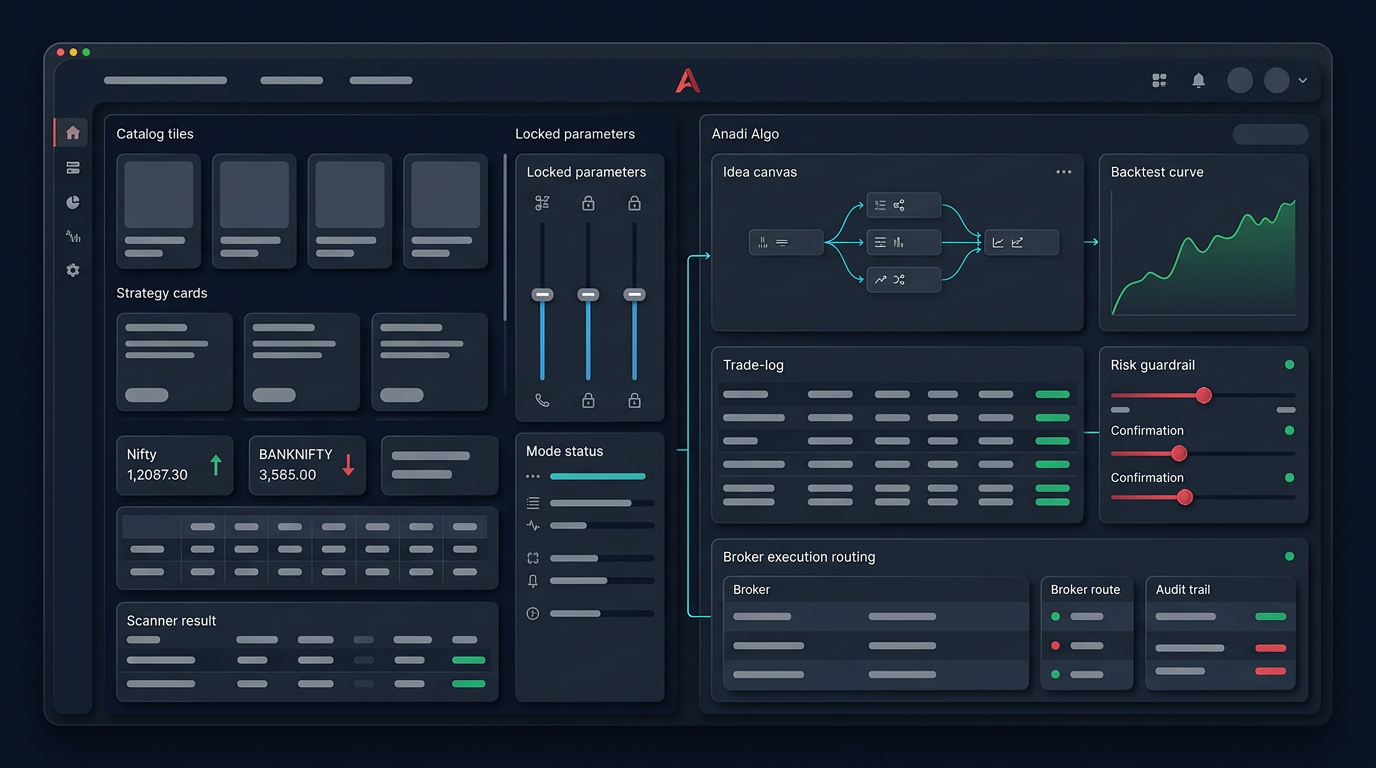
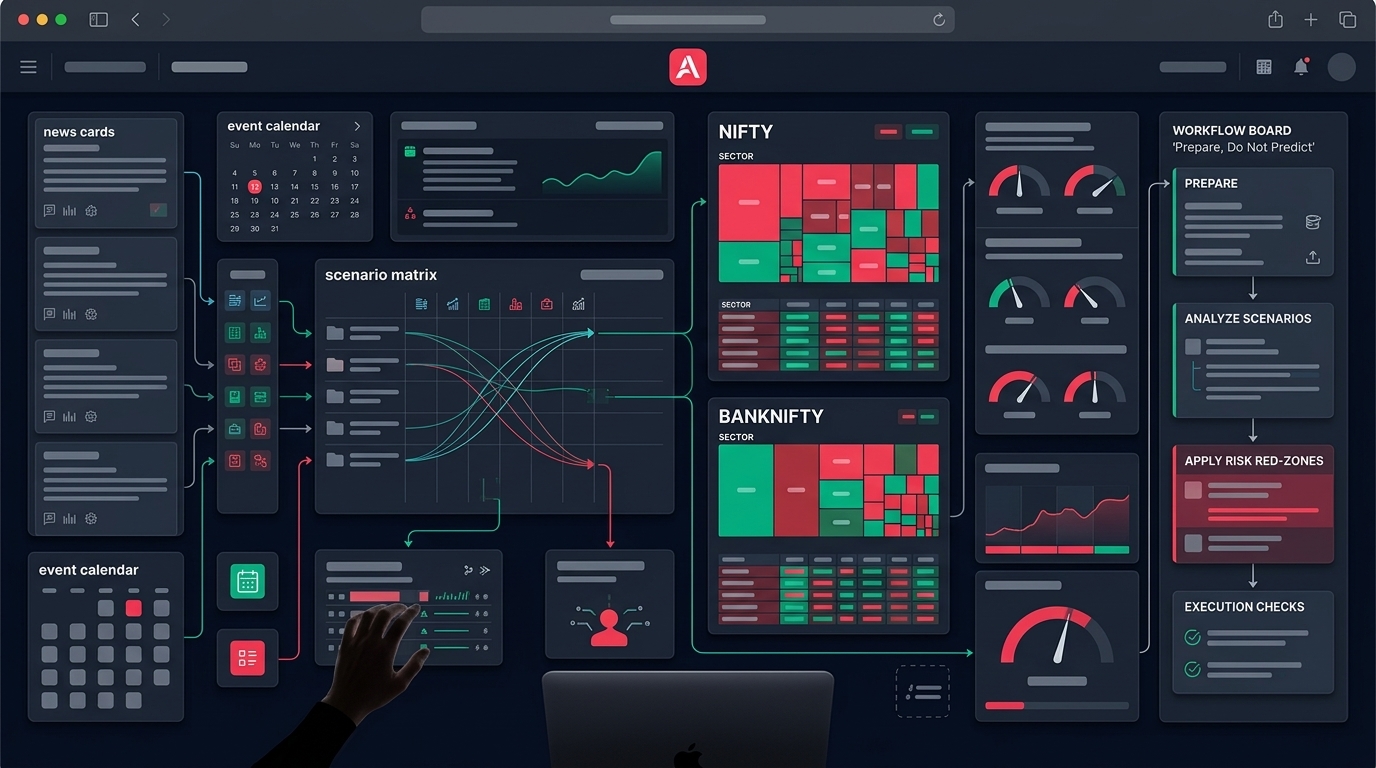
This is the workflow logic behind checking an index and sector view before the scanner, not after. On Anadi, the indices view with its sector heatmap exists precisely as that pre-trade context layer: see which sectors are participating, then evaluate scanner signals against that backdrop instead of in isolation. The Action Center takes this further by showing blocked reasons — like chase distance or invalidated levels — so that a signal which has already run away from its entry doesn't get executed late just because it's still on the list.
Backtest it before you believe it
A warning that applies to every filter, including breadth: a filter that sounds intelligent can still destroy a working system.
Adding a breadth gate changes your trade distribution. It will skip some losers — and some winners. Whether the net effect is positive is an empirical question, not a logical one. Before deploying any breadth or rotation filter live:
- Reconstruct the regime tags historically. Advance/decline and percent-above-MA data can be rebuilt from historical constituent data. If you can't reconstruct the filter's history, you can't test it.
- Run the strategy with and without the filter over the same period and compare trade count, drawdown, and return profile. A filter that cuts drawdown 30% while cutting returns 10% may be worth it; one that cuts both equally is just noise.
- Check regime-specific performance. Split results by breadth regime. If your system loses money in low-breadth regimes in the backtest, the filter has a real job to do. If it doesn't, the filter is solving a problem you don't have.
- Watch the signal count. If the filter eliminates 80% of your trades, your remaining sample is too small to trust, and you've effectively built a different system.
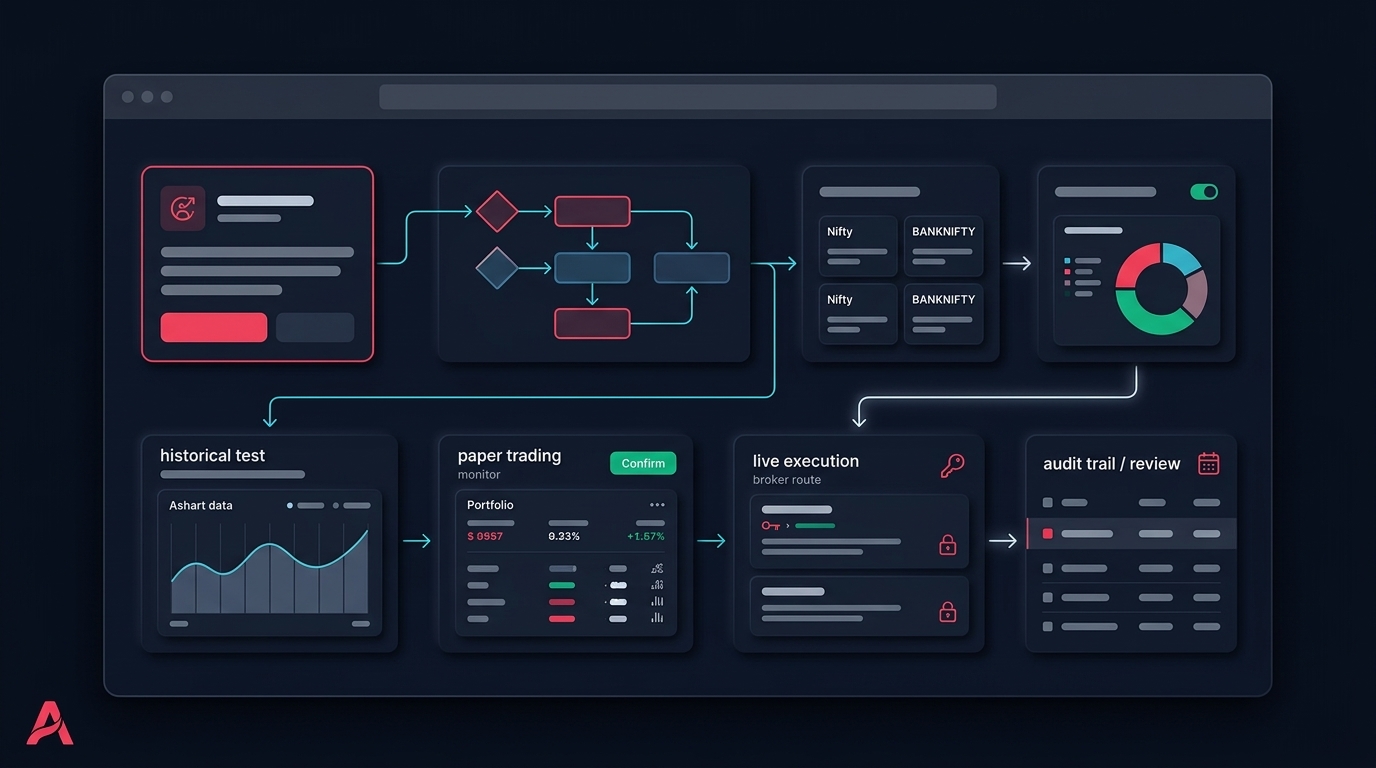
This is the standard scanner-to-validation discipline: signal, context, backtesting, then deployment — in that order. A strategy builder that lets you express the filter as an explicit rule, rather than a manual habit you apply "when you remember," is what makes the filter testable at all.
A note on indicator scripts versus system components
Back to the TradingView indicator that prompted this post. Open-source breadth scripts are genuinely useful for learning — you can read the code, see exactly which 33 indices are tracked and how the dashboard scores them, and verify the logic yourself. That transparency is worth appreciating.
But there's a gap between an indicator you look at and a filter your system enforces. An on-chart dashboard depends on you looking at it, interpreting it consistently, and overriding your own bias on the days it's inconvenient — which are exactly the days it matters. The whole argument for algo trading in India is removing that discretionary leak. If breadth is part of your edge, it belongs in your rule set with thresholds you've tested, not in a panel you glance at.
A reasonable progression: use the indicator to build intuition for a few weeks, write down the rules you find yourself applying, then encode and backtest those rules. The indicator is the teacher; the tested rule is the system.
Pre-trade breadth and rotation checklist
A compact version you can run daily, manually or as automated regime tags:
- Advance/decline check — was yesterday's index move backed by broad participation, or carried by a few heavyweights?
- Trend breadth check — what percentage of the broader universe is above its 50-day average? Rising, falling, or chopping?
- Sector leadership check — which two sectors lead on a 5-day basis? Same as last week, or churned?
- Divergence check — index near highs while new lows expand, or index flat while defensives lead? Flag it.
- Signal budget decision — based on the above, is today a normal-size day, a reduced-size day, or a review-only day? Decide before the scanner output arrives, not after.
- Event overlay — any scheduled macro event (policy, expiry, global data) that already argues for reduced exposure regardless of breadth?
Run this consistently and you'll notice the real benefit isn't catching great days — it's automatically standing smaller on the days your system was structurally likely to underperform.
If you'd rather have this context layer, the scanner, the rule builder, and the backtest loop in one place instead of stitched across five tabs, request early access to Anadi Algo — and the weekly market outlook covers the same breadth and rotation context as preparation, not prediction.
The indicator going viral asks the right question: should I take this trade today? The algo trader's job is to make sure that question gets answered by a tested rule — every day, including the days you'd rather not hear the answer.