Why RBI Policy Day Is Different
Most trading days have predictable rhythm. RBI MPC announcement days do not.
Six times a year, the Reserve Bank of India's Monetary Policy Committee announces its repo rate decision — typically at 10:00 AM IST on the last day of the meeting. Within seconds of that announcement, Nifty moves. Bank Nifty, being the most interest-rate-sensitive index, can move 200–500 points in the 15 minutes that follow. The USD/INR pair reacts simultaneously.
For algo traders, this creates a specific problem: systems designed for normal market conditions encounter an environment where spreads widen, fills slip, and signals stop making sense. Your strategy's assumptions were built on typical sessions — not a moment when the entire market reprices in under a minute.
This post is not about trading the event. It's about not letting the event trade you.
What Changes Before the Announcement
Policy day volatility doesn't start at 10 AM. It builds.
India VIX typically rises 5–15% in the week leading up to MPC day. This inflates option premiums meaningfully. If you're running a short-premium strategy — strangles, iron condors, or short straddles — your entry costs and edge assumptions shift before you've done anything.
A Bank Nifty option that you backtested as a ₹120 credit entry might cost 20–35% more in premium the day before policy. Your expected value calculation is now based on stale numbers.
Check your options backtesting assumptions. If your backtest didn't segment MPC weeks as a separate regime, the historical edge may not hold for these sessions.
Also note: sometimes Bank Nifty's weekly expiry falls on the same day as the RBI announcement. When expiry-day gamma converges with event-day volatility, the combination creates some of the sharpest intraday moves of the year. Your system is now simultaneously dealing with decay acceleration and a macro shock. That's not a setup to run blindly.
The First Five Minutes: A Hard Rule
The moment the policy is announced, the first 5 minutes of price action are noise.
Algos, news bots, institutional desks, and retail panic all hit the market simultaneously. Spreads widen. Order books thin. Prices whipsaw — sometimes moving sharply in one direction, then reversing before the 5-minute candle even closes.
If your system triggers on momentum or breakout logic, these 5 minutes will generate false signals. You're not getting signal from price — you're getting randomness dressed as a move.
The practical rule most experienced event traders follow: do not trade the first 5 minutes after announcement. This applies even more strictly if you're running an automated system, because there's no human filter in the loop.
Adjusting Your Automation Controls
Here's a concrete checklist for what to review before an MPC day:
Position sizing. If your system uses dynamic sizing based on ATR or recent volatility, verify it's reading current VIX-adjusted ranges — not last week's calm. A 2x higher VIX means your nominal position could carry 2x the real risk.
Stoploss levels. Wider-than-usual moves mean fixed-tick stoplosses get triggered by noise, not by actual adverse moves. Consider widening stops or reducing size, not both.
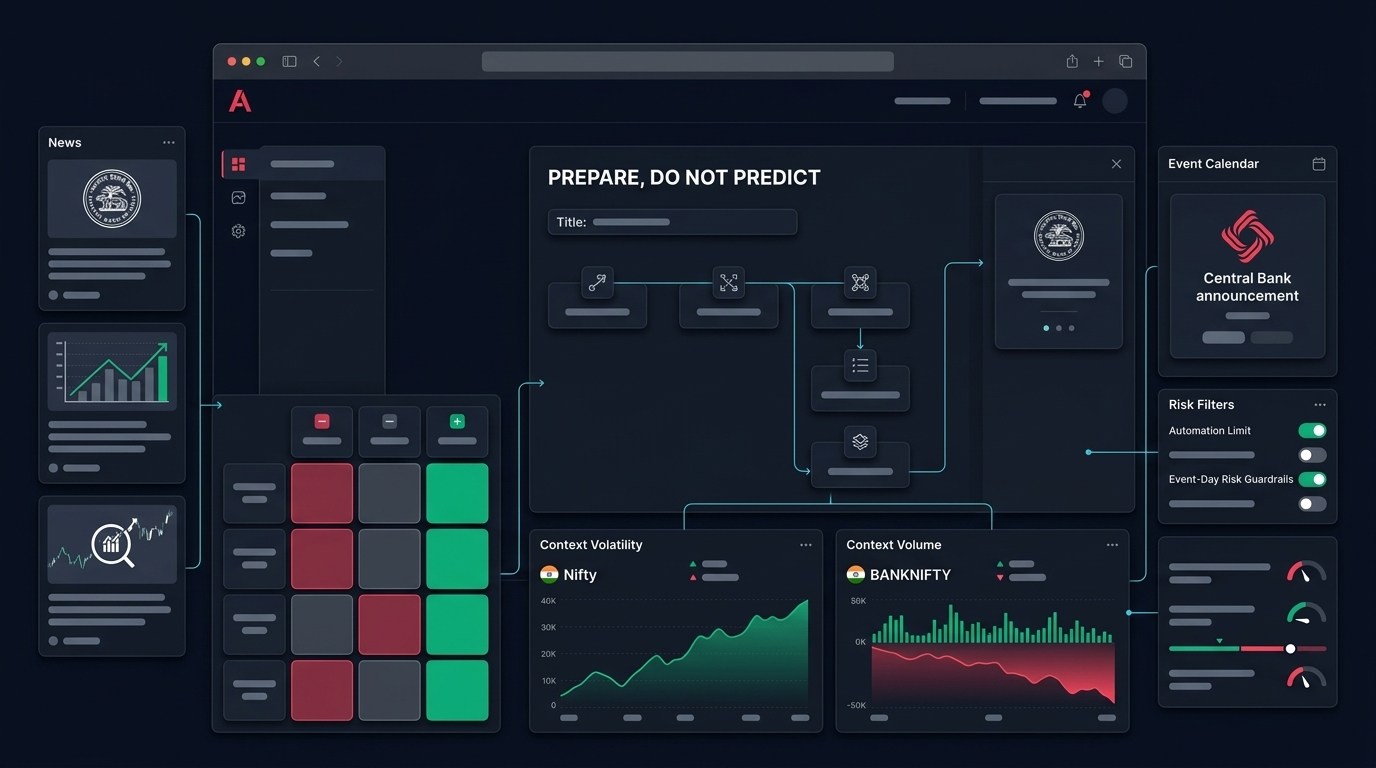
Time-based filters. Many traders implement a blackout window around 9:45 AM–10:30 AM on MPC days — no new entries in that window regardless of signal. If your platform supports time-based execution rules, set this up in advance.
Auto-restart behavior. If your algo gets a reject or error during high volatility (which happens more often than expected), does it retry silently? Uncontrolled retries in a fast market can stack unintended positions. Audit your risk management settings before the day begins.
Broker API stability. High-volume event moments stress broker infrastructure. Session drops and order timeouts are more likely. Have a manual override plan ready — know how to pause your automation from your broker's web platform, not just from your algo interface.
When to Step Back Entirely
There are specific situations where the right call is to not run automation at all on MPC day.
If your strategy was never tested on event days. A system that hasn't been evaluated across MPC dates in backtest has no known behavior in this environment. Running it live is a real-money experiment.
If your strategy is mean-reversion based. Mean-reversion logic assumes prices return to a range. After a large rate decision surprise, the range itself shifts. Selling into a breakout that turns out to be a structural reprice is not a mean-reversion opportunity — it's a loss waiting to complete.
If you're holding overnight positions into MPC day. Gap risk is real. The market could open with a significant gap if any pre-announcement news leaks, or if global markets have moved overnight. If your position is leveraged, the gap can blow through your stoploss.
Use the weekly market outlook to flag these dates in advance so you're not caught off guard.
What Algo Traders Can Still Do
Stepping back from automation doesn't mean sitting out entirely.
Use the scanner to observe how stocks and options are behaving pre-announcement — but observe, not execute. Watch if IV expansion is happening uniformly or only in specific strikes. Watch the OI buildup pattern in Bank Nifty options. This data becomes part of your post-policy context.
If you want to test how a strategy behaves on event days without real capital, paper trading lets you run your system through live conditions without live risk. Running a few MPC days on paper first is a low-cost way to understand your system's actual behavior in these environments — before you find out the hard way.
A Quick Pre-MPC Checklist
Before any RBI MPC announcement day, run through this:
- Note the exact announcement time (typically 10:00 AM IST)
- Check if it coincides with Bank Nifty weekly expiry
- Check current India VIX vs. your strategy's backtested VIX range
- Review open positions — size down anything you wouldn't want to hold through a 400-point Bank Nifty move
- Set a time blackout window in your system: no new entries from 9:45 AM to 10:30 AM
- Verify stoploss widths are appropriate for event-day ranges
- Have a manual pause plan ready at your broker
- If your strategy has no MPC-day backtest data, consider switching to observation mode only
RBI policy day is not the time to discover what your system does under stress. The preparation happens the day before — or better, in your backtest setup months earlier.
If you're building or refining your event-day controls, Anadi Algo's early access lets you set up rule-based execution with time filters, position limits, and paper trading — so the next MPC day is a controlled experiment, not a fire drill.