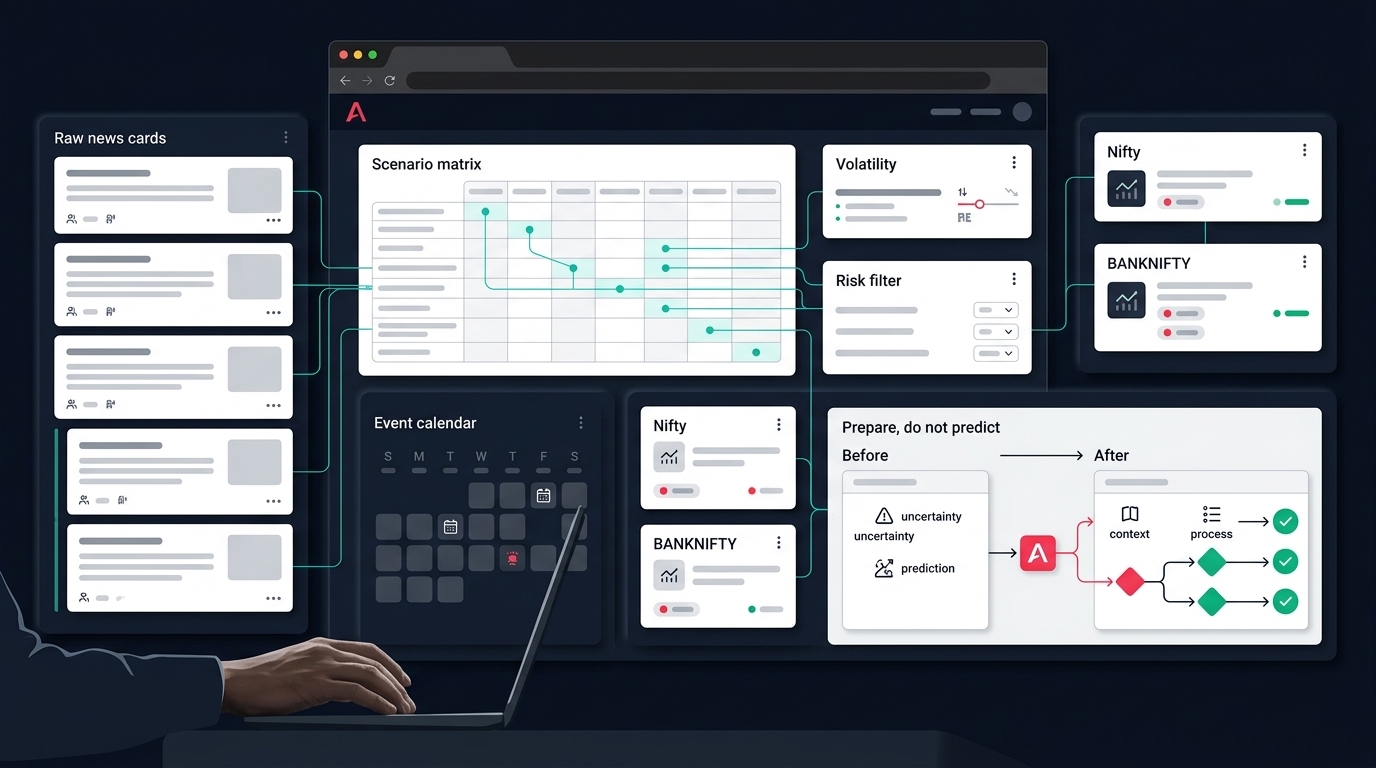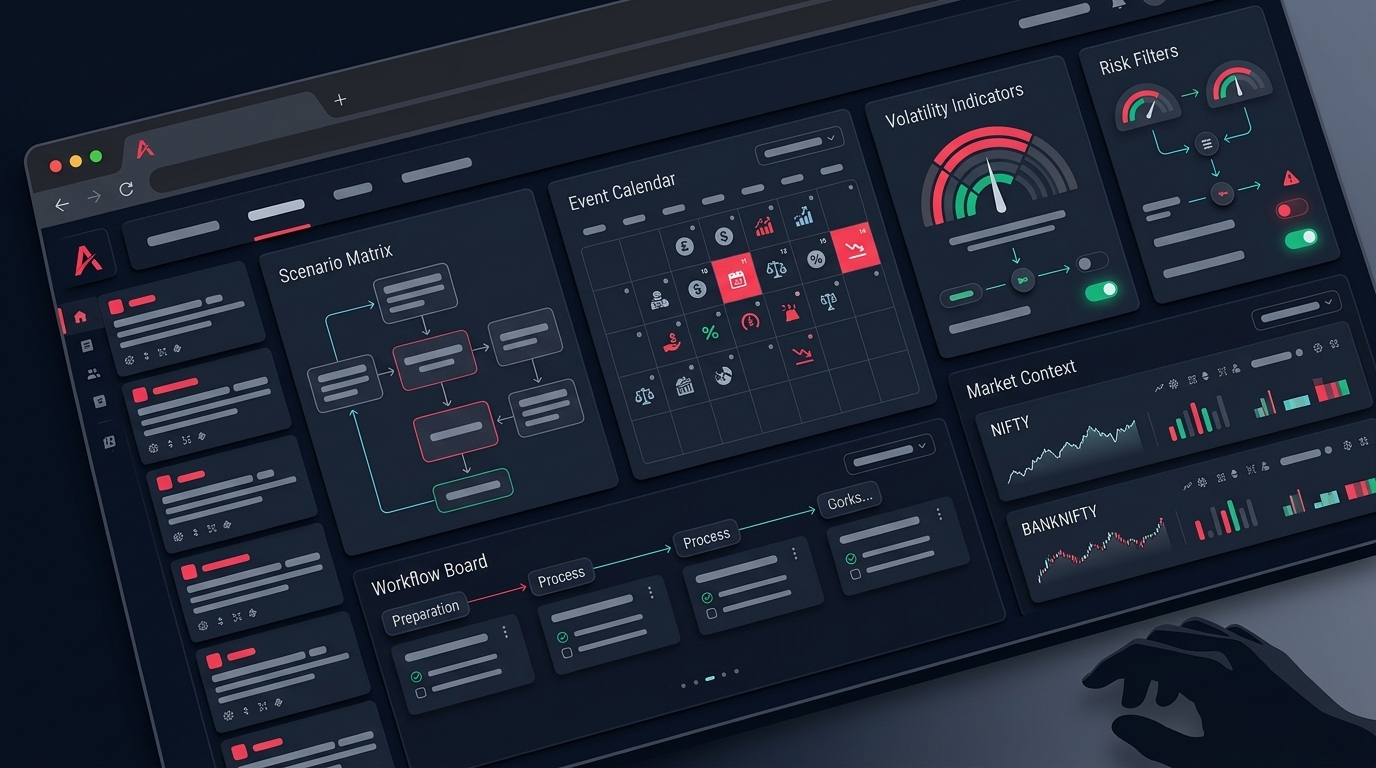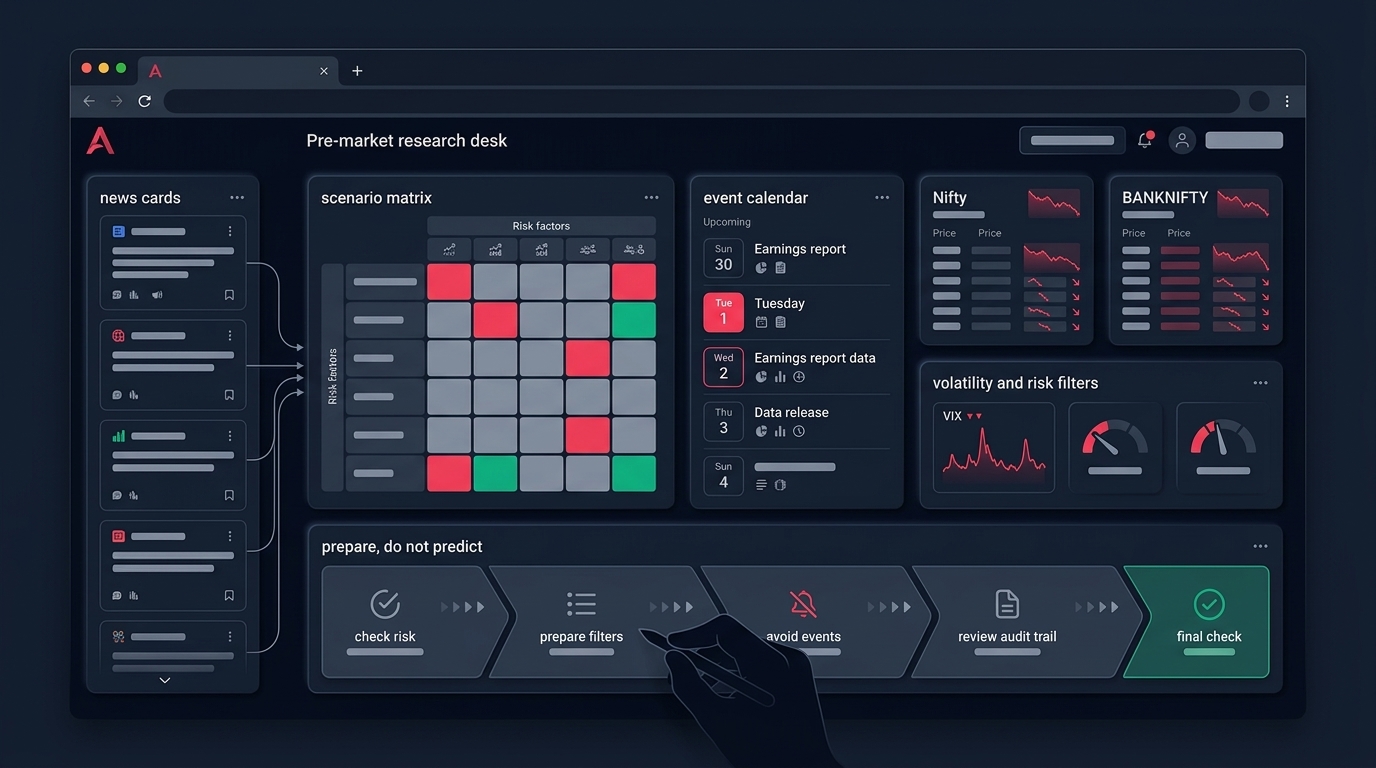
Every evening, financial media publishes some version of the same article: "10 things that will decide stock market action tomorrow." GIFT Nifty, crude, FII flows, Fed minutes, technical levels, a few analyst quotes. Most traders read it, feel briefly informed, and then trade exactly the way they were going to trade anyway.
That is a wasted input. The pre-market checklist is genuinely useful — but only if you convert it from a list of things to watch into a list of decisions your system makes before the open. This post does that conversion for Tuesday, August 18, 2026, using the actual market context in front of us: a Nifty that has fallen for five straight sessions, a broader market that refuses to confirm the weakness, elevated crude, and an earnings season that has just ended.
No predictions here. Just process.
What Monday's close actually told us
Strip the headlines down to the facts that matter for a rules-based trader:
- The Nifty declined for a fifth consecutive session on Monday, with the Sensex falling around 281 points. Reports placed the Nifty below the 24,350 area.
- The broader market diverged. Nifty Smallcap 100 and Nifty Midcap 100 closed green, rising up to 0.3% even as benchmarks fell.
- Market breadth remained bearish, with more declining stocks than advancing ones.
- IT stocks dragged the benchmarks. Metals and select private banks showed relative resilience.
- FII selling continued, but DIIs were absorbing it on the other side.
Notice the tension in that list. Benchmarks weak, midcaps green, breadth negative, flows split between two large counterparties. This is not a one-way tape. The market is effectively saying "abhi decide nahi hua" — and that ambiguity is itself information. Trend systems and breakout systems behave very differently in a contested tape than in a clean directional one, and your risk settings should know which environment they are operating in.
The regime has shifted: earnings season is over
The most underrated line in the current coverage is not about crude or the Fed. It is this: the Q1FY27 earnings season has concluded, and analysts expect markets to stay range-bound while global cues and macro developments take over as the primary drivers.
Why does that matter for an algo trader?
During earnings season, volatility is largely scheduled. You know which stocks report on which dates. You can build avoidance rules around known events, and single-stock moves have identifiable causes. Once earnings end, the driver mix flips. Now the dominant catalysts are West Asia headlines, crude prices, US policy signals, and overnight global sentiment — none of which respect Indian market hours.
Practically, that means:
- Gap risk rises relative to intraday risk. Overnight news from the Iran conflict or a crude spike lands on your open positions before your system can react. If your strategy holds overnight, this is the week to re-check how it handles gaps, not assume the backtest covered it.
- Stock-specific signal quality changes. Analysts expect stock-specific action to become "more selective" post-earnings. In scanner terms: the same breakout pattern that had earnings momentum behind it two weeks ago may now be running on thinner fuel.
- Scheduled events still exist — they're just global now. Fed minutes are flagged as a key driver this week. That is a calendar item with a known release time. Treat it the way you treat RBI policy day: a defined event window where you decide in advance whether your system trades through it, sizes down, or stays flat.
Turning the "10 things" into risk filters
Here is the conversion exercise. Each item on a pre-market list should map to one of three things: a risk state, an event window, or context. If it maps to none of them, it is noise for your workflow.
Crude and West Asia: a state, not a signal
Crude has been the single most cited factor behind the recent weakness, with US-Iran tensions and Strait of Hormuz risk keeping prices elevated. The mistake is treating each crude headline as a trade trigger. The better approach is a simple risk-state model: normal, elevated, or event. Right now the honest label is "elevated" — crude is high and headline-sensitive, but nothing has structurally broken.
In an elevated state, you do not need new signals. You need adjusted parameters: smaller position sizes on overnight strategies, wider expected slippage on stop-loss fills, and a lower tolerance for holding through the close. Your risk management rules should encode this as a config, not as a morning mood.
Fed minutes: a time-boxed event
Unlike geopolitical headlines, Fed minutes arrive at a known time. The Indian market reaction typically shows up at the next session's open. The decision is binary and can be made tonight: does your overnight book carry through the release or not? Either answer is defensible. Deciding at 9:14 AM after seeing the gap is not.
FII selling vs DII buying: context, not timing
Five down sessions with DIIs absorbing FII supply is a specific pattern: persistent pressure meeting persistent support. Flows explain why the tape looks contested, but they do not time entries. Where this context earns its place is in expectation-setting for your strategies. A breakout system in a tape where two large flows are grinding against each other faces higher whipsaw risk than in a clean trend. That should show up in how strictly you filter entries — not in a discretionary "FIIs are selling so I'll skip today."
GIFT Nifty and the open: a gap check, not a direction call
GIFT Nifty told Monday's traders to expect a soft start, and it delivered one. Use it the same way on Tuesday: as an input to your pre-open gap checklist. A gap beyond your tested threshold — say, more than half a percent against your intended direction — should trigger a defined response (delay entries, reduce size, or skip the first N minutes), because most intraday backtests quietly assume opens that resemble the prior close.
The breadth divergence is the real story for scanners
For traders running a stock scanner, the most actionable feature of this market is the divergence: benchmark indices down five straight days while midcap and smallcap indices close green, with overall breadth still negative.
This creates a specific trap. Your scanner will keep producing long setups — midcap names are genuinely moving. But the index context is weak and breadth is bearish, which means follow-through on those setups is statistically shakier than the chart pattern alone suggests. More signals will look fresh at entry and stall by afternoon.
Three checks help here:
-
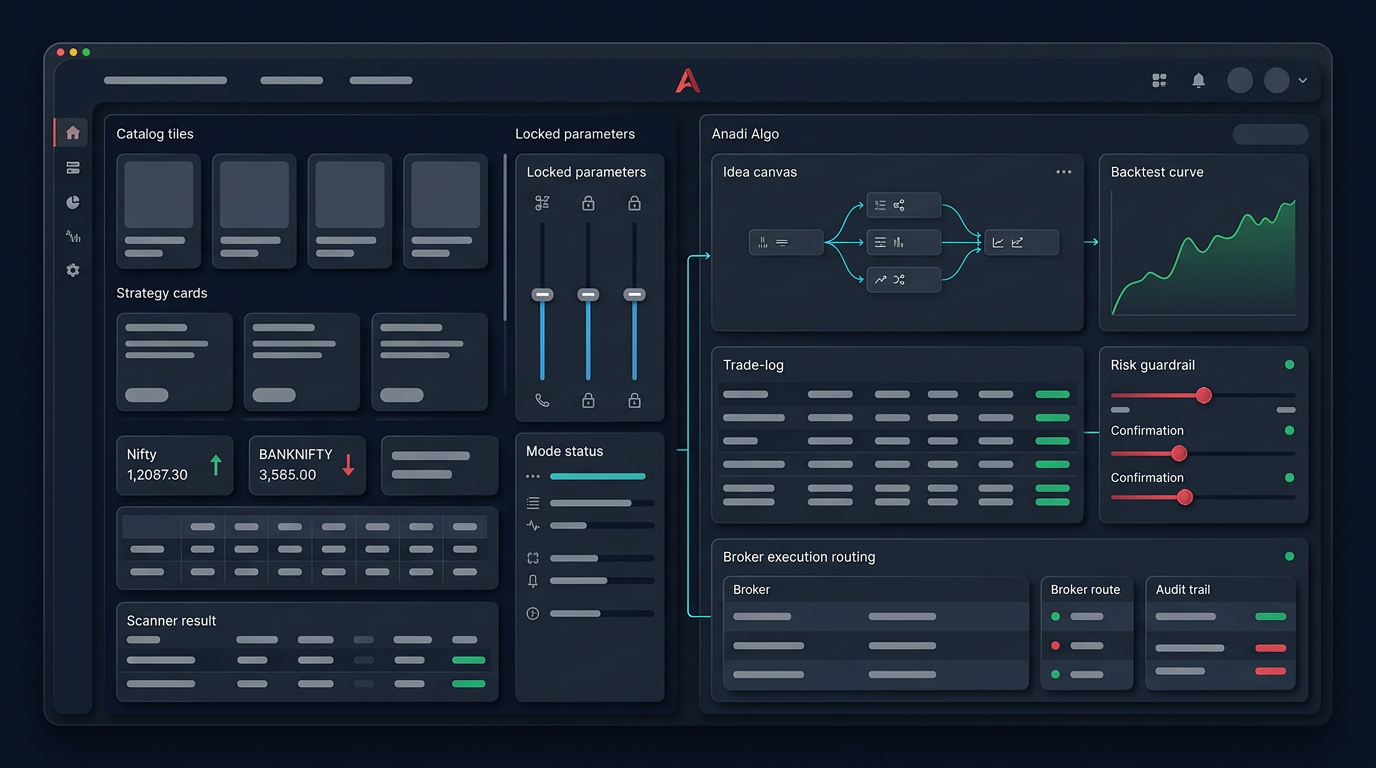
Confirm the sector before the stock. A midcap breakout inside a sector that is actually participating (metals showed resilience Monday) is a different bet than the same pattern in a sector being sold (IT dragged the benchmarks). This is exactly why Anadi puts index cards and a sector heatmap on its Indices view — the point is to see whether the sector tape supports the stock signal before acting on it, not to predict the index.
-
Respect freshness and chase distance. In a choppy, contested tape, late entries are punished harder because moves retrace. A filter layer like Anadi's Action Center exists for this reason: it marks scanner candidates as fresh or stale, and blocks entries where price has already run too far from the trigger level or the setup has been invalidated. A "blocked: chase distance" tag is annoying in a trending market and protective in this one.
-
Count your own breadth. A crude but effective check: of your scanner's long candidates this morning, how many belong to sectors that were green yesterday? If the answer is under a third, your long book is fighting the tape, and size should reflect that.
Options workflow when "range-bound" is the consensus
Analyst consensus this week is range-bound movement. The tempting shortcut is to read that as "sell premium." Resist the shortcut — consensus range calls fail precisely when a headline (Hormuz, Fed) breaks the range, and the current environment is rich in exactly that kind of headline.
If you trade index options, the process-level checks matter more than the view:
- Validate the chain before the structure. Liquidity and spreads at your chosen strikes, OI concentration, and IV context — checked in the option chain, not assumed. A range-bound view expressed through illiquid strikes is a bad trade even when the view is right.
- See margin before execution. Multi-leg structures in a volatile-headline week can demand margin changes mid-trade. Anadi's options workspace shows basket preview and margin estimates with existing positions considered, before the order goes out — the sequencing (risk first, execution second) is the point, whatever platform you use.
- Define the basket-level exit. Individual leg stops on a spread create legging risk. Decide the maximum loss for the structure as a whole, and test whether that rule would have survived recent sessions using options backtesting rather than intuition.
- Check the expiry calendar. Expiry-day dynamics — gamma, accelerating theta, pin behavior around heavy OI strikes — change intraday behavior materially. Before trading any index option this week, confirm whether the contract you are touching expires today or has days left, and whether your strategy was tested on expiry days at all.
Prepare tonight; don't predict tomorrow
The honest version of "10 things that will decide market action Tuesday" is that nobody knows which of the ten will matter. Monday's sellers were confident; midcap buyers were equally confident. Both cannot be right, and your edge is not in out-guessing them.
Your edge is that a prepared system makes fewer unforced errors than an improvising trader. Preparation this week looks like:
- An event calendar updated with Fed minutes and this week's expiries.
- Risk states set: crude/geopolitics at "elevated," with sizing and overnight rules adjusted accordingly.
- A daily loss limit that actually halts trading, tested before it is needed.
- Any new rule (a breadth filter, a gap threshold) running in paper trading first, not deployed live mid-drawdown because five red days made you anxious.
- A weekly review habit — our weekly market outlook exists for exactly this: using context to prepare your system, not to chase the day's noisiest call.
If you want this workflow — scanner context, action filtering, option chain checks, margin-first execution, and paper trading — in one place built for Indian markets, you can request early access to Anadi Algo.
Tuesday pre-open checklist
Run this in ten minutes before 9:15:
- Gap check: Where is GIFT Nifty versus Monday's close? Beyond your tested gap threshold, apply your gap rule — delay, downsize, or skip.
- Risk state: Crude and West Asia headlines overnight — any escalation that moves your state from "elevated" to "event"? Event state means reduced size or no new overnight risk.
- Event windows: Fed minutes timing confirmed on your calendar. Overnight-carry decision made now, not after the release.
- Expiry check: Confirm which index contracts expire today. Expiry-day rules on or off accordingly.
- Breadth context: Yesterday's advance-decline was negative despite green midcaps. Long-side scanner signals need sector confirmation before execution.
- Divergence awareness: Benchmark weak, broader market resilient. Expect whipsaw; tighten entry-quality filters rather than adding signals.
- Sizing sanity: Five straight down sessions. If any strategy is near its drawdown limit, the pre-decided reduction applies today — no renegotiation at the open.
- Kill switch: Daily loss limit armed and verified.
- No mid-day rewrites: Whatever happens by noon, strategy changes go to backtest and paper first.
The market will do what it does on Tuesday. The checklist makes sure that whatever it does, your process — not the headline flow — decides how you respond.