Most retail traders treat RBI policy as a single event: a 10:00 AM announcement, a spike, a reversal, done by lunch.
That framing is what gets algo systems into trouble. Monetary policy does not arrive as one candle. It arrives in three separate time horizons, and each one damages a different part of your workflow — your slippage assumptions, your backtest regime, and your funding and margin environment.
This post is about handling all three as process, not as a forecast. Nothing here is a view on what the MPC will do or where the index goes. If you want a directional call, this is the wrong page.
What the current policy setting actually tells you
Start with the frame, because a lot of retail commentary skips it.
The Monetary Policy Committee is a six-member statutory body under the RBI Act, 1934, mandated to keep CPI inflation at 4% with a tolerance band of 2% on either side. That mandate is the constraint every decision is judged against.
According to published market summaries as of June 2026, the operating setting looked like this:
- Repo rate: 5.25%
- Standing Deposit Facility (floor): 5.00%
- Marginal Standing Facility (ceiling): 5.50%
- LAF corridor width: 50 basis points
- CRR: 3.00%, SLR: 18.00%
Treat those numbers as a snapshot from secondary sources, not as gospel. Before any policy week, pull the current figures from the RBI's own releases. If your strategy notes carry a stale repo rate from two cycles ago, every regime assumption downstream of it is stale too.
Why the corridor matters more than the headline
Retail attention goes to "cut or hold." Systems care about something duller: the corridor and the liquidity stance.
A narrow LAF corridor with an active liquidity stance means overnight rates stay pinned close to the policy rate. That feeds into funding costs for intermediaries, which feeds into margin availability, which eventually feeds into how aggressively leveraged participants can hold positions through volatility.
You cannot trade that relationship directly. You can, however, notice when it changes and stop assuming your last twelve months of live behaviour still describes the market you are in.
Policy shows up in three windows, not one
Window one: the announcement itself
This is minutes, not hours. Spreads widen, depth thins, and the first move often reverses.
For an algo, the risk here is almost never directional. It is mechanical:
- Limit orders sitting at pre-announcement prices get filled into a moving book
- Stop-loss orders trigger on a wick and exit at a materially worse price
- Option quotes go briefly untradeable and your basket leg count breaks
- Margin requirements shift intraday and a new entry gets rejected
None of that needs a rate forecast to manage. It needs a rule that says your system does less during a known window.
Window two: transmission, over weeks
Rate changes work through borrowing costs, discount rates and corporate valuations. That transmission is slow and uneven across sectors — rate-sensitive names react on a different clock than defensives, and the dispersion between sectors often widens more than the index itself moves.
For a scanner-driven trader, this is the sneaky part. Your breakout scanner keeps firing. The signals look normal. But the underlying correlation structure has shifted, and a portfolio of "independent" signals is suddenly one leveraged bet on the same macro factor.
Check breadth and sector concentration in your open positions during transmission weeks. If eight of your ten signals sit in two sectors, you do not have ten positions.
Window three: the plumbing, over quarters
This is the least discussed and arguably the most relevant structural change for anyone trading leverage.
Reporting on RBI's revised framework indicates that from April 1, 2026, banks must extend credit to capital market intermediaries — brokers, clearing members and other securities market participants — only on a fully secured basis. The stated intent is to strengthen systemic risk management and prevent unsecured bank funding from amplifying stress.
Commentary on the change is consistent on two points worth internalising:
- Retail traders are largely not the direct target. The norms address bank lending to intermediaries.
- The effect on volumes and liquidity, if any, is expected to be gradual as intermediaries adjust funding structures, not a step change on day one.
So: do not build a strategy around it. Do watch for second-order symptoms — wider spreads in thinner F&O names, changed margin funding terms from your broker, or a quiet drift in the depth you can actually fill against. Those are things your execution logs will show you before any headline does.
Event-day risk filters that need no forecast
The whole point of a filter is that it works whether you are right or wrong about direction.
Define the blackout window explicitly. Not "around the announcement." A specific clock range, in your config, applied to new entries. Many desks use something like fifteen minutes before through thirty minutes after, then re-enable only if spread and depth conditions normalise. Pick your numbers from your own fill data, not from a forum.
Cut size before you cut signals. A halved position through an event window keeps your system sampling the regime while capping damage. Turning the system fully off teaches you nothing and creates the temptation to override manually.
Raise your slippage assumption for the day. If your live cost model assumes a certain slippage in normal conditions, event windows routinely run multiples of that. Log actual versus assumed cost on every policy day. Over four or five cycles you will have a real number instead of a guess.
Guard the overnight. Policy weeks frequently overlap with global risk events — crude moves, foreign fund flows, geopolitical headlines. Analysts covering Indian equities routinely flag exactly this stack of factors ahead of MPC weeks. If your system carries positions overnight, size for a gap you did not model, because gap risk in Indian markets is consistently understated in backtests.
Have a hard daily loss limit that the system respects without your permission. This matters more on event days than any other. A risk management layer that only exists in your head is not a layer.
Here is a simple way to think about the trade-off:
| Condition | New entries | Position size | Stop type |
|---|---|---|---|
| Normal session | Full | Standard | Standard |
| Policy week, non-event day | Full | Standard | Wider, volatility-scaled |
| Blackout window | Blocked | — | Existing positions only |
| Post-announcement, spreads still wide | Blocked | — | Manage, do not add |
| Spreads normalised | Resume | Reduced | Standard |
The specific values are yours to set. The structure is the reusable part.
What breaks in your backtest around policy events
Regime mixing
If your backtest spans a tightening cycle and an easing cycle and you report one blended equity curve, you have averaged two different markets. Split results by rate regime. A mean-reversion system that looked steady across the full sample may have earned everything in one regime and bled quietly in the other.
Event days treated as normal days
Most historical option data will happily fill you at a mid price during a moment when the book was effectively untradeable. Your backtest does not know that. Tag policy dates in your data and run the comparison: full sample versus sample with event days removed. If a meaningful share of your P&L comes from a handful of event days, you are backtesting a liquidity illusion, not an edge.
IV behaviour around the announcement
Implied volatility often builds into a scheduled event and drops after it resolves. A short-vol structure backtested without modelling that pattern can look far better than it trades. A long-vol structure can look far worse. Neither result is trustworthy until you check whether your data captures the pre-event build and post-event decay.
This is the kind of assumption worth stress-testing before you commit capital — our guide to options backtesting walks through the data assumptions that quietly inflate results.
The overlap you forgot
Policy dates land near expiries often enough that you should check. An MPC announcement in the same week as a monthly expiry stacks gamma risk on top of event risk. If your backtest never separated those weeks, you do not know which factor produced the numbers.
Scanner and options workflow checks for a policy week
Signal quality degrades in event conditions before it degrades in your P&L. Catch it at the signal stage.
Freshness over quantity. A breakout that fired forty minutes ago at a price you can no longer get is not a trade, it is a chase. In Anadi's scanner, signals carry timeframe, score and freshness, and pattern names stay intact — a trendline breakout stays a trendline breakout, not a generic "new high." That specificity matters when you are trying to figure out afterwards which pattern types held up in the event window and which fell apart.
Respect blocked reasons. The Action Center surfaces entry-blocked states like chase distance and invalidated price. On an ordinary day, overriding one of those costs you a few basis points. On a policy day, when the move that triggered the signal has already gone and come back, it is the difference between a planned entry and a panic fill.
Validate the chain before you touch a strike. On event days, apparent option value is frequently a wide spread rather than an opportunity. Before acting on any signal, check the strike's actual bid-ask, whether OI supports the liquidity you need, and what a margin estimate looks like with your existing positions included. Anadi keeps chain inspection, basket preview and margin estimate in one options workspace precisely so this check happens before execution rather than after a rejection.
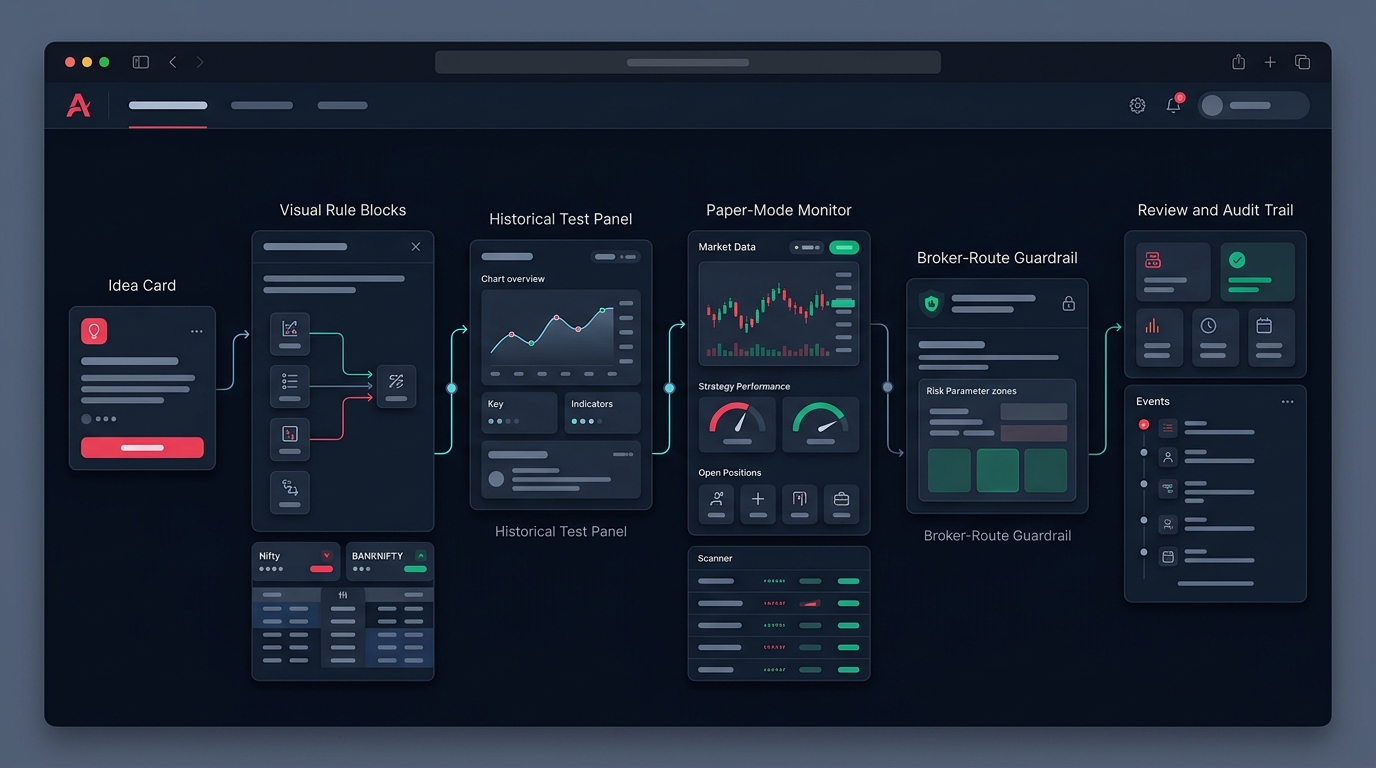
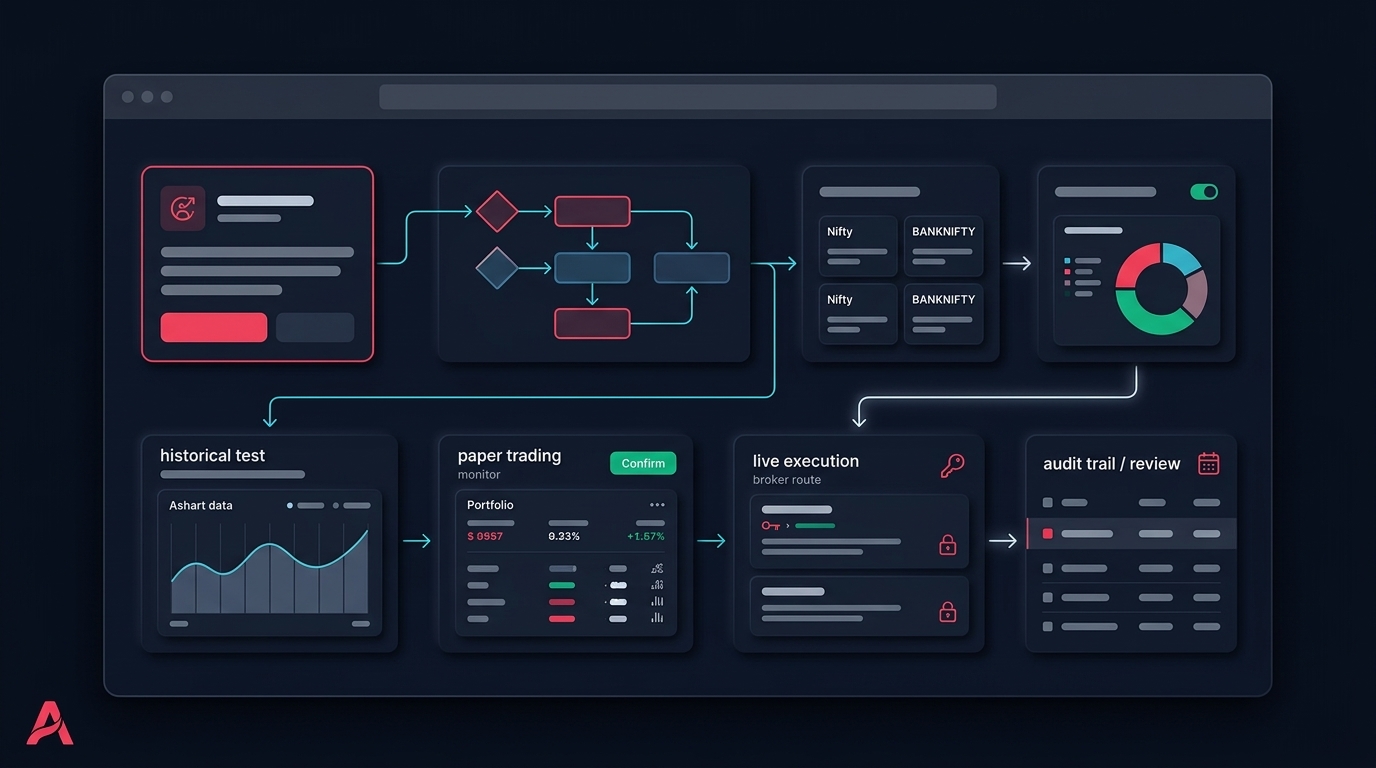
Paper-trade the event first. If you have never run your system through a live MPC announcement, run it in paper trading for a cycle before risking capital. You will learn more about your order-handling logic in that one window than in a month of normal sessions.
Using market context without chasing it
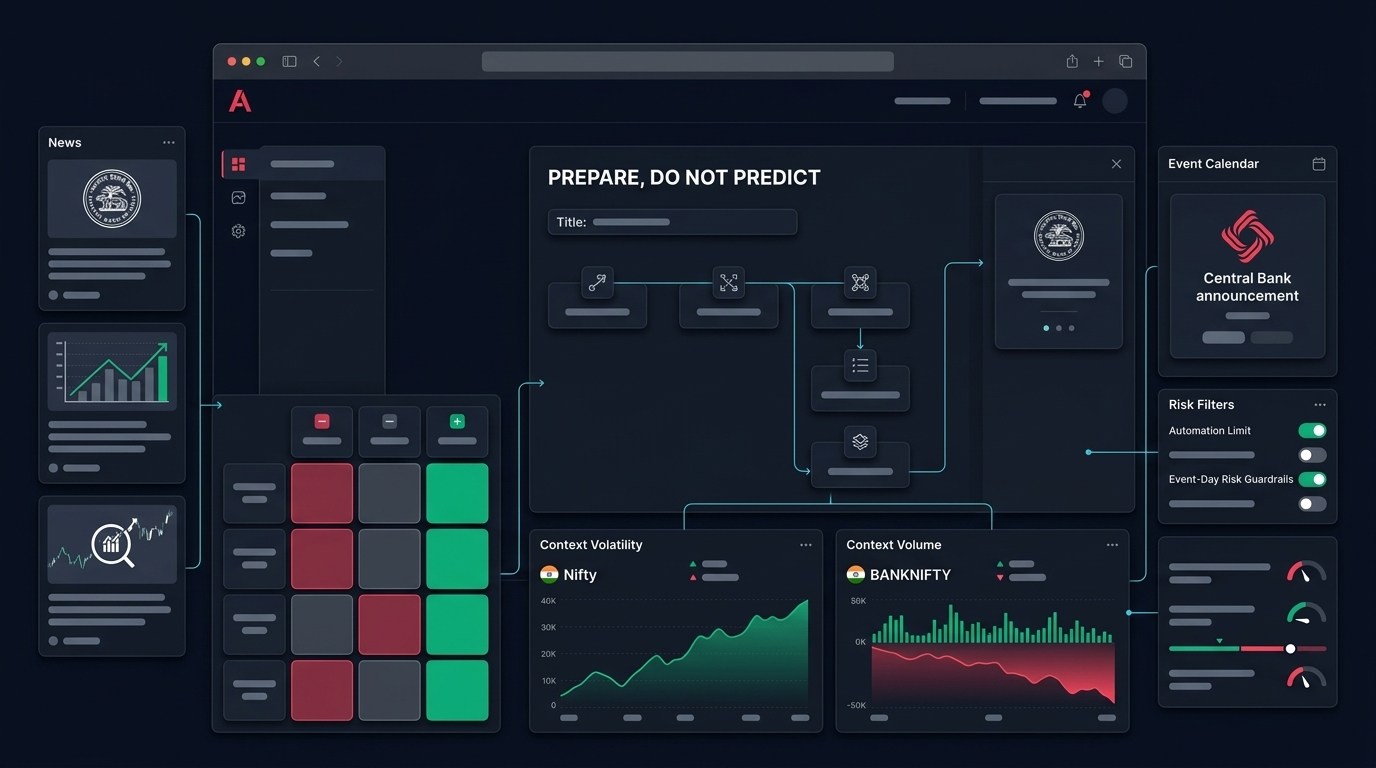
There is a difference between preparing for a policy week and predicting it.
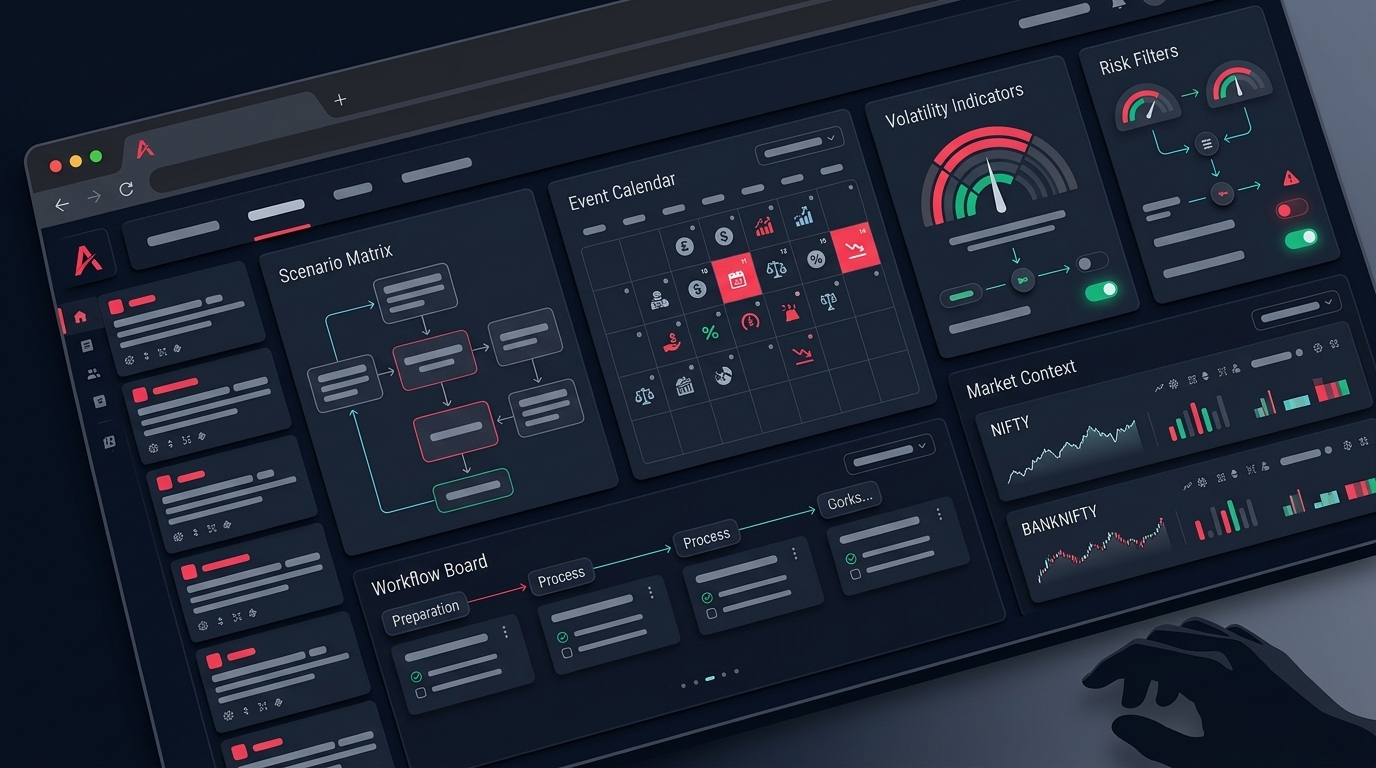
Preparation looks like: knowing the date, knowing your blackout window, having size rules set in advance, having your loss limit armed, and having logged what happened last cycle.
Chasing looks like: reading three views on whether there will be a cut, building a directional position around the more convincing one, and calling it a system.
Our weekly market outlook exists for the first use case. Context is an input to your risk settings, not a substitute for them.
Policy-week checklist
Run through this before the announcement, not during it:
- Pull current repo, corridor, CRR and SLR figures from RBI's own release — do not rely on a stale note
- Confirm the announcement date and time against the official calendar
- Check whether the week overlaps an expiry; if yes, treat gamma and event risk as stacked
- Define your blackout window in config, not in your head
- Set reduced size for the day and confirm the system applies it automatically
- Raise your slippage assumption and set up cost logging for the session
- Cap or flatten overnight exposure ahead of the event
- Verify your daily loss limit is armed and cannot be overridden mid-session
- Review open positions for sector concentration in rate-sensitive names
- After the event: log actual slippage, rejections, spread behaviour and fill quality
- Re-run your backtest with policy dates tagged and compare with and without them
- Note any change in broker margin terms or available depth over the following weeks
If you want to build these filters into a live workflow — scanner freshness, blocked-entry rules, margin-aware option baskets and enforced loss limits — you can request early access and set them up in paper mode first.
The traders who handle policy weeks well are rarely the ones with the best macro read. They are the ones whose system did less, sized smaller, logged more, and was still running normally the next morning.