It is 13 August 2026, a Thursday in the middle of a weekly options cycle, and somewhere right now an Indian retail trader has three tabs open: a live Nifty option chain page, a broker terminal, and an algo dashboard. The chain page is doing a lot of work — computing OI walls, put-call ratio, max pain, IV by strike — and updating every few seconds.
The question this post answers is not "what will Nifty do." It is: if you run or are building an options algo, what do those live chain numbers actually mean for your process — and where does trusting a website's snapshot quietly break your system?
No predictions here, and no trade calls. Just the translation layer between a chain page and a rule-based workflow.
What a live option chain page actually computes for you
Every serious chain view — NSE's own option chain, broker chains, aggregator dashboards like NiftyTrader — presents the same core table. Calls on the left, puts on the right, strikes down the middle. Four columns decide most of what traders do with it: open interest, change in OI, implied volatility, and last traded price.
Above the table, these pages compute summary context for you. The strike carrying the highest call OI is treated as the market's working resistance — the level option writers are selling most aggressively. The highest put OI marks working support. From the full table they derive the put-call ratio and max pain for the selected expiry.
As an illustration of what such a page looks like: a mid-2026 snapshot of one popular Nifty chain dashboard showed the heaviest call OI at 25,000, the heaviest put OI at 24,000, a PCR of 0.75, and max pain near 24,400. By the time you read this, every one of those numbers is different — and that is precisely the first lesson. Chain data is a perishable input, not a fact about the market. Any content, screenshot, or Telegram forward built on it expires within hours.
A discretionary trader glances at this summary and forms a view. An algo trader has to answer harder questions: which of these values do my rules actually read, from which data source, at what refresh cadence, and what happens when two sources disagree? The rest of this post works through those questions.
The August 2026 rhythm: Tuesday expiries and where today sits
Nifty currently trades its weekly and monthly expiries on Tuesday. That makes the weekly cycle run Wednesday to Tuesday, and it changes what a mid-week chain reading means.
A Thursday like 13 August sits early in the cycle — the current weekly series is only a couple of sessions old. That has direct process implications:
- OI walls in a young series are thin and mobile. A "support" strike printed at 10:30 can migrate by 14:00 as writers adjust. Early in the cycle, change in OI carries more information than total OI, because totals haven't had time to accumulate meaning.
- The monthly series carries more mature positioning. August's monthly contracts settle on the last Tuesday of the month, so mid-August the monthly chain reflects weeks of accumulated positioning while the weekly reflects days. When weekly and monthly walls sit at similar zones, positioning agrees across horizons; when they diverge, treat the weekly walls as the less stable of the two.
- Expiry-day effects belong to Tuesday, not today. Gamma acceleration, pinning behaviour, and aggressive unwinding are expiry-session phenomena. If your algo has expiry-day-specific rules — tighter stops, earlier square-off, reduced size — those rules should be gated to the actual expiry date, not running every day because someone hardcoded them during a different expiry regime.
None of this tells you where Nifty goes. It tells you how much weight the chain's structure deserves on a given day of the cycle — which is a risk-filter question, not a direction question.
Turning the four columns into algo-grade filters
OI and change in OI: fresh positioning beats stale totals
The chain pages themselves make this point: a strike adding OI intraday matters more than one carrying stale positions. For an algo, that translates into a two-condition definition of a "wall" — total OI meaningfully above neighbouring strikes, and today's change in OI confirming it is being actively defended.
Rule shapes that come out of this thinking:
- No fresh short-premium entries when spot is within half a strike-step of the top call-OI or put-OI strike, because a break through a defended wall forces repositioning and tends to produce fast moves.
- Tag the session "range-defended" only when both walls added OI today; otherwise treat the range as unconfirmed.
Notice what these are: filters that decide when a strategy is allowed to act. The wall does not predict that price will respect it. It marks where a break would surprise the largest number of positioned participants — a volatility scenario worth guarding against, not a level worth betting on.
IV by strike: pricing the cost of being right
The second check the chain pages recommend is IV at your strike versus neighbouring strikes. Buying an option at inflated IV means the trade must overcome both direction and volatility decay — you can be right on the move and still lose on the premium.
For an algo, two comparisons matter more than any absolute IV number:
- Strike versus neighbours. A visible IV bump at exactly the strike your strategy wants is a signal that you are paying up, often because everyone else wants the same strike.
- Current IV versus its own recent range. An IV of 14 means nothing in isolation; the same reading is expensive after a quiet fortnight and cheap after an event week. Your filter should compare against the recent distribution, not a hardcoded threshold.
This is also where structure selection belongs in the rules, not in the moment. If IV at the target strike is elevated relative to its recent range without a scheduled event to justify it, a rule set might route the idea into a defined-risk spread instead of a naked buy. That decision should be encoded in your strategy builder and validated through options backtesting before it ever touches live capital — improvising structure at 9:20 because the chain "looks expensive" is discretion wearing an algo costume.
LTP, intrinsic value, and the spread: execution reality
Chain pages suggest checking LTP against intrinsic value at ATM strikes — wide time premiums near expiry indicate the market expects movement. Useful context. But for execution, LTP is a lagging fact: it is the last trade that happened, not the market you will get filled at.
An algo should validate the live bid-ask at the strike before firing, because a strike can show a reasonable LTP from twenty minutes ago while the current spread has widened enough to destroy the trade's economics. This is doubly true away from ATM, where backtests that assume LTP fills quietly overstate results. If your backtest assumed tight fills at strikes that trade wide in practice, the edge you measured partly belongs to the assumption, not the strategy — the same class of problem as ignoring slippage and costs entirely.
PCR and max pain: regime tags, not entries
That mid-2026 snapshot's PCR of 0.75 reads as mildly call-heavy positioning. The temptation is to build entry logic directly on PCR thresholds — buy above X, sell below Y. This is a classic overfitting trap: PCR thresholds that "worked" in a backtest window usually stop working because the ratio's meaning shifts with the volatility regime.
A sturdier use: let PCR set a daily regime tag — put-heavy, balanced, call-heavy — and let each strategy check that tag as an allow/deny condition you have actually backtested. Max pain deserves even less weight mid-cycle; whatever gravitational story it tells is an expiry-week phenomenon at best. If none of your rules consume a number, stop staring at it.
The data problems the chain page doesn't mention
This is the part that separates algo traders from chain-watchers, and it is mostly unglamorous plumbing.
Snapshot versus stream. A website refreshes on its own cadence; your algo consumes a broker or API feed with its own cadence. The two will disagree mid-session, sometimes materially. If your rules read feed values, then post-trade review must compare decisions against the feed values your system logged — not against a website screenshot taken twenty minutes later. Reviewing feed-driven decisions against someone else's snapshot is how traders convince themselves a working filter is broken, or worse, that a broken one is fine.
OI lags price. Open interest is reported with a delay, not tick by tick. Any OI-based logic is slower-moving context — regime tags, no-trade bands, session filters. Entry triggers that implicitly assume real-time OI are trading a number that hasn't updated yet.
Provenance logging. Every chain-derived decision should log exactly what the rule saw: strike, OI, change in OI, IV, timestamp, and source. If you cannot reconstruct what your filter read at decision time, you cannot debug it, and every post-mortem degenerates into guesswork.
Cross-source sanity check. Once a day, pull the same strike from two sources. If IV or OI diverge materially, investigate before trusting either — a stale feed discovered at 9:25 is an inconvenience; discovered at 14:45 with positions on, it is a risk management incident.
Where the chain sits in an algo workflow
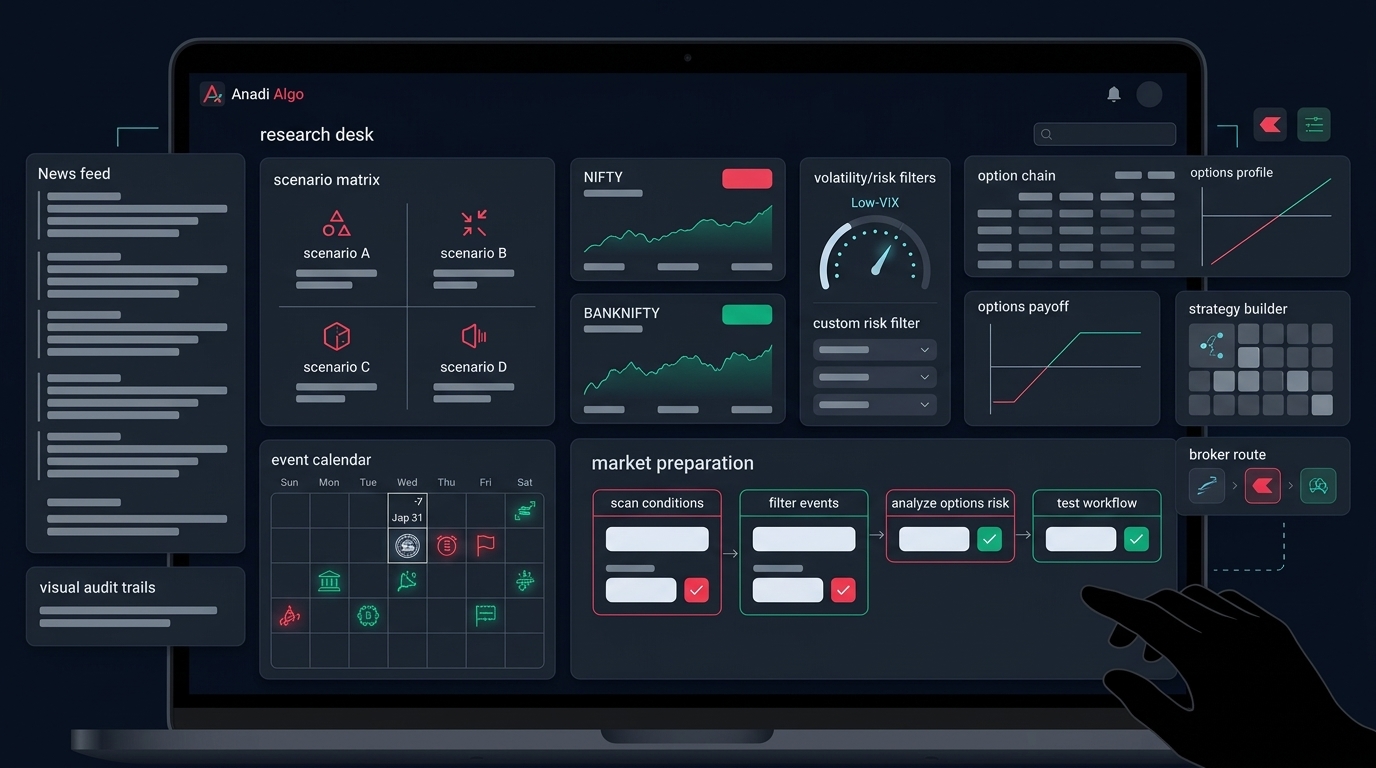
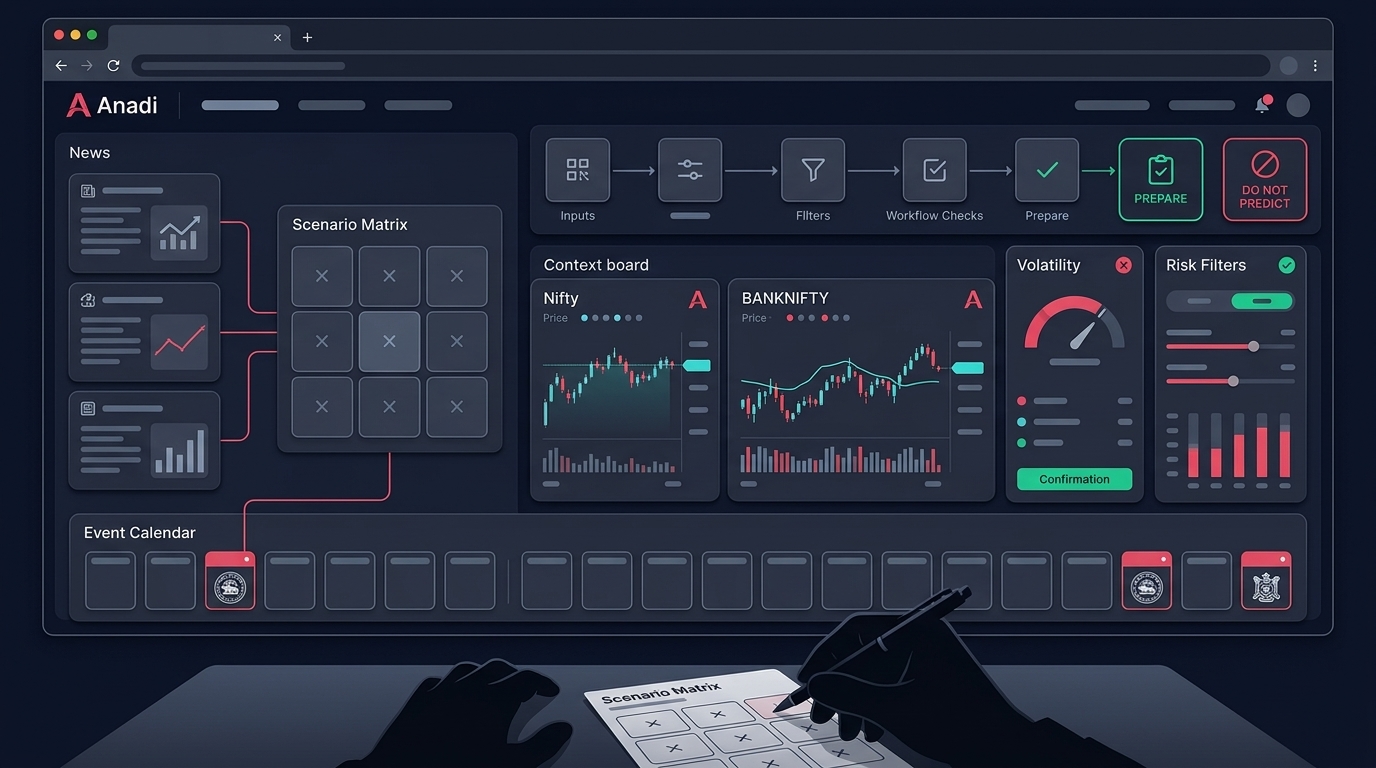
The chain is not step one. A cleaner sequence: a scanner or watchlist produces candidates; index and breadth context says whether the broader tape supports acting at all; the chain then validates the specific expression — strike liquidity, IV context, wall proximity; then structure selection, margin preview, and risk budget run before any order exists.
This is the workflow shape Anadi's options workspace is built around: the option chain, OI analysis, and IV & theta sit as tabs beside strategy selection and position management, so validation happens before the order rather than as a regret afterwards. The same philosophy shows up in Action Center, where signals arrive with blocked reasons — chase distance, invalidated levels — because a filter that stops a bad entry is worth more than one that finds another mediocre one.
The weekly market outlook plays the same role at a longer horizon: context to prepare your filters with, not a source of calls to chase.
Pre-open checklist for chain-driven algos
- Confirm the expiry your rules point at. After a Tuesday settlement, verify every strategy rolled to the intended series — weekly versus monthly mix included.
- Log the opening chain snapshot — top call-OI strike, top put-OI strike, PCR, ATM IV — with timestamp and source.
- Compare ATM IV to its recent range, not to a memorised threshold.
- Check live bid-ask spreads at the strikes your strategies can actually select, not just ATM.
- Recompute no-trade bands around OI walls from today's data. Yesterday's walls are history.
- Tag the regime (put-heavy / balanced / call-heavy) and confirm each live strategy is permitted under today's tag.
- Arm the daily loss limit and basket stops before the first order, not after the first surprise.
- Disable expiry-day-only rules on non-expiry days. Mid-cycle Thursdays don't need Tuesday's reflexes.
- Run the two-source data check. Material divergence gets resolved before size goes on.
- Review at end of day against your own logged values — the values your rules read, not the values a website displayed.
The takeaway: a live option chain page is genuinely useful — it compresses positioning, volatility, and pricing into one screen. But it is context, and context only becomes edge when it is converted into rules, and rules only earn trust after they survive a backtest and honest logging. Chain dekh ke trade nahi hota; process ke saath hota hai.
If you would rather run chain inspection, IV context, structure selection, margin preview, and risk budgeting inside one workflow instead of six browser tabs, you can request early access to Anadi Algo and test the whole loop on paper before any real order goes out.