Search "Nifty Bank Nifty options expiry volatility India market today" and you land on a live number, a dense grid of strikes, and a lot of red-and-green arrows. On a jumpy session that grid feels like it should tell you what to do next. It doesn't.
The Bank Nifty option chain is a context screen, not a signal generator. For an algo trader the real job is narrow: convert what the chain shows into risk filters and workflow checks before any order leaves your system. This post walks through how to read the chain as market context on a volatility-sensitive, expiry-aware day in July 2026 — with no predictions and no trade calls, just process.
What the chain actually shows (and what it doesn't)
A live Bank Nifty option chain gives you four things worth trusting and several things worth doubting.
The trustworthy inputs are the raw, exchange-sourced numbers: the underlying price, the day range and 52-week range, strike-wise open interest (OI), change-in-OI, implied volatility (IV), and volume. As of early July 2026, Bank Nifty was trading in the high-57,000s, near the middle of a wide 52-week band. That last detail — where price sits inside its own range — matters more than most traders admit, because a straddle sold near a range extreme behaves very differently from one sold mid-range.
The doubtful part is interpretation. PCR, max pain, "support and resistance from OI," and dealer-positioning heatmaps (gamma, vanna, charm) are all derived views. They summarise positioning; they do not predict the next move. A max pain of roughly 58,100 does not mean price is drawn there like a magnet. It means, mechanically, that's the strike where option buyers collectively lose the most at expiry — useful as a positioning snapshot, useless as a target.
So the rule for an algo trader is simple. Treat the chain's raw numbers as inputs to a rule, and treat its narrative labels as context you must confirm elsewhere.
The July 2026 context that changes how you read it
Two structural facts shape how the Bank Nifty chain should be read right now.
Bank Nifty is a monthly-expiry instrument
Per NSE's contract specification, Bank Nifty runs on a monthly cycle and settles on the last Tuesday of the expiry month (or the previous trading day if that Tuesday is a holiday). Most of the short-dated, day-to-day expiry churn in index options now sits with Nifty, while Bank Nifty's expiry pressure concentrates into that single monthly event.
Practically, that means the "expiry volatility" you feel in Bank Nifty is not evenly spread. Early in the month, the near-month chain behaves like a positional book — wider IV, slower theta bleed, deeper liquidity across strikes. As the last Tuesday approaches, gamma tightens, the at-the-money strikes get thin and fast, and intraday moves get sharper for the same rupee change in the index. Your risk filters should know which half of the cycle you're in.
Volatility regime, not a volatility number
A single IV reading tells you little. What matters is IV relative to its own recent range — an IV percentile or rank. A 14% IV means one thing after a quiet fortnight and something entirely different the day before a policy event. The chain shows you the level; your workflow has to supply the context of whether that level is high or low for this instrument, this week.
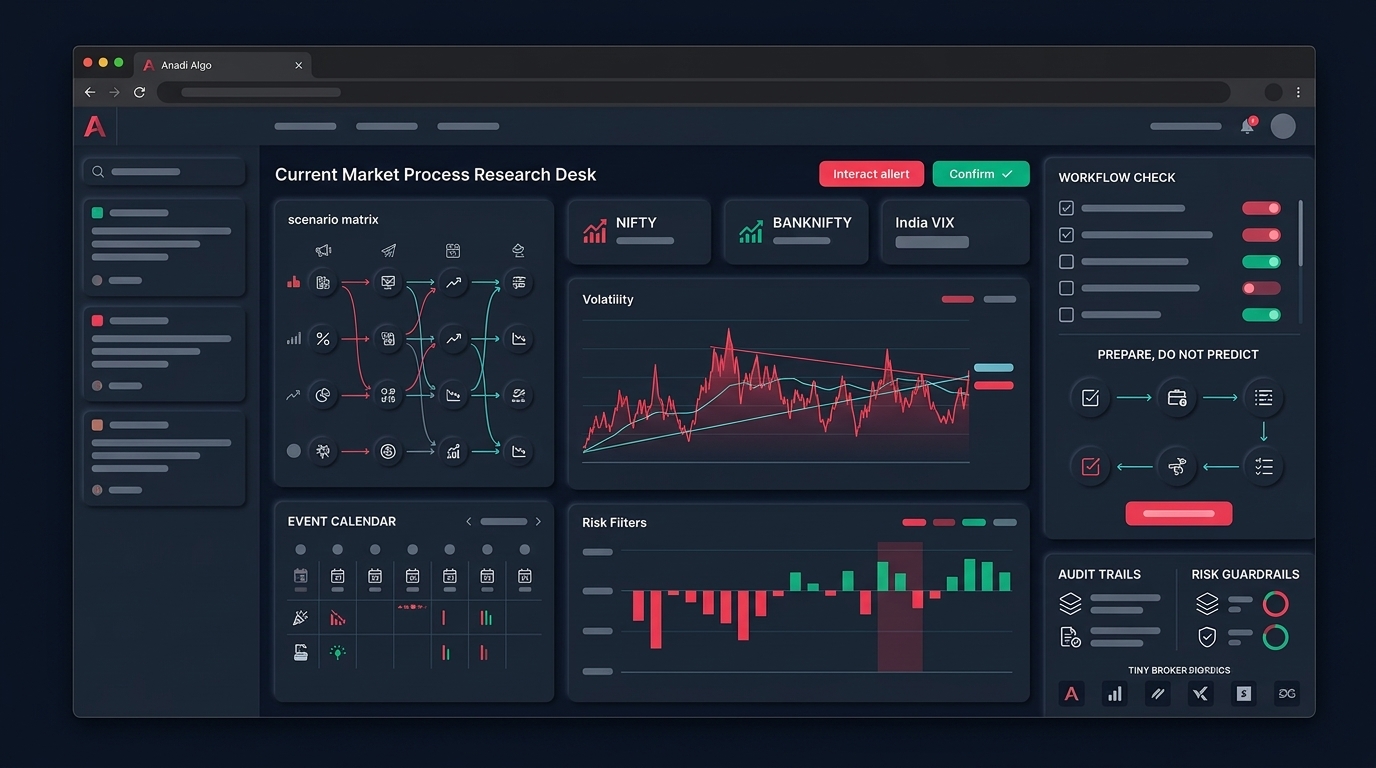
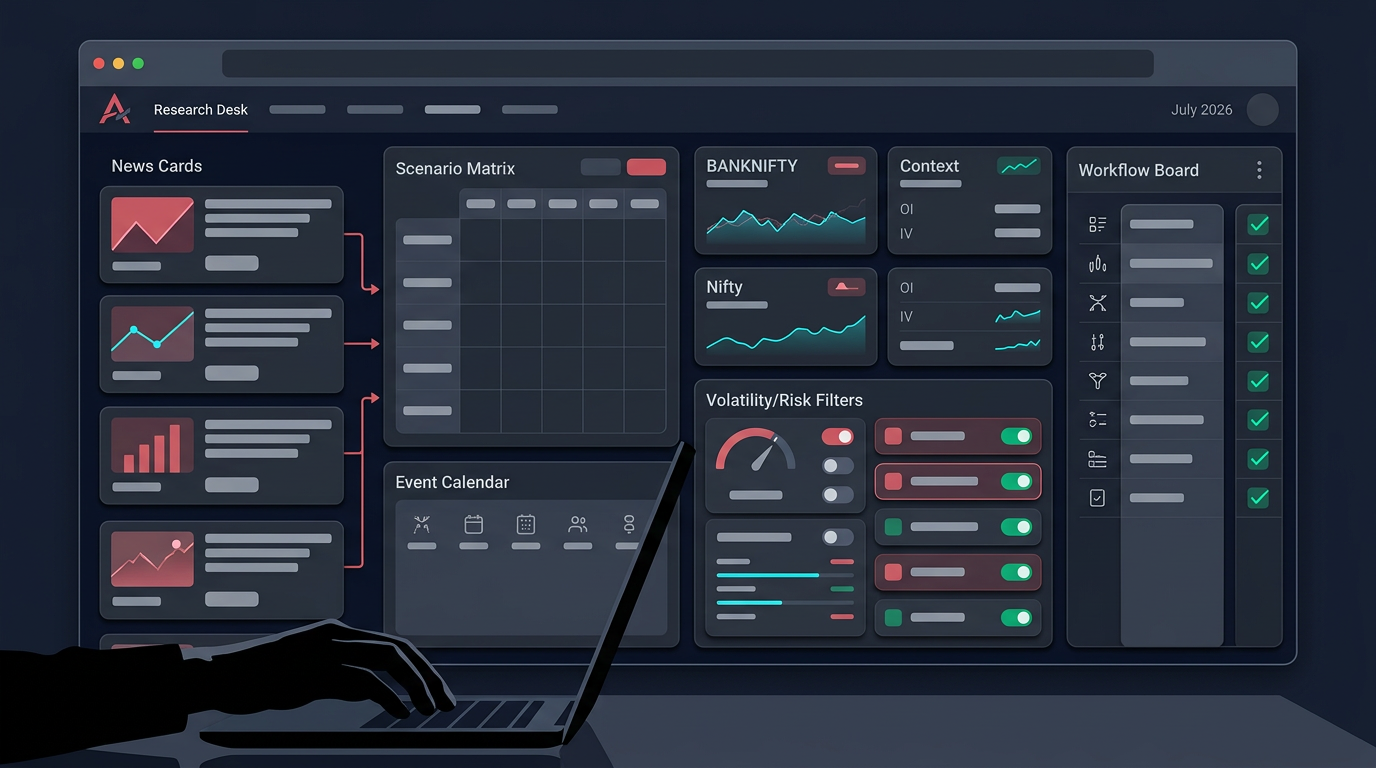
This is exactly the kind of preparation a weekly market outlook routine is for: use it to map the known events on the calendar and the current volatility backdrop, then set your filters — not to manufacture a directional call.
Turning chain data into risk filters, not trade calls
Here is where the chain earns its place in an algo workflow. Each reading below is a filter — a yes/no gate on whether a setup is even allowed to trade — rather than a reason to trade.
OI and change-in-OI as a liquidity and crowding check
Absolute OI at a strike tells you where positions are parked. Change-in-OI tells you what's happening today. The algo-relevant use is defensive:
- Liquidity gate. If the strikes your strategy needs are thin, your fills and stop exits will slip. A rule like "only trade strikes with OI above a set floor and a tight enough bid-ask" keeps you out of the illiquid wings where backtests lie.
- Crowding awareness. A strike with rapidly building OI is a crowded position. That's not a signal to join or fade — it's a note that if that level breaks, unwinding can be violent. Size accordingly.
Change-in-OI plus price direction is the classic long-buildup / short-buildup / unwinding read. Useful as context. But if you want it in a system, it has to become a coded rule and then survive options backtesting across many expiries — not just the one screenshot that confirmed your bias.
IV and theta as a structure filter
Direction is only half of an options trade; the volatility and time-decay half decides whether being right even pays. This is why IV and theta belong beside the chain in your decision, not as an afterthought.
The filter logic:
- High IV percentile favours defined-risk premium structures over naked long options, because you're buying expensive time.
- Low IV percentile makes long options cheaper but punishes you if the expected move doesn't arrive fast — theta grinds you down while you wait.
- Near monthly expiry, theta acceleration on at-the-money Bank Nifty strikes is steep. A "correct" direction that arrives a day late can still be a losing trade.
Anadi's options workspace keeps chain, OI, and an IV & theta view in the same desk so this check happens before the order, not after the loss. The point of putting them together is to stop you from picking a strike on price alone.
PCR and max pain as context, with caveats
PCR (put-call ratio) and max pain are the most over-read numbers on any chain. Use them narrowly:
- PCR is a positioning gauge. A Bank Nifty PCR around 0.85 says the book is modestly call-heavy relative to puts — one input among many, not a mood ring for the market. Extremes are more informative than the middle; a PCR near 1.00 tells you almost nothing on its own.
- Max pain is a mechanical expiry level, most relevant in the final sessions of the monthly cycle and largely noise weeks out.
Neither belongs in a trade rule as a standalone trigger. Both belong in your context layer, where they can veto or de-size a trade but never originate one.
Event avoidance and expiry-day workflow checks
Most avoidable option-trading damage comes from being in a position through the wrong moment. The chain helps you see those moments coming.
- Quantity freeze. NSE publishes a per-order quantity freeze for Bank Nifty. If your algo tries to push more lots than the freeze allows in a single order, it gets rejected or split. Bake the current freeze and the lot size (30 for Bank Nifty) into your position-sizing logic so live orders don't fail at the worst time.
- Event blackout. Around scheduled events — policy days, major data, index rebalancing — pre-event IV is inflated and post-event crush is brutal. A calendar-aware blackout rule that blocks fresh entries in a set window is cheaper than learning this live.
- Expiry-day gamma. In the last day or two of the monthly cycle, at-the-money gamma makes stops and slippage behave badly. Many disciplined systems either widen risk parameters or simply stand aside for expiry sessions. Decide that in advance, as a rule, not in the heat of the tape.
- Chase distance. If price has already run past your intended entry, the setup is stale. A "chase distance" guard that blocks entries beyond a set distance from the signal level stops your algo from buying the move everyone else already caught.
These are the same guardrails a disciplined risk management layer enforces on every order — daily loss caps, per-trade risk budgets, and hard blocks on trades that violate the plan.
Building this into an algo workflow
The reason retail traders drown in the option chain is that they read it manually, decide emotionally, and execute inconsistently. An algo workflow fixes the last two by fixing the first.
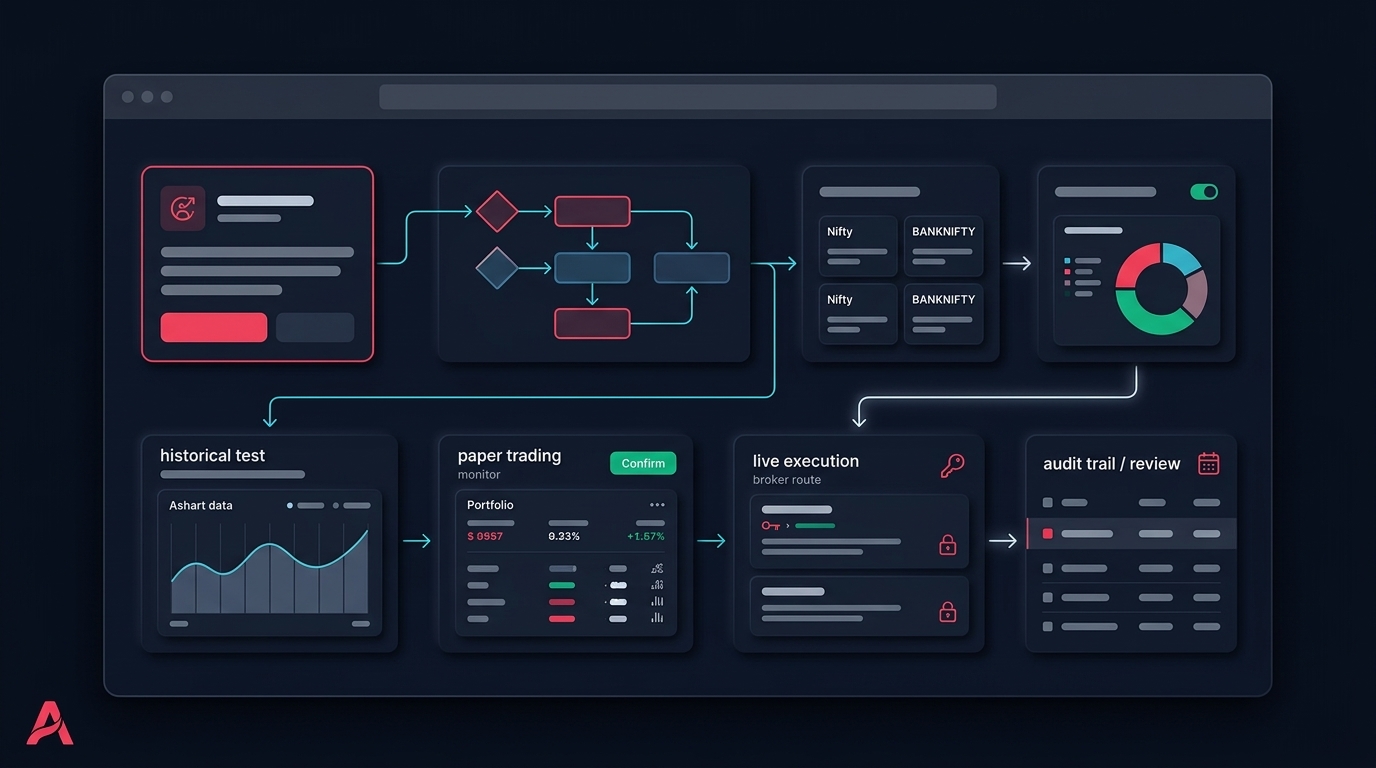
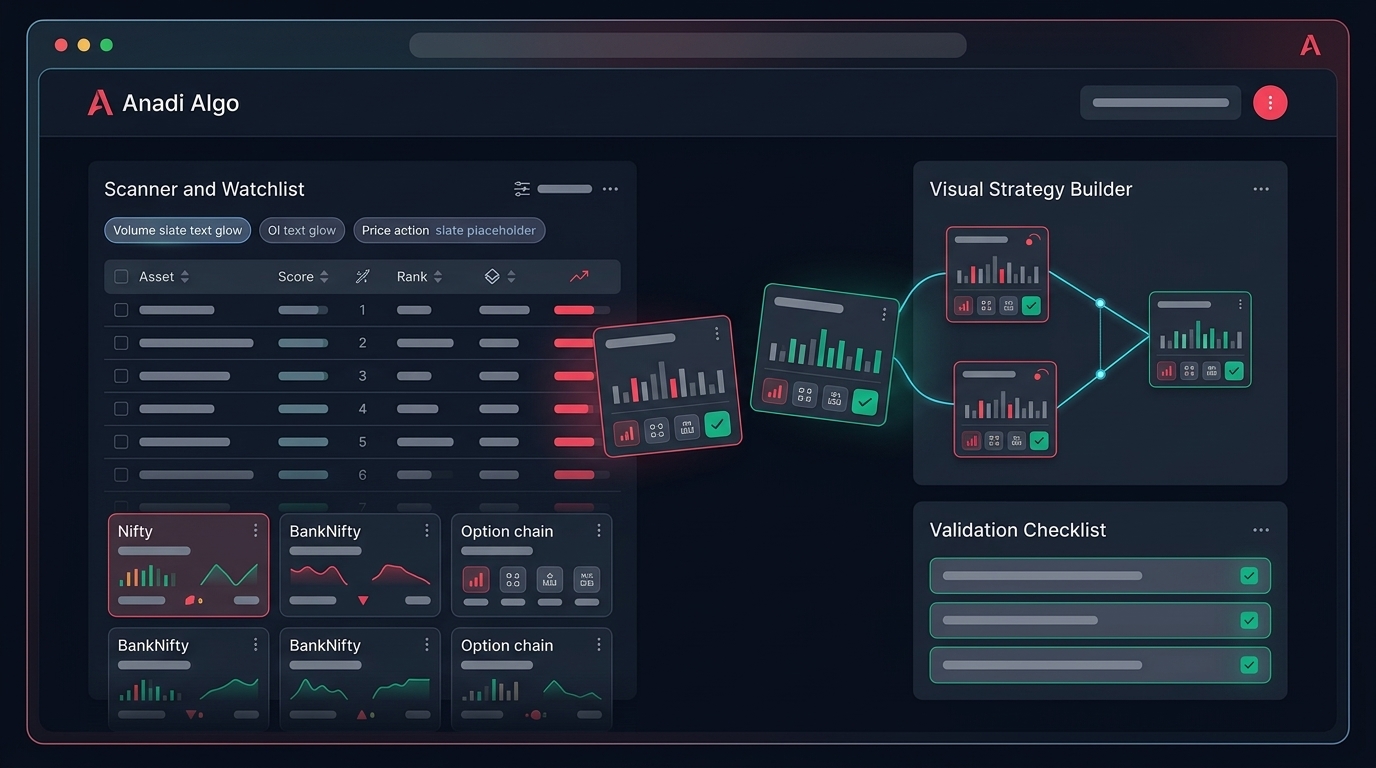
A clean flow looks like this. Broader tape first — index and sector context to confirm the environment isn't fighting your setup. Then a scanner surfaces candidates by rule, not by scrolling. Signals pass through a filter layer (freshness, blocked reasons, F&O eligibility, chase distance) so only clean setups survive. Only then does the chain come in — to validate liquidity, IV context, and structure at specific strikes — before a basket preview and a margin estimate confirm the trade fits your risk budget.
Encoding the whole thing as explicit rules is the point. If your Bank Nifty logic can't be written down as clear conditions, it can't be tested, and if it can't be tested it can't be trusted. A BANKNIFTY strategy builder plus honest backtesting across multiple monthly expiries — including the ugly, gappy ones — is what separates a repeatable process from a good screenshot.
A practical pre-trade checklist
Before any Bank Nifty options order goes live, run the chain through these gates:
- Where in the range? Note the underlying against its day and 52-week range. Mid-range and extreme are different risk regimes.
- Where in the cycle? Positional early-month behaviour or tight late-month gamma near the last Tuesday.
- IV percentile, not level. Is current IV high or low for this instrument? Let that choose the structure.
- Liquidity floor. Are your strikes above your OI and spread thresholds? If not, skip.
- Theta reality. Does the trade survive time decay if direction arrives a day late?
- Context, not trigger. PCR and max pain may veto or de-size; they never originate a trade.
- Event and freeze check. No fresh entries in an event blackout; order size within the quantity freeze and lot size.
- Chase distance. If price already ran, the setup is stale — stand aside.
Read this way, the Bank Nifty option chain stops being a wall of arrows demanding a decision and becomes what it should be: a context screen that either clears your rule to trade or tells you to wait. The edge was never in the chain. It's in the filters you apply to it and the discipline to follow them.
If you want to turn these checks into rules you can test and run instead of eyeballing the grid every session, start with early access and build the workflow around your own risk limits.
The takeaway is small and durable: use the chain to prepare and to filter, never to predict. Let the raw numbers gate your trades, keep the narrative numbers in the context layer, and let a tested, rule-based system do the deciding — especially on the volatile, expiry-heavy days when your judgment is least reliable.