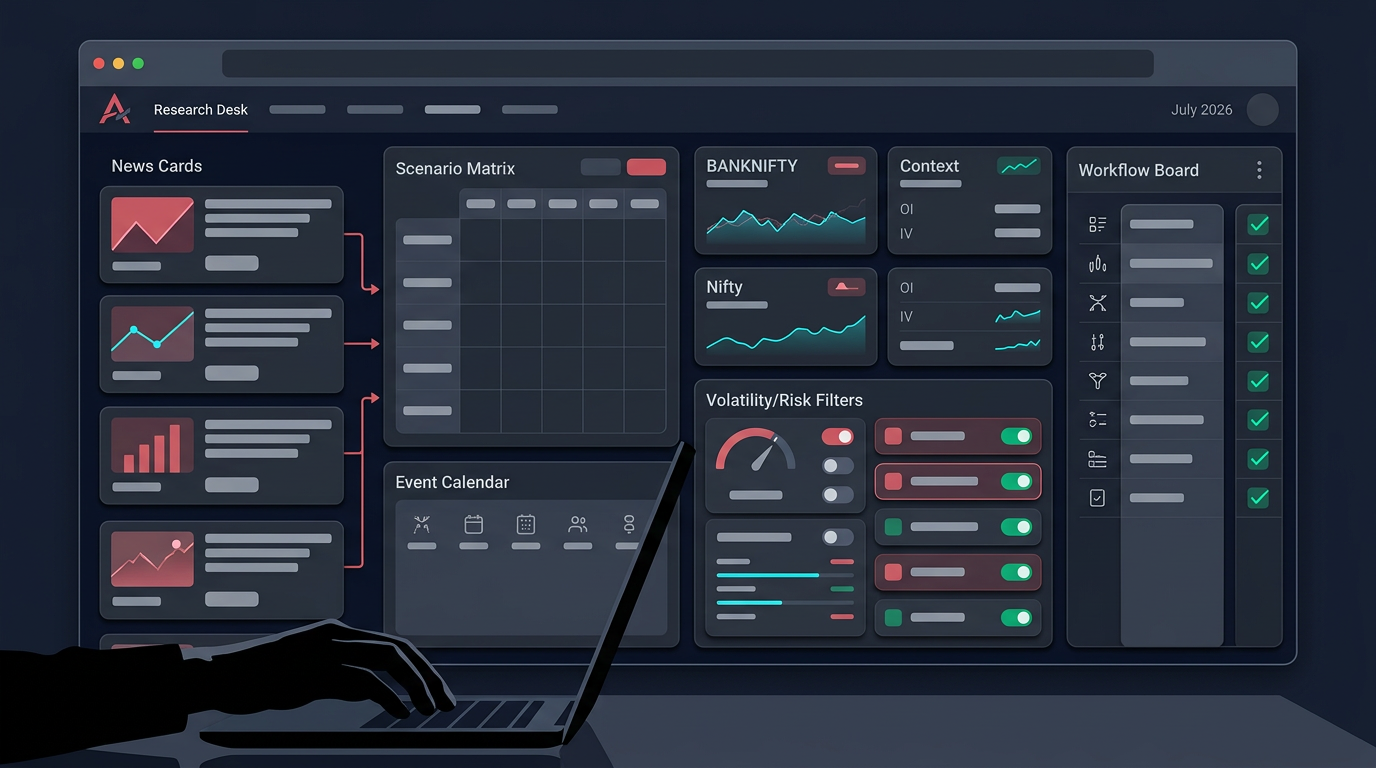
Today is Monday, 10 August 2026. Tomorrow is a weekly index expiry. For a lot of Indian retail traders, that sentence still feels wrong — because for roughly 25 years, Monday was the calm planning day and Thursday was the noisy one.
That changed. As of 1 September 2025, Nifty 50 weekly options expire on Tuesday, following an NSE schedule change directed by SEBI to spread weekly expiry volume across the trading week. Monthly Nifty options settle on the last Tuesday of the month — which, for August 2026, lands on 25 August unless the exchange calendar says otherwise.
So Monday is no longer a warm-up. It is a pre-expiry session with one sleep between you and settlement.
This post is not a market call. It is about what the NSE option chain page actually tells you on a day like today, where its numbers quietly differ from your broker feed, and how to convert that context into filters your algo can enforce — instead of gut feel you apply inconsistently.
What the NSE option chain page actually is
The NSE option chain at nseindia.com is an official, well-structured snapshot. It is not a trading feed, and treating it like one is where most retail data problems begin.
A few of its stated conventions matter more than traders expect:
- Implied volatility is computed using a 10% interest rate. That is NSE's convention, not a universal truth. Your broker, your backtester, and your Greeks library may use a different rate. Same strike, same second, different IV number — and neither is "wrong."
- Volume and open interest are displayed in contracts. If your strategy logic thinks in shares or in lots-times-lot-size, you will silently misread size by a factor equal to the lot size.
- In-the-money options are highlighted. Useful visually, meaningless to code. Your system should derive moneyness from spot and strike itself.
- There is a "Today" and a "Previous Trade Day" view, and an indicative close. An indicative close is not a settlement price. Building rules on it without knowing that distinction is how backtests end up unreproducible.
None of this makes the NSE chain bad. It makes it a reference, and references need reconciliation.
Snapshot versus feed
The practical rule: use the exchange chain to validate, use your broker feed to trade, and never let the two blur.
If your scanner or option workflow reads one source and your execution layer reads another, you need a documented tolerance. Something like: strike-level OI difference above a threshold, or a mid-price gap beyond a set number of ticks, triggers a pause instead of an order. Write the number down. "Roughly matching" is not a rule.
We have covered the granular version of this in our post on option chain scanner validation territory, so here let's stay on the market-context layer.
The Tuesday cycle reshaped the week, not just the date
The shift to Tuesday expiry did something more interesting than move a label on a calendar. It moved where time decay bites.
Under the old Thursday cycle, Monday sat three days from expiry. Traders used it for positioning. Now Monday sits one day out. Weekend news that used to have room to breathe into premiums is immediately fighting accelerated decay.
The mirror image: Friday now carries the weekend into its pricing. A seller holding through Friday to Monday is being paid for three calendar days of decay in one hop, and a buyer is paying for it.
Note carefully what that is and is not. It is a structural change in when theta accrues across the week. It is not a claim that any day is profitable, or that sellers now have an edge. Decay is not free money — it is compensation for gap and gamma risk, and that risk also got compressed into fewer sessions.
What this means for your process, today
If your strategy was designed, tuned, or backtested on the pre-September-2025 Thursday rhythm, its day-of-week assumptions are stale. Not necessarily broken — stale. Three things worth re-checking:
- Day-of-week entry filters. A rule like "no new positions on expiry day" now excludes Tuesday, not Thursday. Sounds obvious. It is also the most common un-updated line in retail strategy configs.
- Holding-period logic. "Enter Monday, exit Wednesday" used to be a mid-week trade. Now it straddles an expiry.
- Rollover timing. If you carry structures across expiries, the roll window moved with the cycle.
An honest note on Bank Nifty
Do not assume Bank Nifty's expiry behaviour from Nifty's. Index derivative contract schedules have been revised more than once in recent years, and the reliable source is the exchange contract master and holiday calendar — not a blog, including this one. Pull it programmatically at the start of each week and fail loudly if it does not match what your strategy config expects.
If you are building index-specific logic, our BANKNIFTY strategy builder notes are a better starting point than generalising from Nifty rules.
Volatility context without turning it into a prediction
India VIX is the obvious place traders look for "is today going to be violent." It is a reasonable context input and a terrible standalone signal.
Two habits separate people who use it well from people who cargo-cult it:
Read the level and the change together. A 12 reading that jumped from 10 is a different tape from a 12 reading that fell from 16. The direction tells you what positioning has been doing; the level tells you what premium currently costs.
Do not quote a number you have not just checked. Volatility data goes stale in minutes. Any workflow where a human reads VIX in the morning and a machine acts on that memory at 2 pm is a workflow with a hole in it. If VIX is an input, it should be a live input to the system, with a timestamp.
Where VIX genuinely earns its place is in regime gating — not entries. Examples of gate-shaped uses:
- Reduce position size when VIX sits above your configured band, because your stop distance in premium terms widens with it.
- Require wider strike distance for short structures in higher-VIX regimes, and accept that the credit changes.
- Refuse to open new expiry-day structures when the intraday VIX move exceeds a threshold you set in advance.
Each of those is a rule with a number. That is the standard to hold yourself to. A risk management layer that enforces these automatically is worth far more than a discretionary "aaj thoda careful rehna hai" reminder to yourself.
Turning chain context into filters your system can enforce
Here is the part most retail workflows skip: converting market observation into a machine-checkable condition.
Liquidity filters
Before any strike enters a basket, check:
- Bid-ask spread as a percentage of the mid, with a hard reject above your threshold.
- Contracts-based OI and volume minimums per leg (remembering the contracts unit).
- Whether the strike traded at all in the last N minutes, not just whether it shows a last price.
Illiquid far strikes look attractive in a payoff diagram and awful in a fill report. On a pre-expiry Monday, the liquid band around the money is usually tight and the wings thin out fast.
Event and calendar blackouts
Maintain a blackout table your algo reads, not a mental list. It should include weekly and monthly expiries, RBI policy dates, major macro prints, index rebalance dates, and market holidays. For August 2026, note that Independence Day falls on a Saturday, so there is no mid-week holiday truncating the expiry week — but confirm against the exchange calendar rather than trusting that sentence.
The filter is simple: if today matches a blackout row, either block new entries or reduce size by a configured factor. No negotiation with yourself at 9:20 am.
Exposure filters
Basket-level caps beat per-trade caps on expiry weeks:
- Maximum total premium at risk across all open option positions.
- Maximum combined delta and, on expiry day, a gamma exposure ceiling.
- A daily loss limit that flattens and locks out, not one that merely warns.
Margin should be visible before execution, with existing positions accounted for — not discovered at rejection time.
What this does to your backtests
Two failure modes show up constantly in expiry-week research.
The calendar mismatch. If your historical data spans the Thursday era and the Tuesday era, and your code hardcodes an expiry weekday, every result crossing September 2025 is contaminated. Derive expiry from an exchange-sourced calendar, always.
The optimistic fill. Expiry-day premium moves are fast and spreads widen exactly when your stop triggers. A backtest that fills at mid-price will overstate performance in precisely the sessions that matter most. Model slippage as a function of spread and time-of-day, and re-run your worst weeks.
If your equity curve gets meaningfully worse under realistic fills, you have learned something useful, not something disappointing. Serious options backtesting is mostly the discipline of removing free lunches from your own assumptions.
A Monday-before-expiry workflow
Concretely, on a day like today:
- Context first. Index and sector breadth before any single setup. Anadi's Indices view exists for this — a strong-looking stock or strike in a weak tape is a smaller position, not a bigger conviction.
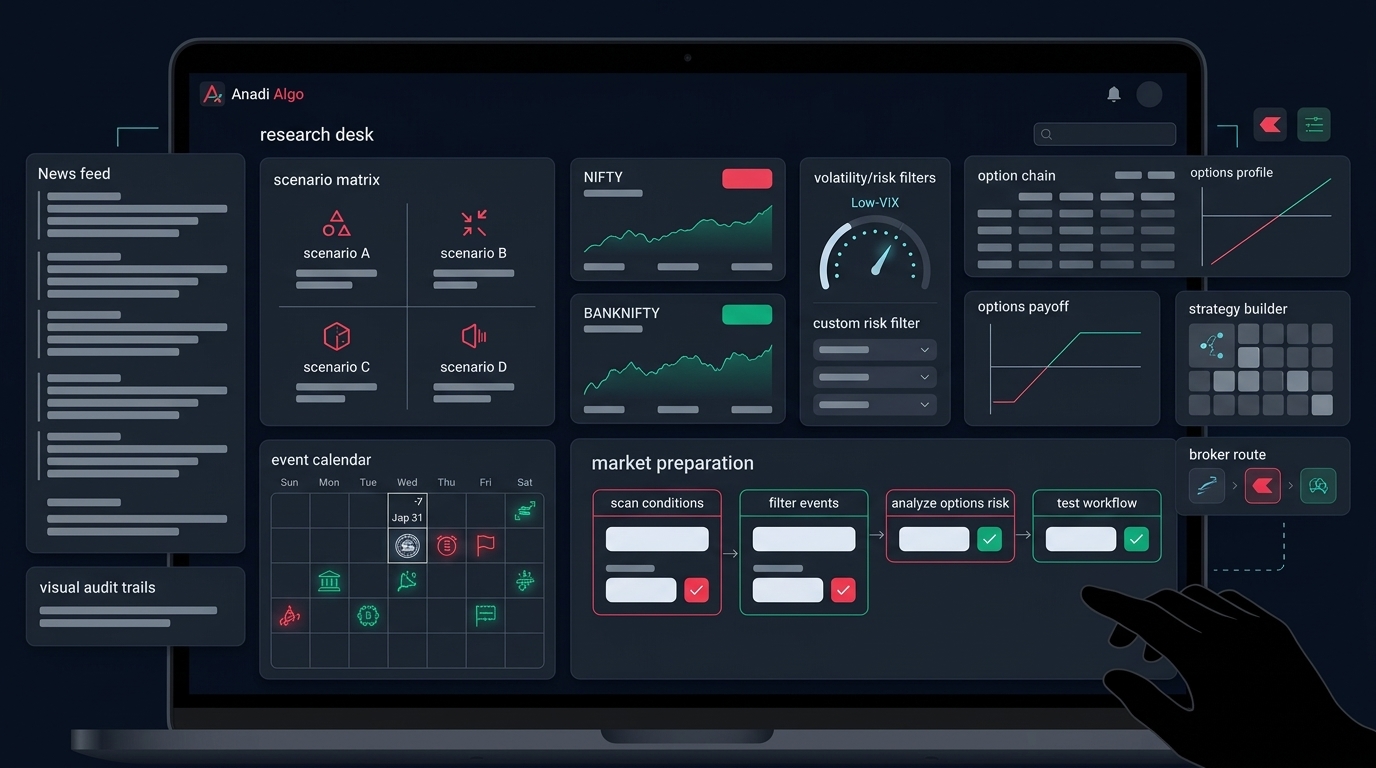
- Chain inspection second. Open the option chain, check the liquid band, and compare exchange-side OI against your feed. Anadi keeps chain rows, leg actions, basket preview, and margin estimate in one workspace so the risk number appears before the order does.
- Structure third. Decide view, risk appetite, and capital before browsing strategies. The Strategy Finder ranks candidates on match, capital, max loss, and theta — the point is that max loss and budget fit are the deciding fields, not the strategy's name.
- Filter fourth. Let Action Center's blocked reasons — chase distance, invalidated price, stale signal — do their job. A blocked entry on a pre-expiry Monday is usually the system protecting you from a late chase.
- Log it. Whatever you did or skipped, record why. Next month's version of you is the only person who can grade this decision fairly.
If you want to build these filters as enforced rules rather than reminders, you can try the workflow during early access.
Checklist
Print this, or better, encode it:
- Expiry dates pulled from the exchange calendar this week, not from config memory
- Day-of-week rules updated for the Tuesday cycle
- IV source and interest-rate convention documented for every Greek you use
- OI and volume units confirmed as contracts, converted consistently
- Exchange chain versus broker feed tolerance defined, with a pause action on breach
- India VIX consumed live with a timestamp, used as a regime gate not an entry trigger
- Per-leg liquidity thresholds set and enforced pre-order
- Blackout table current for August 2026
- Basket-level premium, delta, and gamma caps active
- Daily loss limit that flattens and locks, tested
- Margin estimate reviewed before execution, positions included
- Backtests re-run with spread-aware slippage on expiry sessions
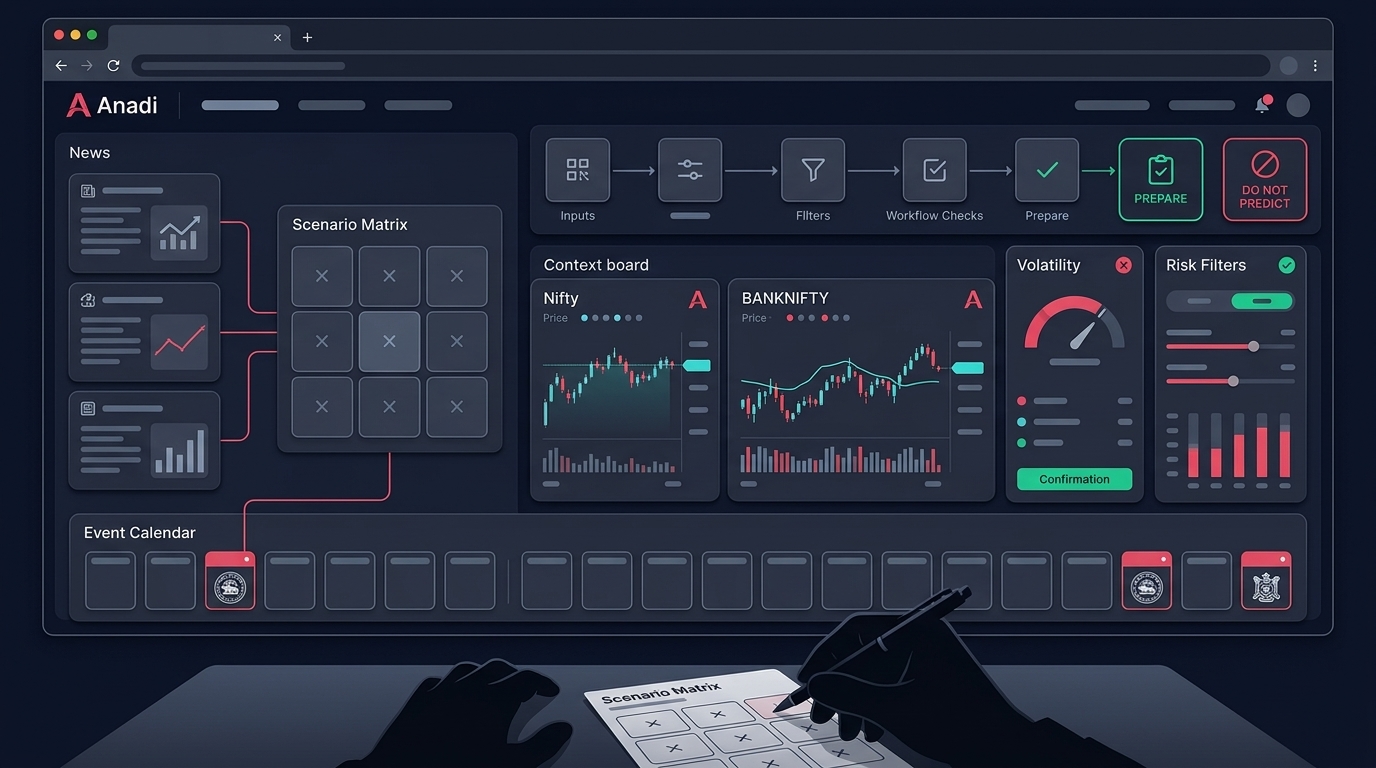
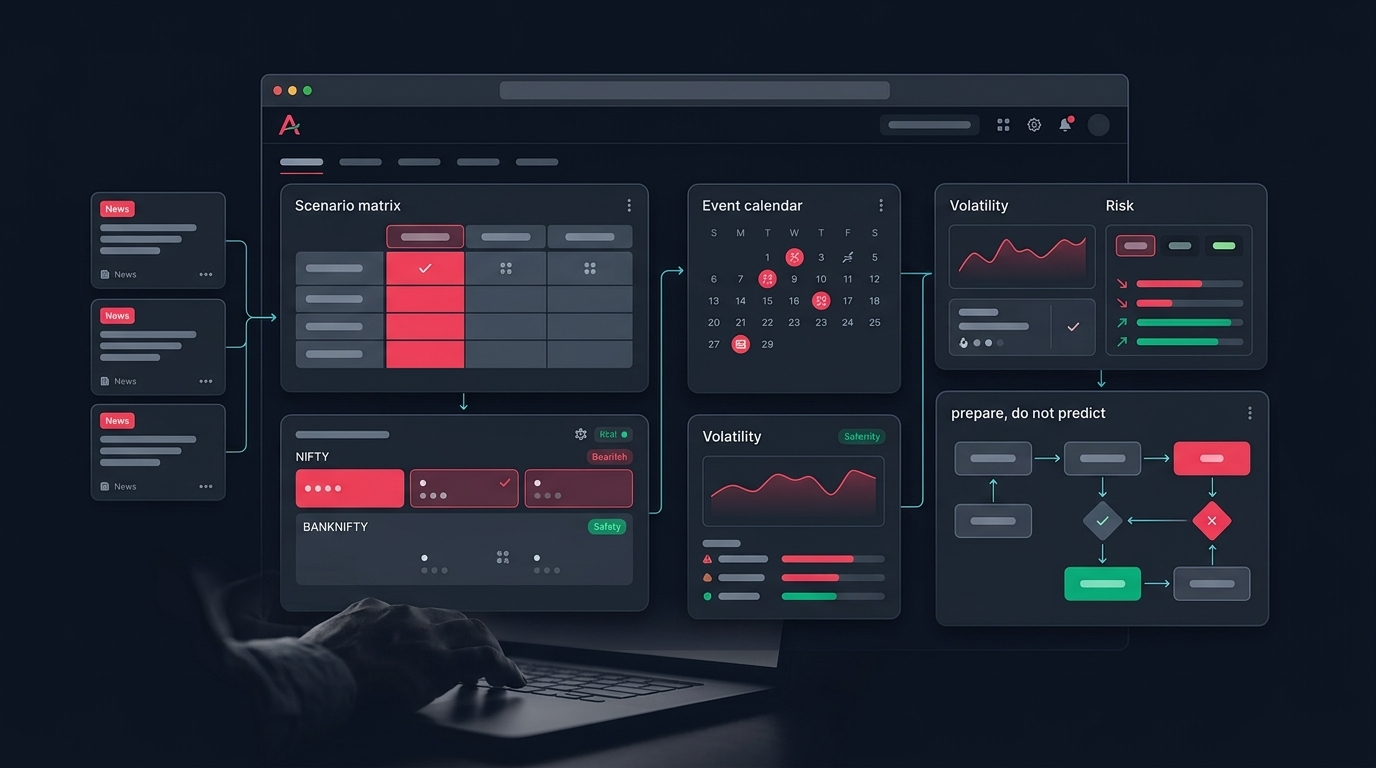
None of this predicts tomorrow. That is the point. Market context is for preparing a process, and the process is what still works on the day the tape does something you did not plan for.
Educational content only. Not investment advice. Derivatives carry substantial risk of loss.