Every MPC week, searches for "RBI policy effect on stock market" spike. Most of the articles that answer them are written for investors: which sectors benefit from a rate cut, how Nifty has historically reacted, how to position a portfolio. Useful reading, but it answers the wrong question for a systems trader.
If you run algos, scanners, or rule-based options strategies, the question is not "will the market go up after the next rate decision?" Nobody can answer that honestly. The question is: how does RBI policy change volatility, liquidity, and sector behaviour — and does my system have explicit rules for those changes, or does it just hope?
This post takes the August 2026 policy backdrop and turns it into process: what the current numbers actually mean, what the quieter regulatory change from April 2026 does to market structure, and the specific risk filters worth building before the next policy event.
The 2026 policy backdrop, in plain terms
The Monetary Policy Committee is a six-member statutory body under the RBI Act, 1934, mandated to keep CPI inflation at 4 percent, with a tolerance band of 2 percent on either side. Six people, one inflation target, and a press conference that can move your open positions.
As of the June 2026 policy review, the repo rate stood at 5.25 percent, with the Standing Deposit Facility at 5.00 percent and the Marginal Standing Facility at 5.50 percent — a 50 basis point corridor around the policy rate. CRR stood at 3.00 percent and SLR at 18.00 percent.
Two process notes before we go further.
First, verify these numbers yourself before every policy cycle. Rates change; blog posts don't. If any part of your strategy logic or margin planning references the rate environment, treat it as a live input, not a constant you set once in 2025.
Second, notice what these numbers are not: they are not signals. The repo rate being 5.25 percent tells you nothing about tomorrow's direction. What matters for trading systems is the direction of the cycle, the surprise relative to expectations, and the liquidity conditions the policy stance creates.
How RBI policy actually reaches your trades
There are four channels worth understanding, because each one maps to a different risk filter.
Expectations versus outcome
Markets price the expected decision before the announcement. The move on policy day comes from the gap between expectation and outcome — the decision itself, the stance, the commentary, the inflation projections. The same repo rate can produce a rally or a selloff depending on what was priced in. This is why "rate cut = market up" rules coded from headlines fail: you are trading the surprise, not the rate.
Rate-sensitive sectors
Banks, NBFCs, autos, and real estate respond to borrowing-cost changes directly. Longer-duration growth stocks re-rate as discount rates shift. On policy days, sector rotation is common — money moves between rate-sensitive and defensive pockets even when the index itself finishes flat. If your scanner universe is heavy on financials, policy day concentrates your risk whether you notice it or not.
Liquidity conditions
CRR changes, open market operations, and corridor management alter how much money is in the system. Liquidity shows up in your trading as fill quality, spread width, and whether intraday moves trend or chop. It is the least visible channel and the one that quietly invalidates backtest assumptions.
The global overlay
Even in a broadly supportive rate environment, markets do not move in a straight line. Fed decisions, crude prices, geopolitical tensions, and foreign fund flows can override the domestic policy signal in any given week. The 2026 research context is explicit about this: analysts repeatedly flag weeks where RBI policy, West Asia risk, crude, and FII flows all land together. Domestic policy is one input in a crowded room.
The quieter change: RBI's secured-lending norms
While rate decisions get the headlines, a structural change went live earlier this year that deserves more attention from active traders than it got.
From April 1, 2026, RBI requires banks to extend credit to capital market intermediaries — brokers, clearing members, and other securities market participants — only on a fully secured basis. The stated objective is systemic: higher leverage in the market ecosystem can amplify volatility during stress, and full collateralisation reduces spillover risk into the banking system.
What does this mean for you as a retail algo trader?
Directly, very little. The norms target bank lending to intermediaries, not retail accounts. Your margin requirements are set by exchange and SEBI rules, not by this change.
Indirectly, more than zero. Broker funding structures adjust gradually as intermediaries move to fully collateralised borrowing. Analysts covering the change expect any liquidity impact to build over quarters, not days. Brokerage firms, exchanges, and prop-heavy businesses may also see sentiment swings around related headlines — worth knowing if those names sit in your scanner universe.
The algo takeaway is narrower and more practical: when market structure changes, your slippage and fill assumptions age. A backtest calibrated on 2024 liquidity is making a quiet bet that 2026 liquidity looks the same. After a structural change like this, that bet needs rechecking, not assuming.
Turning policy context into risk filters
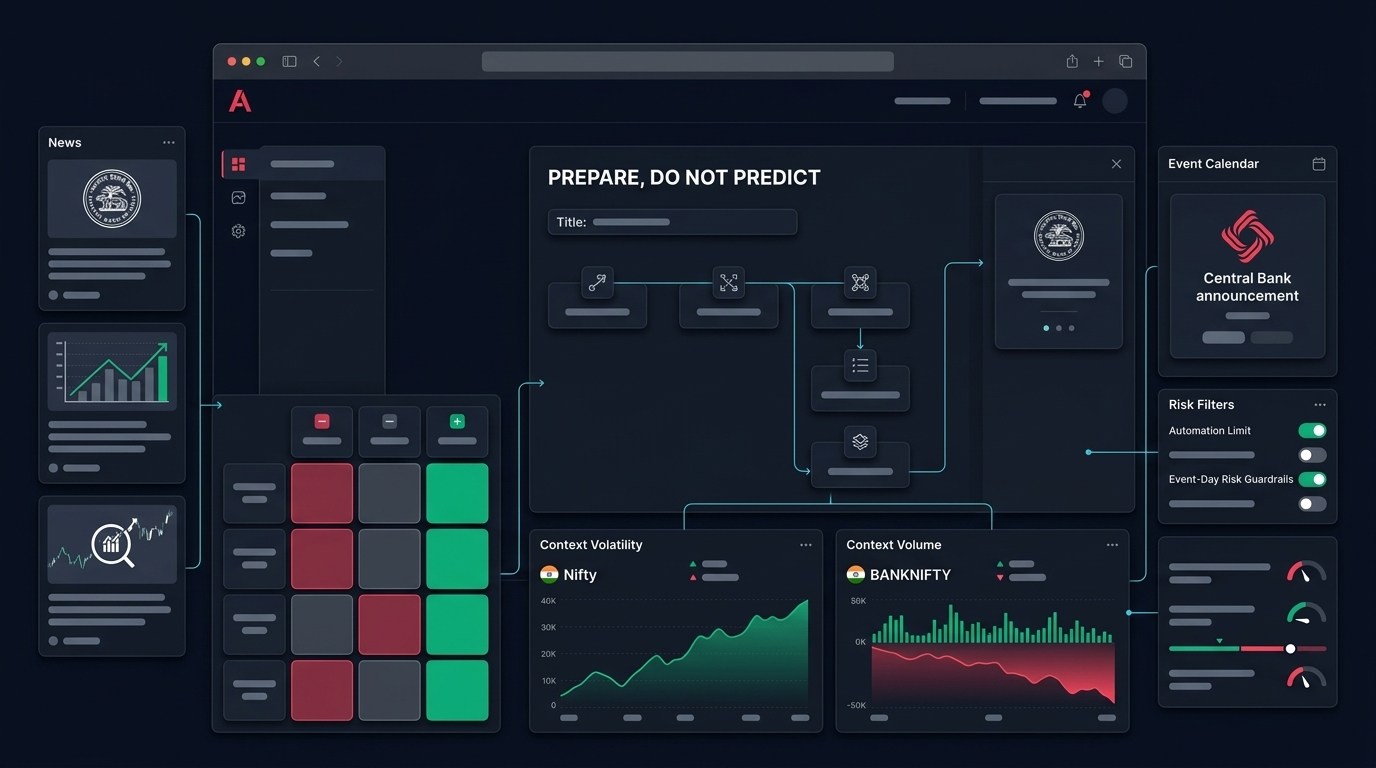
Here is the part that actually protects capital. None of these filters require predicting the MPC. All of them require deciding things before policy week instead of during the press conference.
Filter 1: the event calendar
MPC meeting dates are published well in advance. Your system should know them the same way it knows expiry dates.
For each strategy you run, pick one of three modes for policy day: trade normally, trade at reduced size, or stand aside through the announcement window. Write the choice down per strategy. A mean-reversion intraday system and a positional hedged spread deserve different answers.
A concrete example rule, not a recommendation: no fresh intraday entries from 30 minutes before the scheduled announcement until the first hour of post-announcement trading has printed. The system that misses the announcement candle also misses the whipsaw that reverses it. Post pe sab kuch ek saath move karta hai — and your stop-loss fill quality is worst exactly then.
Filter 2: regime tags in your backtest
A single backtest window that spans a hiking cycle, a pause, and an easing cycle produces one blended Sharpe ratio that describes none of those regimes accurately.
Tag your test windows by policy stance and compare per-regime results: maximum drawdown, win rate, average slippage, time-in-market. If a strategy only performs in one regime, that is not automatically a flaw — it becomes a deployment filter. But you can only apply that filter if you measured it. This is one of the cheapest upgrades you can make to a backtesting habit, and it costs nothing but discipline in how you slice the data.
Filter 3: sector-aware scanner reading
On policy days, rate-sensitive names move together. Ten breakout signals across banks and NBFCs on MPC afternoon is not ten independent opportunities — it is one macro event wearing ten costumes.
Practical checks: cap concurrent positions per sector, and treat clustered same-sector signals as a single risk unit for position sizing. A scanner is a candidate generator, not a permission slip; the correlation filter is your job. This matters most on exactly the days when the signal count spikes.
Filter 4: liquidity and slippage review
Given the April 2026 norms and the gradual funding adjustments they trigger, put a periodic review in your process: measure average spread on your traded instruments, fill quality at your typical order size, and realised slippage per leg against what your backtest assumes.
A usable trigger: if live slippage runs meaningfully above your backtest assumption for two consecutive weeks, halt the strategy and re-measure before continuing. Hoping the fills improve is not a risk framework.
A policy-week workflow, end to end
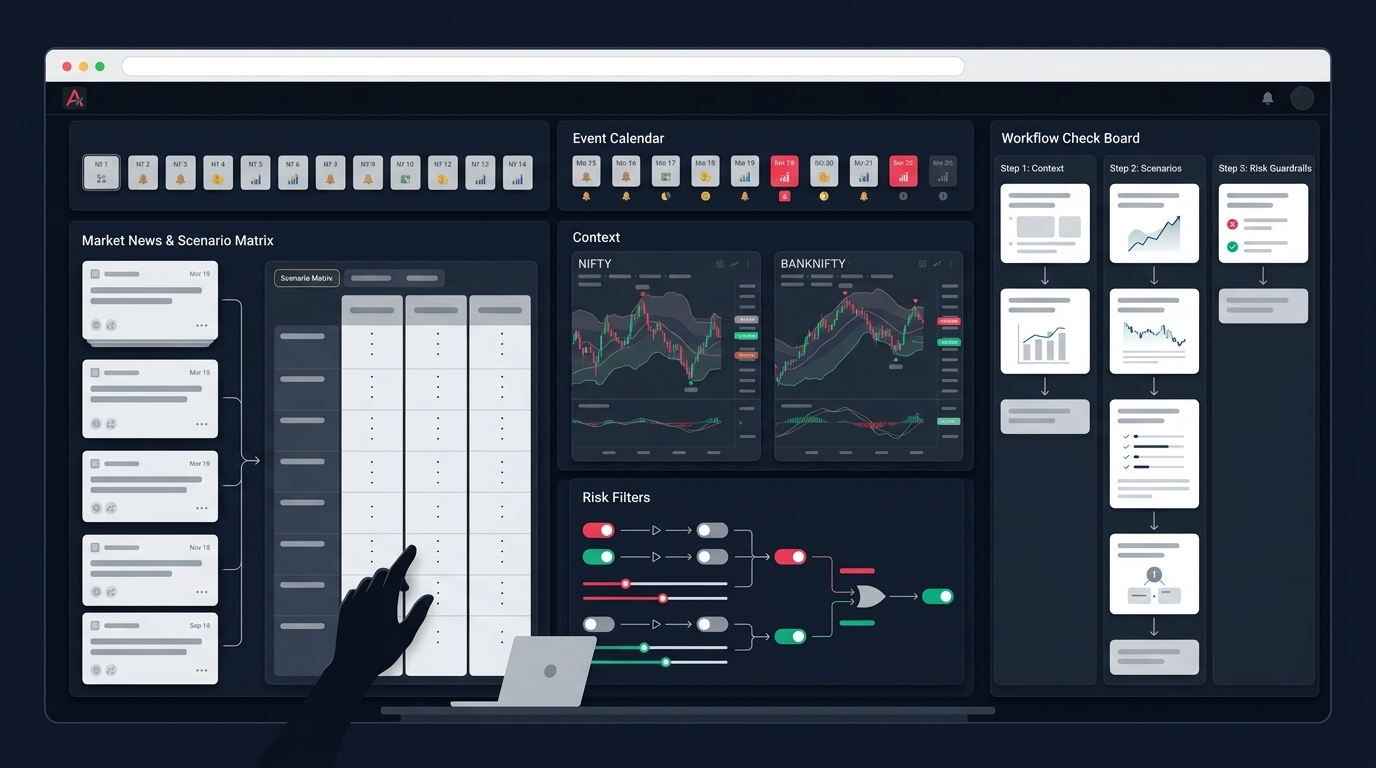
Here is how the filters above translate into an actual weekly routine, using Anadi's workflow as the reference.
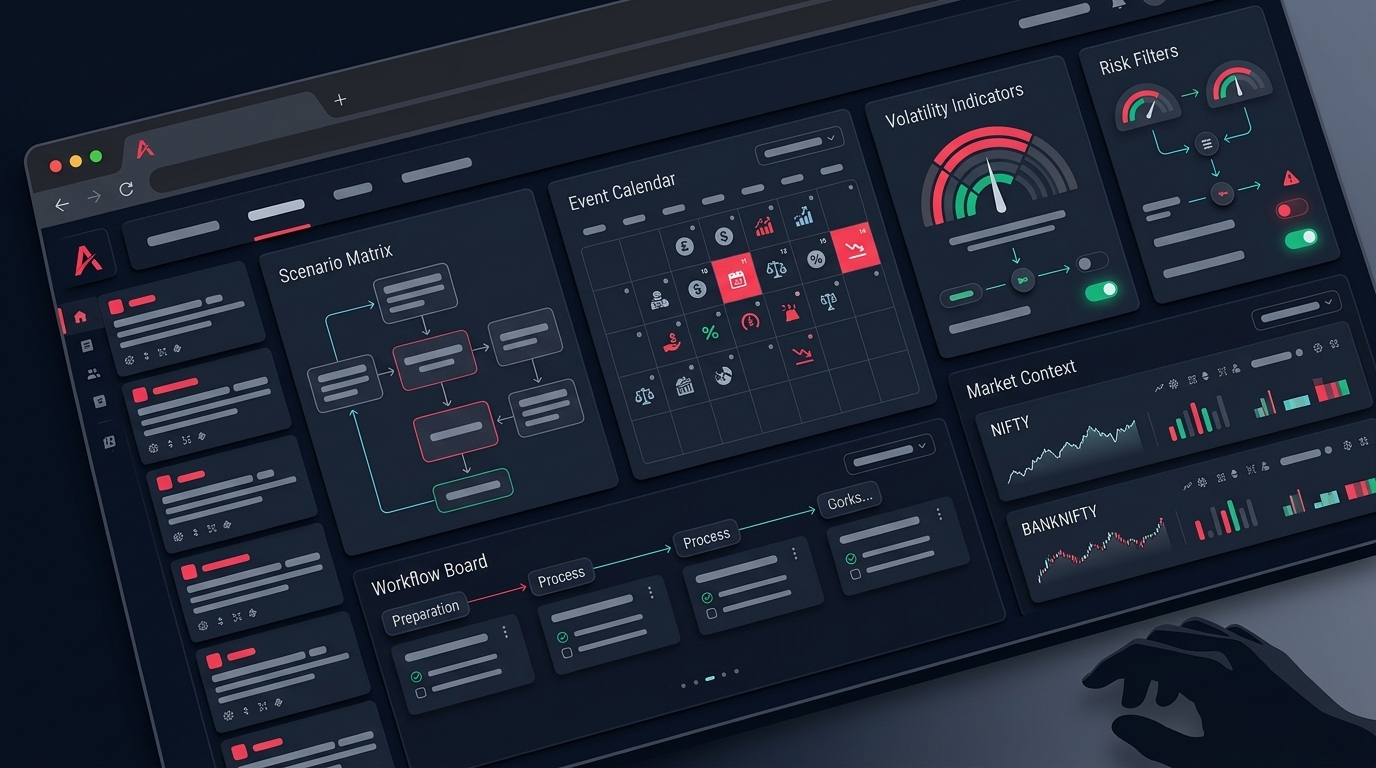
Before the week, read market context to prepare rather than to chase — that is the entire point of a weekly market outlook: know which days carry event risk, which sectors are in focus, and which of your strategies are in "reduced" or "stand aside" mode.
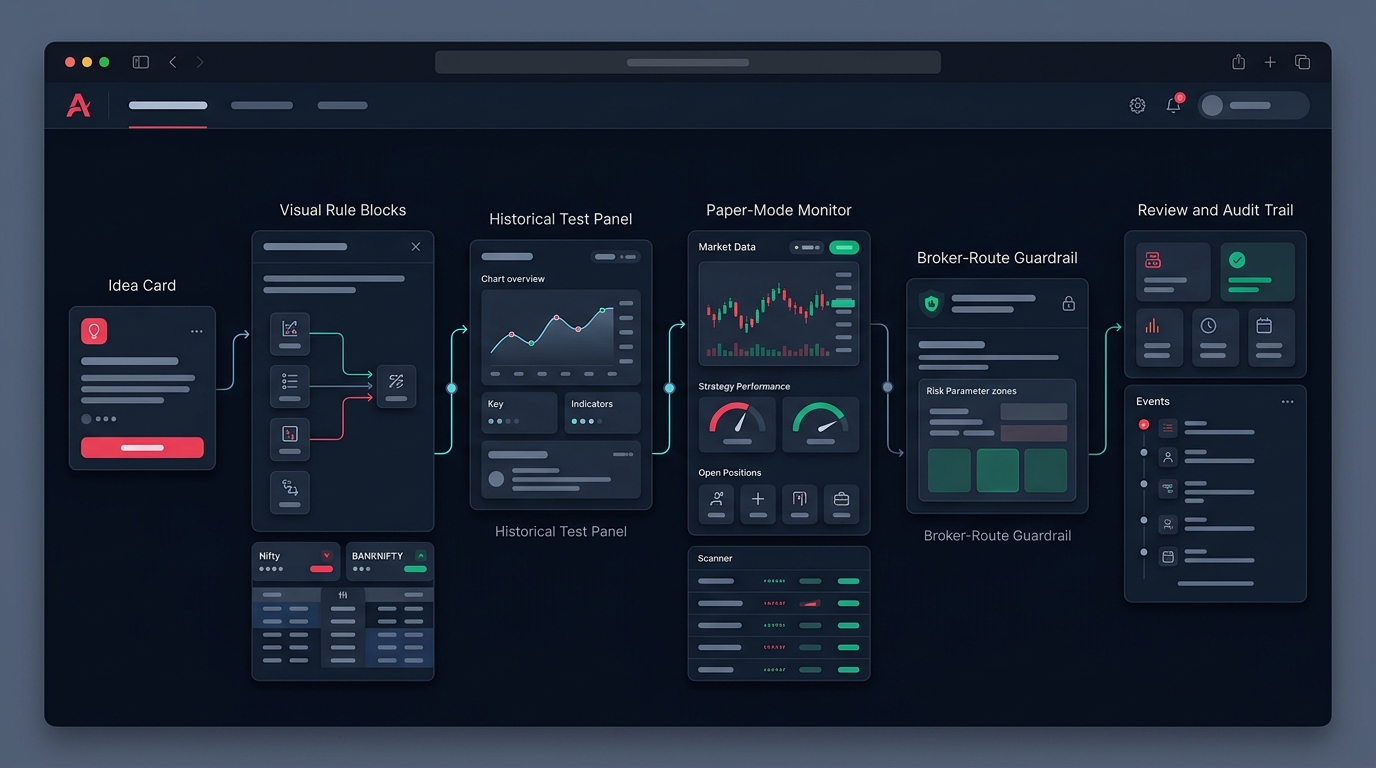
During event days, signal freshness matters more than usual. A scanner signal generated an hour before the announcement describes a market that no longer exists. Anadi's Screener carries freshness state on each signal row for this reason, and Action Center goes further: it shows blocked reasons like chase distance and invalidated price before you can act. On a day when the tape gaps after a policy statement, an entry-blocked tag is not friction — it is the system refusing to let you buy the top of the announcement candle.
For options, the sequence matters even more because policy events move implied volatility, not just price. Premiums you backtested at one IV level behave differently at another. Anadi's options workspace keeps chain inspection, basket preview, and margin estimation — with existing positions considered — in one flow, so risk and margin appear before execution rather than after. Whatever platform you use, that ordering is the point: structure first, margin second, order last.
And if you are introducing a new event-mode rule — a policy-day size reduction, an entry blackout window — run it through paper trading across at least one full policy cycle before it touches live capital. An untested risk rule is just a hope with better formatting. Your broader risk management framework should treat event rules as testable components, same as entries and exits.
What not to build
A few anti-patterns show up repeatedly in retail algo setups around RBI events:
Headline-coded direction rules. "Rate cut means buy Bank Nifty" ignores expectations, stance, commentary, and the global overlay. The same decision text can move the market either way depending on what was priced in.
Hardcoded macro constants. Repo rate, CRR, margin assumptions baked into strategy logic as fixed numbers. Treat them as inputs you verify each cycle.
Event-blind backtests. Testing across policy days while assuming normal-day fill quality flatters every result. Either model wider slippage around events or exclude event windows and say so explicitly.
Mid-speech manual overrides. Watching the press conference and overriding a live system on instinct, with no written override rule. If manual intervention is allowed, define when, by whom, and under what conditions — before the event, in writing.
The takeaway checklist
RBI policy is not a signal to trade. It is a regime variable to respect. Before the next MPC cycle:
- Confirm the current repo rate, corridor, and stance from an official source — don't trust cached numbers, including this post's.
- Mark all scheduled MPC dates in your trading calendar, alongside expiries.
- Assign each live strategy a policy-day mode: normal, reduced size, or stand aside.
- Tag your backtest windows by rate regime and compare drawdowns per regime.
- Cap same-sector concurrent positions, especially in rate-sensitive names.
- Re-measure live slippage against backtest assumptions — particularly relevant after the April 2026 secured-lending norms began reshaping intermediary funding.
- Write your manual override rule down before the event, not during it.
- Paper trade any new event rule through a full policy cycle first.
None of this predicts anything. All of it reduces how much a six-member committee's press conference can hurt a system you spent months building.
If you want a workflow where scanner signals, freshness checks, blocked-entry protection, options risk preview, and paper-first testing live in one place, you can request early access to Anadi Algo and run your next policy week as a process instead of a reaction.