By November 2026, the SEBI retail algo framework has stopped being a "coming soon" topic. It is just how automation works now.
The circular dated 4 February 2025 was deferred twice, then became fully mandatory on 1 April 2026. That means we are now about seven months into live enforcement at the broker level. Most retail traders who automate have already hit at least one of the new friction points — a rejected order from the wrong IP, a provider that had to get empanelled, or a broker asking questions about what exactly their script does.
This post is about process, not prediction. No trade calls here. The goal is to turn the regulatory context into concrete checks you can run on your own setup this week.
What Actually Changed on 1 April 2026
Start with the part that gets misread most often: SEBI did not ban retail algo trading. It regulated it. Retail investors in India may trade with algorithms, but only through a SEBI-registered stock broker.
The practical shape of the framework, based on the published rules:
Every algo order carries an exchange-issued Algo-ID. The identifier travels with the order on placement, modification, and cancellation. The purpose is traceability — any automated order can be tied back to the strategy that generated it. The consequence is blunt: a strategy that is not registered and does not carry an Algo-ID cannot legally trade.
Any order sent through a broker's API counts as an algo order. This is the line that catches people. You may think of your setup as "semi-manual" because you click a button. If it goes out over the API, it is an algo order under this framework and gets tagged like one.
Static IP whitelisting is mandatory. API orders may only be sent from a static IP registered with your broker. Home broadband that rotates, mobile data, café Wi-Fi — brokers are required to reject requests from non-whitelisted addresses. In practice this means a VPS or cloud instance with a fixed IP, or a static IP from your ISP.
Brokers are the principal; algo providers are agents. Your broker answers for the algo orders it allows and for your complaints. Third-party algo providers must be empanelled with the exchanges. Access runs through a key issued for you, with login controls such as two-factor authentication — not an open API.
There is a speed threshold for self-built algos. Reporting around the framework points to a 10 orders-per-second line above which registration obligations kick in for self-built strategies. Most retail strategies sit nowhere near this. If you are genuinely approaching it, that is a conversation to have with your broker's compliance desk, not a detail to assume your way through.
White box vs black box matters. A white box algo has disclosed, inspectable logic. A black box does not, and carries heavier obligations on the provider side. If you cannot see the rules your platform is executing, you are relying entirely on someone else's compliance posture.
One caution on sourcing. Different write-ups on this topic were published at different times, and some were last verified in May or October 2026. Rules evolve, broker implementations differ, and your broker's terms plus the actual circulars are the authority. Treat any blog — including this one — as a prompt to go check the primary source, not as a substitute for it. Nothing here is legal advice.
The Workflow Consequences Nobody Budgets For
Compliance details are easy to read and easy to underestimate. The operational fallout is where retail traders actually lose money or lose days.
Infrastructure is now a dependency, not a convenience
Before April 2026, you could run a script from a laptop on home internet. Now a static IP is a hard requirement. That turns your execution layer into infrastructure you have to maintain: a VPS that needs patching, a fixed address that needs to stay registered with the broker, and a failure mode where your IP changes and every order starts getting rejected mid-session.
Build the check into your routine. Before the first order of the day, confirm the outbound IP your orders are leaving from actually matches what the broker has whitelisted. A one-line check at startup beats discovering it at 9:20 with a half-filled position.
Session and auth failures look like strategy failures
Tighter login controls mean more moving parts between your logic and the exchange. Token expiry, 2FA flows, and key rotation all sit in that path now.
The dangerous version of this is not a clean failure. It is a partial one — the entry fills, then the session dies before the exit order goes out. Your strategy did nothing wrong and you are still holding naked risk. Any serious risk management layer needs to treat "did my exit actually reach the exchange" as a monitored state, not an assumption.
Order-rate limits interact with your logic
Exchanges define order rate limits and message-to-trade ratios, and brokers enforce API rate limits on their side. A strategy that modifies a trailing stop on every tick can generate far more messages than its trade count justifies.
Worth measuring: how many order messages does your strategy send per actual fill? If a single intraday trade produces dozens of modify messages, you are burning rate budget for cosmetic precision. Coarser stop updates usually change your P&L distribution less than you think.
Platform choice is now partly a compliance question
Because providers must be empanelled and brokers carry principal responsibility, the platform question has changed shape. It is not only "does this tool have the features I want." It is also whether the provider's relationship with your broker is sound, and whether you can actually see what the platform executes on your behalf.
When you compare algo platforms, ask about the plumbing: which brokers are supported and under what arrangement, whether the strategy logic is inspectable, and what happens to your open positions when their systems have a bad day.
Turning Regulatory Context Into Strategy Preparation
Here is the part that matters more than the compliance checklist. The framework changed what "ready to go live" means.
Your backtest did not price in the new failure modes
Most retail backtests assume orders arrive. The 2026 reality adds a layer of operational failure above your strategy logic: IP rejections, session expiry, rate limiting, empanelment status changes at your provider.
None of that shows up in a historical simulation. So the honest reading of a backtest result is narrower than it used to be — it tells you whether the idea has edge under clean execution, and nothing about whether your pipe holds. Keep those two questions separate. Good backtesting answers the first. Only paper trading on the live pipe answers the second.
Paper trading on the real pipe is now the real test
Run the strategy against live data, through the actual broker connection, from the actual static IP, for long enough to cross a settlement cycle and an expiry. You are not testing the edge at that point. You are testing whether the infrastructure survives a normal month.
What to log during that period:
- Orders rejected, with the broker's reason code
- Session re-authentications and whether any happened mid-position
- Message-to-fill ratio per strategy
- Any gap between intended and actual position after a disconnect
If that log is clean across a few weeks, you have earned the right to size up. If it is not, the problem is not your rules.
Event days deserve a documented stance
The regulatory layer does not change market behaviour, but it does make event days more expensive to get wrong. Thin liquidity plus an auth hiccup plus a wide spread is a bad combination, and expiry sessions compress all three.
Decide in advance, in writing, what your system does on expiry days, policy announcement days, and results days for heavyweight names. "Reduce size," "skip the first fifteen minutes," and "trade normally" are all defensible choices. Deciding at 9:15 is not a choice, it is a reaction. Use a weekly market outlook to prepare a stance, not to chase a call.
Practical Checks Inside a Platform Workflow
The regulatory framework creates reasons to put a filter between signal and order. That is a workflow design point, and it is worth seeing concretely.
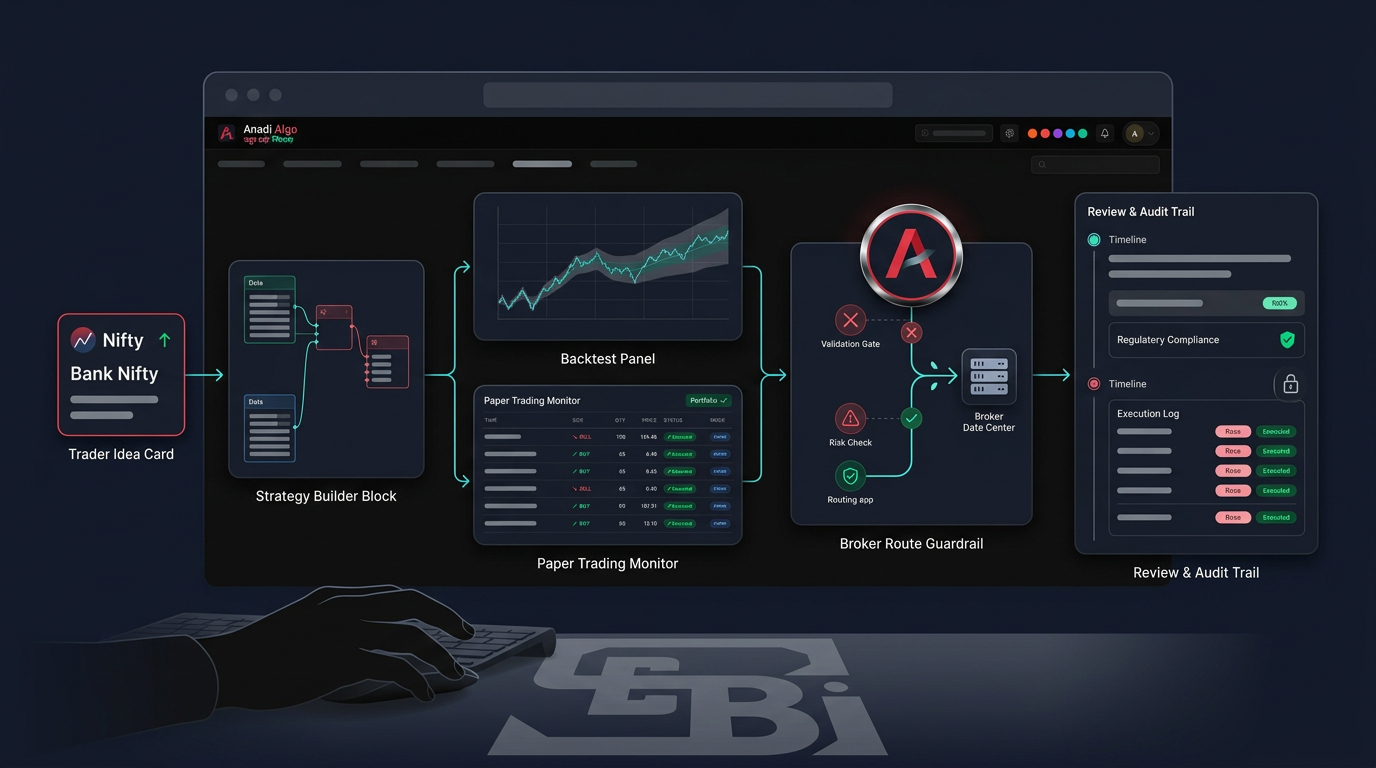
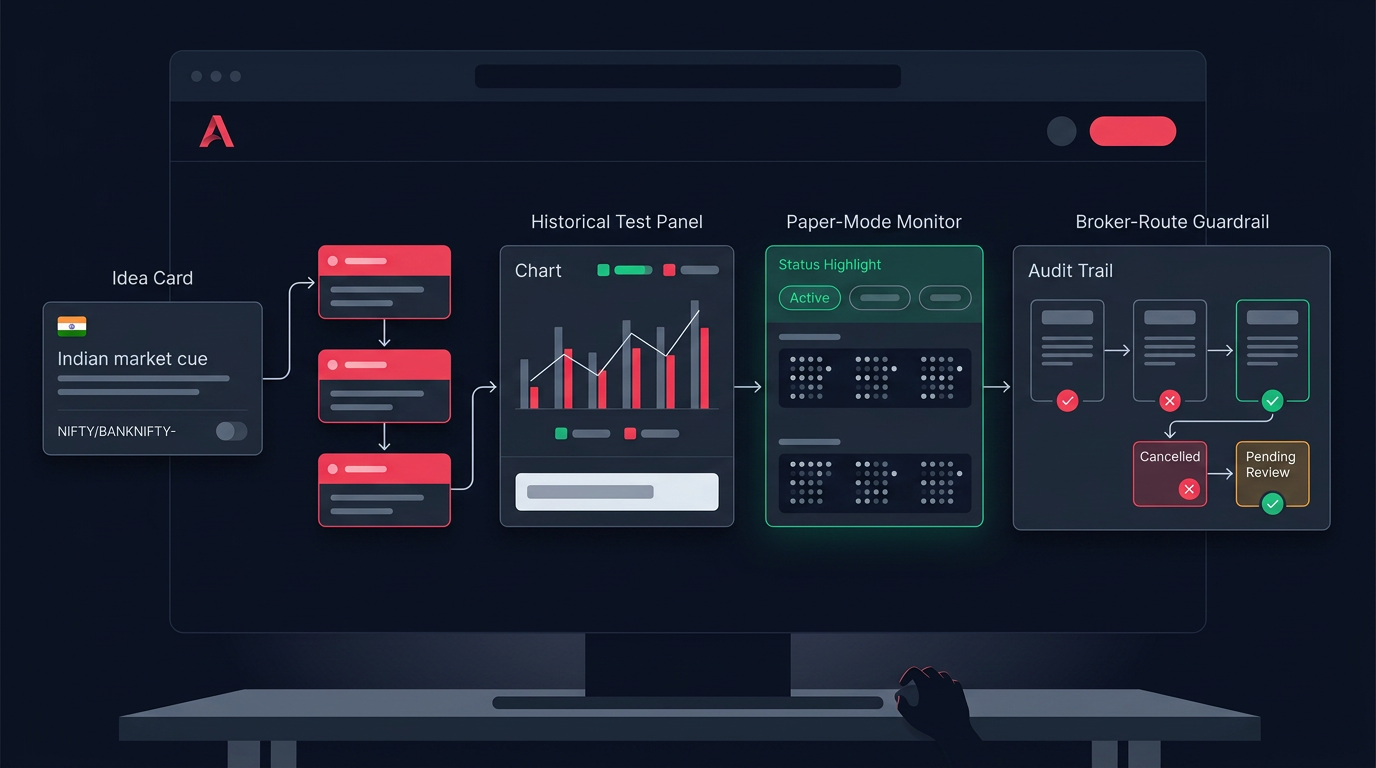
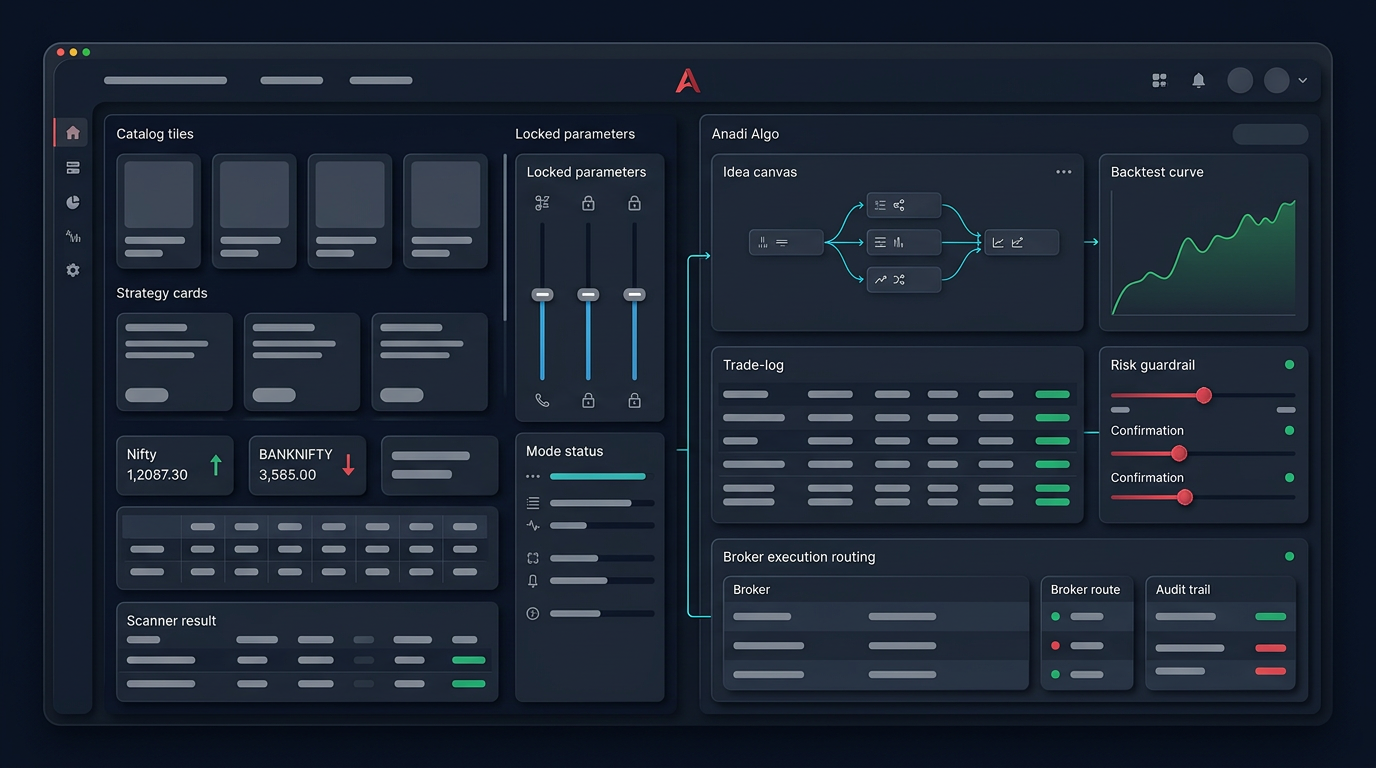
On Anadi Algo, a few places map directly to the pressures above.
The scanner produces candidates, but raw scanner output is noise until something ranks it. Action Center sits between the two — it ranks scanner-backed candidates, shows signal freshness and stage, flags blocked reasons like chase distance or invalidated price, and surfaces F&O eligibility before you route anything. The compliance angle is indirect but real: fewer impulsive late entries means fewer orders, which means less rate-limit pressure and a cleaner audit trail.
For options, the chain workflow keeps strike rows, leg actions, basket preview, and margin estimate in one place. That matters under the new regime because margin surprises are a position-management problem, and position-management problems are exactly what you cannot fix cleanly when a session drops.
The no-code strategy builder and chat wizard address the white-box side. If you describe an idea in plain language and the system converts it into explicit entry, exit, risk, and sizing rules, you end up with logic you can read. Being able to say precisely what your algo does — rather than trusting a sealed box — is a better position to be in when your broker asks.
If you are setting up or re-auditing an automated workflow under the current rules, you can request early access and work through the paper-trading stage before committing capital.
The Checklist
Run this against your own setup. Honest answers only.
Compliance basics
- Am I trading through a SEBI-registered broker, with API access issued to me?
- Is my outbound IP static and currently whitelisted — verified, not assumed?
- If I use a third-party platform, is it empanelled with the exchanges?
- Can I read and explain the logic my platform executes?
- Do I know roughly how many orders per second my strategy can generate at peak?
Operational resilience
- Does my system detect a dead session mid-position, and what does it do then?
- Have I measured my message-to-fill ratio per strategy?
- Do I log every rejection with its reason code and review that log weekly?
- What happens to open positions if my VPS reboots during market hours?
Strategy readiness
- Has this run on paper, through the live pipe, across at least one expiry?
- Do I have a written stance for expiry days and major event days?
- Do I have a daily loss limit that stops the system, not just a mental one?
- Are my backtest assumptions about fills and slippage stated somewhere I can revisit?
The framework that took effect on 1 April 2026 is about traceability and accountability, not about restricting who can automate. That is good news for retail traders who were already running a documented, inspectable process. It is a real cost for anyone whose "system" was a script on a laptop with no logs.
Seven months in, the traders who adapted cleanly mostly had one thing in common: they treated execution infrastructure as part of the strategy, not as something that happens after the strategy is finished.