It is September 2, 2026, a Wednesday, and if you trade Indian derivatives you probably have a live Bank Nifty option chain open somewhere right now — on the NSE site, inside a broker app, or on one of the many third-party chain pages. The page shows strikes, open interest, implied volatility, Greeks, and a last traded price that ticks every few seconds. It looks like a single authoritative feed of truth.
For an algo trader, that is the wrong way to see it. The chain is not one feed. It is a mix of exchange-published numbers, vendor-computed numbers, and interval-refreshed numbers — each with different freshness and different assumptions. Before any of it becomes an input to a system, you need to know which is which, and you need to convert human chain-reading habits into rules that can actually be tested.
This post does both: first, what a "live" chain page really contains; second, how to encode chain observations into risk filters for the September series without turning them into predictions.
What a live option chain actually shows
Prices are live, OI is interval-based, and the two get confused
The last traded price on a liquid Bank Nifty strike is close to real time on most platforms. Open interest is not. OI figures on public chain pages refresh at intervals, and different vendors refresh at different cadences. Even NSE's own option chain page distinguishes between streaming and snapshot views.
A human glancing at the chain never notices this. An algo consuming the chain absolutely must. If your logic compares "current price" against "current OI buildup," you are comparing a seconds-old number with a minutes-old number. That is fine — as long as the rule was designed and backtested knowing that lag exists. It is a problem when the backtest assumed synchronized data that live feeds never provide.
Process check: find out the actual OI refresh cadence of whatever source your system reads, and write it down next to the rule that uses it.
Greeks are computed, not published
The exchange publishes prices, volumes, and open interest. It does not publish the IV and Greeks you see on a chain page. Every vendor derives those from a pricing model, and the inputs differ: which interest rate they plug in, how they count time to expiry, whether they price off spot or the synthetic future. That is why the IV on Groww, 5paisa, NiftyTrader, and your broker terminal rarely match to the decimal for the same strike at the same moment.
None of them is "wrong." But it means an IV threshold is only meaningful relative to the source it was calibrated on. If your options backtesting used one vendor's IV history and your live system reads another vendor's IV, the number 14 does not mean the same thing in both places. Backtest-live parity of the data source is a real risk control, not a pedantic detail.
Why early September changes what the chain can tell you
Calendar context matters before any filter does. As of the current series, Nifty weekly and monthly contracts expire on Tuesday, while Bank Nifty activity is concentrated in the monthly contract — but expiry rules in Indian derivatives have changed more than once in the last two years, so verify the live calendar on NSE rather than trusting an old blog post, including this one.
That calendar shapes today's chain in two ways:
Positioning just reset. Yesterday was a Tuesday expiry for weekly contracts. Any logic linked to "the current weekly expiry" rolled over — the day after expiry is a classic spot where an algo silently queries the wrong series, or an empty one, and behaves strangely without throwing an error. If your system touched an expiry yesterday, today's first job is confirming it is reading the series you think it is.
The monthly structure is still being built. Early in a monthly series, the Bank Nifty chain's OI is thin relative to where it will be near month-end. The highest-OI call and put strikes exist, but they reflect early positioning, not a settled battlefield. Reading them as strong "support and resistance walls" on September 2 gives them more authority than they have earned. The same reading carries far more weight in the last week of the series.
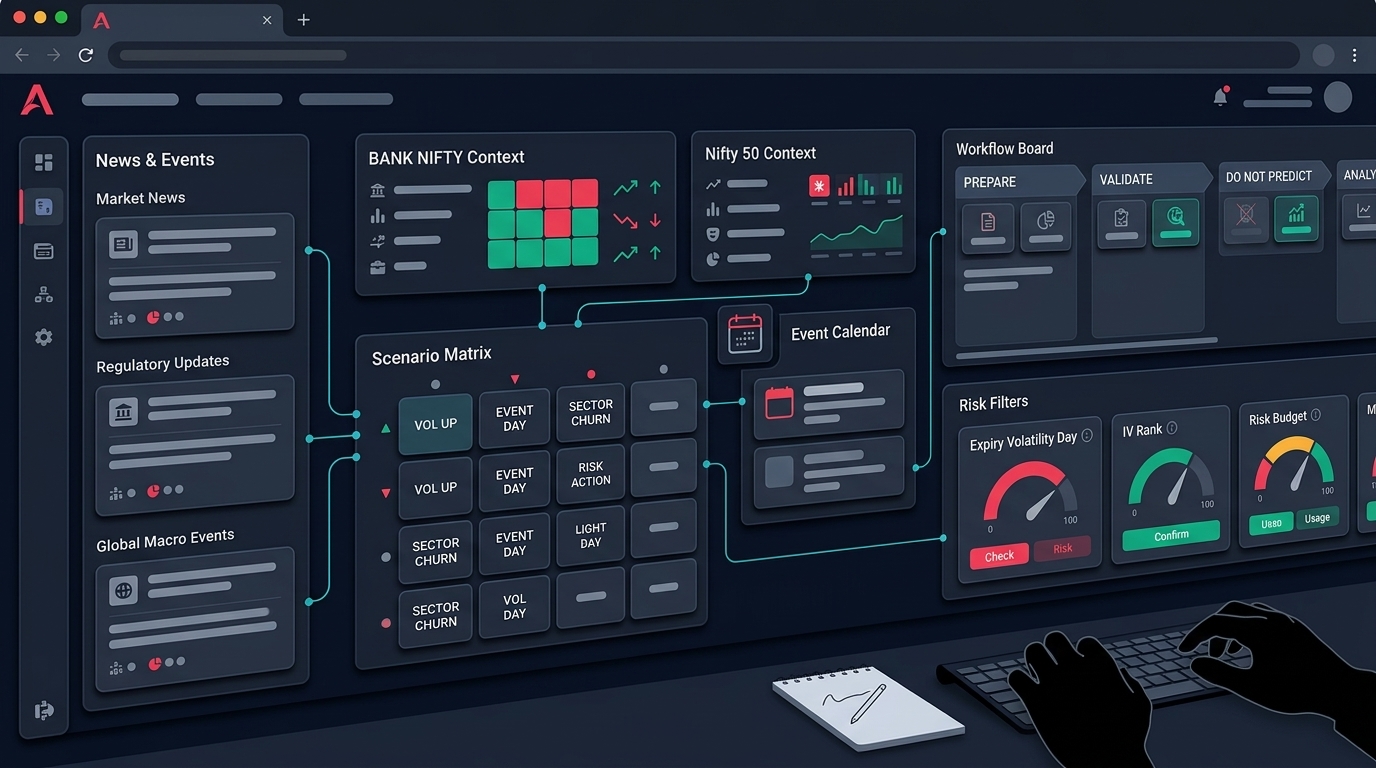
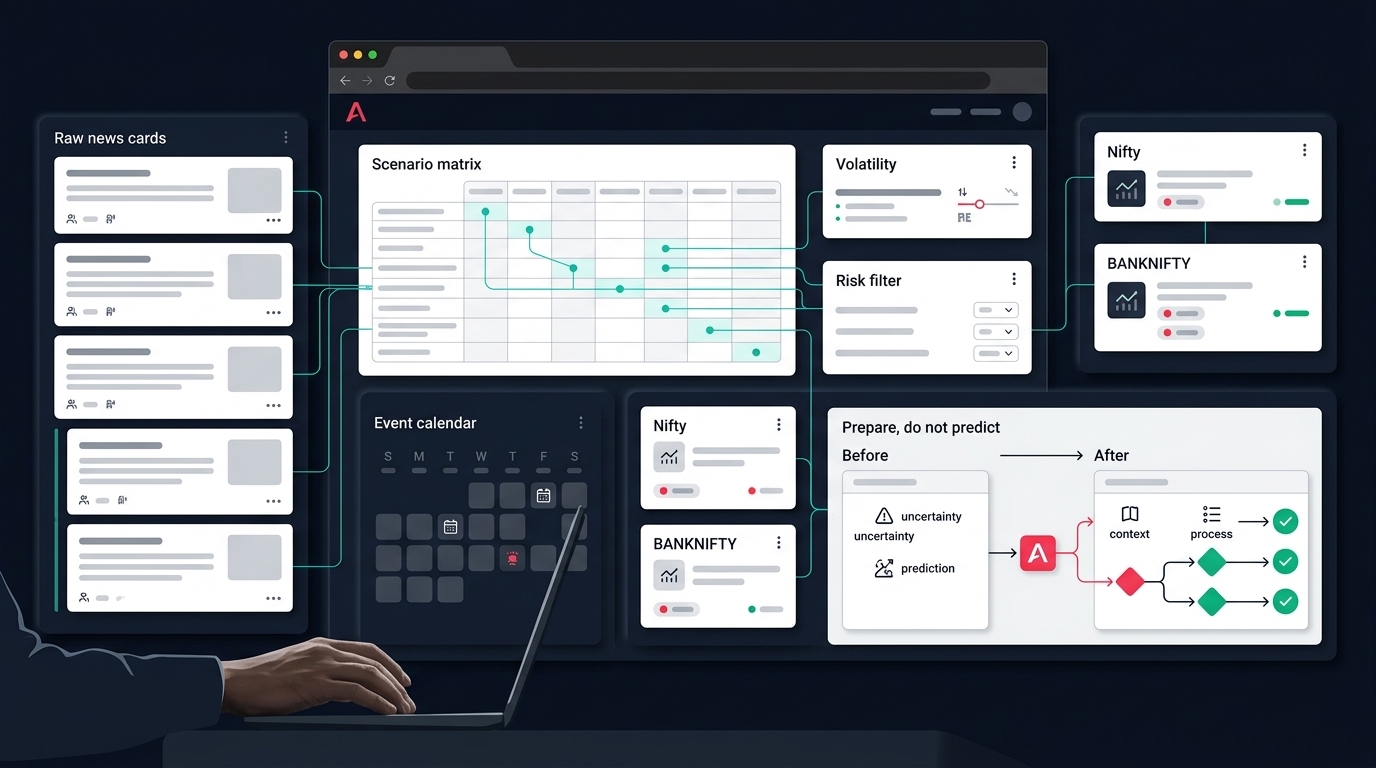
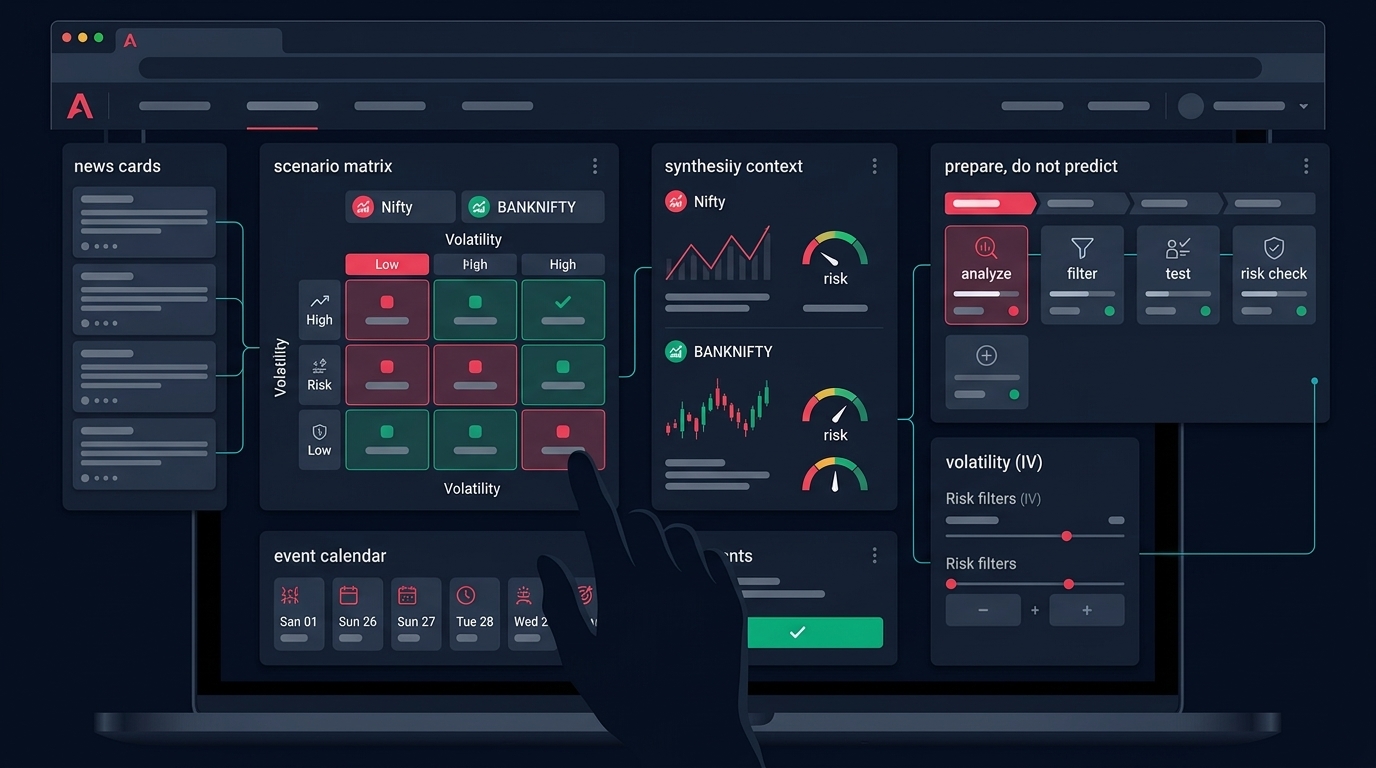
Beyond the chain, the month has a known event map: the RBI policy calendar, scheduled global data prints, and the month-end expiry itself. You do not need to predict any of these outcomes. You need to know the dates in advance and decide — in advance — what your system does around them. That is the whole point of a weekly market outlook style of preparation: context is for planning position size and standing down, not for generating trade calls.
From chain reading to encodable filters
Here is the gap most retail algo traders never close. They read the chain manually with real skill, then run systems that ignore it entirely — or worse, they bolt on chain "signals" that were never tested. The middle path is turning each chain observation into a state or a block that a strategy can consume. Some examples, all illustrative and none a recommendation:
OI walls as distance context, not targets
The strike with the heaviest call OI and the strike with the heaviest put OI mark the zone option writers are defending. An algo should not treat these as price targets. It can treat them as context: the distance between the two walls is a rough proxy for the range the market has priced in, and spot sitting very close to a heavy strike can flag a "congested" state where breakout-style entries historically behave differently. Whether that flag should reduce size, delay entries, or do nothing is an empirical question — one you answer in a backtest, not from intuition. And in the first week of a series, weight the flag lower, because the walls are still forming.
Change in OI beats total OI
A strike adding open interest today tells you more than a strike carrying stale positions from last week. Encodable version: compare the day's change-in-OI distribution against the carried total-OI structure. When fresh buildup contradicts the old structure, the positioning regime is shifting, and yesterday's levels deserve less trust. That is a state variable, not a direction call.
PCR is a regime flag with a backtest requirement
The put-call ratio compresses the whole chain into one number, which makes it popular and dangerous. Folk thresholds — "under 0.7 is oversold, above 1.3 is overbought" — are meaningless until tested against your own strategy's history, because the same PCR reading behaves differently in a trending month versus a range-bound one. If a PCR filter is worth having, it is worth building as a testable rule in a BANKNIFTY strategy builder and running against history, not adopting from a YouTube thumbnail.
IV: relative, not absolute
Two IV checks are genuinely encodable. First, IV at your strike versus neighbouring strikes — paying inflated IV means the trade must overcome both direction and volatility decay, so a "relative IV premium" cap on option buying is a coherent filter. Second, current IV versus its own recent range for that expiry bucket, which frames whether premium-selling structures carry a reasonable margin of safety or a thin one. Neither check says buy or sell. Both change which structure fits: outright buying, spreads, and hedged premium strategies each respond differently to the IV state, which is exactly why IV and theta context belongs beside the chain — in Anadi's options workspace it sits as its own tab next to chain and OI analysis, so the volatility question gets asked before the order, not after.
Greeks at the basket level, not the leg level
Single-leg Greeks are trivia. Basket Greeks are risk. The encodable versions: a net delta band the combined position must stay inside, an explicit theta dependency you have accepted on purpose, and gamma concentration awareness when short strikes sit near heavy-OI zones later in the series. This is also where workflow design matters more than analytics: the combined Greeks and margin of a multi-leg basket should be visible before execution, as a gate. Anadi's chain flow runs chain row to basket preview to margin estimate in one sequence for this reason — the risk picture appears before the confirm button, which is the only place it is useful.
Data quality checks before the chain feeds your system
Whatever filters you adopt, the pipeline underneath them needs its own checklist:
- Timestamp everything. Log fetch time and data time separately. A chain snapshot without a timestamp should be treated as suspect by default.
- Define a staleness limit. Decide the maximum acceptable age for each field. Price-based rules can demand freshness; OI-based rules cannot be fresher than the source's refresh interval, so do not pretend otherwise.
- Restrict Greeks logic to liquid strikes. Computed IV on a strike with a wide bid-ask spread and near-zero volume is noise wearing a decimal point. Filter by volume and spread before any Greeks-based decision.
- Cross-check extremes. If IV or OI on one source looks wild, verify on a second source before the system responds. Automated reactions to bad prints are self-inflicted losses.
- Handle expiry rollover in code. The "current expiry" your system queries changed this week. Test the rollover path explicitly; do not discover it in production on a Wednesday morning.
- Match backtest and live data sources. Same vendor, same field definitions, same conventions. Otherwise every threshold is calibrated on a different instrument than the one it now trades.
These checks sound unglamorous next to strategy ideas. They fail more algos than bad strategies do. Broker feeds hiccup, sessions expire, and chains go stale silently — a system with data-quality gates degrades safely; one without them trades confidently on garbage.
Prepare the week, don't chase the tape
Pulling it together for this week: positioning has just reset after a Tuesday expiry, the September monthly structure is early and thin, and the month's event dates are already public. None of that says which way Bank Nifty goes, and you do not need it to. The process edge is deciding — today, calmly — which days your strategies trade at full size, which days they trade smaller, and which days they stand down, then encoding those decisions as rules under a proper risk management budget with a daily loss limit that does not negotiate.
One design idea worth borrowing even if you never use Anadi: a system that tells you why not to enter — chase distance too far, setup invalidated, level already gone — protects capital more reliably than another entry signal ever will. Blocked reasons are a feature, not a limitation. And any new chain-based filter deserves a spell in paper trading before it touches real margin.
If you want to build and test this kind of chain-aware workflow — option chain, OI analysis, IV and theta context, basket margin preview, and risk gates in one place — you can request early access to Anadi Algo.
The working checklist
- Confirm which expiry series every part of your system is reading today, the day after a Tuesday expiry.
- Know your OI refresh cadence and your IV source's model assumptions; write them next to the rules that use them.
- Treat early-series OI walls as weak context, and let their weight grow as the month matures.
- Prefer change-in-OI over total OI for anything intraday.
- Test PCR and IV thresholds on your own strategy history before letting them gate live orders.
- Evaluate Greeks and margin at the basket level, before execution, every time.
- Gate the pipeline: timestamps, staleness limits, liquidity filters, cross-source sanity checks.
- Map the month's scheduled events now and pre-decide size-down and no-trade days.
The chain will keep updating all day. Your rules should not.