Every trading day, the Bank Nifty option chain gets quoted like scripture. Highest call OI here, put wall there, PCR at this level, max pain at that strike. On most days those numbers carry real information about positioning. But on a day like August 31, 2026 — the last trading day of the month, with the August monthly settlement behind us and the September series only a few sessions old — the same numbers carry far less weight. An algo that consumes them blindly isn't filtering on positioning. It's filtering on noise.
This post walks through what a live option chain with OI and Greeks actually gives an automated workflow, why the chain reads differently at the start of a new series and at month-end, and which risk filters are worth coding so your system knows when to trust the chain and when to discount it. No predictions, no trade calls — just process.
What the live chain gives you — and where it misleads an algo
Strip away the vendor styling and every Bank Nifty option chain — NSE's own page, broker terminals, analytics sites — shows the same strike-wise grid: open interest, change in OI, volume, implied volatility, last traded price, and bid-ask quotes for calls and puts. NSE's chain adds a streaming toggle and a CSV download, which matters more than it sounds, because it forces a question most retail traders never ask: is the number on your screen live, or a snapshot?
For a discretionary trader, that distinction is a shrug. For an algo, it's everything. Four data-quality issues show up constantly:
- Stale LTP on illiquid strikes. A far OTM strike may not have traded for minutes. Any IV computed from that LTP inherits the staleness. Your system sees "IV spiked at 58,500 CE" when in reality one small trade printed against a wide spread.
- Total OI versus change in OI. Total OI includes positions carried from days ago. Intraday change in OI is the fresher signal — a strike adding OI today tells you more about current positioning than one sitting on stale open interest.
- Polling lag. If your pipeline polls the chain every 30 or 60 seconds, timestamp every snapshot and treat cross-strike comparisons from different polls as suspect. Two strikes read 40 seconds apart during a fast move are not the same market.
- Vendor Greeks are model outputs. Delta, theta, and vega displayed on a chain depend on the IV input and the model settings. Two platforms can disagree meaningfully on the same strike. If your risk rules consume Greeks, they should consume them from one consistent source, not whichever tab was open.
None of this makes the chain useless. It makes the chain an input that needs validation gates — exactly the kind of thing an algo does better than a human, if you actually code the gates.
Why August 31, 2026 reads differently
Three contexts overlap today, and each one changes how much weight the chain deserves.
A young monthly series
Bank Nifty now trades only monthly expiries — the weekly contracts are gone — so when a monthly series settles, the entire chain re-forms around the next month. In the first sessions of a new series, OI walls are thin, because writers haven't finished building positions. PCR is unstable, because it's computed on a small base where one large basket can swing the ratio. Max pain is close to meaningless, because there isn't yet enough open interest for "pain" to be a real constraint on anyone.
The practical read: early in a series, the chain shows positioning being built, not positioning being defended. A "resistance wall" of call OI that would be significant in expiry week may just be one desk's opening position today. Systems that key off OI-based support and resistance should either widen their thresholds or downweight the signal until open interest rebuilds toward normal levels.
Month-end flows
August 31 is also the last trading day of the month. Month-end brings rebalancing and rollover-adjacent flows in index heavyweights — and banks are heavyweights. Prices and OI can move for reasons that have nothing to do with a fresh directional view. This is not a prediction that anything will happen today; it's a reminder that an OI print on a month-end session is a lower-conviction signal than the same print mid-month. Don't let your system read every large addition as smart-money conviction.
Nifty's Tuesday expiry next door
Nifty currently trades its weekly and monthly expiries on Tuesday. Bank Nifty has no weekly contract, but banking stocks carry heavy weight in Nifty itself, so expiry-driven hedging and unwinding in the broader index can spill into banking names early in the week. If your Bank Nifty system trades Monday and Tuesday sessions, it is trading next to someone else's expiry even though its own contract is weeks from settlement. That cross-current is worth encoding as a regime flag, not ignoring.
Risk filters worth coding from OI, IV and Greeks
Context is only useful if it becomes a rule. Here are filter families that translate chain data into things a system can actually check before quoting an order.
Liquidity and OI filters
- Minimum OI and volume per strike. Define a floor below which your algo simply may not trade a strike, whatever the signal says. This single gate removes most stale-price problems.
- Spread gate. Skip or delay entries when the bid-ask spread exceeds a set percentage of the premium. Backtests assume fills near mid; live fills on wide-spread strikes quietly destroy that assumption.
- Fresh-versus-stale weighting. In the first week of a new series, weight change in OI over total OI when computing any positioning signal. As the series matures, shift the weight back.
- Wall qualification. If a strategy references OI-based support or resistance, require the wall to exceed a minimum absolute size before treating it as a wall. A thin new-series chain will otherwise generate imaginary levels all day.
IV filters
- IV against its own recent range. Absolute IV numbers mean little; IV relative to where it has been over recent weeks means more. A simple percentile rank is enough to classify "elevated," "normal," and "compressed" — and each state suits different structures.
- Strike-relative IV. Compare IV at your strike against neighbouring strikes. Buying an option priced at inflated IV relative to its neighbours means the trade has to overcome both direction and volatility decay — a double headwind that a chain makes visible if you look.
- IV stability check. If IV at a strike is jumping between consecutive polls, treat it as a data-quality warning first and a volatility event second. Widen filters or stand down until readings stabilise.
Greeks budgets
- Net delta cap. Every multi-leg basket should have a maximum net delta your system tolerates, checked before execution — not discovered after.
- Theta reality for monthly contracts. With only monthly expiries, the nearest Bank Nifty contract on August 31 is weeks from settlement. Its theta and gamma profile is nothing like a Nifty weekly two days from expiry. Porting a Nifty weekly selling backtest onto Bank Nifty unchanged is one of the most common — and most expensive — structural mistakes.
- Vega awareness. Early-series premium carries more vega. If your book is short vega into a data-heavy week, that's a risk state worth flagging, whatever your directional view.
- Gamma is a proximity problem. Gamma risk concentrates near expiry. It's not today's Bank Nifty problem, but it is very much a problem for any Nifty weekly position you're carrying into Tuesday.
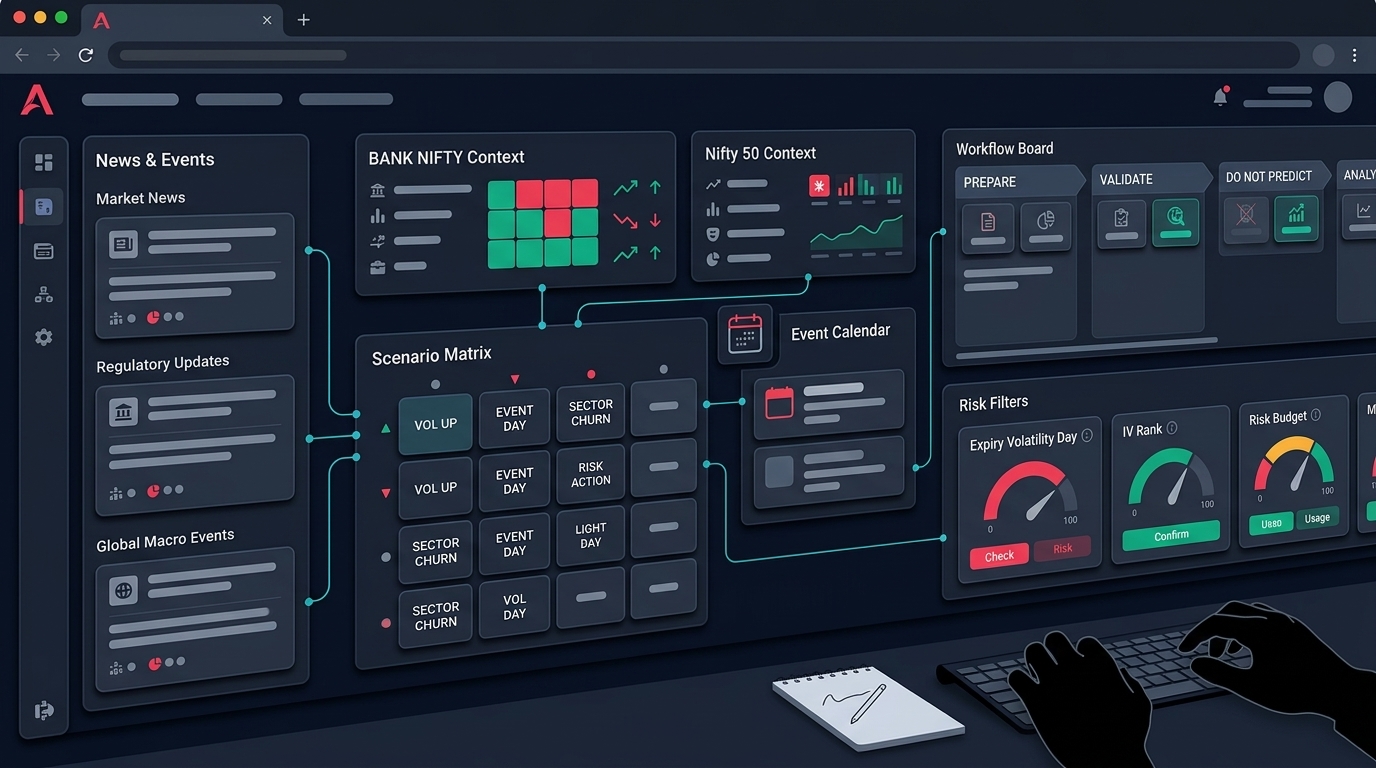
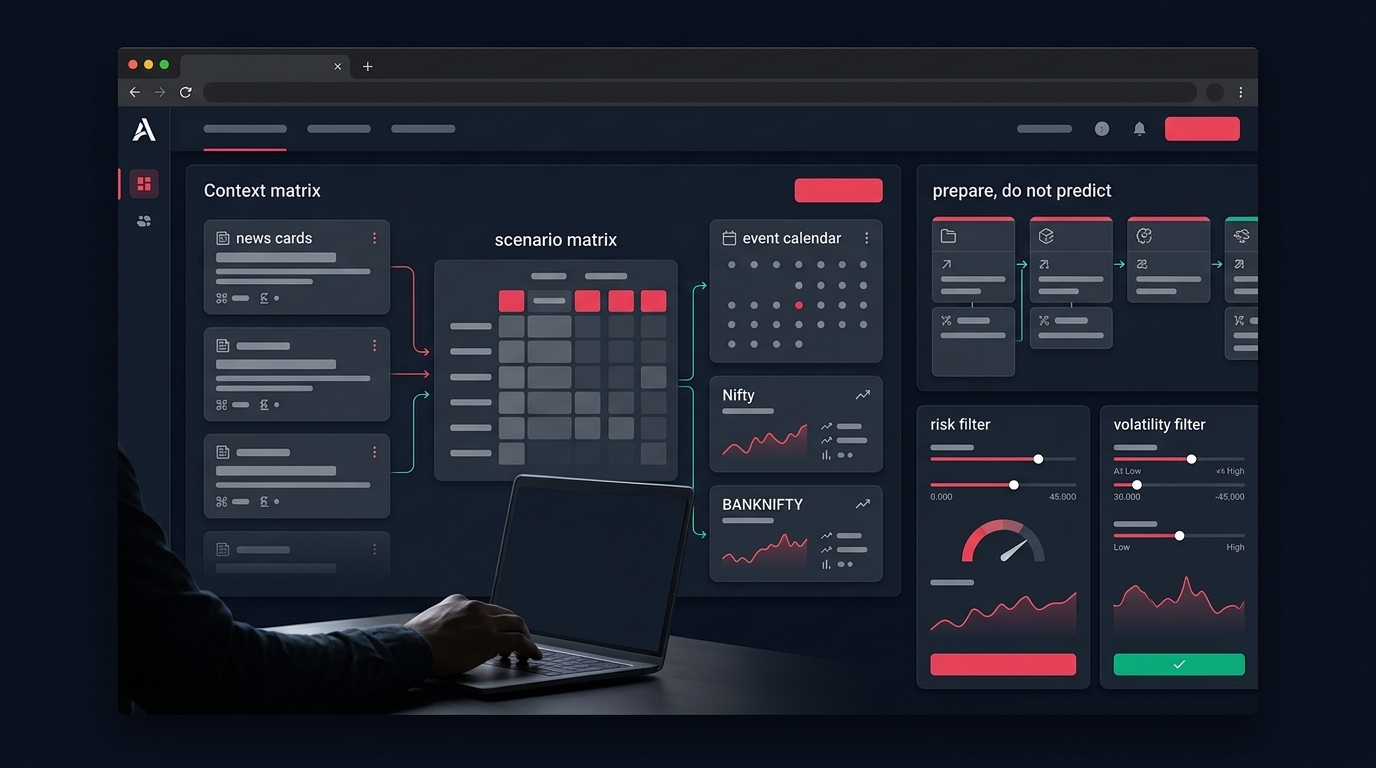
This is also where workflow design matters more than any single filter. In Anadi's options workspace, the chain sits beside dedicated OI analysis and IV-and-theta tabs, and any legs you select flow into a basket preview with a margin estimate before anything executes. The point isn't the specific screen — it's the sequencing: risk and margin visible before the order, not reconstructed after. If your current workflow shows you Greeks only after entry, that's a process gap regardless of which platform you use.
From chain observation to tested rule
Everything above is context. Context becomes edge only when it turns into a rule you can test. "The chain looks thin, so I'll be careful" is a mood. "Skip entries while front-month total OI is under a defined fraction of the prior series' peak" is a rule — one you can run through options backtesting and evaluate honestly.
The same applies to IV filters (test entries only in defined IV percentile bands), spread gates (measure how much slippage the gate saves versus how many trades it costs), and delta caps (compare drawdowns with and without the cap). A BANKNIFTY strategy builder workflow that lets you express these as explicit conditions — rather than burying them in code you'll forget to update — keeps the rules visible and auditable.
One honest caveat: historical option-chain data has its own assumptions, and OI-based rules are harder to backtest cleanly than price-based ones because intraday OI snapshots are patchy in most datasets. Where the data is weak, run the rule in paper trading first and log what it blocks. A filter that never fires, or fires constantly, is telling you the threshold is wrong before real money does.
Event awareness for the week ahead
The first week of a new month tends to be data-heavy — domestic releases, auto and activity numbers, and US data that sets the overnight tone. You don't need to predict any of it. You need to know, in advance, which windows your strategy should not be quoting through, and have that encoded as blocked time-bands or an event flag rather than as a mental note.
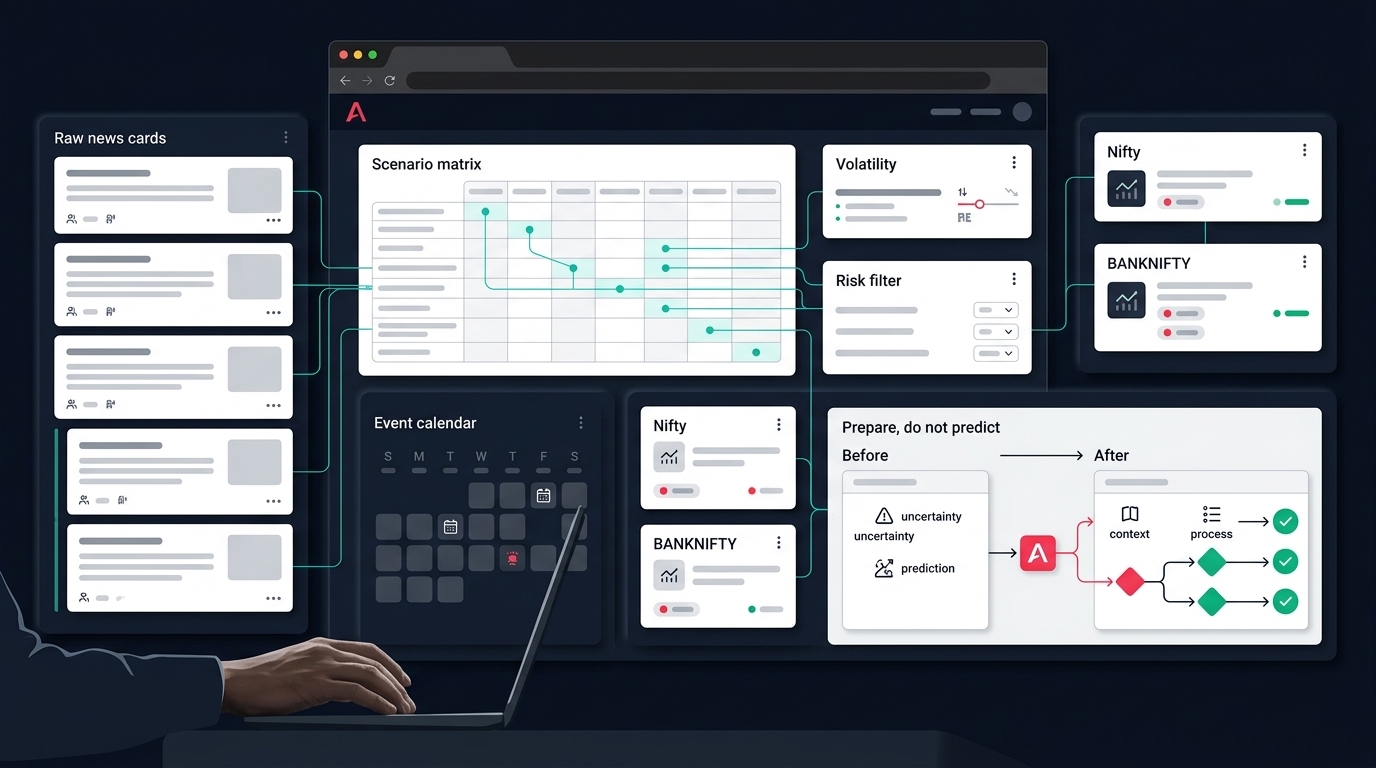
Pair that with the boring guardrails that save accounts: a daily loss limit that flattens the book when hit, position sizing that doesn't creep up after a good week, and clear risk management rules for when manual override is allowed. A weekly market outlook review on Sunday or Monday morning is enough to map the week's events into your calendar — the goal is preparation, not forecasting.
A checklist for chain-driven algos this week
- Timestamp every chain snapshot your system consumes; reject cross-strike comparisons built from different polls during fast tape.
- Enforce liquidity gates — minimum OI, minimum volume, maximum spread — before any strike is tradeable.
- Downweight total OI for the first sessions of the new series; prefer change in OI for positioning signals.
- Treat PCR and max pain as low-confidence until open interest rebuilds to normal levels.
- Check IV percentile and strike-relative IV before choosing between buying premium, spreads, or selling structures.
- Cap net delta and know your vega on every basket, with margin previewed before execution.
- Flag Nifty's Tuesday expiry as a cross-current regime for early-week Bank Nifty sessions.
- Block event windows in advance and keep the daily loss limit live — no exceptions on data days.
- Log every filtered signal and review weekly: filters that never fire or always fire need new thresholds.
The live Bank Nifty option chain is one of the richest free datasets Indian retail traders have. It rewards traders who treat it as an input to be validated and punishes those who treat it as an oracle. If you'd rather encode these checks once instead of eyeballing them every morning, you can request early access to Anadi Algo and build them into your workflow directly.