Every broker portal and market site now streams a live Bank Nifty option chain: open interest, change in OI, implied volatility, LTP, and a full set of Greeks for every strike. For a manual trader, that page is a dashboard. For an algo trader, it is something more demanding — an input feed.
The moment chain data starts driving automated decisions, the questions change. It is no longer "what is the chain saying?" It becomes: which of these numbers is reliable enough to act on, how stale is my snapshot, and what should my system do when the data disagrees with itself?
That question matters more than usual this week. August 25, 2026 falls on the last Tuesday of the month — the slot where Bank Nifty's monthly series winds down under NSE's Tuesday-expiry schedule. Expiry weeks are exactly when chain data moves fastest, when Greeks flip hardest, and when a lazy data assumption inside an algo costs real money. This post walks through the chain as an algo trader should consume it: what each field means as a risk input, what to validate before trusting it, and how to convert readings into process filters instead of predictions.
What the live chain gives you — and what it quietly doesn't
A live NSE option chain for Bank Nifty shows, per strike and expiry: calls on one side, puts on the other, with OI, change in OI, IV, volume, LTP, and usually bid-ask. Portals layer on computed values — PCR, max pain, support and resistance zones inferred from OI walls, and Greeks (delta, gamma, theta, vega) derived from a pricing model.
The standard reading is well known. The strike carrying the heaviest call OI is treated as the level option writers are defending on the upside; the heaviest put OI marks the same on the downside. Spot tells you direction; the chain tells you positioning. Fresh OI building intraday matters more than stale OI carried from previous sessions, which is why the change-in-OI view exists at all.
What the chain does not give you is certainty about any of it. Three quiet gaps matter for algos:
First, OI interpretation is ambiguous. Heavy call OI can mean sellers defending a level — or buyers accumulating a directional bet. The chain shows contracts outstanding, not who initiated them. Any algo rule that treats OI as a one-way signal is encoding an assumption, not a fact.
Second, the Greeks on a portal are model outputs, not exchange data. Two sites can show different deltas for the same strike because they use different volatility inputs or update at different frequencies. If your system consumes Greeks, it should know whose model produced them.
Third, everything on the page is a snapshot. On a normal day a fifteen-second-old snapshot is fine. On an expiry afternoon with Bank Nifty moving fast, it can be materially wrong by the time your order logic runs.
Why a Tuesday expiry slot changes the chain you are reading
Since NSE consolidated index derivative expiries onto Tuesdays, the weekly rhythm of Indian options has a single pressure point. Nifty's weekly and monthly contracts expire on Tuesdays, and Bank Nifty — which trades monthly contracts — settles in the same Tuesday slot when its series ends. On a last-Tuesday-of-the-month session, multiple settlements can stack onto one afternoon.
For chain readers, that has three practical consequences.
The expiring series stops being informative about anything except the expiry itself. OI in the dying series reflects unwinding and pinning behaviour, not forward positioning. If your algo reads "support" from put OI in a contract with hours left to live, it is reading noise. The next monthly series is where positioning signal migrates — and early in its life, that series is thinner, so its OI walls are less established and its IVs are less settled.
Greeks in the expiring series go extreme. At-the-money gamma inflates as time runs out, meaning delta flips violently on small index moves. Theta on the last day is not a gentle drag; it is a cliff. Any strategy logic calibrated on mid-cycle Greek behaviour will misjudge risk on expiry day.
Liquidity concentrates and then fragments. Volume crowds into a narrow band of strikes near spot, while strikes even modestly away go quiet. Bid-ask spreads at those quiet strikes widen, which makes their LTPs — and therefore their computed IVs — unreliable.
None of this predicts direction. It describes conditions. Conditions are what algo filters are built from.
Greeks as risk states, not signals
The most useful mental shift for an algo trader is to stop treating Greeks as trade triggers and start treating them as risk-state variables — inputs that decide how much your system is allowed to do, not what it should buy.
Delta: exposure accounting
Delta answers one question: how much index exposure is this position actually carrying right now? A short strangle that looked delta-neutral at entry can be running meaningful directional exposure after a 300-point Bank Nifty move. An algo that tracks net basket delta can enforce a simple rule — for example, "if net delta exceeds a defined band, hedge or reduce" — without predicting anything. The chain's per-strike deltas are the raw material for that accounting.
Gamma: how fast delta lies to you
Gamma is the rate at which delta changes, and near expiry it is the number that hurts option sellers. High gamma means your exposure figure goes stale within minutes. The process implication: as gamma rises into an expiry session, position-size limits should tighten and monitoring frequency should increase. Many systematic sellers simply define a no-new-entries window in the final hours of an expiring series — not because they know what will happen, but because their exposure estimates degrade too fast to trust.
Theta: the cost of being wrong slowly
Theta is why a correct directional view can still lose money in a bought option. If IV is elevated and theta is heavy at your strike, the underlying must move enough to beat both decay and any volatility fade. A practical filter: compare the premium you are paying against the time remaining and the distance to breakeven. If the trade needs an outsized move just to break even before expiry, the structure is wrong even if the view is right — a spread may express the same view with less decay drag.
Vega: the event-day variable
Vega measures sensitivity to IV changes. Around known events — RBI policy, budget sessions, global data nights — IV inflates and then often compresses once the event passes. Bought premium suffers that compression even when direction is correct. An algo doesn't need to forecast IV; it needs a rule like "if IV at my strike is well above its recent range, prefer defined-risk structures over naked long premium." That is a filter, not a forecast.
Data hygiene: what an algo must validate before consuming chain data
This is where algo requirements diverge sharply from manual reading. A human glances past a bad print. A system acts on it. Before chain data drives orders, five checks belong in the pipeline.
Snapshot freshness. Know the timestamp of the data you are acting on, and reject snapshots older than your tolerance. On expiry afternoons, tolerance should shrink. A system that cannot tell how old its chain data is has no business placing expiry-day orders from it.
Stale OI versus fresh OI. Total OI includes positions carried for days. Change-in-OI isolates today's activity. Rules built on "highest OI strike" behave very differently from rules built on "strike adding the most OI today" — decide deliberately which one your logic uses, and be consistent between backtest and live.
IV outliers at illiquid strikes. IV is computed from traded prices. At strikes with wide spreads and thin volume, a single odd trade produces an absurd IV that can poison any average or percentile your system computes. Filter strikes by minimum volume or maximum spread before feeding their IVs into anything downstream.
LTP versus bid-ask reality. The last traded price at a quiet strike may be minutes old and nowhere near where you can actually deal. Margin and payoff estimates built on LTP alone will flatter you. Where possible, evaluate entries against the touch, not the last print.
Derived-metric skepticism. PCR and max pain are summaries, and summaries inherit every data problem above. Max pain in an expiring series with heavy unwinding is especially noisy. If these numbers feed your logic at all, they should gate risk (trade smaller, skip the day) rather than trigger entries.
From readings to rules: filters you can actually test
The difference between chain commentary and an algo process is that a process is written down, parameterised, and tested. Some examples of chain-derived filters that translate cleanly into rules:
- IV regime gate. Compare current ATM IV against its own recent range. Above a threshold, the system prefers hedged structures or reduces size; below it, premium-selling entries face stricter distance requirements. No forecast involved — just structure selection conditioned on observable state.
- Liquidity gate. No leg is allowed at a strike where the bid-ask spread exceeds a defined percentage of premium. This single rule removes a large class of bad fills that backtests on close prices never show you.
- Expiry-window rule. Define exact time windows in an expiring series where new entries are blocked and only exits or hedges are allowed. Test what the rule costs you in missed trades versus what it saves in gamma-hour losses.
- Basket-level stop. Multi-leg option positions need risk defined at the basket level, not per leg — one leg's mark-to-market is meaningless in a spread. This belongs in risk management design before it belongs in code.
Every one of these is testable. That is the point. A filter you cannot backtest is an opinion; run these through options backtesting against past expiry weeks — including sessions where volatility spiked — before any of them touch live capital. If you are building Bank Nifty structures specifically, a BANKNIFTY strategy builder workflow lets you define the legs and the filters in one place instead of scattering the logic across spreadsheets.
A chain workflow for expiry-volatility days
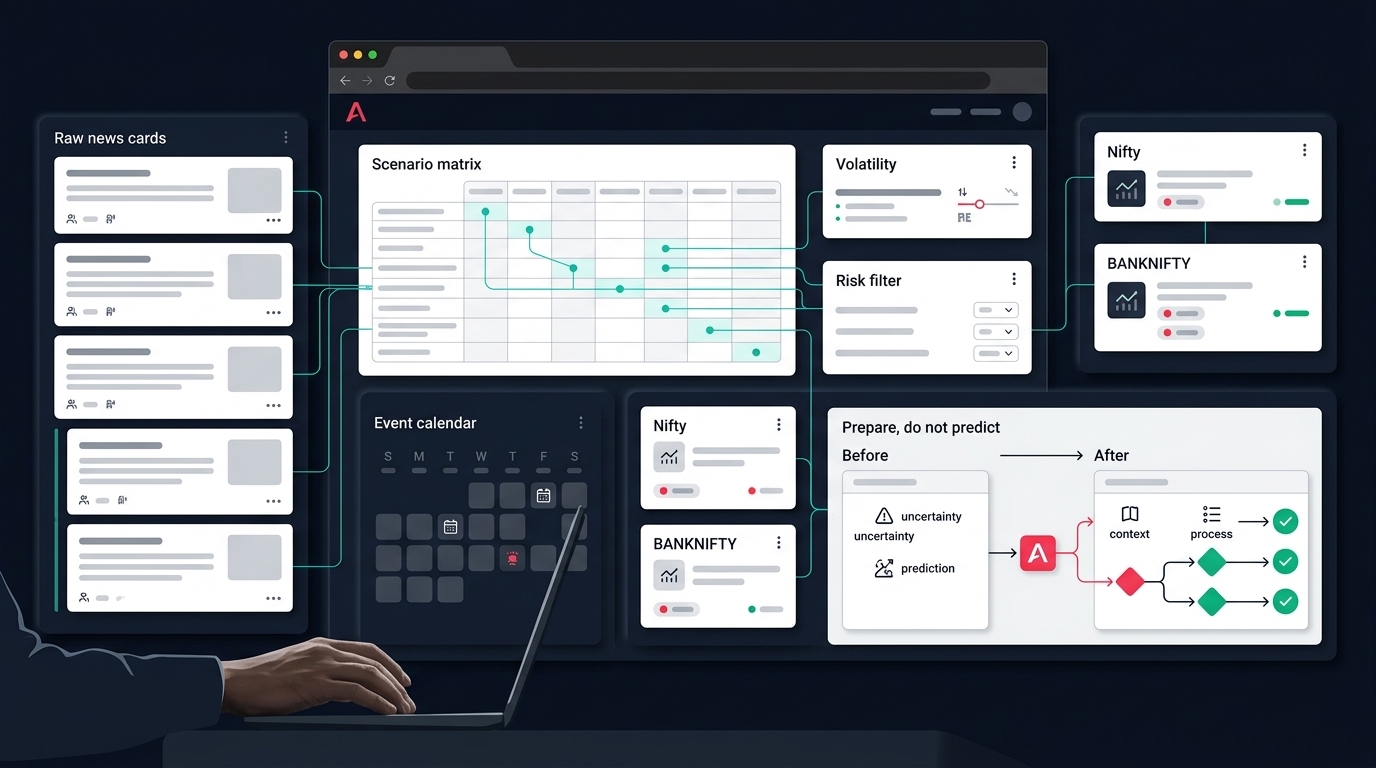
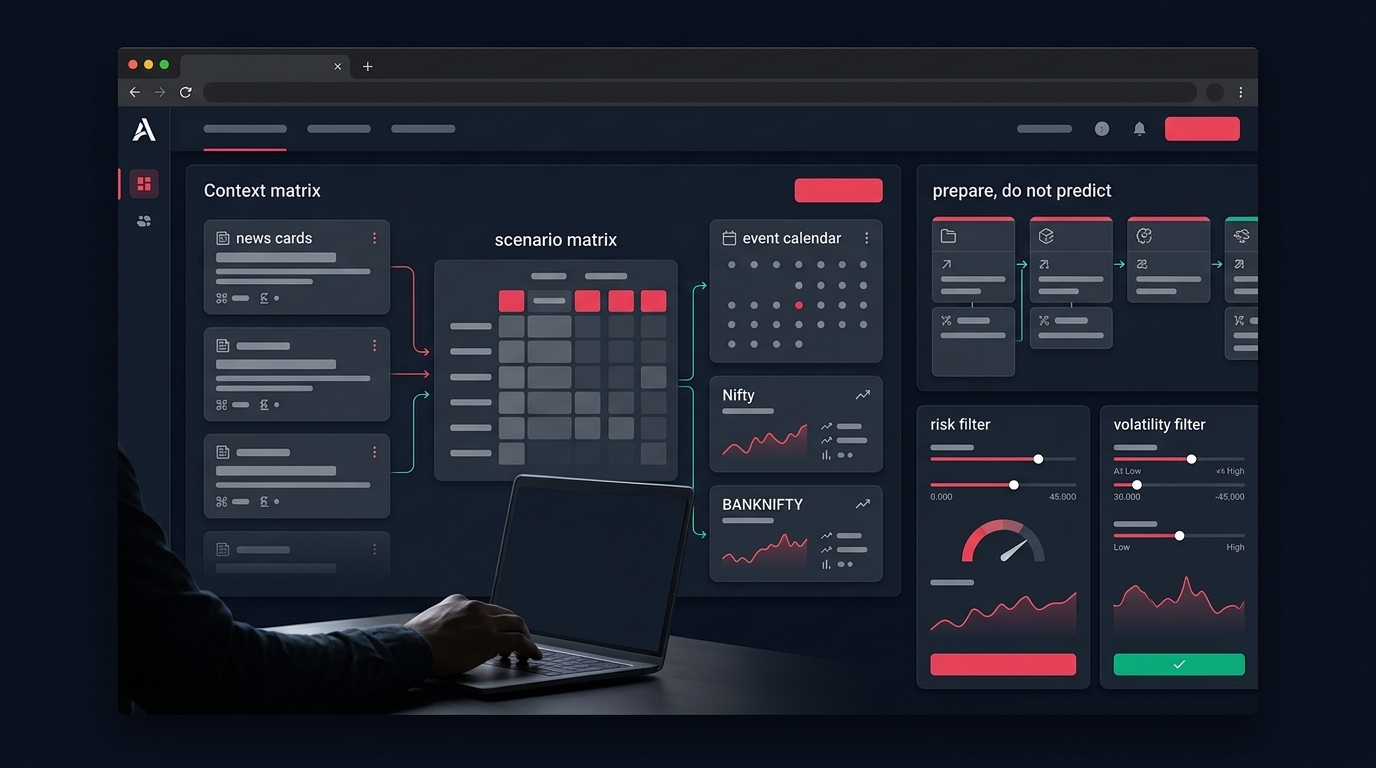
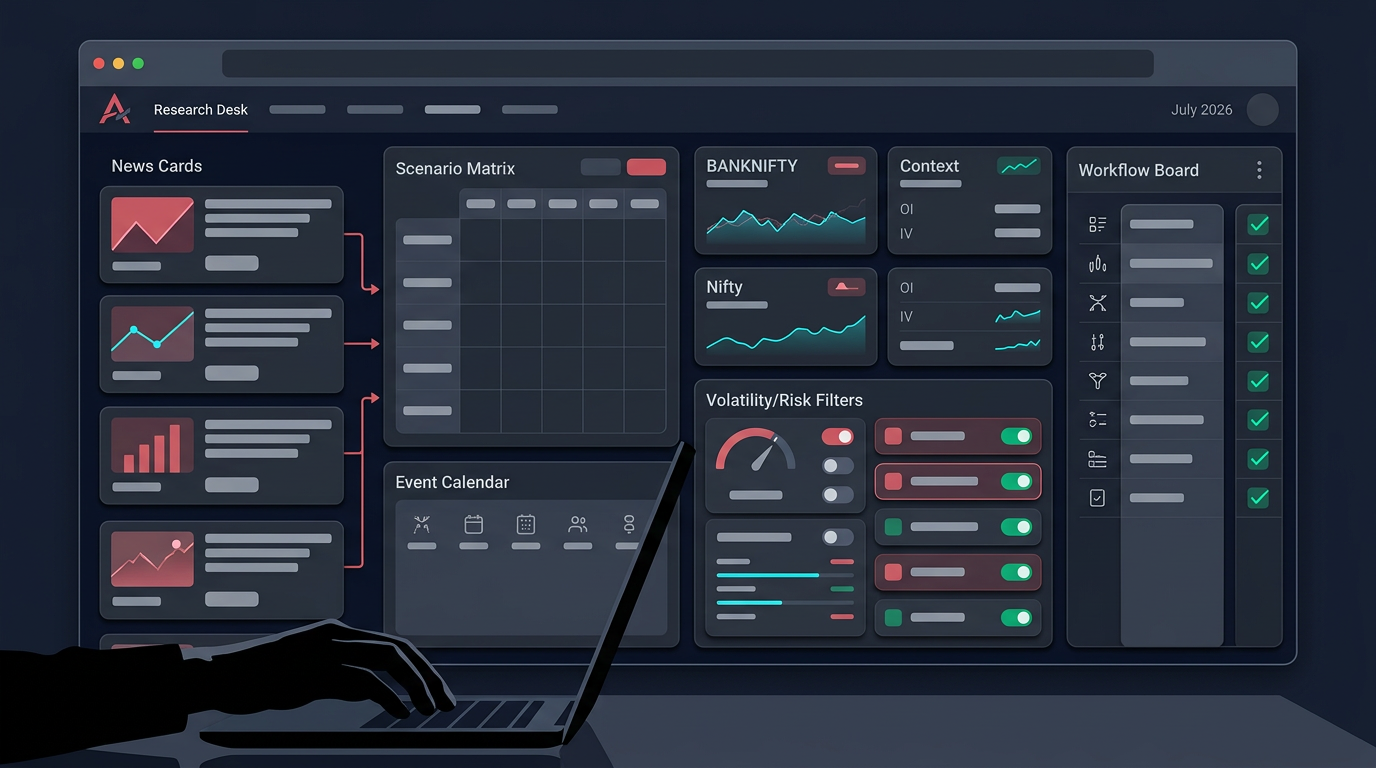
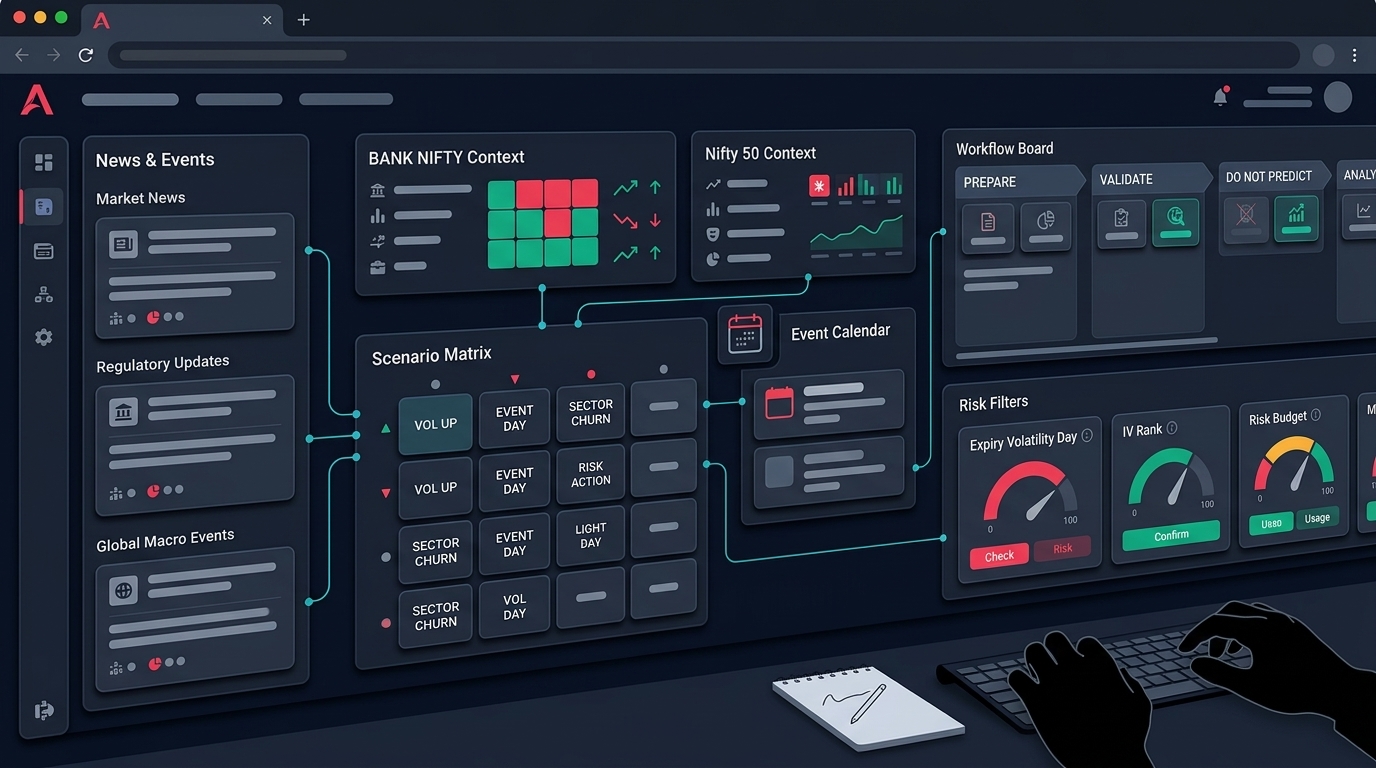
Pulling it together, here is how the chain fits into a disciplined session — the shape Anadi's options workspace is built around, with chain, OI analysis, IV/theta context, and position management as tabs in one desk rather than five browser windows.
Before open, establish context: which series expires today, where the meaningful OI sits in the next series, and whether any scheduled event overlaps the session. A weekly market outlook exists for exactly this — preparing context, not chasing intraday calls.
When a signal arrives — from a scanner or a watchlist — the chain is the validation step, not the discovery step. Check the strike's liquidity, its IV against neighbours, and what the structure's Greeks look like as a basket, with margin estimated before execution rather than discovered after. Anadi's chain view connects strike rows to basket preview and margin estimates for this reason: risk should be visible before the order exists.
During the session, the chain updates your risk state — net delta drift, gamma escalation as the expiring series ages, IV behaviour around any event. Your pre-written rules decide what those states permit. On a stacked expiry Tuesday, the honest answer is often "less than usual," and a system that sits out the noisiest hour has not failed. It has worked.
The checklist
Before your algo consumes Bank Nifty chain data on an expiry-volatility day, confirm:
- Series check — logic reads the series it intends to (expiring versus next monthly), not a merged blur.
- Freshness check — every snapshot is timestamped, and stale data is rejected, with tighter tolerance on expiry days.
- Liquidity gate — strikes with wide spreads or thin volume are excluded from both signals and IV calculations.
- Greek states mapped to actions — defined bands for net delta, a gamma-hour entry block, theta-versus-breakeven checks on bought premium, vega rules around events.
- Basket-level risk — stops and margin evaluated on the whole structure, never per leg.
- Filters backtested — every chain-derived rule tested against past expiry weeks before going live.
The live chain with OI and Greeks is genuinely useful — but for an algo trader its value is conditional on treating it as data to be validated, not truth to be obeyed. Build the filters, test them honestly, and let the chain tell you how much risk today's conditions permit.
If you want the chain, Greeks context, basket preview, and risk checks in one workflow instead of five tabs, request early access to Anadi Algo and pressure-test your process before the next expiry week does it for you.