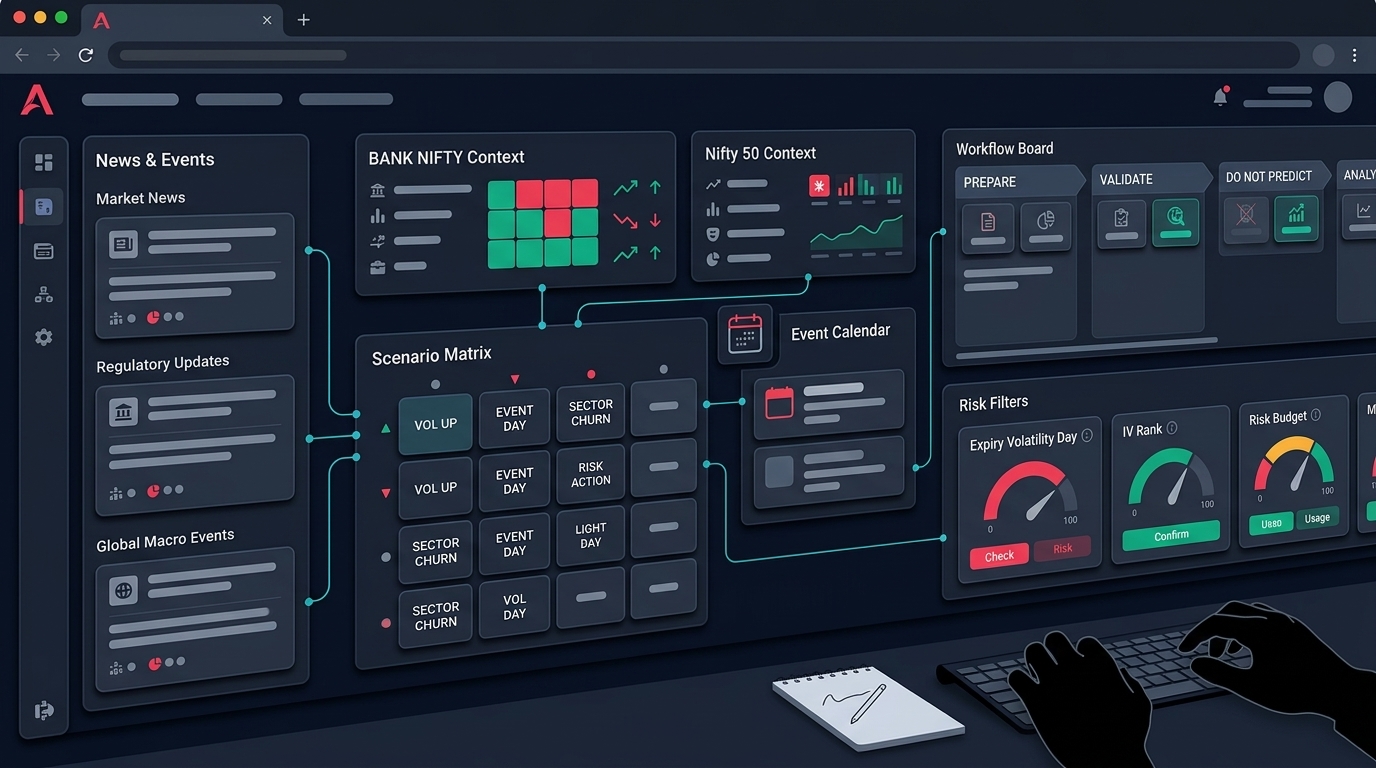
Every Bank Nifty trader has a live option chain page open somewhere — NSE's own chain, a broker terminal, or one of the popular chain trackers. The page updates, OI bars move, IV ticks around, and it feels like watching the market's mind in real time.
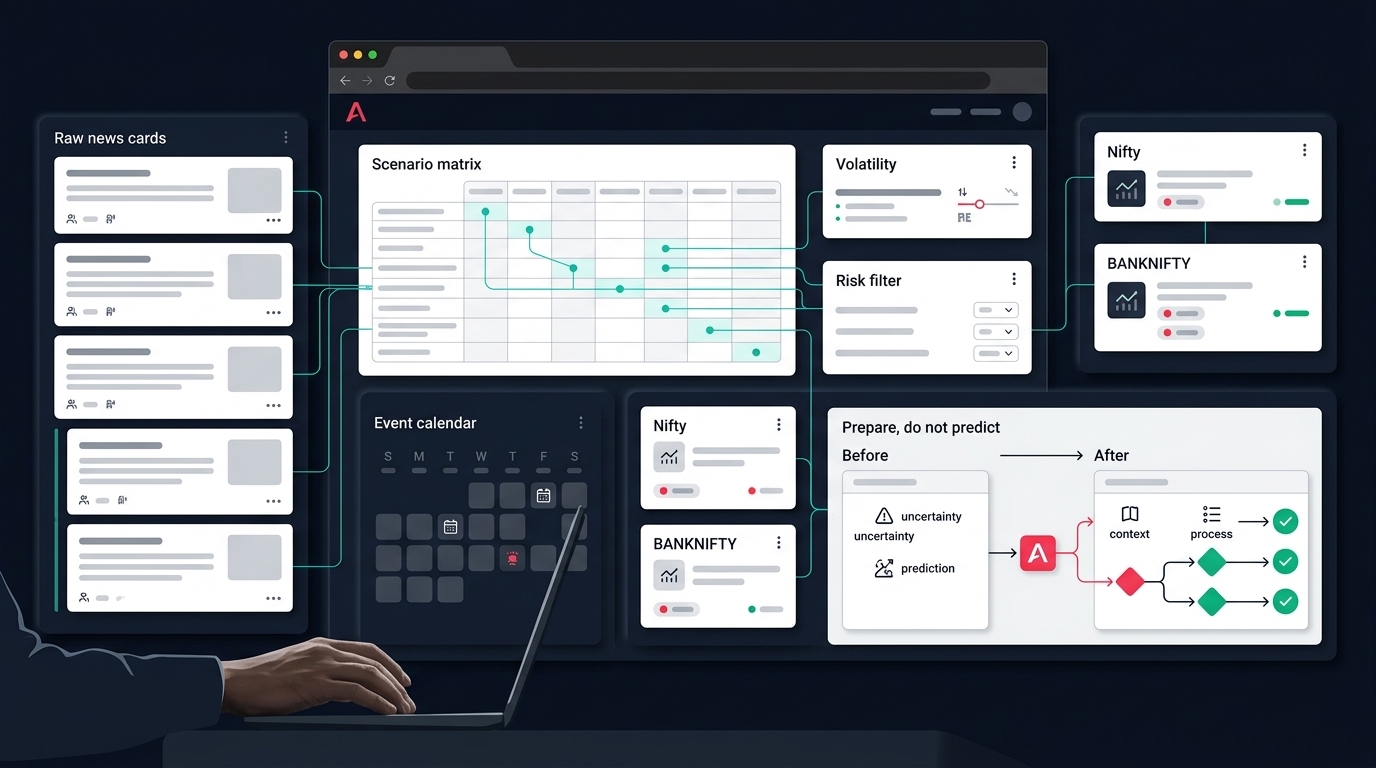
Here is the uncomfortable part for algo traders: watching a chain and using a chain are two different disciplines. A discretionary trader glances, forms a view, and moves on. An algo workflow needs that same chain converted into timestamped, validated, loggable inputs — otherwise your "OI-based filter" is really just a screenshot memory that nobody can backtest or audit.
This post is about that conversion, in the specific context of September 8, 2026: what the live chain shows, what it hides, and how to turn OI and Greeks into risk filters instead of trade calls. No predictions here — only process.
The live chain page is a snapshot, not a feed
Public option chain pages — including NSE's official one — are built for human reading. NSE's chain page even ships with streaming off by default and offers a CSV download, which tells you what it is: a periodic snapshot tool, not a low-latency data source.
That design is fine for inspection. It becomes a problem when traders treat the page as if it were their algo's data layer. Three gaps matter:
- Refresh lag. The OI figure you are reading was true at some point in the recent past. Intraday, especially in fast tape, "recent past" can be meaningfully different from "now."
- No history. The page shows current OI and change-in-OI versus the previous day. It does not show you the path — whether that OI built steadily through the morning or appeared in one burst at 1:45 pm. For a rules-based system, the path often matters more than the level.
- No timestamps you control. If your journal says "call OI was heavy at the 200-point-away strike," but you cannot say when you observed it, you cannot verify the observation later, and you definitely cannot backtest a rule built on it.
The fix is not a fancier page. The fix is treating the chain as data: every reading gets a timestamp, every derived number (PCR, ATM IV, max-pain-style summaries) gets recomputed from raw fields you stored, and every rule references the log — not your memory of the screen.
September 2026 context: a mid-cycle Bank Nifty chain on a Nifty expiry day
Calendar context changes how a chain should be read, and September 8, 2026 is a good example of why.
Bank Nifty now trades only monthly expiries, while Nifty continues to carry weekly contracts, with expiries falling on Tuesdays. September 8 is a Tuesday — so the market has a Nifty weekly expiry in play, while the nearest Bank Nifty expiry sits roughly three weeks away at the end of the month.
That combination creates two very different chains on the same day:
- The Nifty weekly chain is in its final hours. Gamma is concentrated, theta is brutal near the money, and OI at nearby strikes is being defended, rolled, or abandoned hour by hour.
- The Bank Nifty chain is mid-cycle. Premiums still carry weeks of time value, Greeks move more gently, and OI concentrations reflect positional views rather than expiry-day defence.
The common mistake is letting expiry-day intuition leak across. A trader watching violent moves in Nifty weekly options starts reading the Bank Nifty chain with the same urgency — treating a modest OI shift at a mid-cycle strike as if it were an expiry-hour battle line. It usually is not. Mid-cycle OI changes are slower signals, and rules calibrated on expiry-day behaviour will misfire when applied three weeks out.
There is also a spillover effect worth respecting as a scenario, not a forecast: index option expiry sessions can transmit volatility to correlated indices through the expiry window, especially in the last 90 minutes. An algo that trades Bank Nifty does not get to ignore the Nifty calendar just because Bank Nifty itself is not expiring.
Process implication: your system should know, as a hard input, (a) days to the nearest Bank Nifty expiry and (b) whether today is an expiry day for any major index. Those two flags alone justify different parameter sets — or a smaller size, or a no-trade window — without any prediction about direction.
What to actually log from the chain
If you accept that the chain is data, the next question is: which fields, how often, and with what checks? Here is a minimal, practical structure.
The minimum field set
For each snapshot, store at least:
- Timestamp (exchange time, not your laptop's clock)
- Spot level and the ATM strike you derived from it
- ATM IV for both call and put
- OI and change-in-OI for a band of strikes around ATM — five strikes either side covers most intraday work
- The top three call-OI and put-OI strikes for the active expiry
- PCR for the expiry, computed from the OI you stored (not copied from a page, so you can reproduce it)
- Days to expiry
Greeks deserve a note. If your data source provides delta, theta, and vega per strike, log them. If it does not, log the inputs (spot, strike, IV, time to expiry) so Greeks can be recomputed. What you should not do is eyeball Greeks from a page at 10:15 am and reference them in a post-trade review at 6 pm as if they were constant all day.
Snapshot cadence
For most retail algo workflows, a snapshot every 5 to 15 minutes is enough. You are not building a market-making system; you are building risk context. What matters is consistency — the same cadence every session — because inconsistent sampling quietly corrupts any statistic you compute later. Ek din 5-minute snapshots, agle din sirf do screenshots — that log is unusable.
Sanity checks before a snapshot enters the log
- Stale-data check. If the new snapshot is identical to the previous one across all strikes during market hours, suspect a frozen feed, not a frozen market.
- IV outlier check. A single strike showing IV wildly out of line with its neighbours is usually a bad print or an illiquid quote, not information. Flag it; don't filter on it.
- Post-expiry OI reset. The morning after any expiry, change-in-OI comparisons against the expired series are meaningless. Your log should mark series transitions explicitly.
- Liquidity floor. Strikes with negligible volume can show dramatic-looking IV and OI percentages. Set a minimum volume/OI threshold below which a strike is excluded from derived metrics.
This is exactly the discipline that separates a backtestable rule from a story. If you later want to test "avoid fresh shorts when put OI at the nearest support strike is unwinding," you can only test it against a log that captured OI at known times with known quality. Anything less and you are in the territory covered by every honest conversation about options backtesting — the backtest looks fine because the data never contained the thing that hurts you live.
From logged chain data to risk filters
Now the useful part: what do you do with this log? The answer, for a retail algo trader, is almost always risk filtering — deciding when not to trade, or how much smaller to trade — rather than signal generation.
IV level as a sizing input, not a direction input
Compare today's ATM IV against your own logged history — the last 60 to 90 sessions of your snapshots. If IV sits in the upper band of that range, premium-buying strategies face richer entry prices and premium-selling strategies face fatter tails. Neither fact tells you direction. Both facts justify adjusting position size or structure. A trader who checks IV context before choosing between naked options and spreads is doing risk management; a trader who buys options at inflated IV because "the chart looks strong" is fighting direction and volatility decay simultaneously.
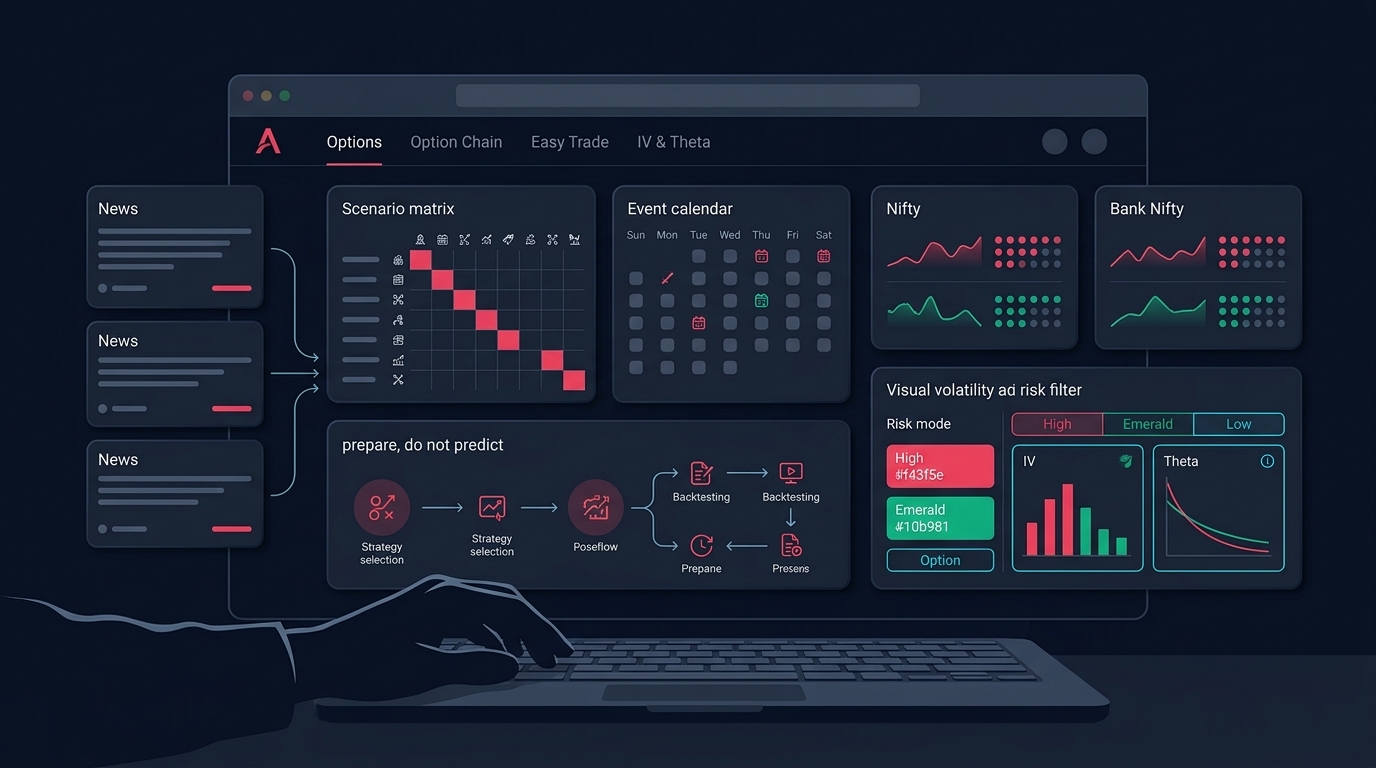
This is also where a dedicated IV and theta view earns its place in the workflow. In Anadi's options workspace, IV and theta context sits in its own tab beside the chain and strategy selection — before the trade, not after — precisely because structure selection is the decision IV actually informs.
OI concentration as context, not as a wall
High call OI at a strike above spot and high put OI below spot describe where option writers currently carry risk. Treat that as context: a range the market is currently positioned around, which can shift or break. The logged change-in-OI path tells you whether that positioning is fresh and growing or stale and unwinding — a meaningful difference the static page hides. What OI concentration is not: a guarantee of support or resistance, or a standalone entry trigger.
Event flags as avoidance windows
Your log plus a simple calendar gives you the cheapest risk filter available: scheduled-event avoidance. Nifty weekly expiry Tuesdays, monthly expiry sessions, RBI policy days, major global data releases — an algo does not need to predict any of these. It needs a flag that widens stops, cuts size, or pauses entries around them. Preparation over reaction is the whole point of reviewing a weekly market outlook before the week starts rather than chasing intraday headlines.
Pre-execution checks that use the same data
The final filter set runs at order time. Before any option order goes out, the workflow should confirm: the strike's liquidity clears your floor, the margin estimate accounts for existing positions, and the total basket risk fits your day's risk budget. In Anadi's option chain workflow, chain rows connect to leg actions and a basket preview with a margin estimate before execution — the sequencing matters more than the feature. Margin and risk shown after execution is trivia; shown before, it is a gate. The same philosophy applies whether you build rules in a BANKNIFTY strategy builder or code them yourself: every rule that reads the chain should have a partner rule that limits what the chain can make you do. That partner rule lives in risk management, not in the signal.
Workflow checks before automation touches the chain
A short list of failure modes worth checking this week, because they surface repeatedly in live retail setups:
- Page-versus-feed mismatch. If your algo consumes broker API data but you sanity-check against a public chain page, expect small disagreements. Decide in advance which source is authoritative, and log from that one.
- Clock discipline. All timestamps from exchange/broker time. A machine clock drifting two minutes makes every "OI built before the move" claim unverifiable.
- Series rollover handling. Verify your system switches cleanly to the next Bank Nifty monthly series after expiry week, including OI baselines resetting.
- Dry-run first. Any new chain-based filter should run in observation mode — logging what it would have done — before it controls real orders. Paper trading through AutoTrade exists for exactly this stage.
- Manual override rules written down. Decide before the session what you will do if the feed freezes or IV prints look wrong mid-trade. Deciding during the freeze is how small problems become large ones.
If you want this whole loop — chain inspection, IV/theta context, basket preview with margin, and risk checks — inside one workspace instead of six browser tabs, that is the workflow Anadi is building. You can request early access and test it against your own process.
The takeaway checklist
Before your next Bank Nifty options session, confirm:
- You know days-to-expiry for Bank Nifty's monthly series, and whether today is a Nifty expiry day
- Chain snapshots are logged on a fixed cadence with exchange timestamps
- ATM IV is compared against your own logged history, and it feeds sizing — not direction
- OI concentration is read with its change-in-OI path, and treated as context, not a wall
- Illiquid strikes are excluded from every derived metric
- Scheduled events map to explicit avoidance or size-reduction flags
- Margin and basket risk are checked before execution, with existing positions considered
- New chain-based rules run in observation mode before touching live orders
The live chain page will always be more exciting than the log. But the log is the only version of the chain your algo can be honest with.