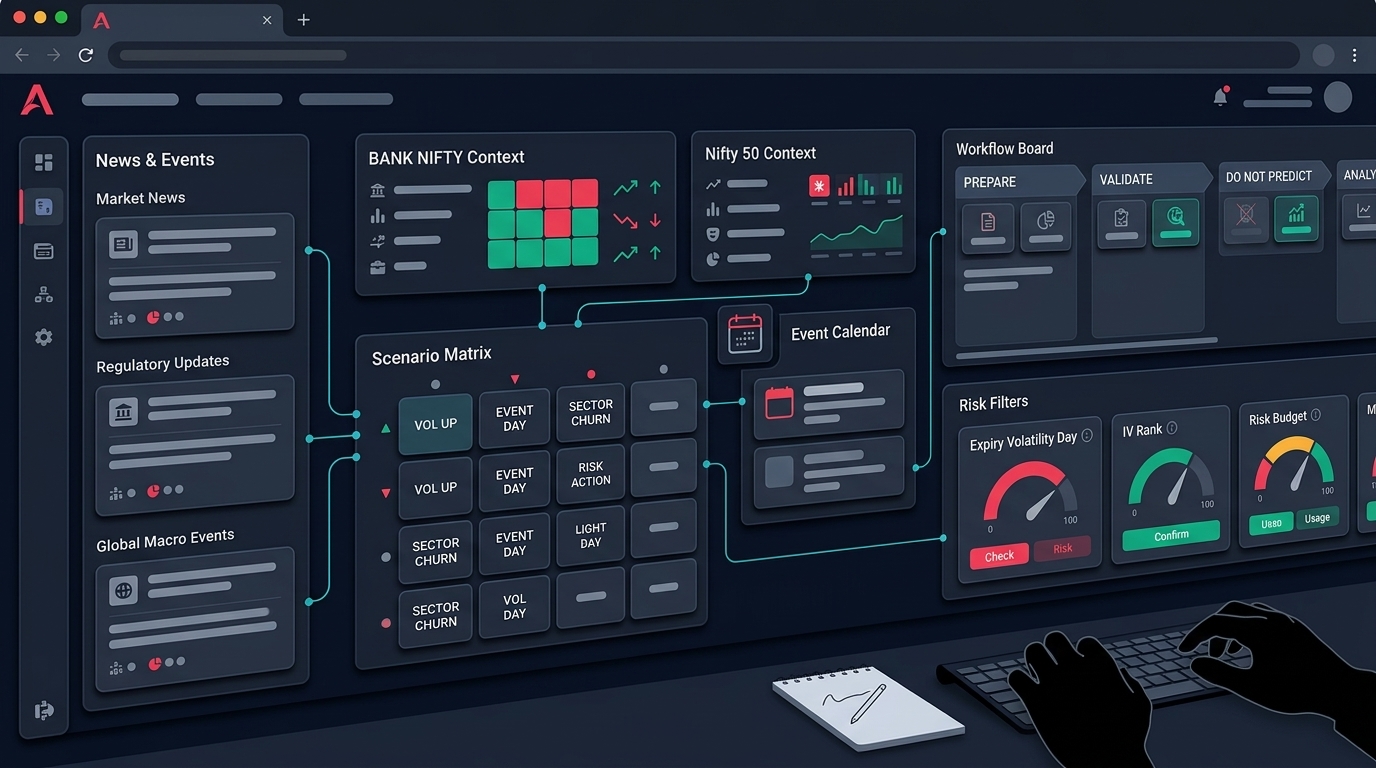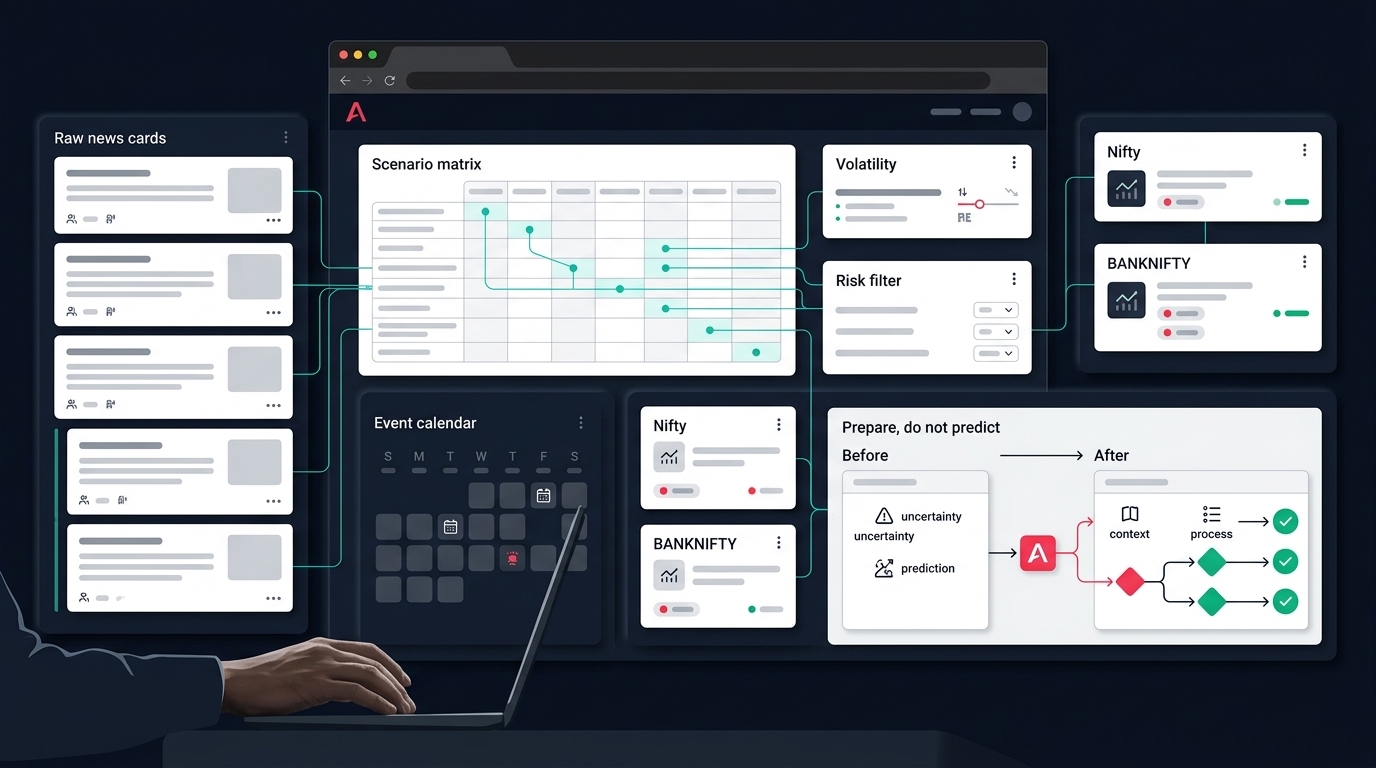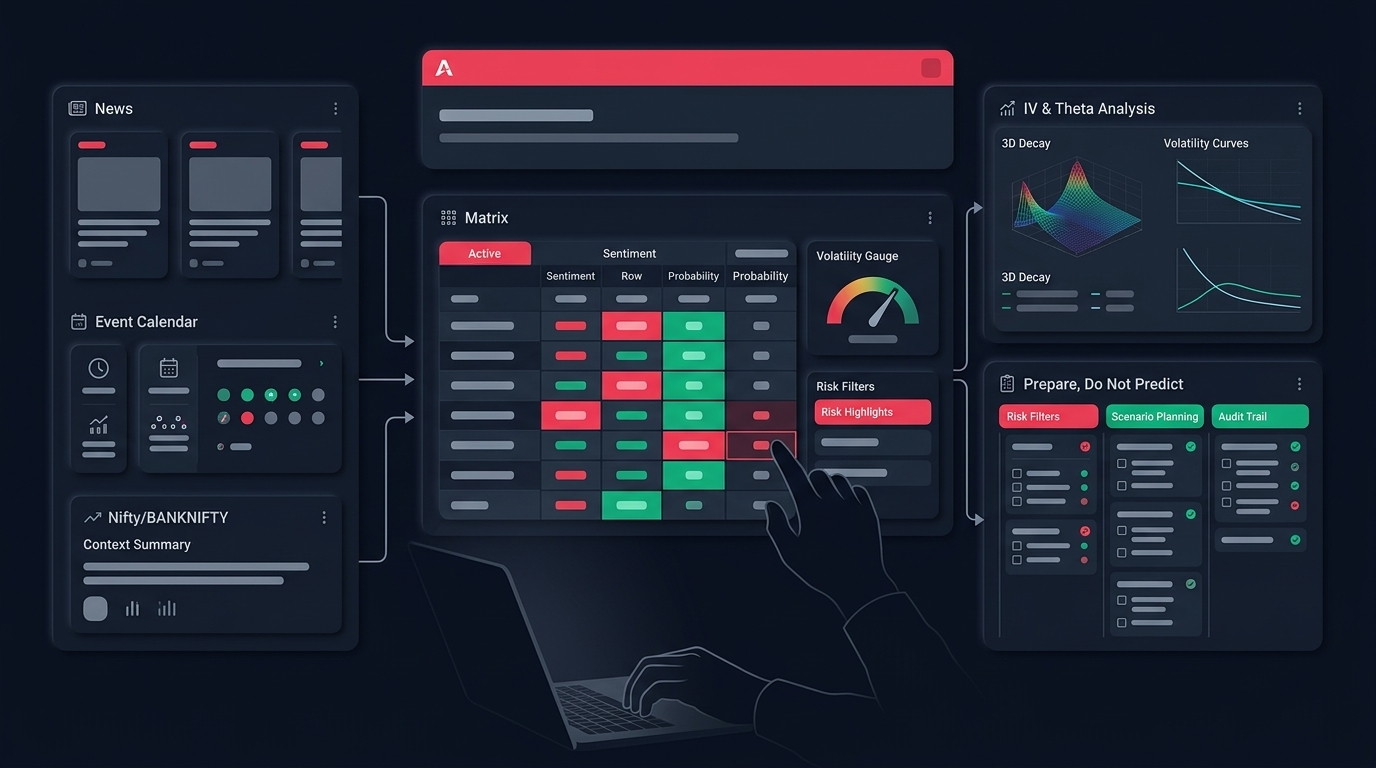
It is Monday, September 7, 2026. Nifty's weekly contracts expire tomorrow, on Tuesday. Bank Nifty has no expiry this week at all — its only expiry this month is the monthly contract at the end of September.
Yet a lot of retail traders will open a live Bank Nifty option chain tomorrow and read it exactly the way they read it on any other day: highest call OI is resistance, highest put OI is support, PCR below one is bearish, done. That shortcut ignores the single most important fact about this week — the index you are trading is not the index that is expiring, and the chain you are reading behaves differently because of it.
This post walks through what the live chain (OI, IV, Greeks, LTP) actually tells you on a week like this, how a Nifty expiry Tuesday can spill into Bank Nifty, and which risk filters are worth encoding into an algo before the session opens.
One Index Expires Tomorrow. The Other Doesn't.
The current expiry structure is easy to state and easy to forget in code. Nifty trades its weekly and monthly expiries on Tuesday. Bank Nifty no longer has weekly contracts — after NSE trimmed weekly products down to the benchmark index, Bank Nifty trades only monthly expiries.
So on September 7, the two chains are at completely different points in their life cycle:
- The near Nifty chain has roughly one day of life left. Theta is brutal, gamma is high, and OI at nearby strikes is actively being defended or unwound.
- The near Bank Nifty chain has around three weeks to run. Theta is slower, gamma is flatter, and a big chunk of the OI you see was built days or weeks ago.
That difference changes what every number on the chain page means. A 20 lakh OI wall on a contract expiring tomorrow is a position someone must deal with in hours. The same wall on a monthly contract is a position someone can sit on until the end of the month. Same column, same font, very different information.
One process note before anything else: never hardcode the expiry weekday into a strategy. Exchange holidays shift expiry dates, and expiry-day rules have changed more than once in the last two years. Read expiry dates from the instrument master or contract file your broker API provides, every single day. An algo that "knows" expiry is Tuesday is an algo waiting to be wrong on a holiday week.
What the Live Chain Page Gives You — and What It Doesn't
Live chain pages — NSE's own option chain, broker pages, third-party trackers — all present the same core table: calls on one side, puts on the other, with OI, change in OI, IV and LTP per strike. Four columns decide most of the interpretation. Here is how to read each one on a mid-cycle Bank Nifty chain specifically.
OI and change in OI are not the same signal
The strike carrying the highest call OI is where option writers have sold most aggressively — the market's working resistance. The highest put OI marks working support. Together they describe the range sellers are currently defending. This is positioning information, and it is genuinely useful. It is not a prediction. Writers get run over regularly, and the whole point of reading the chain is to know where that would happen, not to assume it won't.
On a monthly chain, the distinction between total OI and change in OI matters much more than on a weekly. Total OI includes positions accumulated since early in the series. Some of that is hedged, some is stale, some belongs to structures you cannot see. Fresh intraday OI build at a strike tells you where positioning is happening today — and that is the column an algo should weight. A rule that reacts to total OI on a three-week contract is reacting partly to history.
IV, LTP and the Greeks
Implied volatility is the price of uncertainty at that strike. The practical check is relative, not absolute: compare IV at your strike against neighbouring strikes and against its own recent range. Buying an option at inflated IV means the trade has to overcome both direction and volatility decay — being right on the move and still losing money is a very real outcome, and it is the most common way option buyers get confused by their own P&L.
Greeks on a mid-cycle monthly behave differently from what expiry-week habits suggest. Delta transitions across strikes are smoother, gamma near ATM is lower, and theta — while always working against the buyer — is not the cliff it becomes in the final week. If your strategy logic was tuned on expiry-week behaviour (fast gamma, sharp pin effects), running it unchanged on a three-week Bank Nifty contract is a category error, not a parameter tweak.
The summary numbers: PCR and max pain
PCR and max pain compress the entire chain into single numbers, which is exactly why they should be treated as context flags rather than entry signals. A PCR shift over the day tells you positioning is migrating; it does not tell you what to buy. As a scale reference, one broker's live page recently showed Bank Nifty moving in a day range of roughly 57,324 to 57,677 — a band of well under one percent. In a band that narrow, single-number sentiment summaries flip back and forth all day. Encoding "PCR crossed 1 so go long" is noise-chasing with extra steps.
How Nifty's Tuesday Expiry Can Spill Into Bank Nifty
Financial stocks carry the largest sector weight in Nifty 50, so the two indices rarely move independently. When Nifty has an expiry session, Bank Nifty usually feels it even though nothing on the Bank Nifty chain expires. Three scenarios worth preparing for — as scenarios, not forecasts:
A pinned, drifting Nifty. If Nifty spends expiry day oscillating around a heavy-OI strike, banking names often go quiet too. For a Bank Nifty algo this looks like shrinking ranges, more failed breakouts, and stop-outs on moves that never follow through. Momentum entries suffer; nothing is "wrong" with the strategy — the tape is being held.
An unwind move. If a defended Nifty level breaks near expiry, the unwind can be fast, and banks typically participate in the move. Bank Nifty option IV can jump intraday even though its own expiry is weeks away, repricing every open premium position on your book at once.
A last-hour distortion. The final hour of an index expiry session is when settlement-related flows concentrate. Even positions in the other index can see erratic prints, wider spreads, and OI numbers that look strange until the next morning's true-up. Expiry ke din sab kuch fast lagta hai — and most of that speed is mechanical flow, not information your strategy should trade against.
None of this says what Bank Nifty will do tomorrow. It says the distribution of outcomes on a Tuesday like this is wider and lumpier than on an ordinary Monday-to-Wednesday stretch, and your risk settings should know that.
Risk Filters Worth Encoding Before Tuesday
These are process filters, not signals. Numbers are illustrative starting points to backtest, not recommendations.
- Fresh-OI confirmation. Require intraday change in OI in the direction of your read before acting on any "OI wall" logic on a monthly chain. A level built two weeks ago, with zero fresh build today, should carry less weight in the rule — or none.
- Relative-IV gate. Before any long-premium entry, compare strike IV to the adjacent two strikes and to that strike's own multi-day range. If IV is stretched versus both, the structure choice should change (spread instead of naked buy) or the trade should skip.
- Spread and depth gate. Reject entries where the bid-ask spread exceeds a fixed percentage of premium — mid-cycle monthly strikes away from ATM can be far thinner than weekly-expiry habits assume. Slippage that a backtest never saw shows up here first.
- Time-of-day windows. Keep the algo out of the first 15–30 minutes on Tuesday, and either flatten or tighten risk in the final hour of the Nifty expiry session even for Bank Nifty positions. Both windows are dominated by flows your logic was not designed to read.
- Feed-sanity check. Chain pages can be snapshots, not streams — NSE's own page has an explicit streaming on/off state. An algo consuming chain data must validate timestamps and reject stale ticks. Acting on a five-minute-old OI snapshot during a fast expiry hour is how "the strategy worked but the fill didn't" happens.
- Basket-level stop and margin pre-check. For multi-leg positions, define loss limits at the basket level, not per leg, and estimate margin with existing positions considered before firing orders — expiry-day volatility is the worst time to discover a margin shortfall mid-execution.
If a filter blocks a trade tomorrow, that is the filter working. OI dekh kar entry lena is not analysis; analysis is knowing under which conditions the OI read is allowed to become an order.
From Chain Page to Workflow
The gap between reading a chain and trading it well is workflow, not information. Everyone sees the same OI table; what differs is whether validation happens before or after the order.
A reasonable sequence looks like this. Market context first — index and sector view, so a Bank Nifty setup is not taken against a broadly weak financials tape. Then signal generation through a scanner with defined rules, not chain-staring. Then chain validation: check the specific strikes for fresh OI, relative IV, and spreads before the trade, with the payoff and margin of the full structure previewed rather than discovered. This is the flow Anadi's options workspace is built around — chain, OI analysis, IV and theta context, basket preview and margin estimate sit in one place, and its Action Center marks signals as blocked when price has already run too far, which on a spillover-volatile Tuesday is exactly the protection late entries need.
Two more pieces close the loop. Rules like the filters above only earn trust through options backtesting — including expiry-week sessions, where slippage and gap behaviour differ most from calm weeks. And position-level discipline belongs in a written risk management plan with daily loss limits, so one distorted expiry hour cannot undo a month. If you want to formalise the whole thing as explicit entry, exit and filter rules, a BANKNIFTY strategy builder lets you encode and test them without touching code. For the broader week-ahead context, the weekly market outlook exists to help you prepare — not to hand you trade calls to chase.
A Monday Checklist Before Tuesday's Expiry
Before the open tomorrow, September 8:
- Confirm expiry dates from your broker's instrument master — never from a hardcoded weekday.
- Note which index expires (Nifty) and which doesn't (Bank Nifty), and check that your strategy's theta/gamma assumptions match a three-week contract.
- Mark the highest call-OI and put-OI strikes on both chains as context levels, not signals.
- Weight change-in-OI over total OI everywhere in your rules.
- Check your entry strikes' IV against neighbours and recent range before any long-premium trade.
- Set spread, depth and feed-timestamp gates so stale or thin data cannot trigger orders.
- Define time windows: reduced or zero activity at the open and in the Nifty expiry last hour.
- Pre-compute basket margin and basket-level stops for any multi-leg position.
- Decide now what makes you flatten manually — and write it down before emotions are involved.
The chain will tell you where positioning sits. Your process decides whether that information becomes a controlled trade or a chased one. If you want a workspace where chain reading, IV context, risk checks and execution live in one disciplined flow, you can request early access to Anadi Algo and put these filters to work on your own rules.