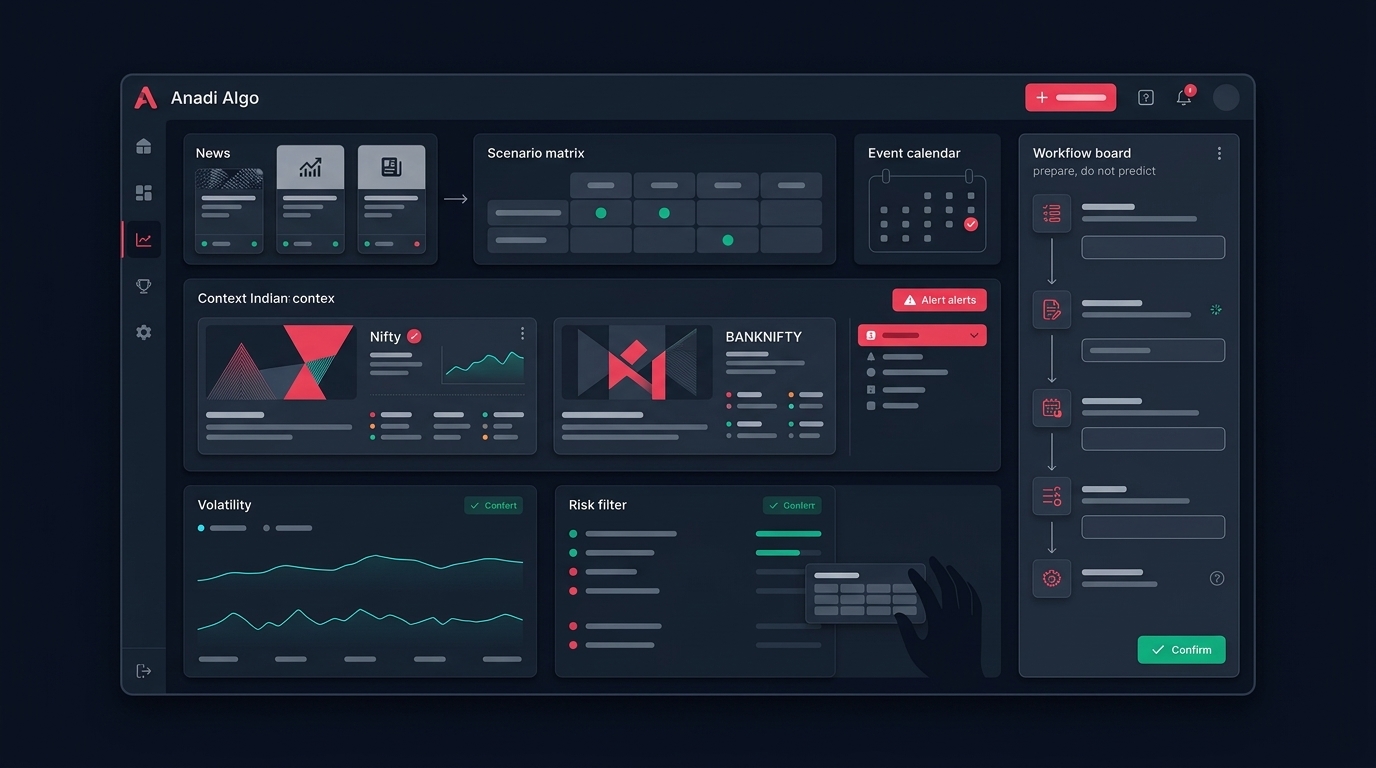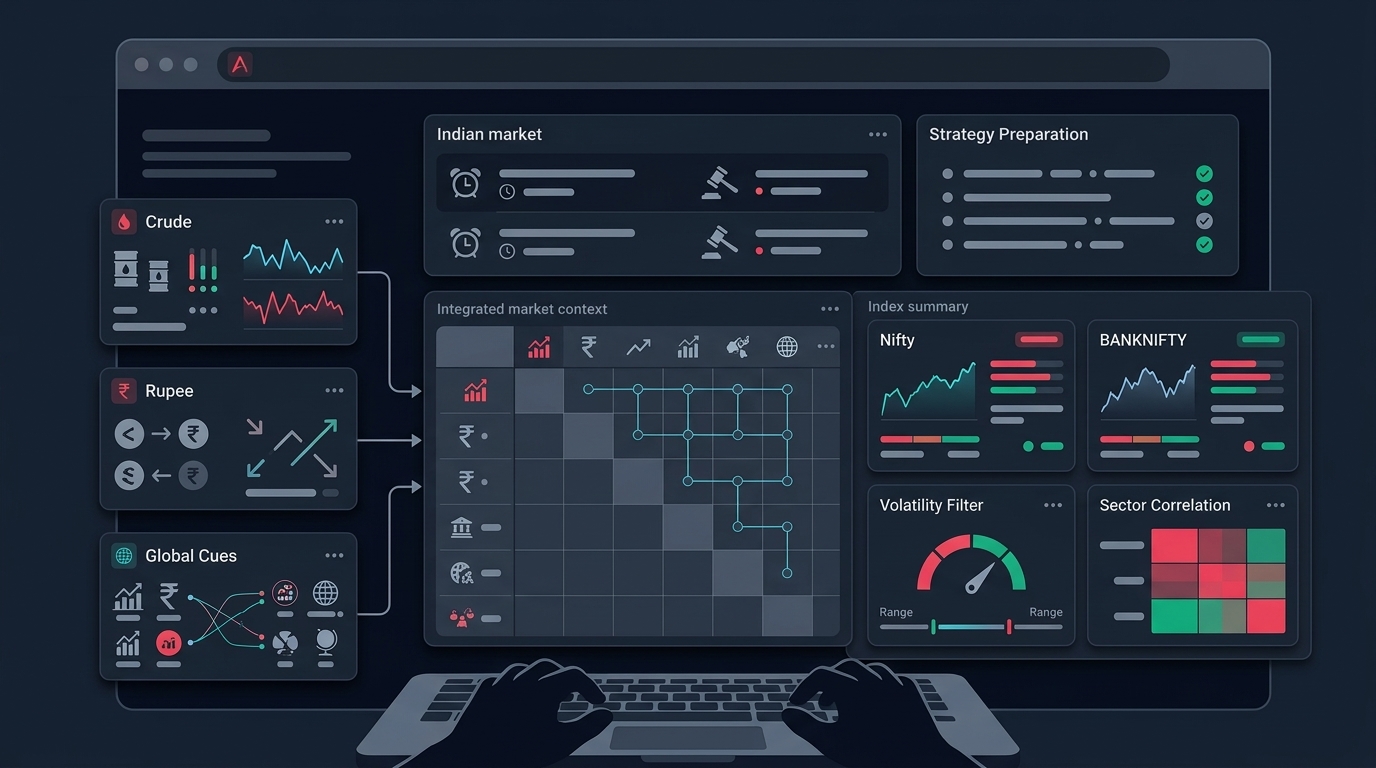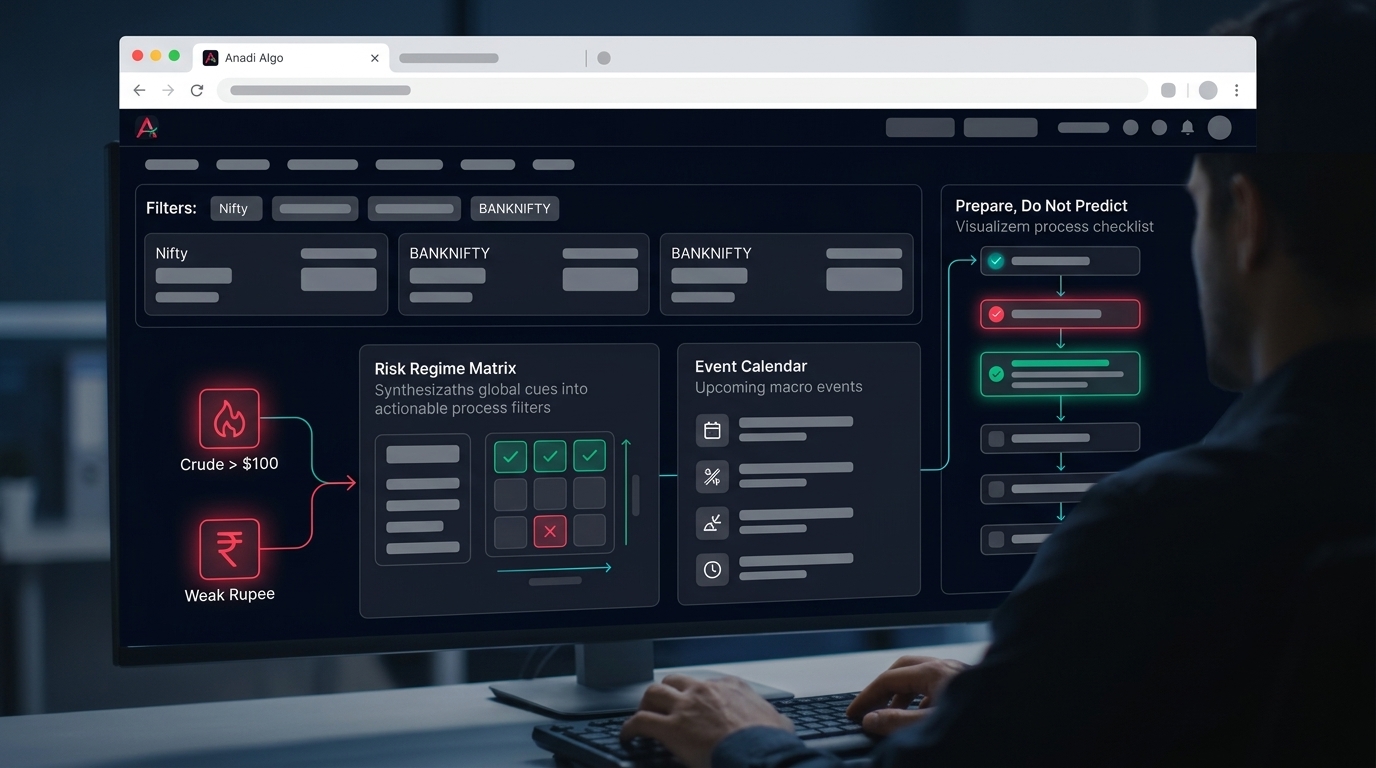
On September 9, 2026, the Sensex fell over 800 points and the Nifty closed below 23,450 as crude oil pushed past $100 a barrel. The rupee slipped further against the dollar, US equities declined overnight, and Asian markets moved in different directions — the classic "mixed global cues" phrase that fills every morning bulletin.
Here is the part that should bother you more than the fall itself: barely two weeks earlier, in late August, WTI crude had dropped more than 6% in two sessions to the $80–81 range, US Treasury yields were easing, and Gift Nifty was signalling gap-up opens. Before that, mid-August, Brent was above $91 on West Asia tensions and FII selling.
That is roughly $91 → $80 → $100-plus in about a month. If you run algos, the question is not "what happens next?" It is "was my system built for any of these regimes — and does it know which one it is in today?"
This post is about process for weeks like this one. No predictions, no trade calls.
What Actually Happened: A Month of Crude Whiplash
Stitch the recent market coverage together and the sequence looks like this:
- Mid-August: Brent climbed above $91 amid renewed West Asia tensions. Indian benchmarks fell, with FII selling, rising US bond yields, and a weakening rupee all cited as pressure points. Most sectoral indices traded lower, with pharma and oil & gas the exceptions.
- Late August: Crude reversed hard. WTI fell over 6% in two sessions to around $80–81, global yields cooled, and Indian markets were positioned for strong opens on improved sentiment. Derivatives commentary turned constructive.
- Early September: Crude surged again, this time past $100 a barrel. The Sensex dropped over 800 points in a session, the Nifty closed below 23,450, and the rupee lost further ground.
None of these individual moves is unusual. What is unusual is the compression: three distinct crude regimes inside roughly twenty trading sessions, each with its own yield backdrop, FII flow behaviour, and rupee trajectory.
For a discretionary trader, that is exhausting. For an algo, it is worse — because most retail systems carry parameters that were tuned in exactly one of these regimes and silently assume it will continue.
Why the Round Trip Matters More Than the Level
Plenty has been written about crude at $100 as a level. The more useful lens for a systematic trader is the rate of regime change.
Your Parameters Were Tuned in a Different Regime
Think about when you last optimised your intraday system. If it was during the late-August window — crude at $80, gap-up opens, constructive derivatives positioning — your stop distances, target multiples, and entry filters reflect that environment. Average true range was one thing then; it is another thing now.
A stop that was "two ATRs" in a calm week can be inside normal noise on a shock day. A breakout threshold that filtered well when the index moved 0.4% a day generates constant signals when it moves 1.5%. The strategy has not changed. The world under it has, twice, in a month.
Correlations Are Not Fixed
The tidy story — crude up, rupee down, Nifty down — held on September 9. But it did not hold uniformly in August: on some sessions oil & gas and pharma rose while the index fell; on others, IT dropped despite a weaker rupee that textbook logic says should help exporters.
If your system encodes a hard rule like "crude up means short index," you have encoded a correlation, not a law. Correlations drift, and they drift fastest exactly when regimes flip. This is the same trap covered in our post on why triggers conflict, but the September round trip is the sharpest live example of it this year.
The Transmission Channels, in Brief
Worth restating quickly, because these are the channels your risk filters should watch — not because they predict direction:
- Import bill and inflation. India imports most of its crude. Sustained prices above $100 feed inflation expectations, which feed rate expectations, which feed index valuations. "Sustained" is the key word — a two-day spike and a two-month plateau are different problems.
- The rupee. A weaker rupee amplifies the crude bill in local terms. Coverage this week noted the rupee falling 21 paise in a single session. For algos, rupee weakness mostly matters through its second-order effects: FII flow behaviour and sector rotation.
- US yields and FII flows. Mid-August coverage flagged rising US bond yields alongside FII selling. When dollar yields rise, the case for emerging-market risk weakens at the margin. You cannot trade this directly intraday, but it shapes whether dips get bought.
- Sector dispersion. High crude hits input-cost-heavy sectors (paints, aviation, OMCs on marketing margins) differently from upstream producers. This is not a tip sheet — it is a reminder that "the market fell" hides huge dispersion your scanner will surface.
A Process for the Sessions Ahead
Here is a workflow you can actually codify, whether you trade manually with rules or fully systematically.
Step 1: Classify the Open, Don't Predict It
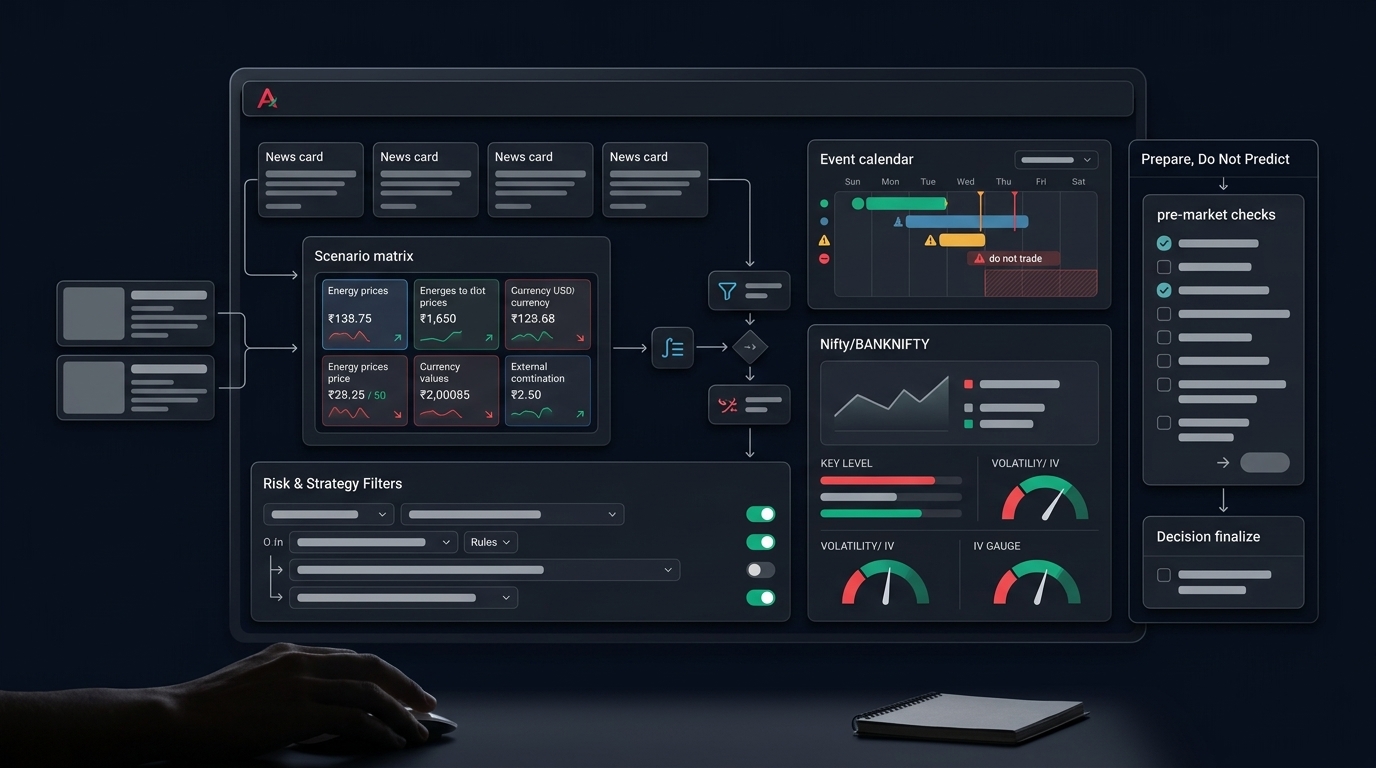
Before 9:15, write down which of three scenarios the pre-open evidence supports — and what your system does in each:
- Shock continuation: Crude holds above $100 overnight, Gift Nifty signals another gap down, Asia is uniformly weak. Expect wide opening ranges and fast invalidation of levels.
- Stabilisation: Crude flat-to-lower, Gift Nifty near parity, mixed Asia. Expect a choppy first hour where breakout systems get whipsawed.
- Relief move: Crude retreats meaningfully (the late-August pattern), yields soften, gap-up signalled. Expect gap-fade risk — a gap up into an ongoing macro problem is not the same as a gap up in a calm tape.
The point of writing scenarios is not to guess which one happens. It is that your algo should have a defined behaviour for each — trade normally, trade smaller, or stand down — decided the night before, not at 9:20 with a red screen.
Step 2: Codify Risk Filters Before 9:15
Turn context into machine-readable conditions. Examples of the shape such filters take (the exact numbers must come from your own backtests, not from a blog):
- Volatility gate: If India VIX is above your tested threshold, halve position size or disable mean-reversion entries.
- Gap gate: If the opening gap exceeds a defined percentage, skip the first N minutes of signals, because your backtested entries assumed continuity that a gap breaks.
- Event gate: Check where you are in the expiry cycle and whether any scheduled macro release (inflation prints, central bank commentary) lands during your trading window. Shock weeks plus event windows compound.
- Correlation sanity check: Log crude, USD-INR, and index direction daily. If your strategy implicitly depends on their usual relationship, alert yourself when it inverts.
Our risk management guide covers how to structure these as hard gates rather than soft intentions.
Step 3: Size for the Regime You Are In
The cheapest risk control available in a whiplash regime is size. If your normal deployment assumes the volatility of a calm week, cutting size by a third or half during shock weeks costs you some upside on good days and saves you disproportionate damage on bad ones — because slippage, gap-throughs, and stop-hunts all scale with volatility.
Also re-check margins. Option margins move with volatility, and a basket that fit your capital last week may not fit it this week. In Anadi's options workspace, the basket preview shows a margin estimate with existing positions considered before you fire the order — that check matters most in exactly these weeks, when traders discover margin changes at rejection time.
Step 4: Watch Execution Quality, Not Just Signals
On high-volatility days, the gap between backtested fills and live fills widens. Spreads widen at the open, quotes move between signal and order, and "market" orders in illiquid strikes get ugly fills.
This is where late-entry protection earns its keep. A scanner signal generated at 9:18 may be stale by 9:24 on a day like September 9. Anadi's Action Center attaches freshness and blocked reasons — like chase distance or invalidated price — to scanner-backed candidates precisely so that a signal which was valid does not become a bad entry because you acted late. On shock days, respecting a "blocked: price invalidated" tag is not missing a trade. It is the system working.
What This Does to Your Backtest
Two uncomfortable truths for anyone evaluating strategies this month:
First, your sample is probably regime-poor. If your backtest covers the last one or two years, count how many sessions in it featured crude above $100 with a falling rupee. Likely very few. A strategy that looks robust on that sample is really "robust in the regimes the sample contained." Before trusting it this week, slice your backtesting results by volatility bucket — performance on the top decile of high-range days is the number that matters right now, not the blended average.
Second, recency-tuned parameters are now stale twice over. If you re-optimised in late August because "the market changed," you tuned to the $80-crude relief regime — which lasted about two weeks. Chasing each regime with a re-optimisation is how systems end up permanently one regime behind. The better discipline: build strategies whose edge survives across regimes even if performance varies, and use regime filters (trade / reduce / stand down) rather than regime-specific parameter sets you cannot validate fast enough.
Yehi asli farak hai between a tested system and a tuned one — the tested one has already seen days it does not like, and you know what it does on them.
If you want a structured way to encode entry, exit, and filter rules without writing code, a no-code strategy builder forces you to make these conditions explicit — which is half the battle, because an explicit rule can be backtested and a vibe cannot.
Where This Leaves You for the Coming Sessions
Nobody knows whether crude holds above $100, fades back to the 80s again, or does something in between. The August-to-September round trip is proof that confident forecasts on this exact question had a shelf life of days.
What you control is process. Our weekly market outlook exists for exactly this use: take the macro context in once, before the week, convert it into filters and scenarios — then stop consuming intraday noise that begs you to override your system.
If you are still evaluating whether your workflow can handle weeks like this — scanner signals with freshness checks, strategies with explicit risk gates, backtests you can slice by volatility regime, and paper execution before real capital — you can request early access to Anadi Algo and pressure-test it on the current tape, where it counts.
Post-Shock Session Checklist
Before the next open, run through this:
- Regime log updated: Crude level and 5-day change, USD-INR, India VIX, US yields, Gift Nifty indication — written down, dated.
- Scenario sheet written: Continuation, stabilisation, relief — with a defined system behaviour for each.
- Volatility and gap gates active: Thresholds from your own tests, enforced in code or hard rules, not memory.
- Size reduced to regime-appropriate levels: And margin rechecked for every options basket at current volatility.
- Backtest sliced by regime: You know how your strategy behaved on its worst high-volatility decile, not just on average.
- Stale-signal protection on: Freshness and chase-distance limits respected; a late entry declined is a risk avoided.
- Override rules pre-written: The only manual interventions allowed are the ones you documented before 9:15.
The traders who get hurt in regimes like this are rarely the ones with the worst strategies. They are the ones whose systems assumed the world of two weeks ago. Make sure yours knows what month it is.