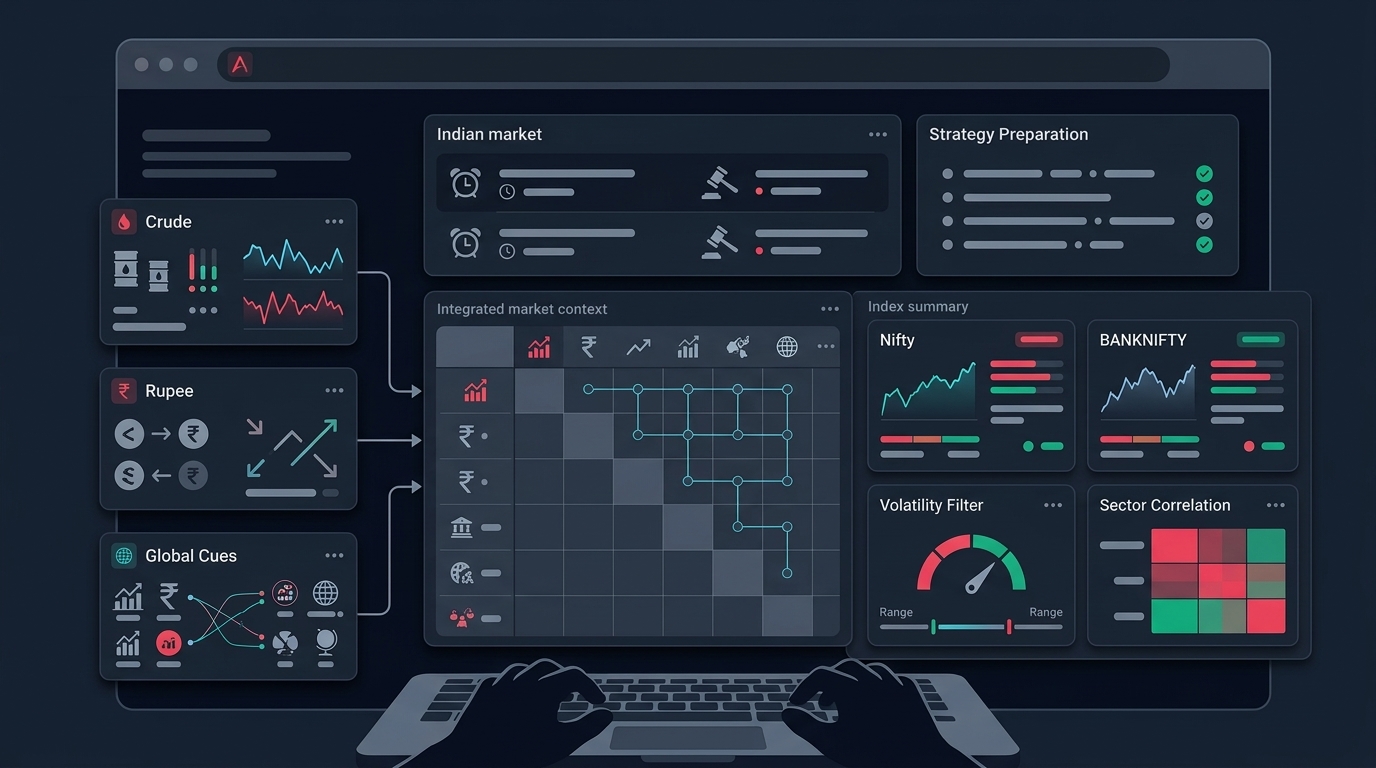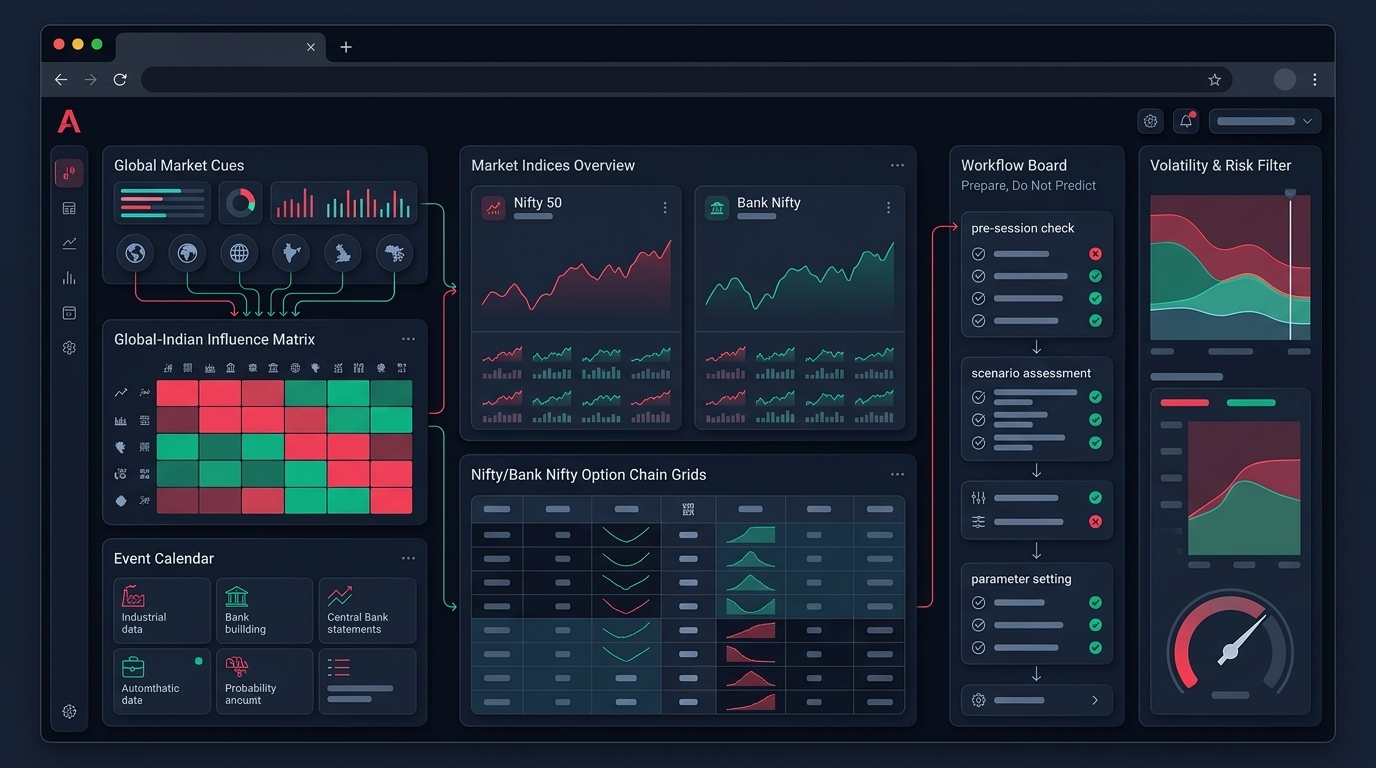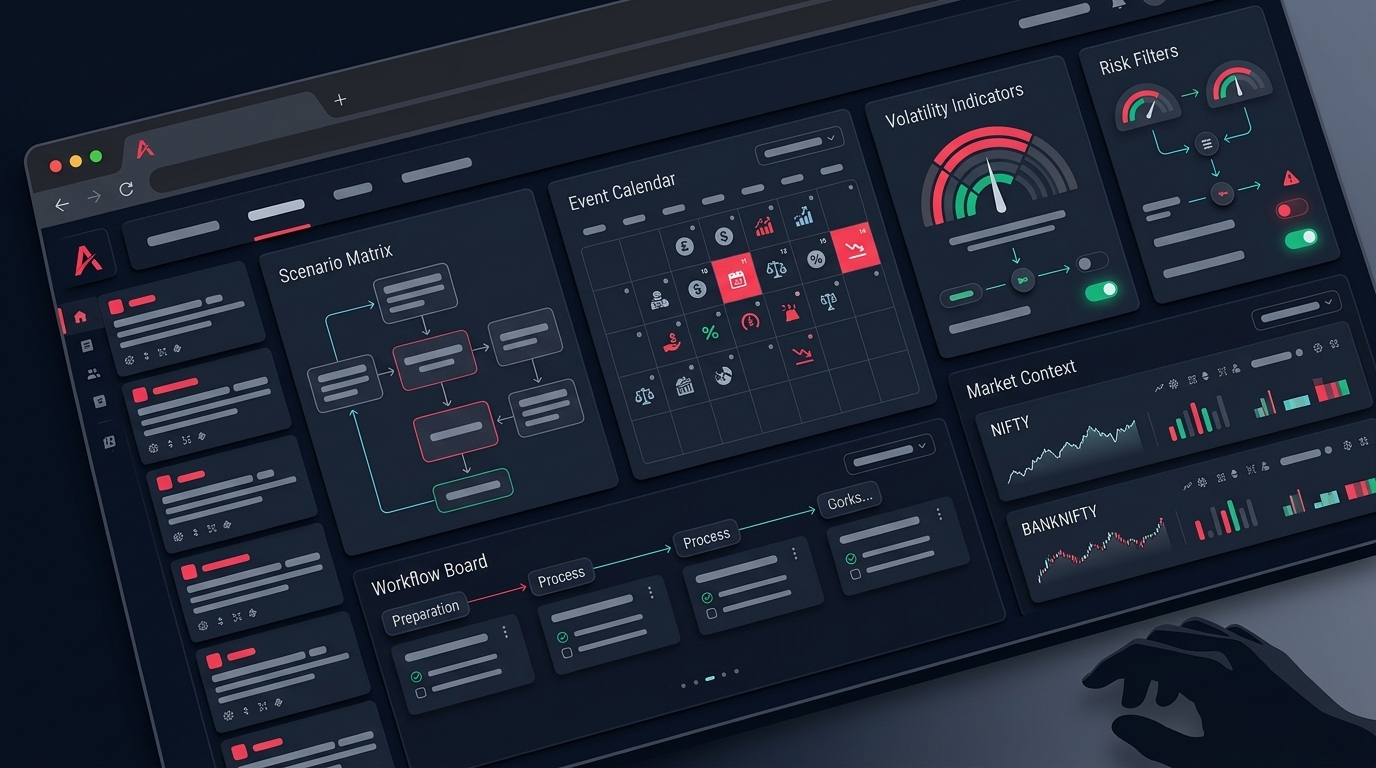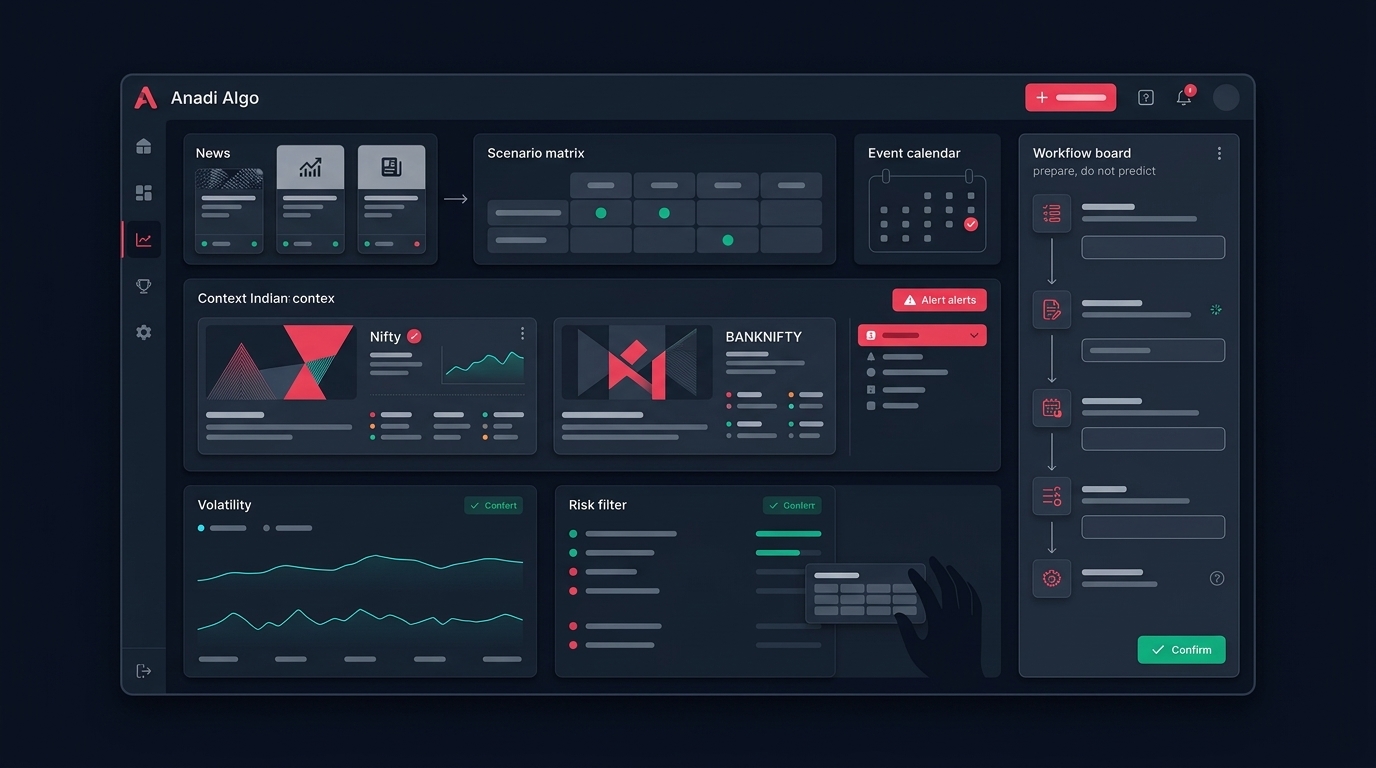
If you opened any market app this morning, you saw the same stack of headlines: crude oil hovering near multi-month highs, the Iran conflict still unresolved after a peace deal expired, global cues mixed, and the rupee under watch. As of August 21, crude was trading near the $95 mark on reports that neither side was making efforts to resume talks.
For a discretionary trader, the question is "kya lagta hai, market upar ya neeche?" For an algo trader, that is the wrong question entirely. Your system does not need a view on crude. It needs a process for mornings when crude is the headline.
This post walks through what today's opening updates actually contain, why the first hour deserves its own rules, and how to convert morning context into checks your system can execute — without a single prediction.
Why the First Hour Deserves Its Own Process
The Indian market's opening session absorbs everything that happened overnight: US market close, Asian session moves, crude and currency shifts, and any geopolitical news that broke while you slept. That is why the first hour is routinely the most volatile part of the day — the market is repricing twelve-plus hours of information in about sixty minutes.
Most retail algo losses on headline-heavy mornings do not come from having a bad strategy. They come from running a normal-day strategy in an abnormal-day opening. The signal logic was fine; the context filter was missing.
The fix is not to switch your system off every time crude makes news. Crude has been making news for weeks — if "headline exists" were your off switch, you would never trade. The fix is a time-boxed process: specific checks before the open, at the open, and through the first hour, each producing a decision your system can act on.
What This Morning's Updates Actually Contain
Before building rules, be clear about what each morning input tells you — and what it does not.
Crude oil: a conflict between two forces
The current crude picture is genuinely two-sided, which is exactly why it produces whipsaw. On one side, supply fear: the Strait of Hormuz situation remains unresolved, an earlier peace deal expired this week, and attacks on shipping have kept a war premium in prices. On the other side, demand weakness: OPEC cut its 2026 global oil demand growth forecast to 580,000 barrels per day, and the IEA now expects oil consumption to contract by 1.6 million barrels per day this year.
Supply fear pushes crude up. Demand downgrades pull it down. When both forces are active, crude can swing on every fresh headline — which means any Indian market reaction keyed off crude can also reverse intraday. For your process, the takeaway is not "crude will rise" or "crude will fall." It is: crude-driven moves right now have a higher chance of reversing than trending, so entry confirmation matters more than speed.
The rupee: the transmission channel
India imports the bulk of its crude requirement, so sustained high crude feeds into the import bill, inflation expectations, and rupee pressure. The rupee matters to equity algo traders for a second-order reason: FII behaviour. A weakening rupee erodes dollar returns for foreign investors, which can affect flows into index heavyweights. You do not need to trade USDINR to care about it — a sharp rupee gap at open is a risk-state input, not a signal.
Global cues: tone, not direction
US close, Asian markets, and GIFT Nifty set the opening tone. But tone is not direction for the day. Markets frequently gap in one direction on global cues and spend the session doing something else. Recent sessions have shown exactly this pattern — rangebound trade while investors balanced improving global cues against crude concerns. Treat global cues as an input to how much risk you allow, not which side you take.
A Time-Boxed Opening Process for Algo Traders
Here is a structure you can adapt. The goal at each stage is a classification, not a forecast.
Before 9:00 AM: classify the day
Spend ten minutes producing one label for the day. A simple three-state scheme works:
- Normal: crude moved under 2% overnight, GIFT Nifty gap under 0.5%, no fresh geopolitical escalation, rupee stable.
- Elevated: one or two of those thresholds breached, or a scheduled event (expiry, policy, major data) lands today.
- Defensive: multiple thresholds breached, or an unscheduled shock overnight (fresh strikes, a major policy announcement, a currency move well outside recent range).
The exact thresholds matter less than having them written down before the open. A trader deciding thresholds at 9:14 with a gap on screen is not classifying — they are reacting. This classification then drives concrete parameters: position size, number of concurrent positions, and whether new entries are allowed in the first 30 minutes. If you maintain a risk management framework, the day-state label is the top of it.
9:00–9:15: the pre-open window
The pre-open auction gives you an indicative open. Use it for verification, not trading:
- Does the indicative Nifty level match what GIFT Nifty implied? A large mismatch means the open is still finding itself.
- Are your broker sessions alive? Headline mornings are the worst time to discover an expired API token. Fire a test order status call or margin check before 9:15, not after your first signal.
- Is your data feed showing pre-open ticks correctly? A feed that lags at open will feed your strategy stale prices exactly when prices move fastest.
9:15–9:45: first prints are data, not signals
The first fifteen to thirty minutes produce wide spreads, erratic prints, and levels that look like breakouts but are just the market settling. Two rules help:
- Spread gate: block entries when the bid-ask spread on your instrument exceeds a defined limit. Option spreads at open on a crude-headline morning can be several times their normal width — your backtest almost certainly did not model that.
- Chase-distance gate: if price has already moved a defined distance beyond your signal level, the entry is late. Skip it. This is one of those rules that feels painful in the moment and saves capital over a quarter. In Anadi's Action Center, this shows up as an explicit blocked reason on a candidate — "entry blocked: chase distance" — which is a useful pattern to copy even if you run your own stack: make the block visible and named, not silent.
9:45 onwards: let filters release, not headlines
By mid-morning, spreads normalise and the day's real structure starts forming. If your day-state was Elevated, this is where reduced-size entries can resume — released by your own filter conditions (spread back under limit, realised volatility inside band), not by a TV anchor saying "market stabilises." Signal freshness matters here too: a scanner signal generated at 9:18 on settling prices is not the same quality as one generated at 10:15 on formed structure. If your scanner does not timestamp signals and track freshness, add it — stale signals executed late are a quiet source of slippage.
Turning Morning Context into Executable Rules
The difference between "I watch crude" and "my system handles crude mornings" is encodability. Some examples of the translation:
- "Crude is volatile" becomes: if overnight Brent/MCX crude move exceeds 2%, cap concurrent positions at half of normal.
- "Global cues are weak" becomes: if GIFT Nifty gap exceeds 0.75%, no market orders in the first 30 minutes; limit orders only.
- "Rupee is under pressure" becomes: if USDINR gaps beyond a defined band, disable strategies whose backtest sample contains no similar currency-stress days.
- "It's a nervous market" becomes: daily loss limit reduced by a fixed fraction on Defensive days, checked by the system, not by willpower.
Notice what these rules never contain: a view on where the market goes. Every rule maps a context measurement to a risk parameter. That is the entire discipline. If a morning update cannot be turned into a measurable condition and a parameter change, it is commentary — interesting, but not actionable for your system. A no-code strategy builder makes this translation easier because conditions like gap size, volatility bands, and time-of-day windows become explicit blocks you can see and edit, rather than assumptions buried in code.
For options traders specifically, morning context adds one more check: IV. Elevated crude and geopolitical risk tend to keep option premiums rich. Before any short-premium entry, look at the chain — not just the strike price, but the spread on that strike and the margin the full position needs. Anadi's options workspace puts chain, basket preview, and margin estimate in one flow for this reason: the decision "is this trade affordable and liquid right now" should be answered before the order, not discovered after.
Backtest the Open Before You Trade the Open
If your strategy trades the first hour, your backtest needs to earn that right. Three checks:
- Gap handling: does your backtest engine fill orders at realistic post-gap prices, or at yesterday's close plus your signal level? On mornings like today's, that difference is the whole result.
- Opening spread assumptions: a flat slippage number calibrated on mid-day fills will flatter first-hour trades badly. If you cannot model time-varying slippage, at least run the strategy with entries delayed past 9:45 and compare.
- Sample composition: count how many crude-shock or gap days your backtest sample actually contains. A system tested mostly on calm months has simply never met a morning like this one. Proper backtesting on Indian options data, including stressed periods, is the only honest way to know how your rules behave when spreads widen and premiums jump.
And before any of this goes live with real money on a Defensive-state morning, run it through paper trading on exactly these mornings. Paper results on calm days tell you little; paper results on headline days tell you whether your gates actually fire.
Mistakes Traders Make on Headline Mornings
- Overriding the system because the headline feels big. If crude at $95 justifies a manual override today, it justified one last week too. Either encode the condition or accept the system's decision.
- Widening stops "because volatility." Volatility is an argument for smaller size, not looser risk. Same rupee risk per trade, fewer rupees deployed.
- Trading the first candle of a gap open. The first prints after a gap are auction noise. Your edge, if it exists, is in the structure that forms after — not in being first.
- Reading every crude update intraday. You classified the day before the open. Unless something crosses a pre-defined re-classification threshold, the 11 AM crude headline is noise for your process.
- Confusing a rangebound session with a safe one. Recent sessions have been rangebound precisely because opposing forces are balanced. Balanced forces can unbalance in one headline — which is why the day-state stays Elevated even when the chart looks quiet.
A Reusable Checklist for Crude-Headline Mornings
- Classify the day before 9:00 — Normal, Elevated, or Defensive — using written thresholds for crude, GIFT Nifty gap, and rupee.
- Map the label to parameters: size, max positions, entry window, daily loss limit.
- Verify broker session, margin availability, and data feed before 9:15.
- Enforce spread and chase-distance gates for the first 30 minutes minimum.
- Check signal freshness — trade formed structure, not settling prints.
- For options: chain spreads, IV context, and margin before any basket goes out.
- Log what fired and what was blocked; review the blocks weekly — they are your cheapest lessons.
- Re-classify only on pre-defined thresholds, not on headlines.
Nobody knows whether the Hormuz standoff resolves next week or drags for months, and your trading process should not depend on knowing. Context is for preparation, not prediction — that is the same principle behind our weekly market outlook: use the week's known events to set your risk posture, then let your rules do the trading.
If you want a workflow where day context, scanner signals, blocked-entry reasons, option chain checks, and margin sit in one place — tested on paper before a single rupee is live — request early access to Anadi Algo and build your opening process once, properly.