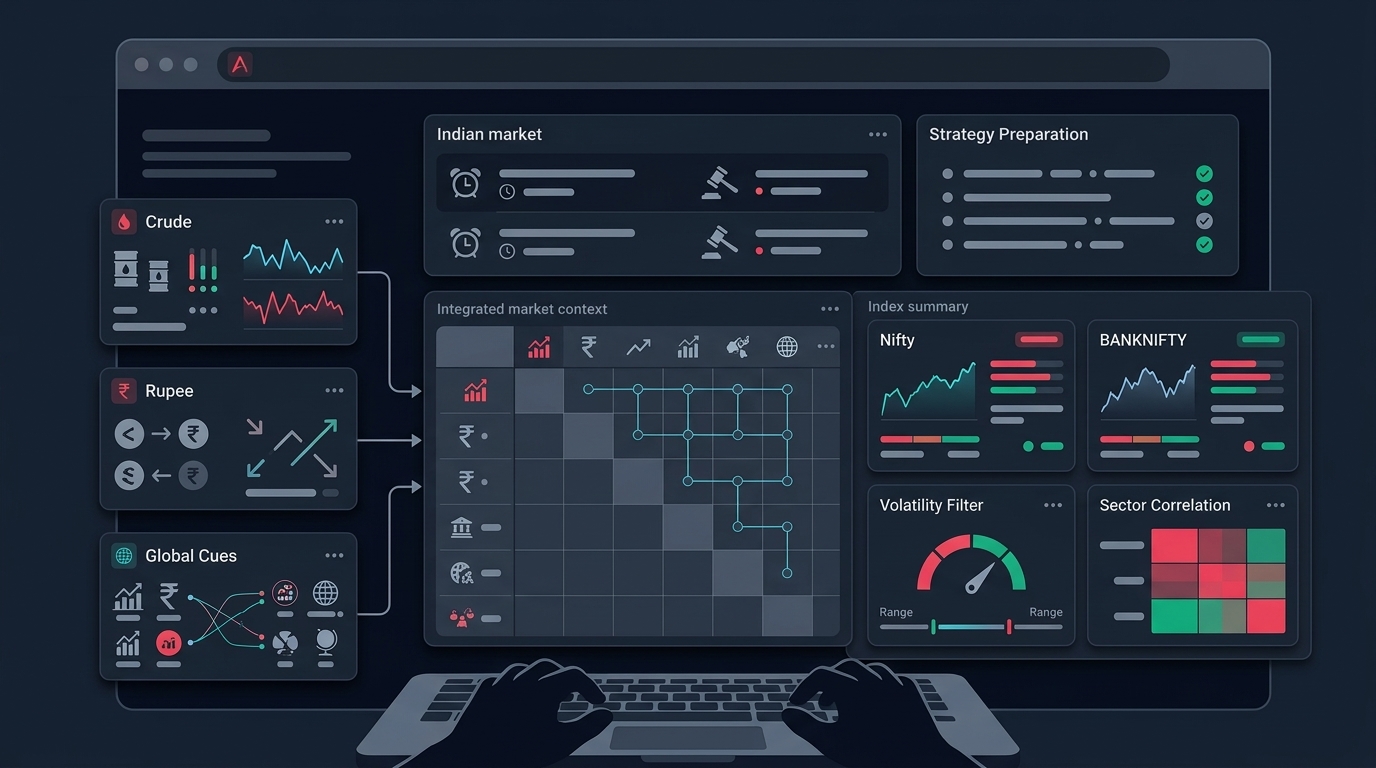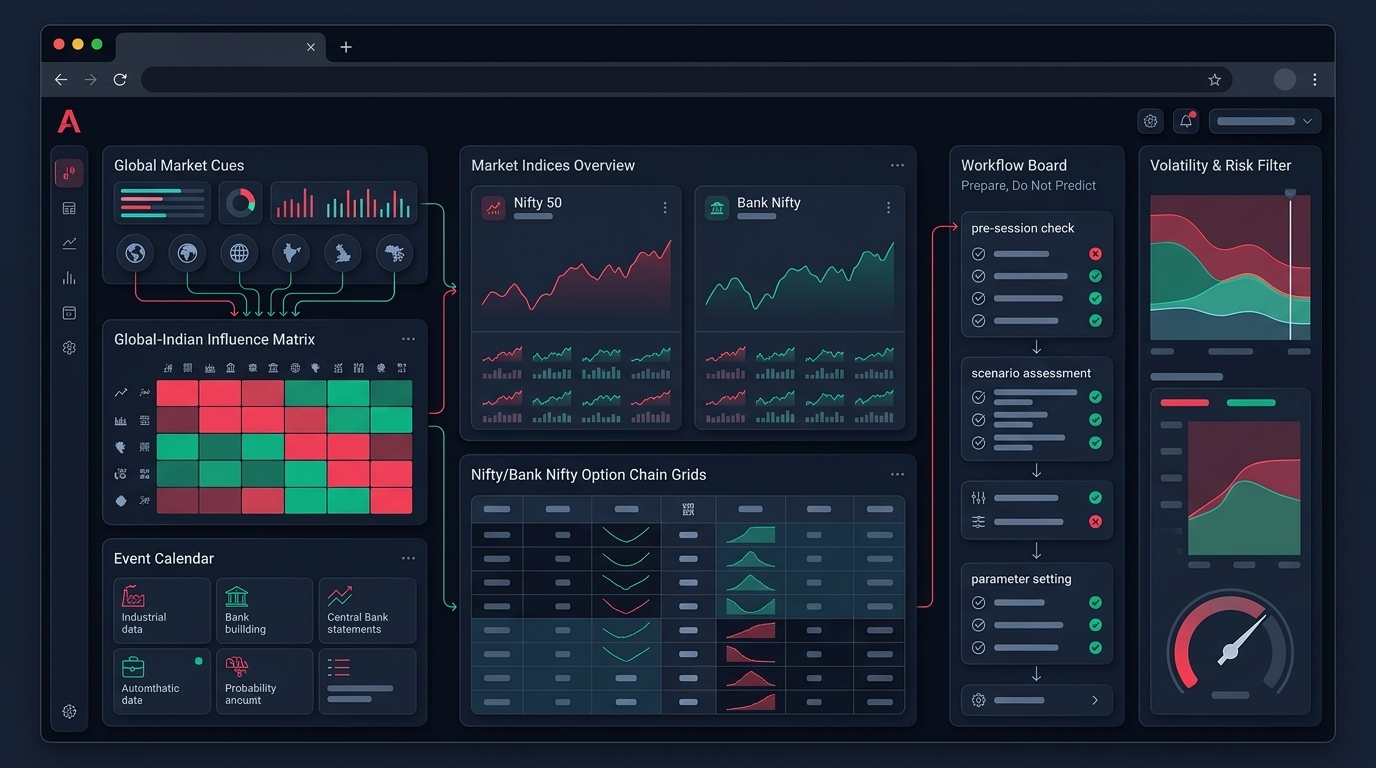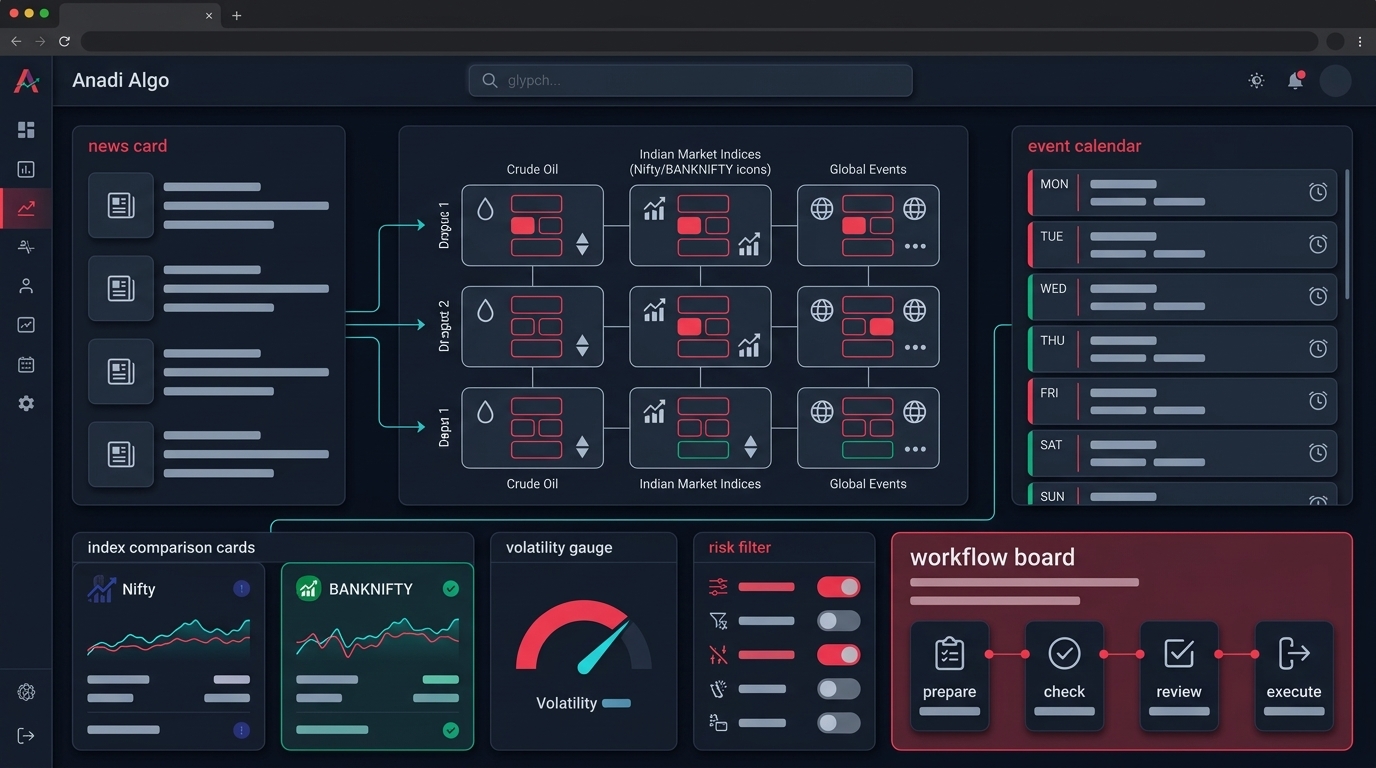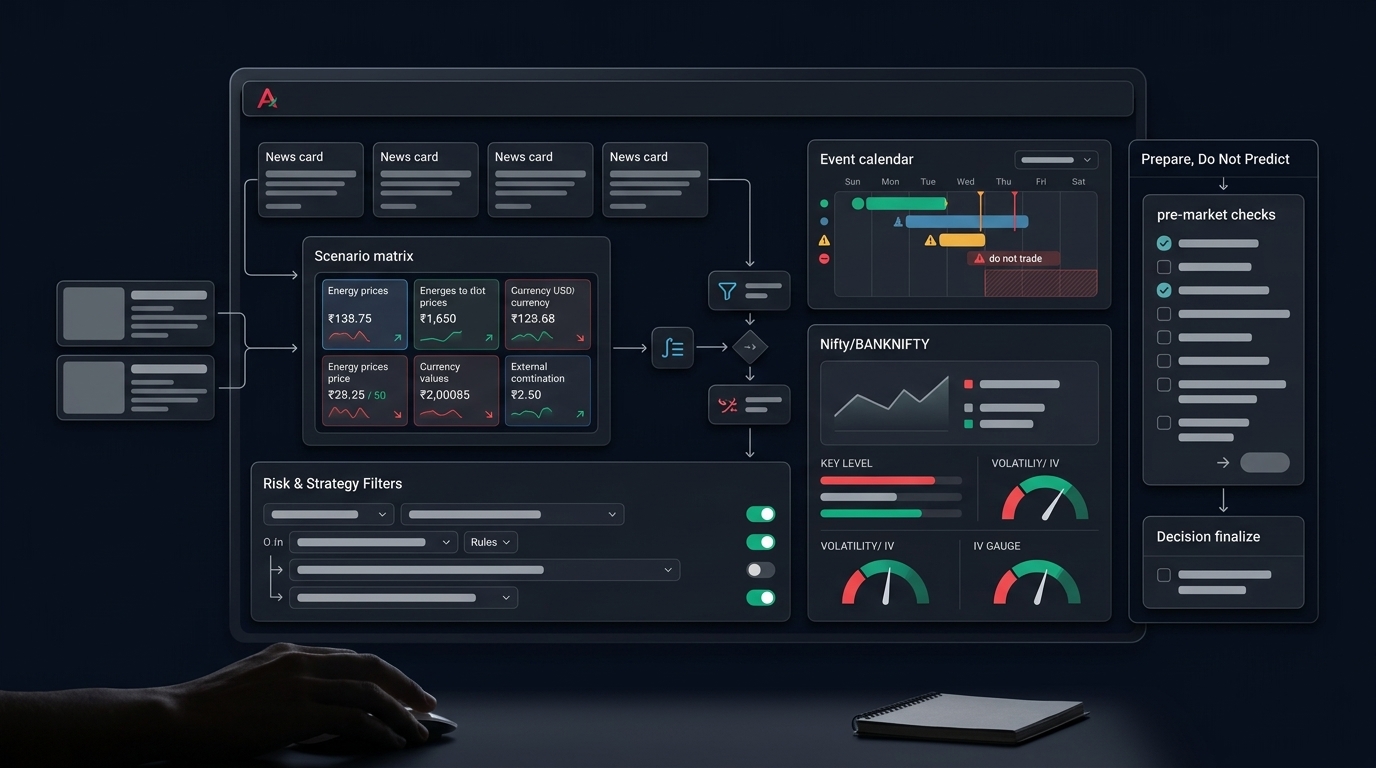
The morning of September 4, 2026 looks a lot like most mornings this year: headlines about US–Israel–Iran tensions, worries about the Strait of Hormuz, crude quotes moving before your first cup of chai, and Gift Nifty pointing one way at 8 AM and somewhere else by 9:07.
Financial media has a standard framework for days like this. The Financial Express, covering the conflict escalation earlier this year, grouped the moving parts into seven key triggers: crude oil, the rupee, bond yields, foreign flows, safe-haven demand, sectoral impact, and global market cues.
That framework is genuinely useful — just not the way most retail traders use it. Reading seven triggers at 9 AM and forming a market opinion is prediction. Mapping seven triggers to pre-written changes in your system's behaviour is process. This post does the second thing.
What a "trigger" means for a systematic trader
A trigger is not a directional signal. Crude spiking does not mean Nifty falls today — late August proved that in the other direction, when WTI dropped more than 6% in two sessions into the 80–81 dollar range and Indian markets set up for gap-up opens on improved global cues. The same variable flips sign within a week.
What a trigger reliably changes is the distribution of outcomes: wider intraday ranges, faster reversals, larger gap risk, wider option spreads, more slippage. Your algo doesn't need to know which way the market goes. It needs to know when the environment it was backtested on has changed shape.
So for each trigger below, the question is never "is this bullish or bearish?" It is: what does my system do differently when this trigger is active, and did I decide that before 9:15?
The seven triggers, translated into process
1. Crude oil — the fastest reaction
India imports roughly 85–90% of its crude, and nearly a fifth of the world's oil trade passes through the Strait of Hormuz. That is why crude reacts first to any Middle East escalation and why Indian indices care.
The process question is not the price — it's the type of move:
- Trending move (crude grinding higher over days): this is regime information. Tag it in your journal, expect oil-sensitive sectors to diverge from the index.
- Headline spike (overnight jump on conflict news): this is event risk. Overnight gaps in crude tend to show up as gap opens and a noisy first half hour in Nifty and Bank Nifty.
A concrete rule: if crude has moved beyond your normal-day threshold overnight — you pick the number from your own data, not from a headline — treat the open as an event open. Mean-reversion intraday systems sit out the first 15–30 minutes. Breakout systems demand extra confirmation because the first breakout after a gap is often the fade.
2. The rupee — the first line of market stress
Currency stress usually shows up before equity stress becomes obvious. A sharp USD/INR move tells you importers' costs are shifting, FII flows are likely churning, and the calm index number may be hiding sector rotation underneath.
Process translation: on days the rupee moves sharply, check whether your scanner universe is concentrated in names that are sensitive to it — importers, oil marketing companies, IT exporters (which cut the other way). If your system was built on a universe assumption of "liquid F&O stocks behave roughly alike," rupee-stress days are exactly when that assumption breaks.
You don't need a currency model. You need a tag: "rupee-stress day" in your trade journal, so that three months later you can see whether your strategy's losers cluster on those days.
3. Bond yields — reading fiscal anxiety
Rising crude plus rising government bond yields is the combination that signals inflation and fiscal worry together. For an equity algo trader, yields are slow-moving context, not an intraday input. Their practical use is regime tagging: bank and NBFC names trade differently when yields are climbing, and a strategy backtested mostly in a falling-yield period may be carrying an invisible assumption.
Process translation: note the yield direction weekly, not daily. If your backtest window sits entirely inside one yield regime, treat the results as conditional, not general.
4. Foreign flows — context, never timing
FII and DII numbers arrive with a lag — you see today's flows in the evening. Anyone using flow data as an intraday signal is trading yesterday's information. Its honest use is confirmation: sustained FII selling alongside rupee weakness and rising crude tells you the risk-off cluster is real and not just one noisy headline.
Process translation: flows go into your weekly review, not your entry logic. They help you decide position sizing posture for the coming week, which is a risk management decision, not a trade signal.
5. Gold and safe-haven demand — the cross-check
Gold's job in this framework is to separate real fear from headline noise. Crude up on its own could be supply mechanics. Crude up, gold up, equities down, rupee weak — that cluster is a genuine risk-off state.
This is the most important idea in the whole trigger framework: one trigger alone is noise; a cluster of aligned triggers is a state. Your process should react to states, not to individual headlines. That single distinction removes most of the panic-driven manual overrides that wreck live algo performance.
6. Oil-sensitive sectors — where index calm hides stock-level storms
On crude-shock days, the index can be flat while OMCs, aviation, paints, and tyres move hard in one direction and upstream oil names move in the other. If your scanner runs on a broad F&O universe, an "ordinary" day at the index level can still be an extreme day inside your actual candidate list.
Process translation: on active-crude days, look at what your scanner is actually surfacing before you trust it. If eight of your top ten signals are from one oil-sensitive sector, you don't have ten independent trades — you have one correlated macro bet wearing ten hats. Cap exposure per sector, or at minimum, know that you're making that bet.
7. Global market cues — the tone setter with a short shelf life
US close, Asia open, US Treasury yields, and Gift Nifty set the tone for the Indian open. In late August, Gift Nifty signalling an 80-point gap-up alongside falling crude and softer US yields was a textbook "constructive open" setup. Useful information — for about an hour.
Process translation: global cues are pre-open inputs. They help you classify the open (gap up, gap down, flat, uncertain) and pick which strategy set is allowed to run. By mid-morning, the Indian market is trading its own flows, and stale global cues should carry zero weight in your logic.
Compressing seven triggers into one decision
Here is the failure mode: a trader tracks seven dashboards and makes seven fuzzy judgments at 9:10 AM, every day, under time pressure. That is discretion pretending to be process.
The fix is compression. Before the open, resolve the seven triggers into a single risk state with pre-written consequences:
- Normal: No trigger cluster active. All strategies enabled, standard size, standard entry windows.
- Elevated: One or two triggers active (say, crude moving and rupee soft, but global cues stable). Size reduced by a fixed fraction you chose in advance. Strategies that hate volatility — tight-stop mean reversion, short-gamma option structures — run at reduced size or sit out. Wider stops acknowledged as wider risk, not free lunch.
- Event: Trigger cluster aligned — crude, rupee, gold, and global cues all pointing to stress, or a scheduled binary event overlapping (expiry day, RBI policy, major geopolitical development overnight). Discretionary rule: new entries paused for the opening window, existing positions managed by their exit rules, no fresh short-option risk added.
The exact thresholds matter less than the fact that they are written down before the market opens. A "5-point crude move" rule decided at 8:45 AM beats a perfect judgment call attempted at 9:16 with positions on.
If you maintain a weekly prep habit, this classification takes five minutes. That's the entire point of reading a weekly market outlook — you're preparing states and responses in advance, not collecting opinions to chase.
Where this shows up in an actual workflow
In your scanner. On elevated and event days, signals form faster and go stale faster. A breakout that was fresh at 9:40 can be fully extended by 9:48. This is where signal freshness and entry-quality checks earn their keep — a system that refuses an entry because price has already run too far past the level ("chase distance") feels annoying in the moment and saves you from the worst fills of the month. In Anadi's Action Center, that shows up as blocked reasons on otherwise valid signals; whatever stack you use, the principle is the same — the filter between signal and order is where discipline lives on volatile days.
In your options workflow. Before any structure on a crude-headline day, check the chain itself: has IV already repriced? Have bid-ask spreads widened past your normal fill assumptions? A short-strangle backtest built on calm-day spreads quietly overstates results on event days. Inspecting the chain, previewing the basket, and seeing the margin estimate before execution is the workflow order that keeps event days survivable.
In your backtests. This is the highest-leverage check almost nobody does: segment your backtest results by trigger regime. Take your intraday strategy's trade log and split it — calm days versus crude-shock days versus rupee-stress days. Many strategies earn steadily on normal days and give a quarter of it back on a handful of event days. If you never segment, you'll conclude "the strategy works" when the honest conclusion is "the strategy works when the seven triggers are quiet." Proper backtesting with regime tags turns news awareness into a measurable edge in risk control.
In your journal. Every day gets a state tag — normal, elevated, event. Over a quarter, this becomes the dataset that answers the only question that matters here: does my system's edge survive the days the headlines are loudest?
What this deliberately does not tell you
Nothing above predicts where Nifty closes today. Two mornings with identical trigger readings can produce opposite sessions — the late-August episode where falling crude flipped the entire narrative within a week is proof enough. Anyone who converts "crude up, rupee weak" into "market will fall, sell" is selling certainty that doesn't exist.
What the trigger framework can do is bound your damage on the days it matters and keep your system running its tested logic on the days it doesn't. That's not a small thing. Over a year, exposure control on event days is often the difference between a live equity curve that resembles the backtest and one that doesn't.
If you want to run this kind of state-based discipline — scanner filters, entry-quality checks, chain inspection, and regime-tagged review in one place — you can request early access to Anadi Algo and build it into your daily routine instead of your good intentions.
The pre-open trigger checklist
Run this in five minutes before 9:15, every day the headlines are loud:
- Crude: overnight move beyond my normal-day threshold? Trending or headline spike?
- Rupee: orderly drift or sharp move? Is my universe importer-heavy today?
- Yields: direction this week noted in the journal (weekly, not daily).
- Flows: what did yesterday evening's FII/DII data confirm about the regime?
- Gold: confirming risk-off, or diverging from the crude story?
- Sectors: is my scanner queue concentrated in oil-sensitive names?
- Global cues: classify the open — gap up, gap down, flat, uncertain.
- Resolve: normal, elevated, or event. Apply the pre-written consequences. No renegotiation after 9:15.
Seven triggers, one state, zero predictions. That's the whole trade-off — and it's the version of "tracking the news" that a systematic trader can actually cash.