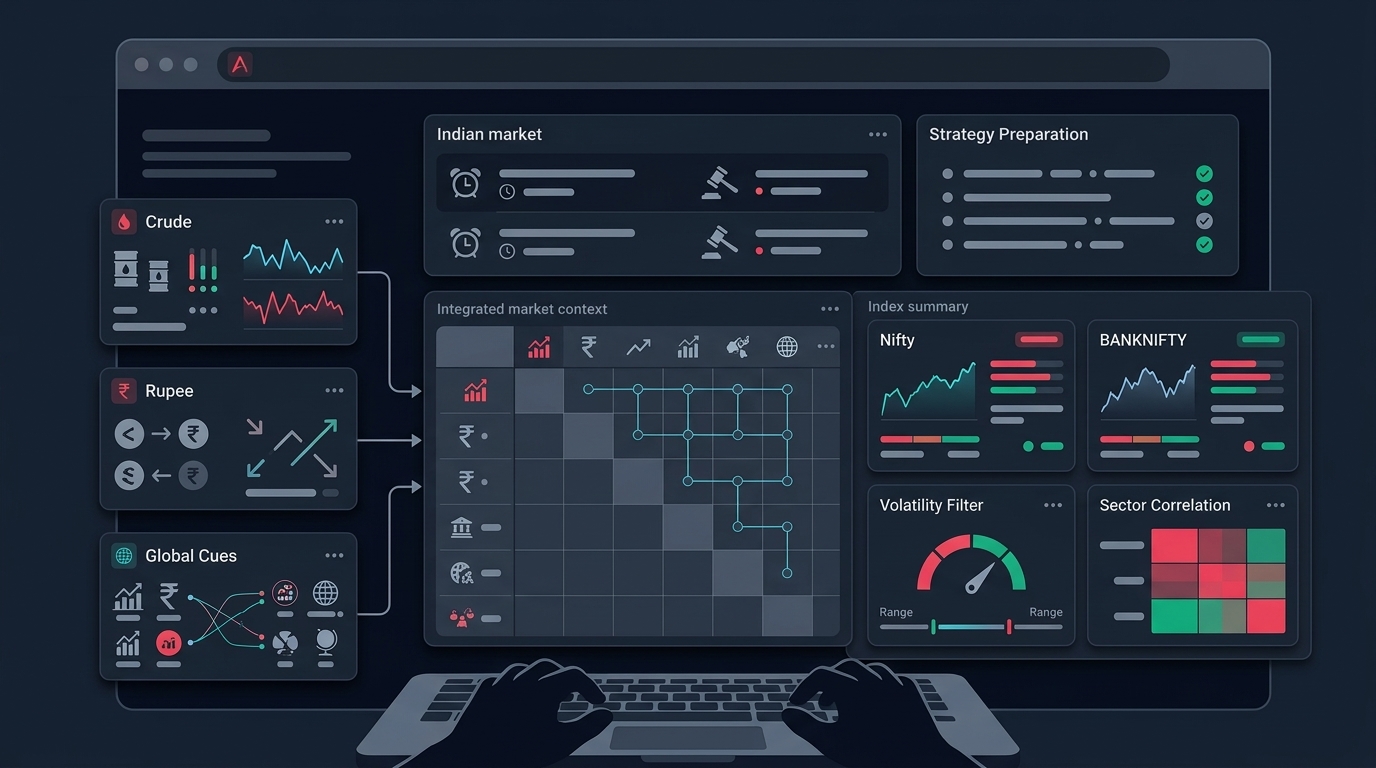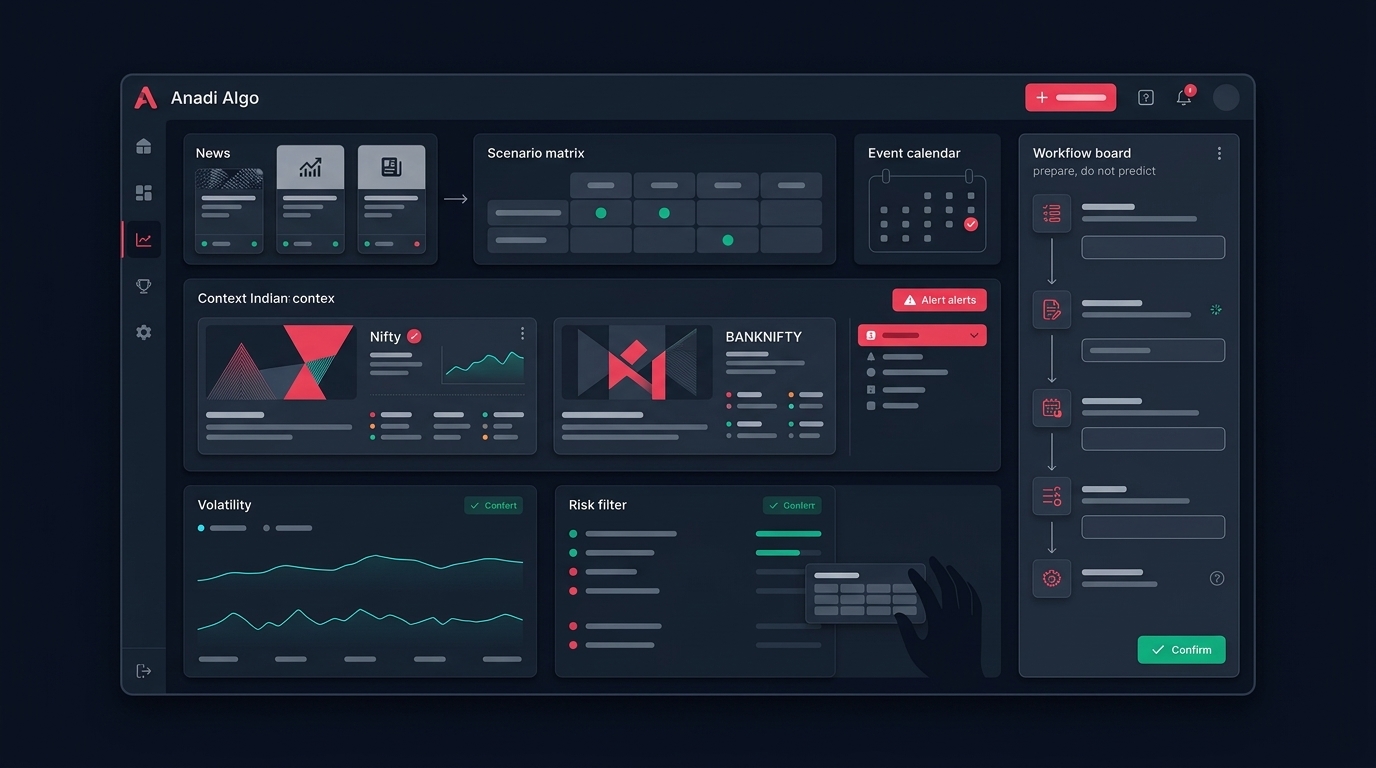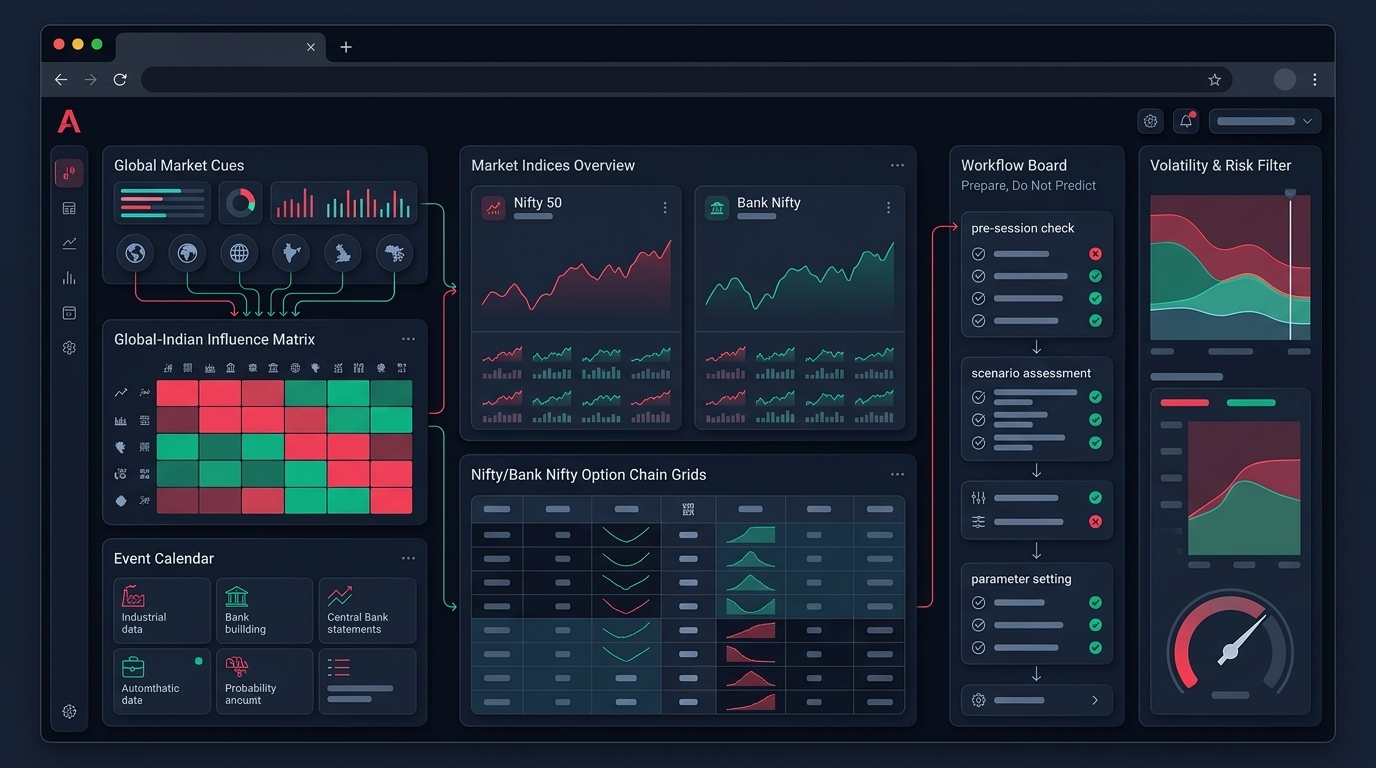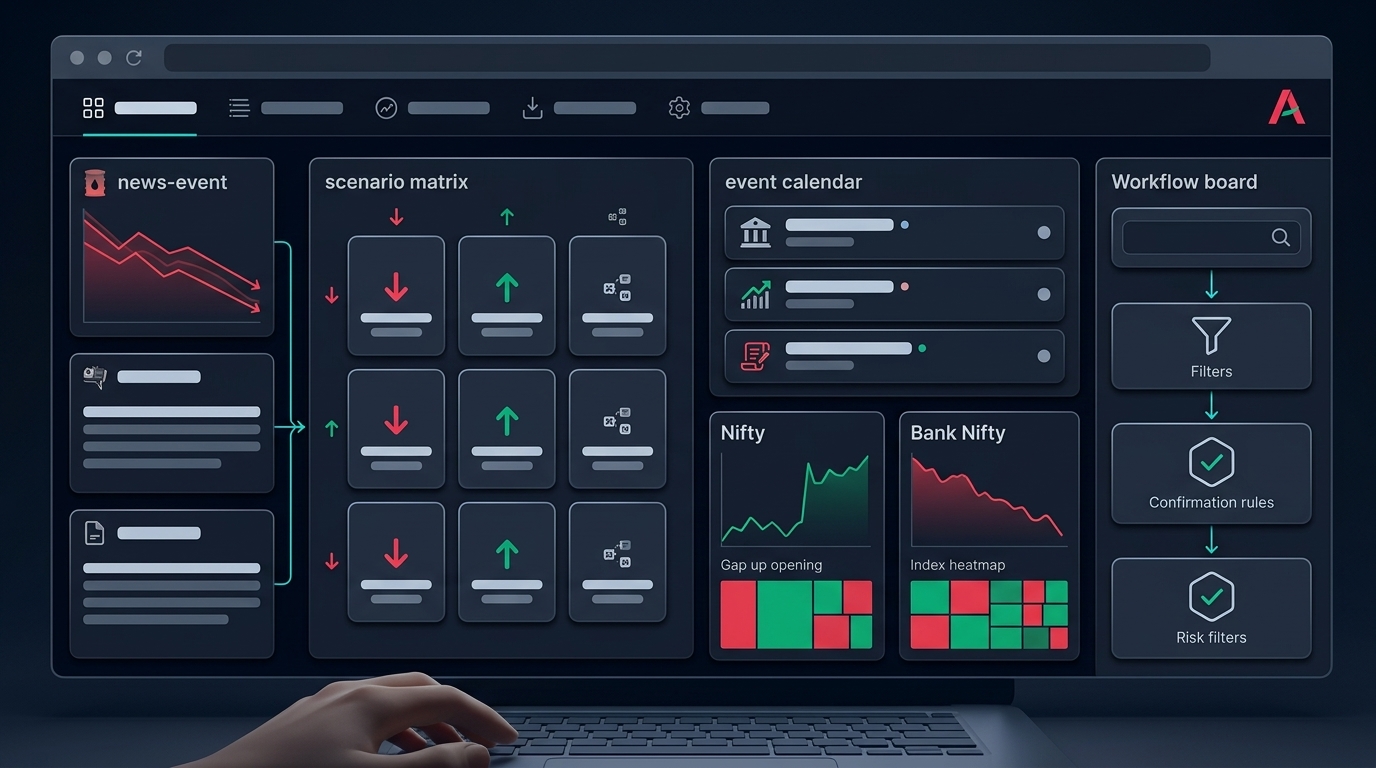
This week gave Indian algo traders a near-perfect case study in why headlines and outcomes are two different datasets.
On Wednesday morning, the setup looked clean. Crude oil had fallen sharply, US Treasury yields had eased, Wall Street had bounced overnight, and Gift Nifty was signalling a gap-up of about 80 points. Market previews called for a strong opening, and the opening was indeed strong.
By the close, the Sensex was down 183 points at 77,472.94 and the Nifty had shed 126.80 points to 24,207.75, after spending most of the session in a narrow range.
Nothing about that sequence is unusual. What matters is what you do with it. If your trading process treats "strong opening expected" as a directional signal, Wednesday was a trap. If your process treats it as context that changes your filters and risk state, Wednesday was just another day your rules handled.
This post walks through how to convert this exact kind of market context — falling crude, shifting global cues, a gap-up that fades — into process, without pretending anyone can predict the close.
What Actually Happened: The Gap That Faded
Here is the sequence, stripped of adjectives:
- WTI crude fell more than 6% over two sessions into the 80–81 dollar per barrel range, after trading near 85–86 dollars (with Brent around 93 dollars) earlier in the week amid uncertainty over Iran and Gulf shipping routes.
- Lower crude plus a pullback in US yields improved sentiment for risk assets, and Indian indices were widely expected to open higher.
- The Nifty opened higher, tracking those cues.
- The index then traded in a narrow range and closed lower, down about 127 points.
- Under the surface, the day was split: banking names like Kotak Bank, Axis Bank, ICICI Bank and SBI gained, while Bharti Airtel, Infosys, Tech Mahindra, L&T and several others dragged.
So the "crude falls, market rises" chain held for roughly the first fifteen minutes and then stopped mattering. That is not a failure of the logic. It is a reminder that the chain from crude to index level is a tendency, not a rule — and tendencies are exactly the kind of thing an algo trader should encode as filters, not entries.
Why "Strong Opening" Headlines Are Context, Not Signals
The causal story in the headlines is real. Crude matters to India because we import most of our oil; cheaper crude eases inflation and import-bill pressure, supports the rupee, and improves the backdrop for rate-sensitive sectors. Softer US yields reduce the pull of dollar assets and can support foreign flows into Indian equities. These relationships are why crude and global cues appear in every morning note.
The problem is timing and resolution. A headline describes sentiment before 9:15. Your fills happen after 9:15, at prices that already contain that sentiment. When Gift Nifty signals an 80-point gap-up, the good news is largely in the opening price. What is not in the opening price is how the day resolves — and this week showed the same cues producing a higher open and a lower close within one session.
There is also regime whiplash to respect. Crude went from roughly 93 dollars Brent to 80–81 dollars WTI territory within days, with Strait of Hormuz developments still described as fluid in the same reports. A variable that can move 6% in two sessions on geopolitical headlines is a terrible entry trigger and a very useful risk-state input.
The honest framing for an algo trader: crude, yields and Gift Nifty tell you what kind of day to prepare for, not which direction to trade.
Three Ways a Good-News Gap Can Resolve
If you want the morning context to do real work in your system, classify the open instead of trading it. A gap-up on positive cues typically resolves one of three ways, and each one stresses a different part of your rulebook.
Gap and go
The index opens higher, holds above the previous day's high, breadth is strong, and the move extends. Momentum and breakout systems earn their keep here. The practical check is confirmation: does price hold the gap for the first 15–30 minutes, and do advances meaningfully outnumber declines? Without those, "go" is an assumption, not an observation.
Gap and fade
The index opens higher and sells into the gap — Wednesday's version. This is where chasing hurts most, because the worst fills of the day are printed in the first half hour. The checks that protect you are mechanical: how far is the current price from the signal level (chase distance), and is the opening range being lost rather than defended? A long signal generated at the open can be invalid twenty minutes later, and your system should be able to say so.
Gap and drift
The index opens higher, then compresses into a narrow range. Breakout systems get chopped, and option sellers face a different problem: a quiet index can hide sharp sector rotation underneath. The check here is range: if the first hour's range is a small fraction of the recent daily average range, momentum entries deserve stricter filters or a smaller size.
You cannot know at 9:15 which of the three you are getting. That is the point. A process that handles all three beats a prediction that handles one.
Crude and the Rupee: Regime Filters, Not Entry Triggers
A clean way to encode this context is a simple risk-state model, evaluated pre-open:
- Normal state. Crude stable, no major event on the calendar, gap within a normal band. Full rule set, standard size.
- Elevated state. Crude has moved sharply in either direction over the last two or three sessions, or a large gap is signalled. Same strategies, reduced size, wider stops where your backtest supports it, and stricter entry-quality filters.
- Event state. A known release or a live geopolitical situation (this week: US PCE inflation data, a closely watched Fed speech, Hormuz developments). Defined no-trade windows around the event, or intraday-only exposure.
Notice what is absent: any rule of the form "crude down, so buy Nifty." The rupee belongs in the same bucket. A weaker rupee makes crude imports costlier and pressures the import-heavy parts of the market, which is why crude and USD/INR usually appear in the same paragraph of every morning note. Both are regime inputs. Neither is an entry.
This is also where risk management stops being a chapter heading and becomes configuration: per-trade risk, a daily loss limit, and position sizing that actually changes when your risk state changes. A risk state that never alters your size is just a label.
If you want to sanity-check the thresholds — what counts as a "sharp" crude move, what gap size is abnormal — that is a research question, not a debate. Pull historical gap-up days and measure how often the gap held versus faded, and what your strategy would have done on each. Proper backtesting of gap behaviour is far more useful than another opinion about crude.
Sector Divergence: The Part Headlines Skip
Wednesday's close — "Nifty sheds 127 points" — sounds like a mildly weak day. The sector detail says otherwise. Banks rose while IT, telecom and select capital-goods names fell. An index-level summary averaged two opposite tapes into one dull number.
This matters most for stock scanners. A long signal in an IT name on Wednesday was fighting its sector all day, regardless of what the index or crude was doing. A similar signal in a bank had the sector at its back. Same index, same headlines, very different context.
The process fix is to check breadth and sector participation before acting on a stock signal, not after. This is exactly how index and sector context is meant to be used inside Anadi: the indices view and sector heatmap exist as a context layer you read before touching a scanner signal, not as a prediction engine. A stock setup aligned with its sector and with reasonable breadth is a different bet from the same chart pattern fighting both.
The same logic applies one level down in options. If the morning narrative pushes you toward an index options structure, the option chain is where the narrative meets reality: liquidity at your strikes, IV that may already price the event you are worried about, and the margin the full basket actually needs. Checking chain, Greeks and margin before execution — rather than after a fill surprises you — is the whole difference between expressing a view and inheriting a position.
A Note on Derivatives Commentary
This week's previews also cited strong rollovers as supporting a constructive view, alongside specific Nifty levels from derivatives positioning. Treat this class of information the same way: rollover and open-interest data describe positioning, and positioning describes what traders have done, not what the market will do. It is legitimate context for expiry-adjacent sessions — worth reading, worth logging, not worth hard-coding as a directional rule. If you follow a structured weekly view, something like a weekly market outlook is the right container for this: prepare with it, then let your rules trade.
A Checklist for the Next "Strong Opening" Headline
The next morning that looks like this one — crude moving, global cues positive, Gift Nifty signalling a gap — run this before 9:15:
- Classify the gap. Measure the signalled gap against your historical distribution. Normal band, elevated, or extreme?
- Set the risk state. Crude moved more than a few percent in the last two sessions, or a major event sits in the next 48 hours? Then size down or flag no-trade windows, per pre-written rules.
- Demand confirmation, not narrative. Define what must be true at 9:30 or 9:45 for gap-direction trades: gap held, opening range defended, breadth supporting. No confirmation, no chase. Gap dekh ke entry lena is exactly the behaviour a chase-distance filter exists to block.
- Check sector, not just index. Before any stock signal, confirm its sector is participating. An index gap-up with split sectors is two markets, not one.
- Validate options at the chain. Strike liquidity, IV context, and full-basket margin before execution — every time, not just on quiet days.
- Log the day. Record the signalled gap, the actual open, the close, and what your rules did. Twenty such days are a dataset; one such day is an anecdote.
None of this tells you where the Nifty closes today. Nobody knows that, including the authors of this morning's previews. What it does is make sure that the days when good news fades — like this Wednesday — cost you a filtered signal instead of a chased loss.
If you would rather run these checks inside one workflow — index and sector context, scanner signals with entry-quality and blocked-reason filters, option chain validation, and rule-based execution with paper trading first — you can request early access to Anadi Algo and test the process on your own strategies before any real money is involved.