Most Indian retail traders no longer get their market context from a terminal. They get it from a reel, a YouTube pre-market show, a forwarded screenshot, or a headline card in a WhatsApp group.
That is not automatically bad. The problem is what happens next: the feed gives you a conclusion ("crude cooled, markets rallied"), and the trader skips straight to a position. The step in between — turning context into a rule your system can actually check — is the one that gets dropped.
This post takes the actual market context around August 6–7, 2026 and walks through how to convert it into filters, guardrails and workflow checks. No calls, no targets. Just process.
What the tape actually said on August 6
Per The Hindu BusinessLine's market wrap for August 6, 2026, the BSE Sensex closed up 373.76 points (0.48%) at 78,954.76, while the NSE Nifty 50 settled at 24,636 — up just 11.35 points, or 0.05%.
Read those two numbers again.
One index closed up nearly half a percent. The other closed effectively flat. Same session, same country, same news flow. The reported drivers were easing crude oil prices, the RBI's steady policy stance, and selective buying in heavyweight banking and energy names including Reliance — offset by profit booking in auto, metals, IT, realty and cement. Small- and mid-caps stayed resilient on stock-specific and earnings-led buying.
A reel summarising that session will say "markets rallied on crude relief." A Nifty intraday system that traded a 0.05% day on the assumption of a trending tape will have a very different opinion.
This is the first and most useful lesson: the headline describes sentiment; the index level describes your P&L. They diverge more often than feeds admit.
Why "feed context" needs a reconciliation check
Social distribution of market news has a specific failure mode: the same story gets scraped, re-templated and re-hosted on domains that have nothing to do with markets, often with stale or mangled numbers.
While researching this piece, one "Sensex falls 700 points, Nifty slips below 23,600 as crude hits 100" article was sitting on the domain of an Italian genetics laboratory group. It may well be a real July 2026 session being described. But you cannot tell from the page, and a Nifty print of "below 23,600" reads very differently once you know the index closed at 24,636 on August 6.
So before any market context enters your process, run three cheap checks:
- Source check. Is this an exchange, a broker, or a recognised financial publisher? Or is it a content farm re-hosting someone else's wrap?
- Date check. Feeds show engagement-sorted content, not chronological content. A four-day-old clip looks identical to this morning's clip.
- Reconciliation check. Does the quoted index level match the last official close? If a post says Nifty is near 23,600 and your broker terminal says 24,636, the post is either old, wrong, or about something else entirely.
If a piece of context fails any of the three, it does not get to influence position size.
Turning crude, rupee and global cues into filters
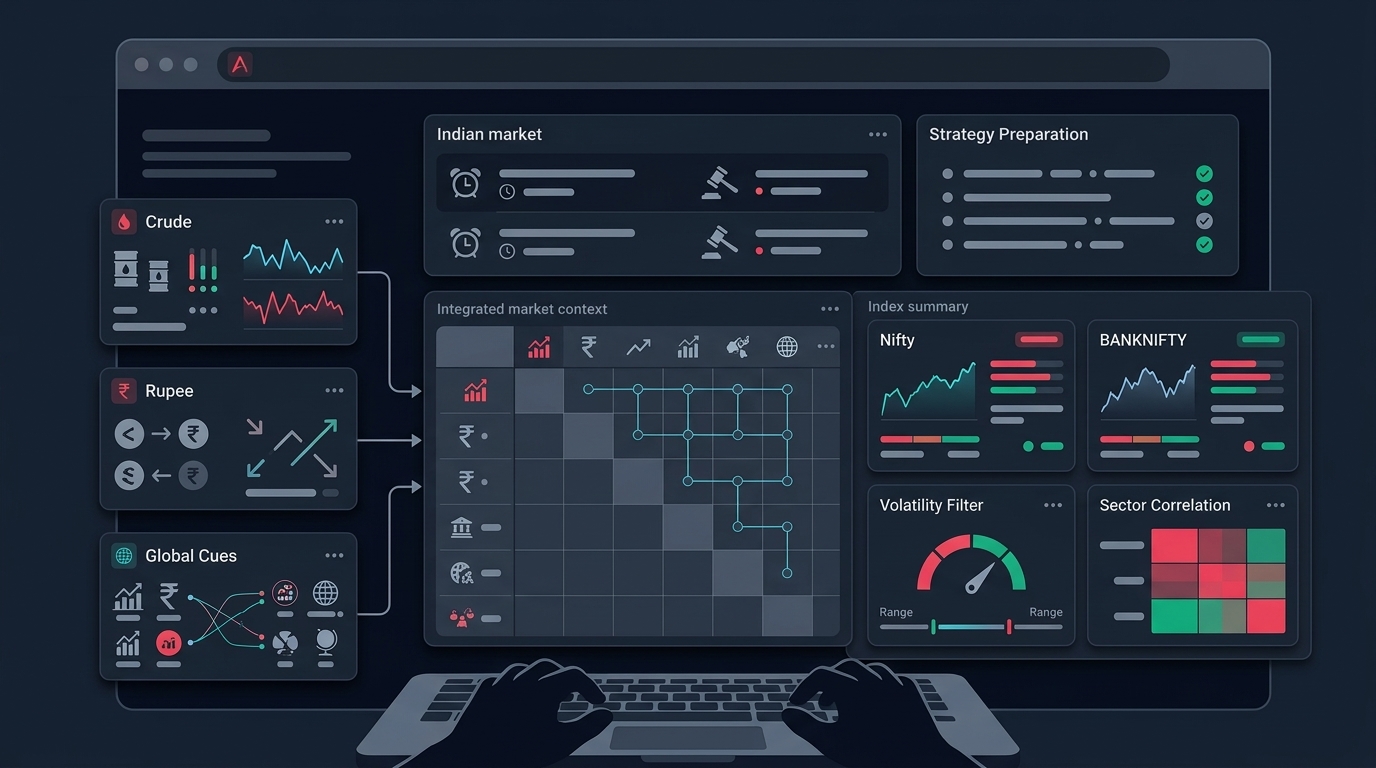
Crude, the rupee and overnight global cues matter to Indian equities — that part is not controversial. Softer crude is generally read as easing input-cost and inflation pressure; a steady policy stance removes one source of repricing. Those are the transmission channels the August 6 wrap itself cited.
But "crude is down, so I'll go long" is not a rule. It has no threshold, no time window, no invalidation, and no way to be tested.
A rule looks more like this:
- Define the input precisely. Brent settlement change versus previous settlement, measured at a fixed time. Not "crude looks soft."
- Define the threshold. For example: overnight move beyond a set percentage band. Pick the number yourself, then check it against history.
- Define what changes. Does the filter block entries, halve size, widen stops, or only skip specific sectors? A cue that changes nothing is not a filter.
- Define the expiry of the signal. Does the overnight cue apply until 10:15am, until the first hour's range breaks, or for the full session?
Then — and this is the part most traders skip — check whether the filter actually helped. Run it through backtesting with the filter on and off across the same period. Plenty of intuitively sensible macro filters cut winning trades and losing trades in roughly equal proportion, which means all you bought was fewer trades and more variance.
The rupee and global-cues layer
The same discipline applies to USDINR, Gift Nifty's overnight drift, US 10-year yields and dollar-index moves. Each is a legitimate input. None of them is a strategy.
A practical structure many systematic traders use is a tiered regime tag rather than a binary switch:
- Tier 1 (normal): all strategies live at standard size.
- Tier 2 (elevated): directional intraday entries allowed, but size reduced and chase distance tightened.
- Tier 3 (stressed): new entries blocked, existing positions managed only, no fresh option shorts.
The tags are set by measurable inputs — overnight gap magnitude, India VIX level, crude move, currency move — decided before the open, written down, and applied without argument. The value is not that the tiers are correct. The value is that they remove the 9:20am negotiation with yourself.
What a "steady policy, softer crude" tape does to option structures
Sessions like August 6 — range-bound, mildly positive, no policy shock — are the ones that quietly damage undisciplined options books in both directions.
If you are short premium, a calm tape feels like confirmation. It is also exactly when position sizes creep up, hedges get skipped as "wasteful", and a single gap event later erases weeks of theta. If you are long premium or trading breakouts, a 0.05% index day is a slow bleed of entries that never follow through.
Neither of those is a prediction about tomorrow. They are structural properties of the strategy types, and the process response is the same: know which regime your strategy needs, and measure whether today looks like it.
Concrete checks before an options session, in the options workspace or wherever you run your flow:
- Chain liquidity, not just chain price. Look at bid-ask width on the exact strikes you intend to trade, not the ATM headline. Wide books on wings are where backtest fills and real fills diverge most.
- OI and PCR as context, not signal. OI pulse, daily OI and PCR describe positioning. They tell you what could unwind violently; they do not tell you direction.
- Margin before entry, not after. Estimate basket margin with existing positions considered. A structure that looks fine standalone can breach limits when it lands on top of what you already hold.
- Basis and VWAP gates on the underlying. If your option leg depends on the future's behaviour, check the future's basis and whether price is respecting VWAP before assuming the underlying leg behaves.
Multi-leg baskets deserve a basket-level stop, not four independent leg stops that can leave you accidentally naked when one leg fills and another does not.
Breadth divergence deserves its own rule
The August 6 wrap described something specific: heavyweight banking and energy buying, profit booking in auto, metals, IT, realty and cement, and small- and mid-caps outperforming on stock-specific flows.
That is a narrow-leadership tape with an active broader market underneath — and it explains the Sensex-versus-Nifty gap better than any single macro cue does.
For an algo trader, this has two practical consequences.
First, index-level filters can mislead stock strategies. If your stock scanner is gated on "Nifty must be up," you will block valid stock-specific setups on days when the index is flat but the broader market is working. Conversely, an unfiltered stock scanner on a narrow tape will hand you dozens of signals from the exact sectors being sold.
Second, the signal needs a route decision, not just a trigger. A breakout in an F&O-eligible name may be better expressed through a future or an option structure than through cash, depending on cost, gap risk and holding period. This is where a queue that shows entry quality, freshness, blocked reasons and F&O eligibility — rather than a raw signal list — does most of its work. A signal blocked for "chase distance exceeded" or "invalidated price" is the system protecting you from acting on a move that already happened four candles ago while you were reading the feed.
Event avoidance: write the calendar into the system
Most retail event handling is manual and therefore unreliable. You remember the RBI policy date. You forget the monthly expiry that lands on the same week as a US CPI print and a heavy earnings day.
Put it in the system instead:
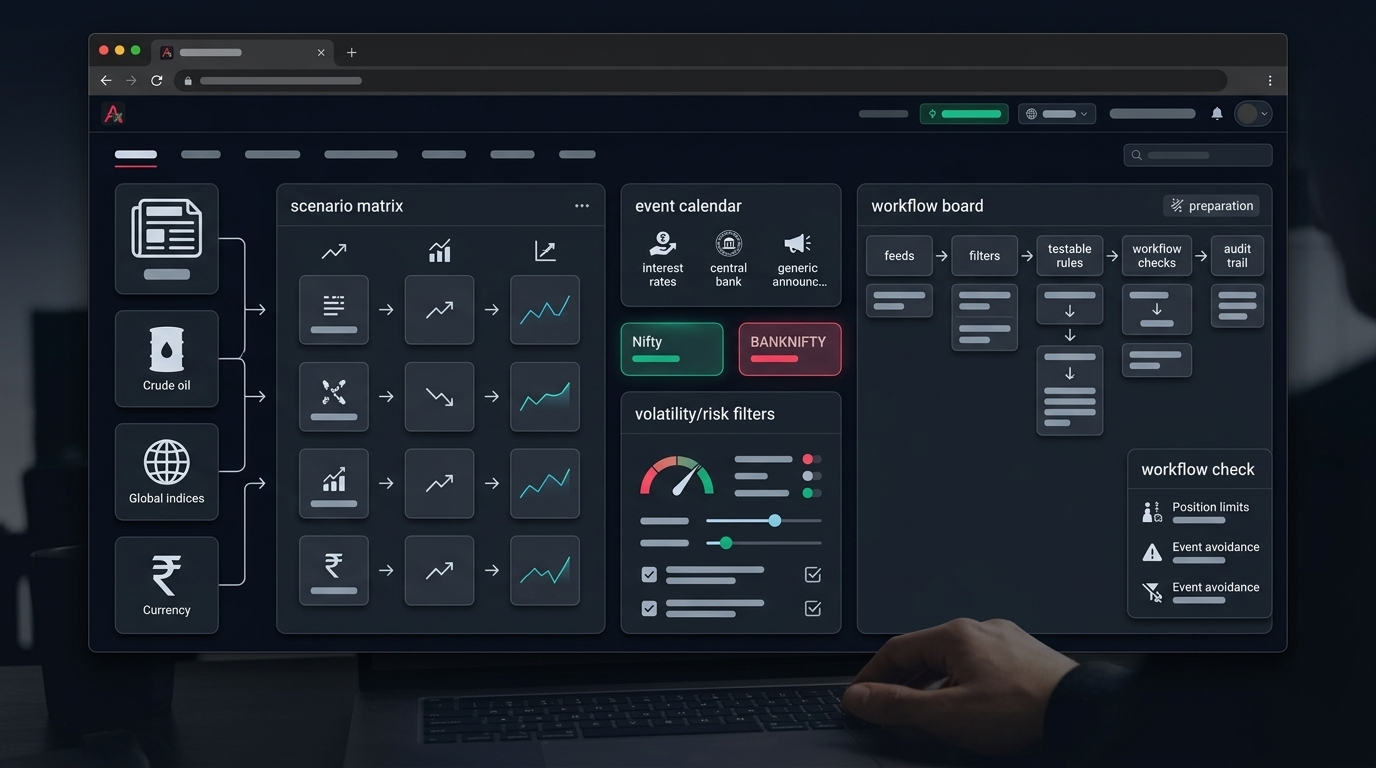
- Maintain a dated event list — policy days, expiry days, major domestic and US data releases, index rebalancing, results of any stock you hold or trade.
- Attach a rule per event type, decided in advance: no new entries in the 30 minutes around the release, reduced size for the session, or full flat.
- Log the events, then check your own trade history. Many traders discover their event-day P&L is a meaningful negative contributor that they had never separated out.
- Treat non-scheduled shocks — geopolitical headlines, sharp commodity moves — with the tiered regime tags above, since you cannot calendar them.
A weekly market outlook is most useful read this way: as a preparation document that tells you which days need tighter rules, not as a source of trade ideas.
Where the workflow checks sit
The point of a platform in all this is to remove the gap between "I read something" and "my system behaves differently."
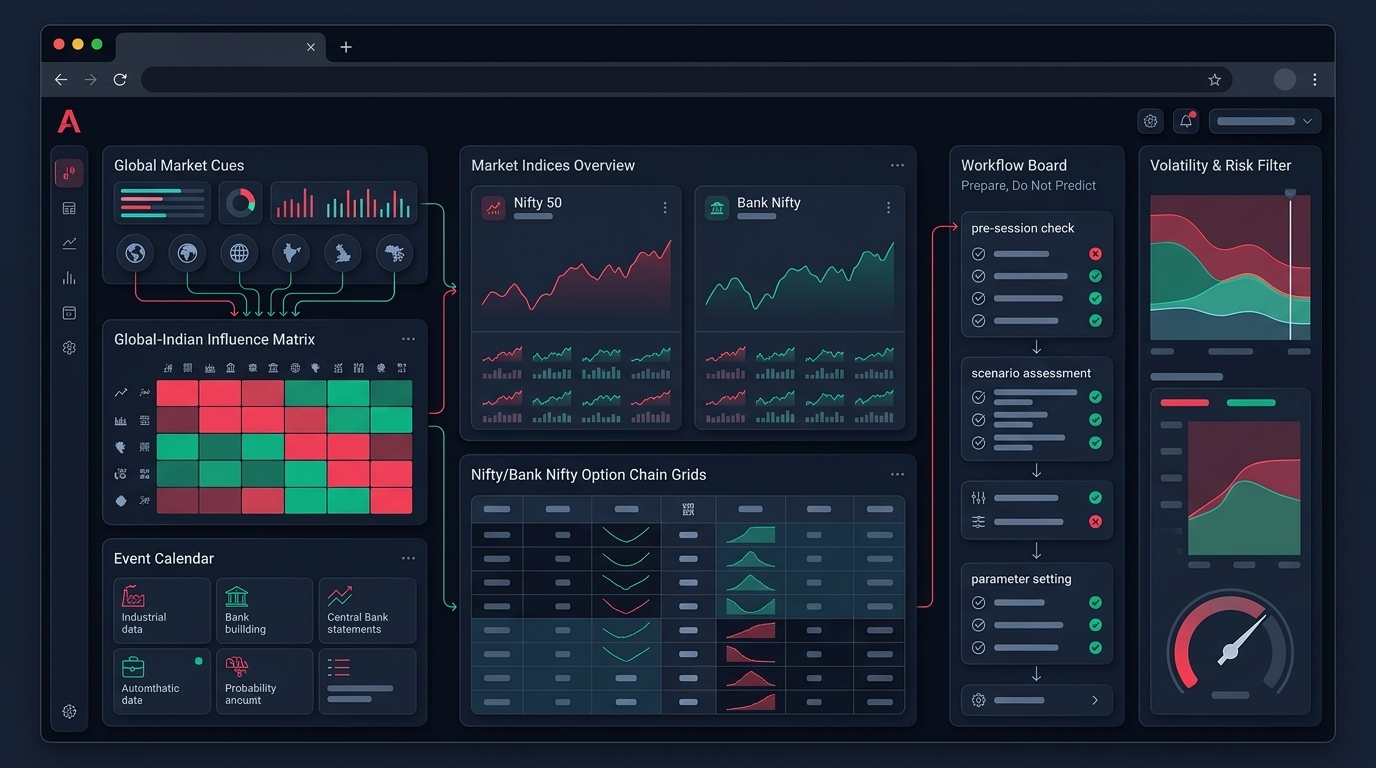
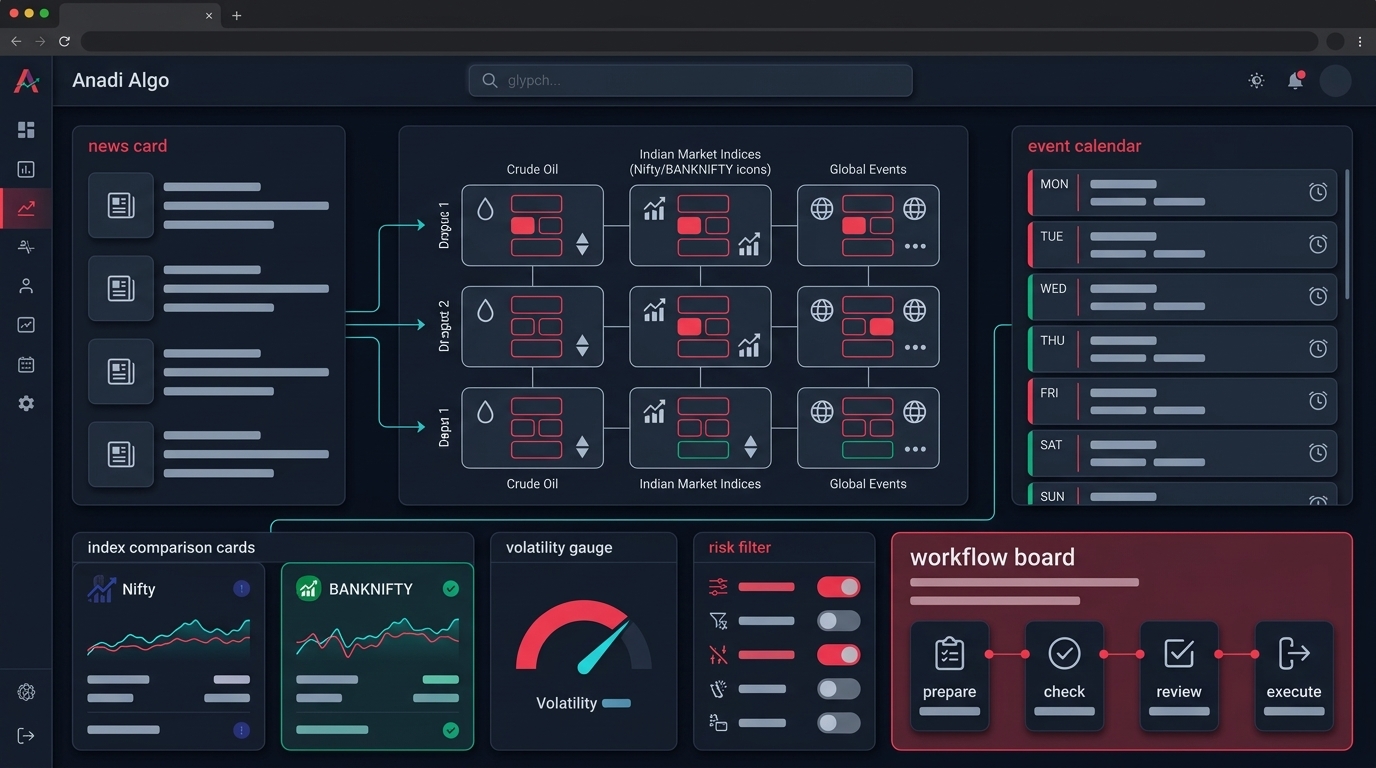
In practice that means: context and levels sit next to the live quote and your existing position before you place anything; scanner signals keep their real pattern names and freshness rather than being flattened into generic breakouts; option structures show margin and payoff before execution; and the same rules run in paper trading first so you find out whether a filter helps before it costs money.
If you want to build these filters as testable rules rather than mental notes, the strategy builder and risk management pages are the right starting points, and you can request early access here to run them against your own workflow.
The checklist
Before the next session, for any market context that reaches you through a feed:
- Source, date, reconcile. Recognised publisher? Today's date? Does the quoted index level match the actual last close?
- Headline versus index. "Markets rallied" and "Nifty closed up 0.05%" are different facts. Trade the second one.
- Threshold or nothing. Every macro cue needs a number, a time window and a defined action, or it stays out of the system.
- Test the filter both ways. Backtest with and without it. If it only removes trades symmetrically, it is not a filter — it is a mood.
- Regime tag before the open. Normal, elevated, or stressed. Set it at 9:00am, not at 9:20am.
- Breadth check. Index flat with narrow leadership is a different environment for stock strategies than for index strategies. Filter accordingly.
- Structure checks before entry. Strike liquidity, basket margin with existing positions, basket-level stop, basis and VWAP on the underlying.
- Events written down. Calendar plus a pre-decided rule per event type, and a periodic review of your own event-day P&L.
- Daily loss limit is non-negotiable. No amount of macro conviction outranks it.
None of this predicts what crude, the rupee or the index will do next. That is the point. The feed will keep producing confident narratives; your job is to decide, in advance and in writing, which of them are allowed to change your position size — and by how much.