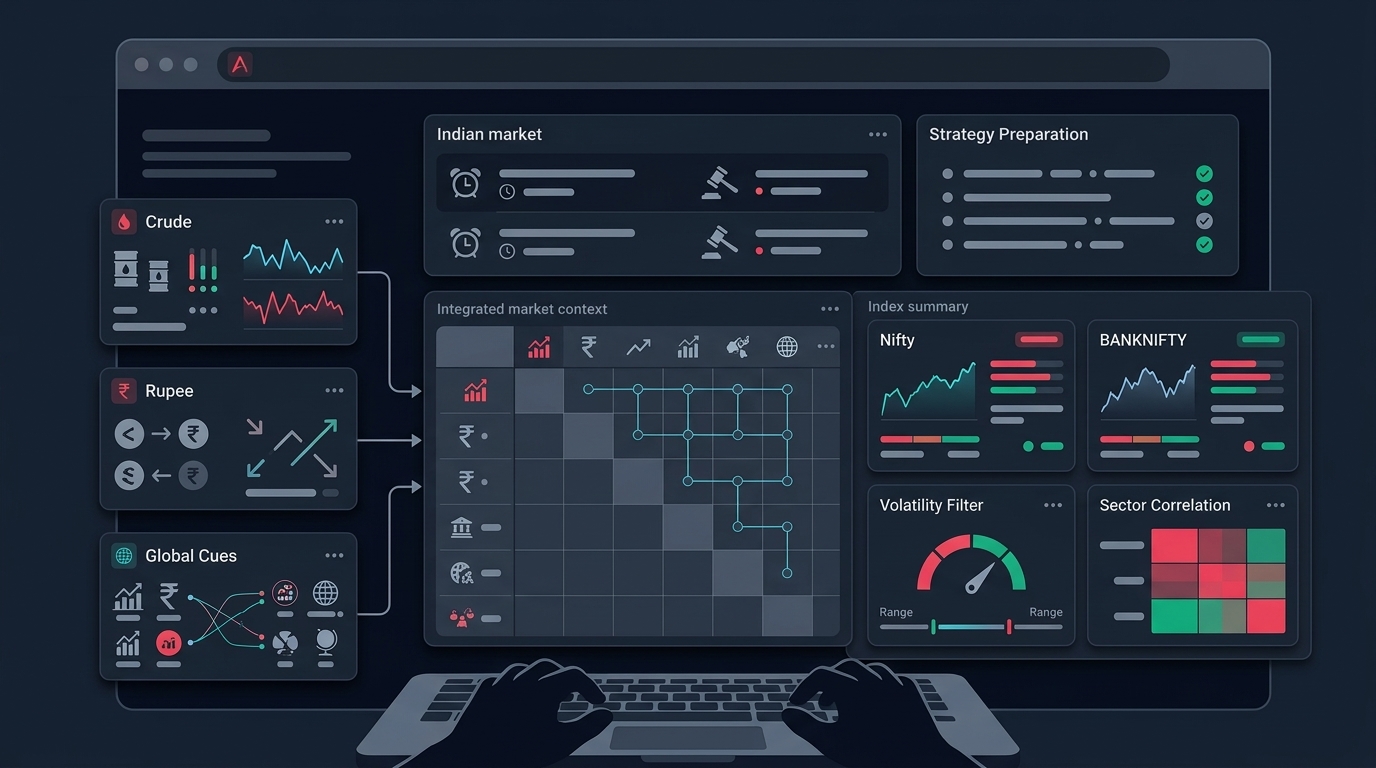
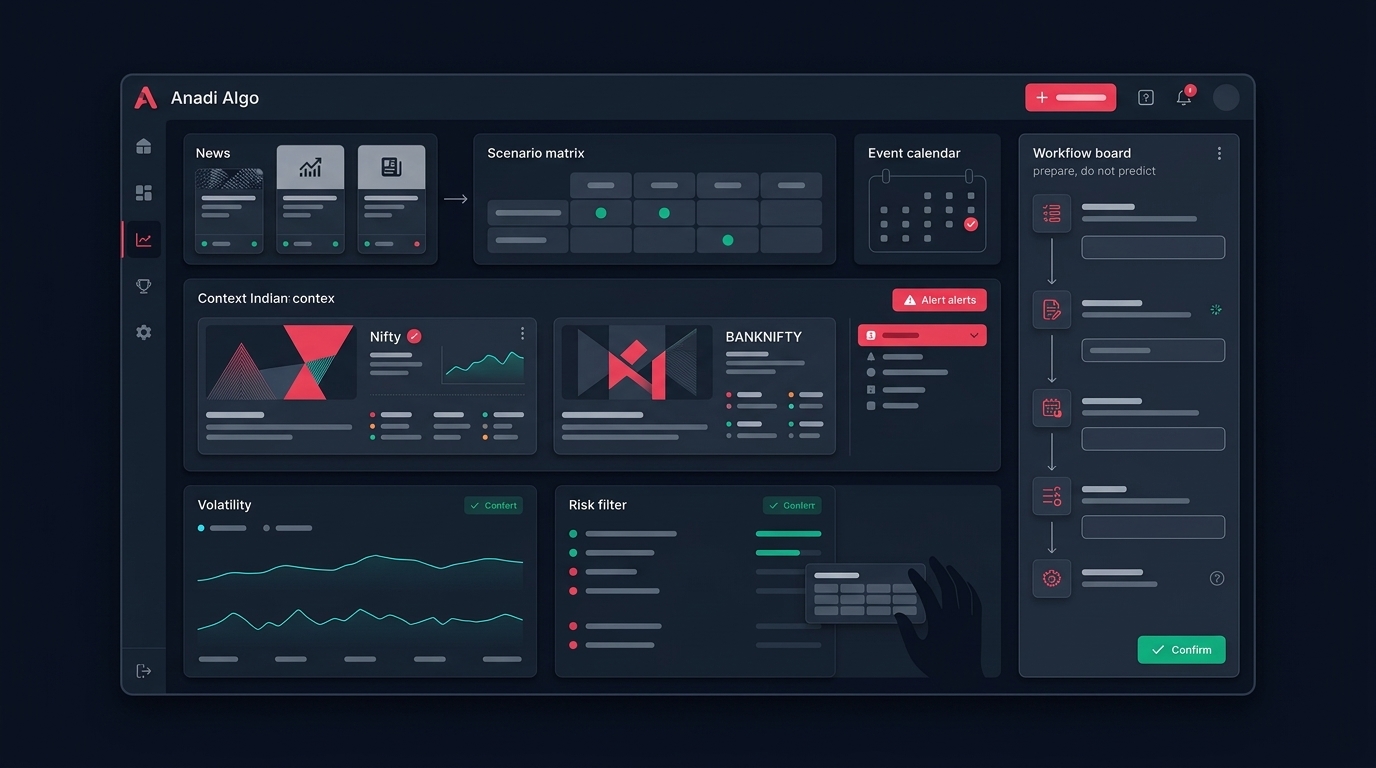
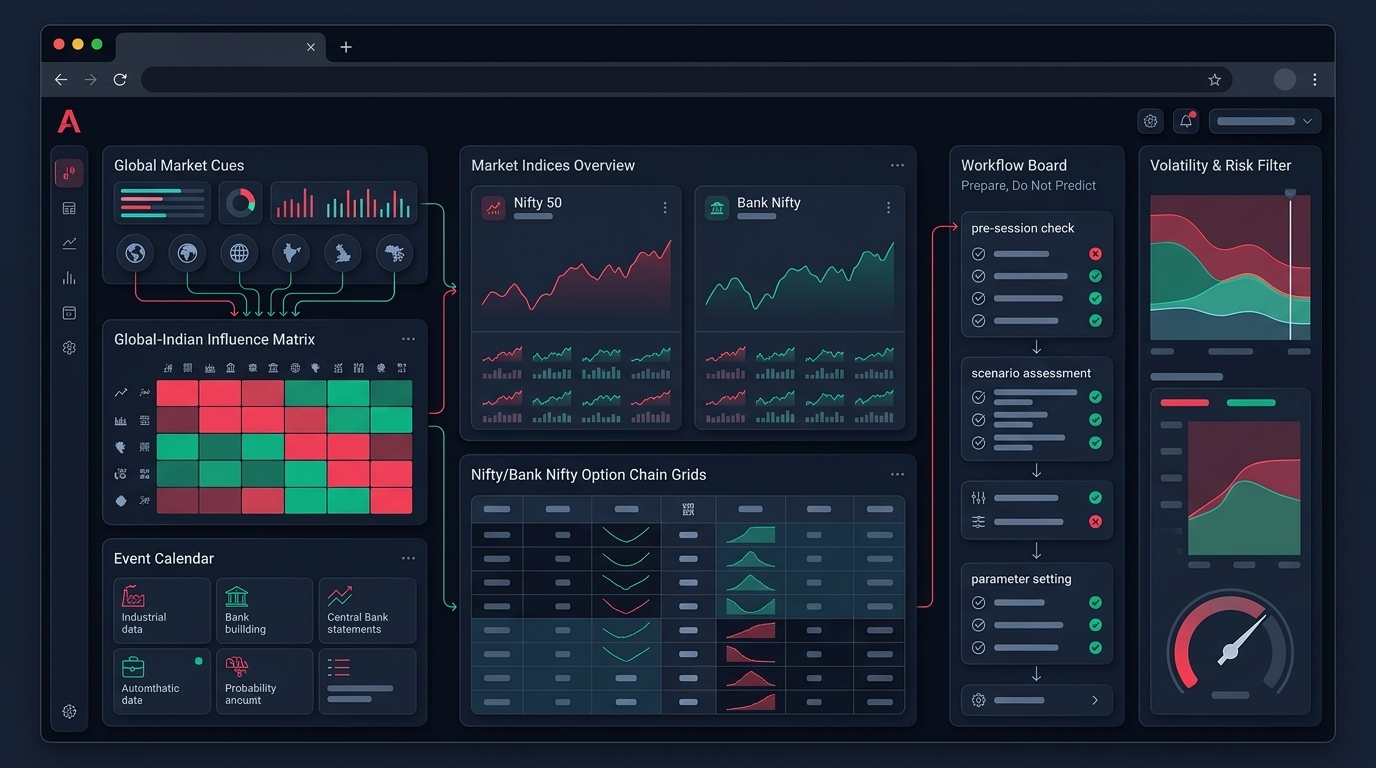
The last week of August 2026 handed Indian traders a perfect case study. On Wednesday, August 26, headlines said the Nifty was set for a strong opening: crude oil had fallen sharply, US Treasury yields had pulled back, Wall Street had rebounded overnight, and Gift Nifty at around 24,560 pointed to a gap-up of roughly 80 points.
The open did come in higher. The close did not cooperate. By the end of the session, the Sensex had fallen about 183 points to 77,472 and the Nifty had shed about 127 points to close near 24,208 — after spending most of the day in a narrow range.
So within one session: bullish global cues, a gap-up open, and a red close. If you trade with systems, this is not an annoyance. It is data. And it raises the question every algo trader eventually has to answer honestly: does a macro cue like "crude fell overnight" deserve a place in your rules at all — and if yes, in what role?
This post is not about predicting what crude or the Nifty does next. It is about a process for auditing a cue before you code it into anything.
What actually happened last week
A quick factual recap, because the sequence matters more than any single day.
Early in the week, crude was elevated. Brent traded near $93 a barrel and US crude near $85–86, with uncertainty around Iran and Gulf oil shipments keeping a geopolitical premium in prices. Indian benchmarks closed slightly lower on Monday, and global markets were waiting on US inflation data and the Jackson Hole event.
Then crude broke lower. WTI fell more than 6% over two sessions into the $80–81 range. That flipped the overnight narrative: lower oil, softer US yields, a Wall Street rebound. Wednesday morning's setup looked constructive, and Gift Nifty confirmed a gap-up open. Derivatives commentary even pointed to strong rollovers supporting a constructive view.
And still, the index faded through the day and closed lower.
None of this means the cues were "wrong." It means the relationship between an overnight macro cue and an intraday outcome is noisier than headlines make it feel. For a discretionary trader, that is a vibe. For an algo trader, it is a testable claim.
A cue is not a rule until you have measured it
Most retail algo journeys go like this: read that crude matters for Indian markets (it does — India imports most of its oil, a weaker rupee makes those imports costlier, and crude-driven inflation worries had dominated sentiment for weeks before this drop). Then jump straight to coding: "if crude falls overnight, go long Nifty at open."
That jump skips the entire measurement layer. The honest questions in between:
- What exactly counts as "crude falling"? Down 1% overnight? Down 6% over two sessions? Brent or WTI? From an elevated base near $93 or from a normal range?
- What outcome are you claiming it predicts? The gap at open? The open-to-close drift? The day's realized range? These are three different claims, and last Wednesday they gave three different answers — the gap was up, the drift was down, the range was narrow.
- Over what sample have you checked this, on your instrument, on your timeframe?
Until you answer these, "crude fell, so markets should rise" is a headline, not a rule. The good news: turning it into a testable statement is exactly the kind of work a backtesting workflow exists for.
The five-step cue audit
Here is a process you can run on any macro cue — crude, the rupee, US yields, FPI flow headlines — before it touches live capital.
Step 1: Define the cue as a number, not a story
"Positive global cues" is not codeable. "Front-month crude down more than 3% over the prior two sessions" is. Write the cue as a precise condition with a data source, a threshold, and a lookback window. If you cannot write it that way, you cannot test it, and you definitely cannot automate it.
Be honest about which contract and which session you mean. Crude quotes you see at 8:30 am IST reflect a different snapshot than the settlement your backtest data may use. Small definitional gaps like this quietly poison results.
Step 2: Define the outcome separately
Decide, in advance, what you claim the cue predicts:
- Gap direction and size at open
- Open-to-close drift (the part last Wednesday's headline reading would have missed)
- Realized range for the day
- Behaviour of a specific strategy you already run (does your breakout system do better or worse on these days?)
This matters because a cue can be genuinely informative about one outcome and useless for another. A cue that predicts gaps but not drift is a position-sizing input, not an entry signal.
Step 3: Test the pairing on your own market
Now run the actual study: on days matching your cue definition, what did your outcome variable do, across a few years of NIFTY or BANKNIFTY data? Not "did the market go up" in general — did the specific thing you claimed happen often enough, and by enough, to matter after costs?
Expect to be humbled. Most overnight macro cues, tested honestly, show weak or unstable relationships with intraday direction. That is not a failure of the audit; that is the audit working. A strategy builder with proper historical testing keeps you from discovering this with real money.
Step 4: Check regime dependence
Crude falling 6% from $93 during a fluid geopolitical situation — Strait of Hormuz risk in the headlines, Iran-related supply uncertainty — is not the same event as crude drifting 2% lower in a calm quarter. The base level, the reason for the move, and the surrounding volatility regime all change what the cue means.
Practically: split your test sample by regime. High-VIX vs low-VIX periods. Elevated crude vs normal crude. Expiry week vs non-expiry week. If a cue only "works" in one regime, your rule needs that regime as an explicit condition — or the result is probably noise wearing a costume.
Step 5: Assign the cue a role — filter, sizing input, or nothing
This is the step most traders skip. After the audit, a cue earns one of three roles:
- Entry signal: rare. The bar is high — stable, regime-robust, survives costs.
- Risk filter or sizing input: common. "On large overnight macro moves, trade half size" or "skip the first 15 minutes" are modest rules that survive testing far more often than directional bets. This is where risk management thinking earns its keep.
- Context only: also perfectly respectable. You stay aware of it, your algo ignores it.
Last week's tape is a live illustration of why the filter role usually wins. A trader using crude as an entry signal bought the gap-up and sat through a fade. A trader using it as a volatility-awareness filter simply knew the open carried headline risk and let their normal rules handle the rest.
Where the rupee fits in the same audit
The rupee-crude link is real at the macro level: costlier crude widens the import bill and pressures the currency, and a weaker rupee feeds back into imported inflation. FPI flow behaviour interacts with both. Beginners' guides list all of this correctly.
But the same audit discipline applies. "Weak rupee" as a daily trading input needs a definition (weak versus what, over what window?), an outcome claim, and a test. For most intraday index strategies, rupee moves resolve into the same practical output as crude: a volatility and gap-risk context, not a direction. Treat it as an input to how much risk you carry overnight, not as a signal for which side to take at 9:15.
Running headline mornings as a workflow
Suppose next week brings another "Nifty set for strong opening" morning. Here is what a process-driven desk actually does, mapped to concrete checks.
Before the open
Read the context, then park it. A weekly market outlook habit is useful precisely because it front-loads this thinking on the weekend — you already know the crude range, the pending events, and the expiry calendar before any morning headline arrives. The morning is for confirming, not deciding.
Check what your own rules say about gap opens. If your backtests show your strategy degrades on large gaps, that rule — not the headline's mood — decides whether you trade the first candles.
At and after the open
Look at breadth before acting on any single setup. A gap-up with weak sector participation is a very different tape from a gap-up with broad buying. This is exactly why Anadi puts index cards and a sector heatmap on the Indices view — as context that sits before scanner and option decisions, not as a prediction tool. Last Wednesday, the gainers list (a few private banks, cement, metals) against a long losers list (IT, telecom, capital goods) was visible early; narrow leadership is information.
Let your entry-quality checks do their job. On gap mornings, the biggest retail error is chasing — entering far from the level your system actually validated. Anadi's Action Center exists for this exact moment: it ranks scanner-backed candidates and shows blocked reasons like chase distance or invalidated price before you can route an order. On a headline-driven open, a "blocked: too far from entry" tag is not friction. It is the audit from Step 5 running live.
If you trade options on these mornings, inspect before you structure. A gap open shifts IV and OI across strikes; the option chain check — liquidity at your strikes, what the Greeks look like after the gap, what the payoff and margin picture is for the full basket — comes before any order, inside one workflow rather than across five tabs.
And regardless of instrument: your daily loss limit applies extra strongly on days when the narrative and the tape can diverge by lunch. Wednesday's session was narrow, but headline mornings often are not.
The takeaway checklist
Before any macro cue — crude, rupee, yields, "global cues" — enters your live system:
- Write the cue as a number. Threshold, window, data source. No stories.
- Name the outcome. Gap, drift, range, or strategy performance — pick one per test.
- Backtest the pair on your instrument across a few years, after costs.
- Split by regime. Crude level, VIX band, expiry week. Unstable across regimes means unreliable.
- Assign a role. Filter or sizing input is the usual honest answer; entry signal is rare; "context only" is fine.
- On headline mornings, run checks, not feelings. Breadth first, entry-quality gates on, chain inspected before structures, loss limit non-negotiable.
Last week's crude-driven gap-up that closed red was not a trap or a lie. It was a reminder that overnight cues and intraday outcomes are separate variables — and that the distance between them is exactly what a testing-first workflow is built to measure.
If you want to run this kind of cue audit and the morning workflow in one place — scanner, action queue with blocked reasons, option chain, backtests, and paper execution before live — you can request early access to Anadi Algo and build the process before the next headline morning arrives.