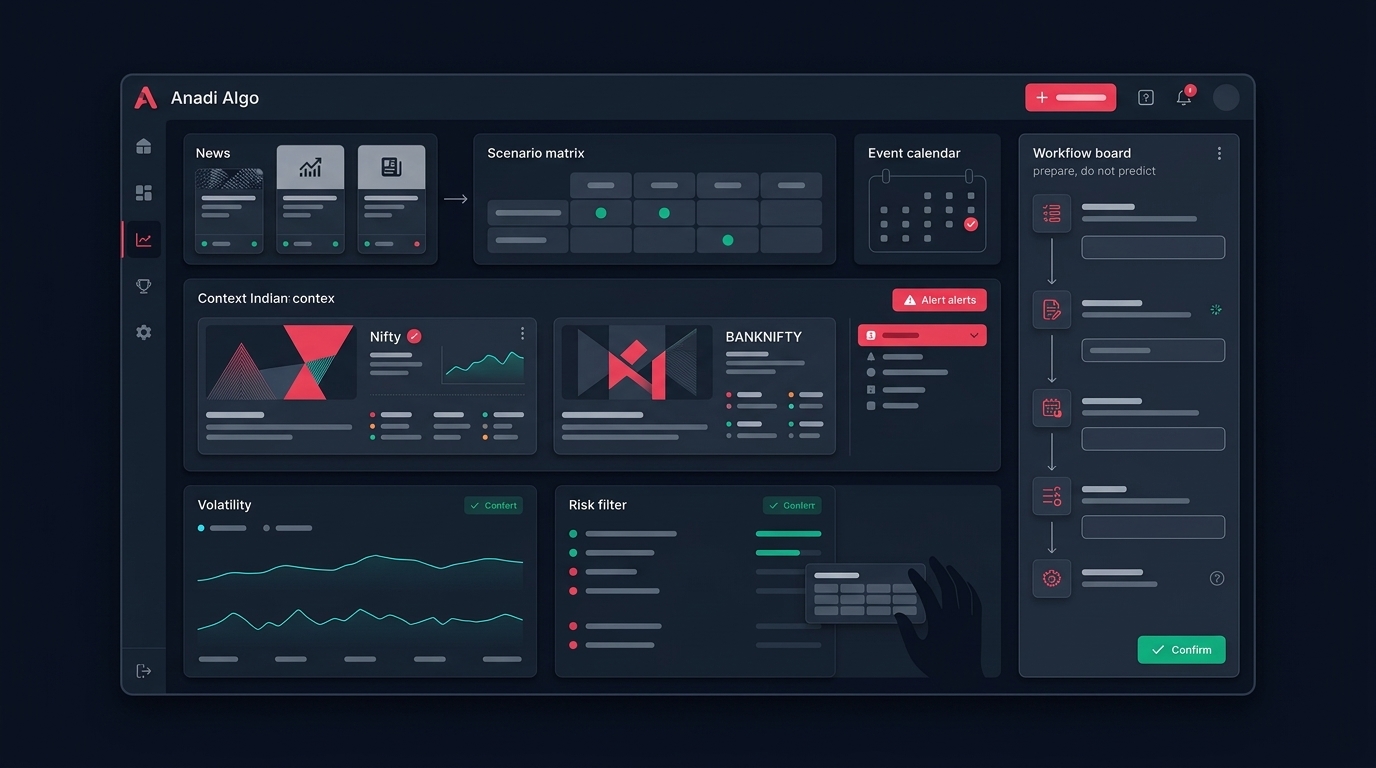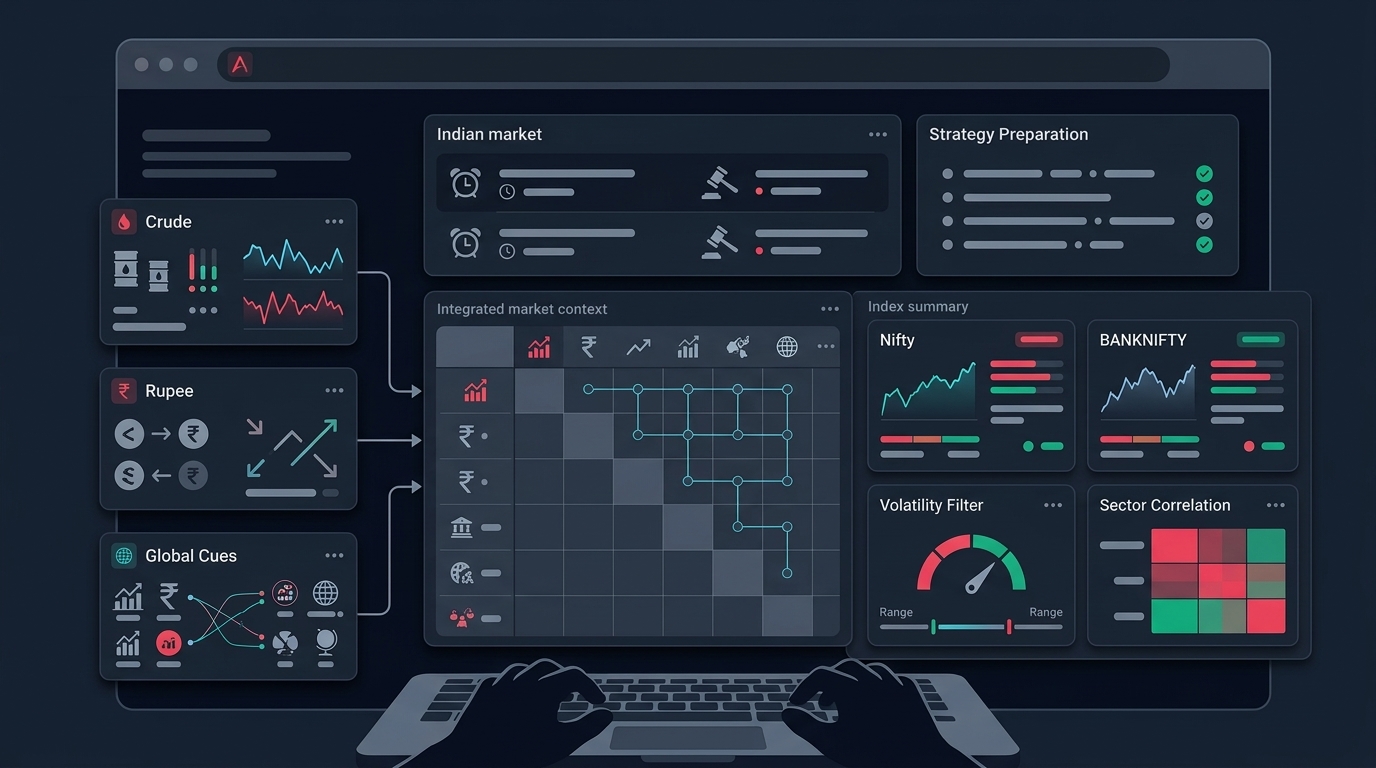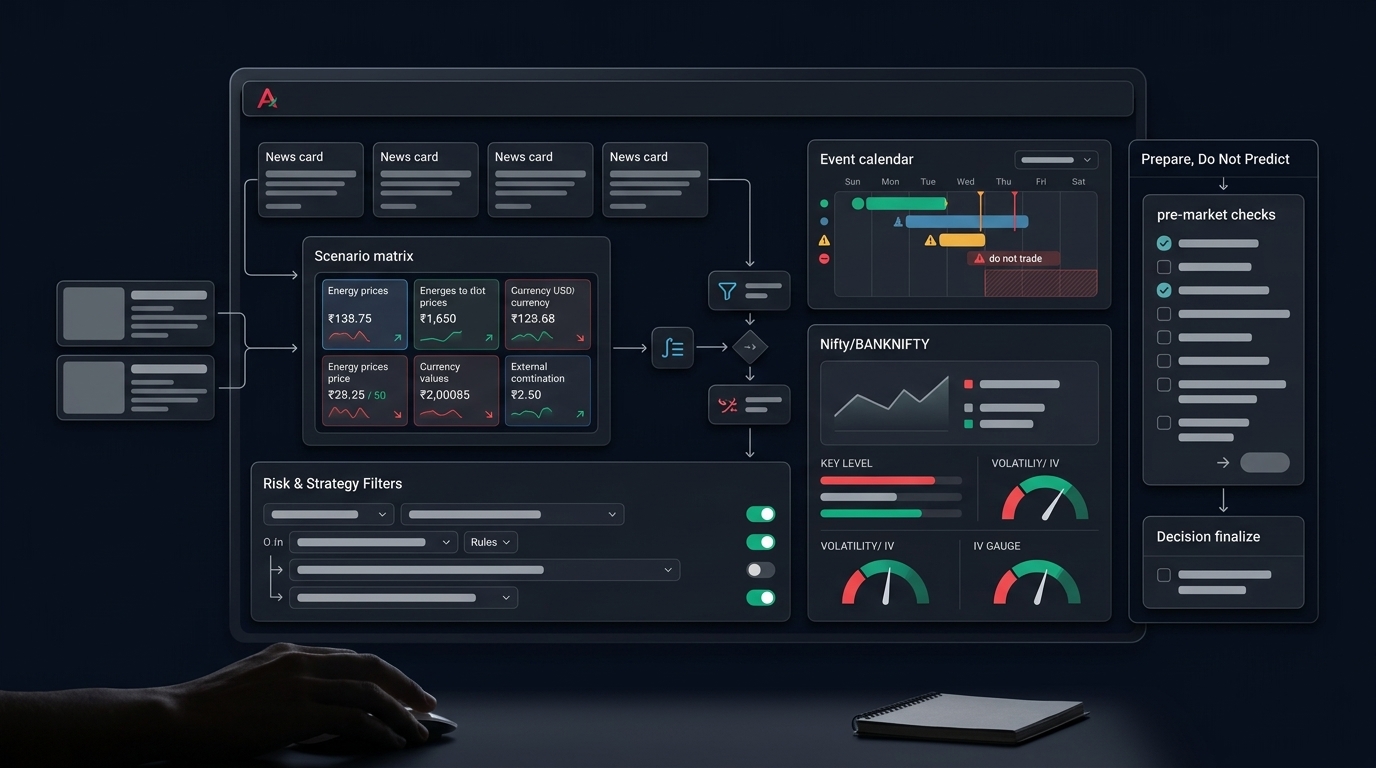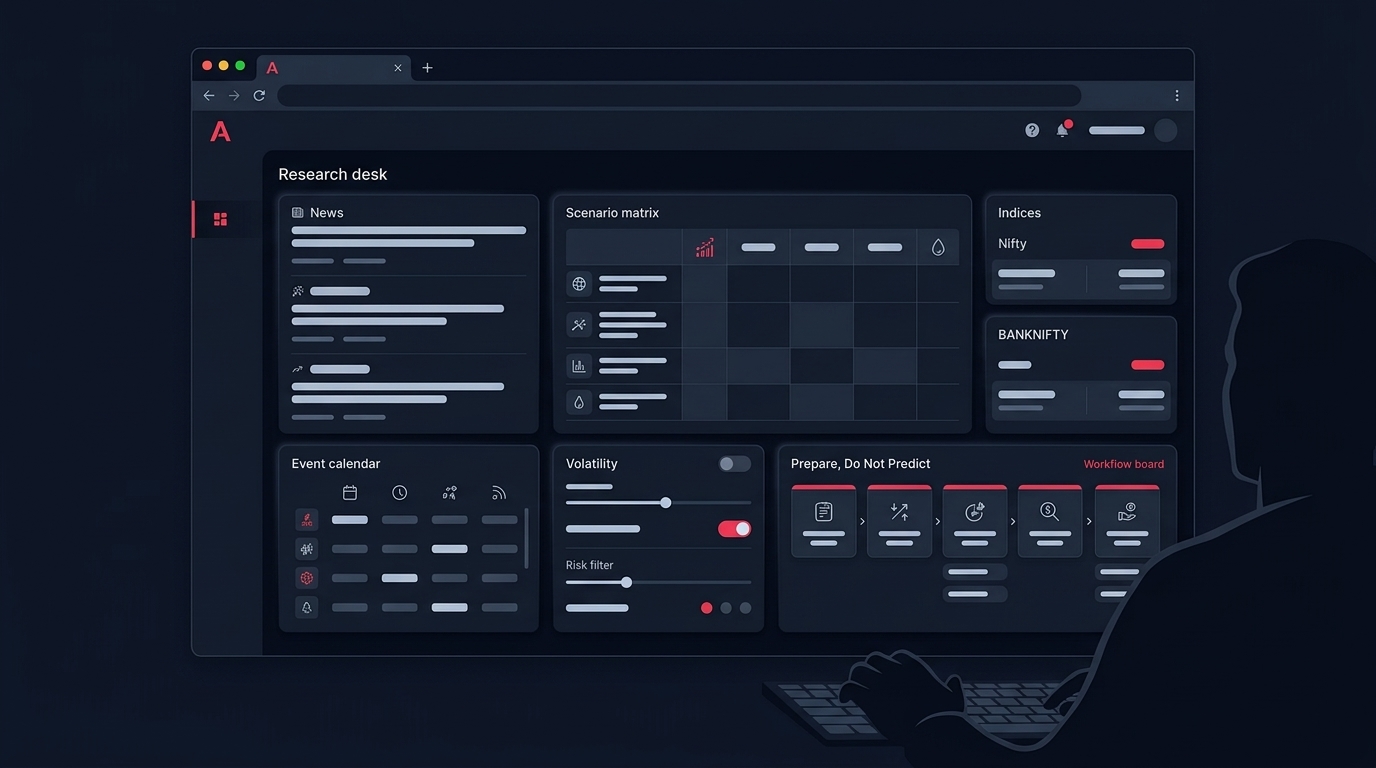
It is the weekend of September 20, 2026, and the crude oil story has not taken the weekend off. Brent spent the past week swinging between roughly $104 and $109 a barrel, Saudi Arabia and Yemen's Houthis exchanged fresh strikes, and Indian markets have been closed since Friday while all of this kept moving.
The usual retail response to a weekend like this is to hunt for a Monday prediction. The better response for anyone running systematic strategies is a weekend audit: check what actually happened, check what your system assumes, and fix the gaps before the 9:15 bell does it for you.
This post walks through that audit. No calls, no targets — just process.
What actually happened this week
Start with the facts, because filters built on vibes fail silently.
In the week ending September 11, crude surged about 13% and closed above $100 for the first time in four months, driven by escalating attacks on energy infrastructure in the Middle East. The following week extended the move: prices jumped roughly 3% to near $108 on September 14, and hovered just below $109 by September 16 as drone strikes kept Saudi Arabia's East-West pipeline shut and Saudi Aramco delayed some crude deliveries to European buyers, according to a Bloomberg report cited by The Economic Times.
Then something interesting happened. From September 17, crude fell for three straight sessions, with Brent slipping to around $104.62 and WTI near $101.20 — even as Saudi Arabia and the Houthis exchanged strikes across their border. In ET's words, markets "largely looked past the latest threats to supply." By Friday's close, crude sat below $104, and the near-month MCX crude contract traded around the ₹9,500 mark.
The backdrop matters too. Back in mid-August, when Brent first pushed above $91, Sensex and Nifty fell on a familiar combination: FII selling, weak Asian markets, rising US bond yields, and a slipping rupee. A month later, $100 crude is no longer a shock headline — it is the operating environment.
So the honest summary going into Monday is: headlines remain hot, but price has stopped confirming them. That divergence is exactly the kind of input that confuses rule-based systems, which is why the rest of this post is about your system, not the market.
Why this weekend is not a normal overnight gap
Every overnight session carries gap risk. A weekend like this carries a concentrated version of it: two full days of geopolitical news flow with zero Indian price discovery. Whatever happens between Friday's close and Monday's pre-open gets compressed into a single opening print.
Three things make this worse for algo traders specifically.
First, backtests systematically understate weekend gap risk. Most weekends in your historical data are quiet, so the average weekend gap looks small. The damage comes from the tail — the handful of regime weekends where crude, currency, and headlines were all live at once. If your backtest treats this weekend like an average one, your position sizing is calibrated to the wrong distribution. This is a core risk management problem, not a strategy-logic problem.
Second, there is a plumbing detail hiding in plain sight: the near-month MCX crude contract expires on Monday, September 21. If any of your signals, dashboards, or regime filters read MCX crude as an input, Monday's data will include a contract rollover. A naive feed that switches from the September to the October contract mid-stream can print a "move" that is really just the basis between two contracts. Verify how your data source handles rollover before you let a crude-based filter gate live trades.
Third, the first reliable India-specific cue arrives only with GIFT Nifty and the pre-open session on Monday morning. Everything before that is inference from global markets. A system that starts acting on Friday's stale context at 9:15 sharp is trading last week's information.
The weekend audit: four checks before Monday
Here is the audit worth doing while markets are closed. It takes an hour, and it is worth more than any amount of Monday-morning prediction content.
1. Positions carried over the weekend
List every position you are holding into Monday. For each one, answer three questions: what is the margin impact if the underlying gaps 1–2% against you, is the hedge leg (if any) actually live at your broker or only in your head, and does your basket-level stop-loss logic fire on the open or wait for a candle to complete? Option sellers in particular should re-check that a gap through a short strike does not leave a naked leg because one order of a multi-leg basket failed.
2. The coming week's event map
Write down the scheduled events for the week — MCX crude expiry on Monday, the weekly index option expiries, any macro data releases you track — and mark which of your strategies should stand down or trade smaller around them. The point of an event map is not to predict the events. It is to make "do nothing here" a rule instead of a mood.
3. Data and session plumbing
Broker API sessions expire. Tokens lapse. WebSocket feeds need re-authentication after quiet periods. A depressing share of "algo losses" on volatile Mondays are actually plumbing failures: the strategy was fine, but the feed was stale or the session had expired and orders silently failed. Log in early, confirm live quotes are ticking, and confirm your order route with a small paper or test action before your first real signal can fire.
4. Regime labels in your backtest
If your strategy was built and tested mostly on data where crude sat between $70 and $90 and the rupee was stable, its edge in a $100-plus crude regime is an assumption, not a result. You do not need to rebuild the strategy this weekend. You need to label your backtesting data by regime — crude band, VIX band, currency trend — and check how the strategy behaved in the slices that resemble the current environment. If those slices are thin or ugly, that argues for reduced size, not for hope.
Turning context into filters, not forecasts
Market context is only useful to an algo if it becomes an executable rule. Here are examples of how this week's context translates — treat these as illustrations of the method, not settings to copy.
A gap filter. Define what counts as a "large" open for your strategy — say, a gap beyond 0.75% on the index — and decide in advance what happens: skip the first N minutes, halve the size, or stand down entirely. The number matters less than the fact that it is written down before Monday.
A crude regime flag. A simple boolean — crude above $100, yes or no — can gate which strategies run and at what size. This week adds a subtlety: crude is above $100 but falling. If your flag only reads the level, it says "risk on the boil." If it only reads the three-day direction, it says "cooling." Decide how the two combine before the open, because a system that flips state every time one input twitches will churn you to death on a week like this.
Sector sensitivity lists. Crude and USDINR do not hit all stocks equally. Oil marketing companies, paints, and aviation carry crude as an input cost; IT carries the rupee as a revenue translation. If your scanner is surfacing breakout candidates on Monday, knowing which names sit on these sensitivity lists tells you whether a signal is company-specific or just macro beta wearing a stock's name.
Freshness and chase-distance rules. On a gappy open, a pattern signal generated on Friday afternoon may be stale by 9:16. This is where a workflow like Anadi's Action Center earns its place: it tracks signal freshness and blocks entries with explicit reasons — price has moved too far from the trigger, or the level that justified the setup has been invalidated. A blocked trade on a volatile Monday is not a missed opportunity; it is the system doing its job. If you run your own stack, replicate the idea: every signal should carry a timestamp and a maximum chase distance.
Three Monday scenarios, one process each
Nobody knows which of these happens. That is precisely why you prepare all three.
Gap down with crude rebounding. Weekend escalation headlines, crude back up, index opens heavy. Process: gap filter active, no fresh shorts chased into the open, existing hedges verified before 9:15, first evaluation only after your defined settling window.
Gap up with crude staying soft. The three-session slide in crude extends, risk appetite returns, index opens strong. Process: same discipline, opposite temptation. Gap-up opens fade often enough that freshness checks and chase-distance blocks matter more here, not less. A green open is not a signal; it is a starting condition.
Flat open, churny session. Crude and cues offset each other and the index opens near Friday's close, then whipsaws intraday. Process: this is the scenario that quietly bleeds trend-following intraday systems. If your regime label says "conflicted inputs," smaller size and fewer trades is a legitimate systematic choice.
Notice what is common across all three: the decisions were made on Sunday, not at 9:15 Monday. That is the entire difference between an algo trader and a fast manual trader.
Where this fits in a weekly routine
A weekend audit like this should not be a heroic one-off you do only when crude is above $100. It works best as a standing Sunday routine: read the week's context — a weekly market outlook is meant for exactly this preparation role, not for chasing trade calls — update your event map, re-check plumbing, and confirm regime labels.
If you are still building this muscle, run the whole loop on paper trading first. Let a volatile Monday hit your paper account and show you which filter was missing. Then encode the fix as an explicit rule in your strategy builder setup rather than a mental note. Anadi's workflow is built around this sequence — context, rules, backtest, paper, then live with risk checks in front of every order. If you want to set this up before the next regime weekend arrives, you can request early access.
The Monday-morning checklist
Print this, or copy it into your trading journal:
- Friday close facts written down: crude level and three-day direction, rupee trend, US yields, FII flow. Facts, not opinions.
- MCX crude rollover handled: any signal reading MCX crude knows the September contract expires Monday.
- Carried positions stress-checked: margin and hedge status verified for a 1–2% adverse gap.
- Event map for the week: expiries and data releases marked, stand-down windows defined.
- Broker session live before 9:00: token valid, feed ticking, order route confirmed.
- Gap filter armed: threshold and response decided in writing.
- Regime flag state resolved: level and direction inputs combined into one state, not two arguing signals.
- Signal freshness rules on: maximum chase distance set; blocked means blocked.
- Size decision made: if the regime is outside your backtest's comfort zone, the size cut is already applied.
Crude below $104 after nearing $109, headlines still live, a contract expiry on Monday, and two days of news your backtest never saw — none of it tells you what Nifty does next. All of it tells you what your system should check first. Do the audit; let Monday be boring.