If you opened any market app on the morning of November 14, 2026 and searched "crude oil price today," you got a number. The problem is that the number you got depends entirely on which page you landed on — and in a week like this one, those numbers were not telling the same story.
Over four sessions, Brent fell below $90 for the first time in three months on headlines that the Iran conflict was effectively over, climbed back near $92 as attacks on ships offset peace-talk hopes, slipped below $92 again as US-Iran and Russia-Ukraine talks firmed up, then pushed above $95 after fresh Middle East attacks. A week before that, crude had been near $100, and before that it took a roughly 9% single-day plunge around the US midterm results.
That is not a trend. That is a headline tape.
For a discretionary trader, a headline tape means "be careful." For an algo trader, it means something much more specific: every crude-linked filter, regime flag, and risk gate in your system is now being fed an input that can reverse its own signal within 24 hours. This post is about handling that as a data and process problem — not about guessing where crude goes next. Nobody in this article, including the banks quoted in the news, knows that.
"Crude oil price today" is at least four different numbers
Before you build any rule on crude, you have to know which series your rule is reading. There are four common ones, and they disagree in ways that matter.
Brent versus WTI
Brent is the North Sea benchmark that most international buyers price against, and it is the one Indian commentary usually means when it says "crude." WTI is the US grade and trades at a different level — in this same week, Brent was quoted around the low $90s while WTI sat around the mid $80s.
If your filter says "crude above $90 equals risk-on for OMCs, risk-off for aviation," you have just built a rule that fires on Brent and stays silent on WTI, or vice versa, purely because of a benchmark spread you never wrote down. Pick one, name it in your rule, and keep it consistent between your backtest and your live feed.
MCX rupee contracts, and the expiry nobody plans for
MCX quotes crude in rupees per barrel, and it quotes a specific contract, not a spot price. The ladder visible on November 14, 2026 ran 19 Nov 2026, 18 Dec 2026, 19 Jan 2027, and onward, with a Crude Oil Mini contract on the same near-month date.
That near-month expiry is five sessions away as of this post. If your algo reads an MCX "continuous" crude series, you will get a price jump at rollover that is a contract change, not a market move. A rule that triggers on "crude moved more than 2% overnight" can fire on a rollover gap and route you into a trade for no reason at all.
The fix is boring and effective: log the contract identifier along with the price, and add an explicit rollover-window flag to your data pipeline that suppresses gap-based triggers on the roll date.
Converted OIL/INR quotes
Several popular pages show crude "in rupees" by taking a dollar benchmark and applying the day's USD/INR rate, updating every minute. That is genuinely useful for understanding India's import bill — and genuinely dangerous as an algo input, because the series now contains two moving parts.
A 1% move in a converted rupee crude quote can be a crude move, a rupee move, or both pulling in opposite directions and partly cancelling. If your regime flag is built on that series, you cannot tell which risk you are actually responding to.
Useful sanity check: divide your rupee crude quote by the dollar benchmark it claims to track. That implied exchange rate should sit close to the spot USD/INR you see elsewhere. When it drifts, your feed is stale on one leg — and stale feeds are one of the quieter ways live algos start disagreeing with their backtests.
Why the rupee leg deserves its own rule
India is the world's third-largest crude consumer and imports roughly 85% of its petroleum needs. That single fact is why crude shows up in Indian market commentary every single morning: it feeds the import bill, the trade deficit, inflation expectations, and government finances.
But the transmission is not linear, and traders routinely over-model it.
Retail petrol and diesel prices are set by state-owned oil marketing companies under a daily dynamic pricing system benchmarked to international crude and the rupee. On top of that sit central excise duty and state VAT, which can account for 40–55% of the pump price. The practical consequence: a 10% fall in crude does not produce a 10% fall in petrol. The tax layer absorbs and delays a lot of it.
So if you have written a rule along the lines of "crude down equals OMC margins up equals buy the basket," you have compressed a slow, policy-mediated, partly-taxed transmission into a same-day trigger. Backtest that assumption honestly before you let it size positions. Most crude-to-equity relationships in India are regime-dependent and weaker intraday than they look on a monthly chart.
Turning a two-way headline tape into rules
Here is the core difficulty of a week like November 10–13, 2026. A simple threshold filter — "pause the strategy when crude is above $95" — would have switched state at least three times in four sessions. Each switch means flattening, re-arming, missing re-entries, and paying costs on both sides. The filter does not lose money because it is wrong about crude. It loses money because it is unstable.
Four practical adjustments:
Add hysteresis. Use two thresholds, not one. Risk-off engages above $95 but only disengages below $91. The dead band stops a single headline from flipping your system twice.
Add dwell time. Require the condition to hold for N consecutive closes — or N hours — before the state changes. On a tape driven by peace-talk headlines and shipping attacks, a two-session dwell requirement would have removed most of last week's churn.
Separate "reduce" from "stop." A binary on/off switch is too crude for a crude filter. Intermediate states — half size, hedged only, no fresh entries but manage existing ones — let you respond to elevated risk without a full strategy restart every time a headline crosses.
Count your flips before you trust the filter. Run the filter over the last 12 months of data and simply count state changes. If it flips more than a handful of times a quarter, you have built a noise amplifier. This kind of check belongs in your backtesting routine, not in a live post-mortem.
What about the $140 forecast?
Goldman Sachs recently raised its oil forecasts and flagged that Brent could reach $140 per barrel in 2027 if Gulf production stays significantly below its 2025 average. That got wide coverage, and it will show up in your feed again.
Treat it correctly: it is one institution's conditional scenario, with an explicit "if" attached to a supply condition that has not happened. It is not a price target you can trade, and it is not a forecast this article is endorsing or disputing.
What a published scenario like that is genuinely useful for is stress testing. Take your current book, apply a large adverse crude move, and ask what breaks — margin requirements, sector exposure concentration, gap risk on your overnight options positions. That is a risk management exercise with a concrete output. Positioning for someone else's 2027 scenario is not.
Where this plugs into an actual workflow
The reason crude context goes wrong for retail algo traders is usually not analysis — it is that market context lives in one tab and the trading system lives in another, and they never meet.
A workflow that holds up on a noisy-cue morning looks roughly like this.
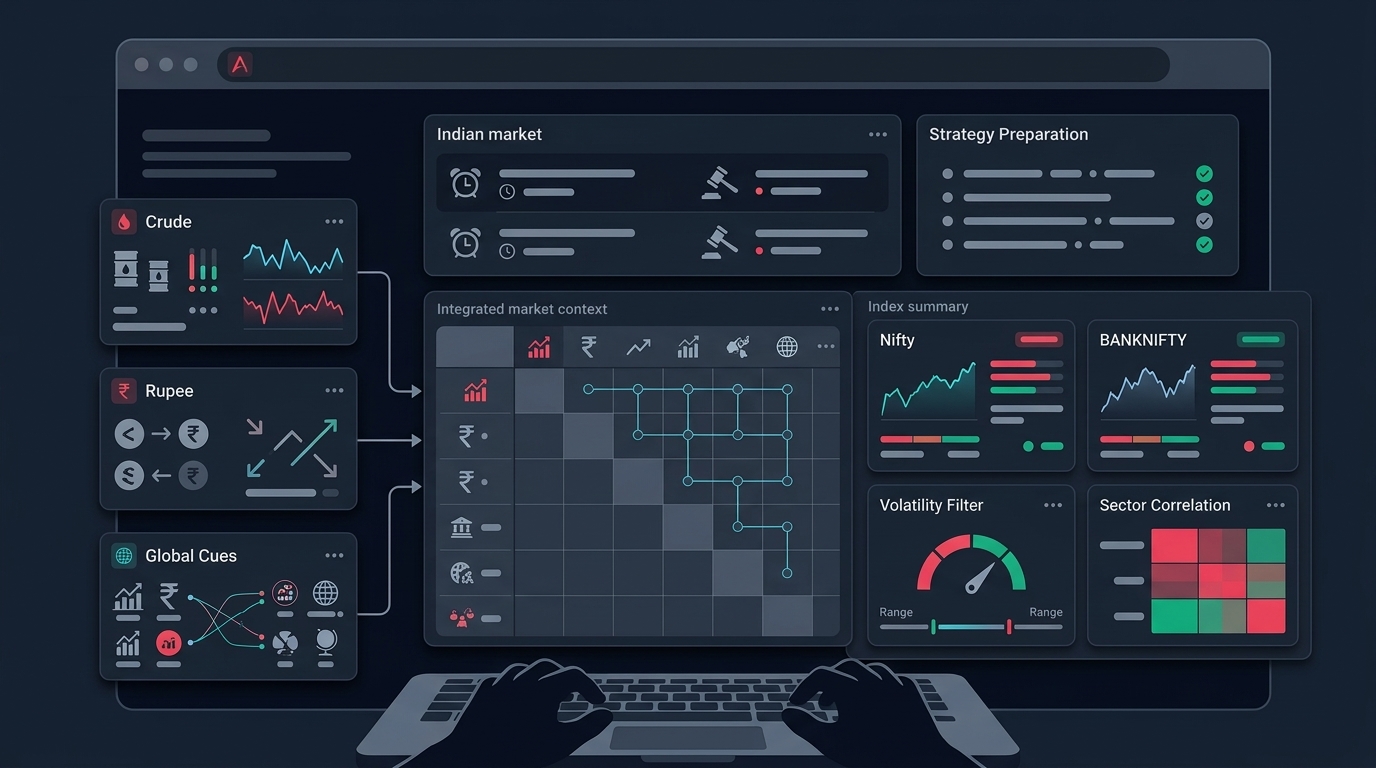
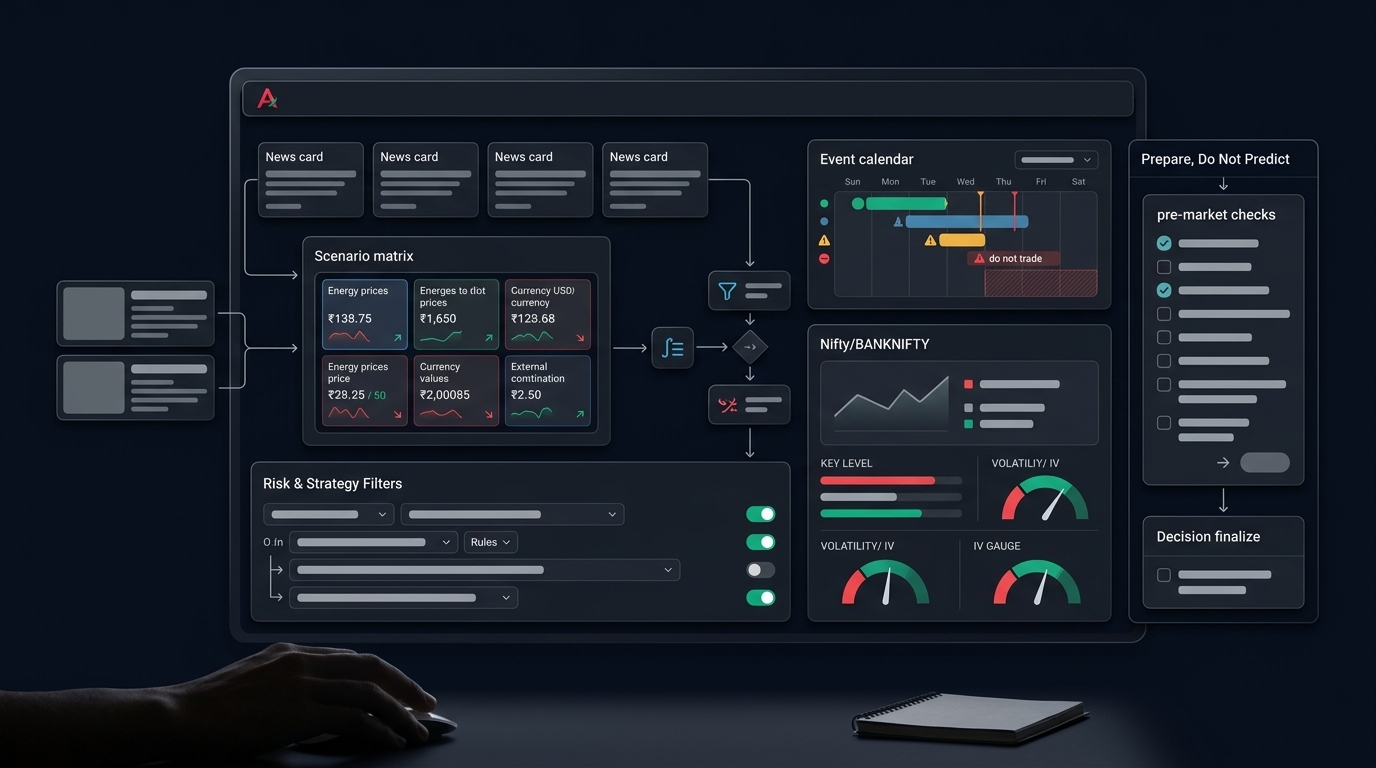
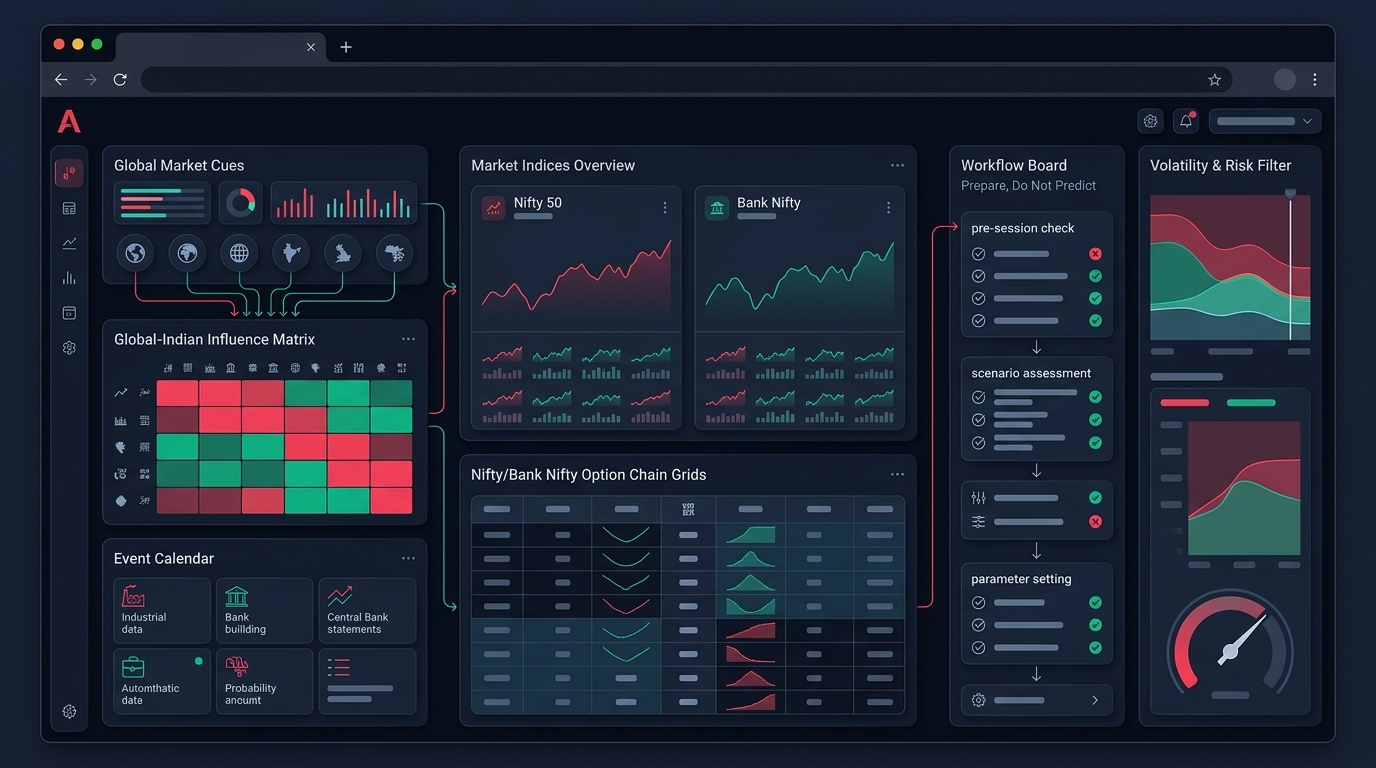
Context first, as a state, not a story. Note the crude benchmark and level, the rupee, and overnight global cues, and convert them into a single regime label for the day — normal, elevated, or stand-down. One label. Written down before the open. This is the whole point of a weekly market outlook: it exists to prepare the rules, not to generate calls.
Let the filter reach the signal queue. In Anadi's Action Center, scanner-backed candidates carry freshness, signal stage, entry quality, and blocked reasons such as chase distance or invalidated price. On a gap-driven morning, those blocked reasons do most of the protective work — a signal that looked clean at 9:10 is frequently a late chase by 9:22, and the queue should say so rather than leaving you to notice.
Validate structure before strike. If a crude-sensitive sector move sends you toward options, the chain is where the decision actually happens — strike, liquidity, Greeks, basket payoff, and margin estimate together, not entry price alone. Noisy-cue days tend to come with wider spreads and fatter IV, and both show up in the chain long before they show up in your P&L.
Paper-trade the regime, not just the strategy. If you have added a new crude or rupee filter this month, run it in paper trading through a full event cycle before it gets live capital. A filter that behaves sensibly in backtest and thrashes in live data is extremely common, and the only cheap place to discover that is paper.
Your crude and global-cues checklist
Run this before the open, not during it:
- Which series am I reading? Brent, WTI, MCX rupee near-month, or a converted OIL/INR quote. Write it into the rule.
- Is a contract roll near? MCX near-month crude expires 19 November 2026. Suppress gap-based triggers on roll dates.
- Is the rupee leg separated? If you use a converted rupee crude quote, you cannot attribute the move. Track crude and USD/INR as two inputs.
- Does my filter have hysteresis and dwell time? One threshold on a headline tape is a churn machine.
- How many times did this filter flip last quarter? More than a handful means it is amplifying noise.
- Do I have intermediate states? Half size and no-fresh-entries are usually better responses than full stop.
- Is my event calendar current? Known events get planned exposure reduction. Unknown headlines get the regime filter.
- Did I log today's context with today's fills? Without that, you can never audit whether the crude filter actually helped.
- Is my broker session and feed healthy? A stale quote on a volatile cue morning is worse than no quote.
The honest summary of a week like this: crude told you that uncertainty was elevated and two-sided. It did not tell you direction, and any system that claims otherwise is reading a headline as a forecast.
Build the filter so it survives both outcomes. If you want to put these checks into a working scanner, chain, and backtest loop instead of a spreadsheet, you can request early access and set the regime rules up before the next headline week arrives.