Indian markets just closed out one of the more instructive weeks of 2026. The Nifty snapped a seven-session losing streak on Thursday, then spent Friday drifting sideways while crude oil held near $94, US Treasury yields climbed back toward multi-year highs, and the rupee stayed under pressure around 95.7 to the dollar.
If you trade with algos, scanners, or systematic options strategies, the question this weekend is not "will the market fall on Monday?" Nobody knows, and this post will not pretend to. The useful question is: what does a crude-plus-yields regime change about your process — your filters, your sizing, your event calendar, and what you should be checking before the next session opens?
Let's break the context down and turn it into process.
What last week actually looked like
A quick factual recap, based on market reports through Friday, August 21:
- The Nifty fell for seven straight sessions before bouncing on Thursday, closing at 24,231.85, up 0.64%. The Sensex rose 628 points to 77,537.72 the same day.
- Friday was rangebound. The Nifty hovered near 24,240 and the Sensex near 77,560 through most of the session, with reports noting that buyers were waiting for stronger triggers before committing.
- Crude oil traded near $94 a barrel, with Middle East tensions keeping supply risk in the headlines.
- US Treasury yields resumed climbing after a brief pause that followed a surprise US Treasury intervention in the bond market. The 10-year moved to around 4.71% and the 30-year back near 5.25%.
- The rupee traded around 95.7 against the dollar, pressured by elevated crude prices.
- Breadth was split on Friday: the Nifty Smallcap index gained nearly 0.7%, the Midcap index slipped around 0.2%, IT fell about 0.5% on profit booking, and Bank Nifty stayed in a narrow range.
- Globally, Japan's Nikkei logged a weekly loss of more than 4% as bond-market stress weighed on equities across Asia.
None of this tells you what Monday will do. All of it tells you what kind of tape you are operating in.
Why crude plus rising yields is its own regime
Crude at elevated levels is a familiar story for Indian traders: a higher import bill, margin pressure for oil-sensitive sectors, and a heavier rupee. Many of us have filters for that already.
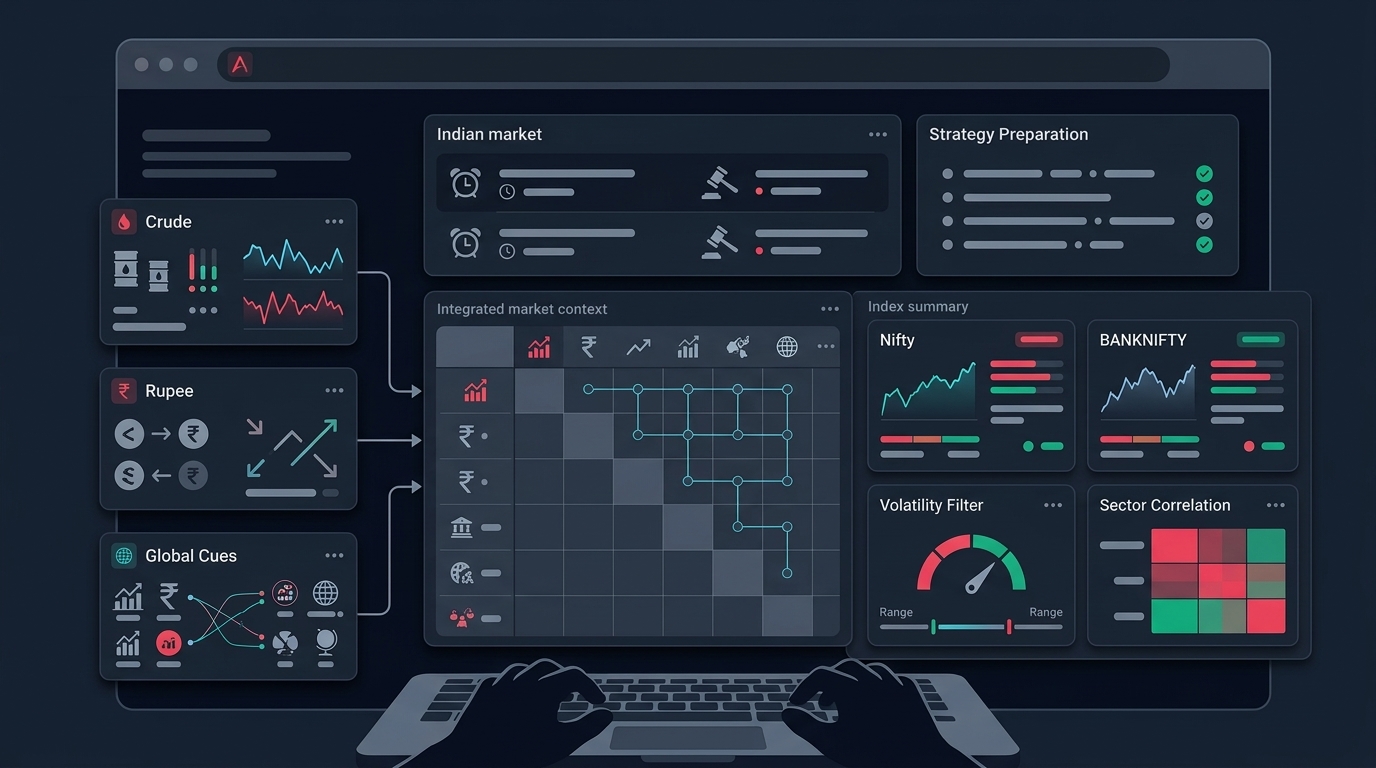
What makes the current stretch different is that crude is rising alongside US yields. That combination behaves differently from either factor alone:
Foreign flows face a double pull. Higher US yields make dollar assets more attractive, which historically pressures emerging-market equities. Add a weakening rupee, and the currency-adjusted return math for foreign investors gets harder. You don't need to predict FII behaviour — you just need to recognise that flow-driven days become more likely, and flow-driven days often don't respect intraday technical levels the way quiet days do.
The news flow breaks outside Indian hours. US bond auctions, Treasury interventions, crude inventory data, and Middle East headlines mostly land in the evening or overnight IST. That's why this regime expresses itself as opening gaps and choppy first hours rather than clean intraday trends. A backtest built on smooth continuous sessions will underestimate what this does to stops and fills.
Index-level calm hides sector dispersion. Friday's session is a good example: the headline index was flat, but smallcaps rallied, IT sold off, and midcaps drifted lower. An algo that reads only Nifty-level signals — "index flat, low volatility, safe to deploy" — can walk into a sector rotation it never measured.
Rangebound is not the same as low-risk. Reports through Friday described buyers waiting for triggers. A market waiting for a trigger is a market that can move fast when one arrives. Range-compression days in a stressed macro backdrop are exactly when breakout traps and false starts multiply.
Five risk filters worth encoding before Monday
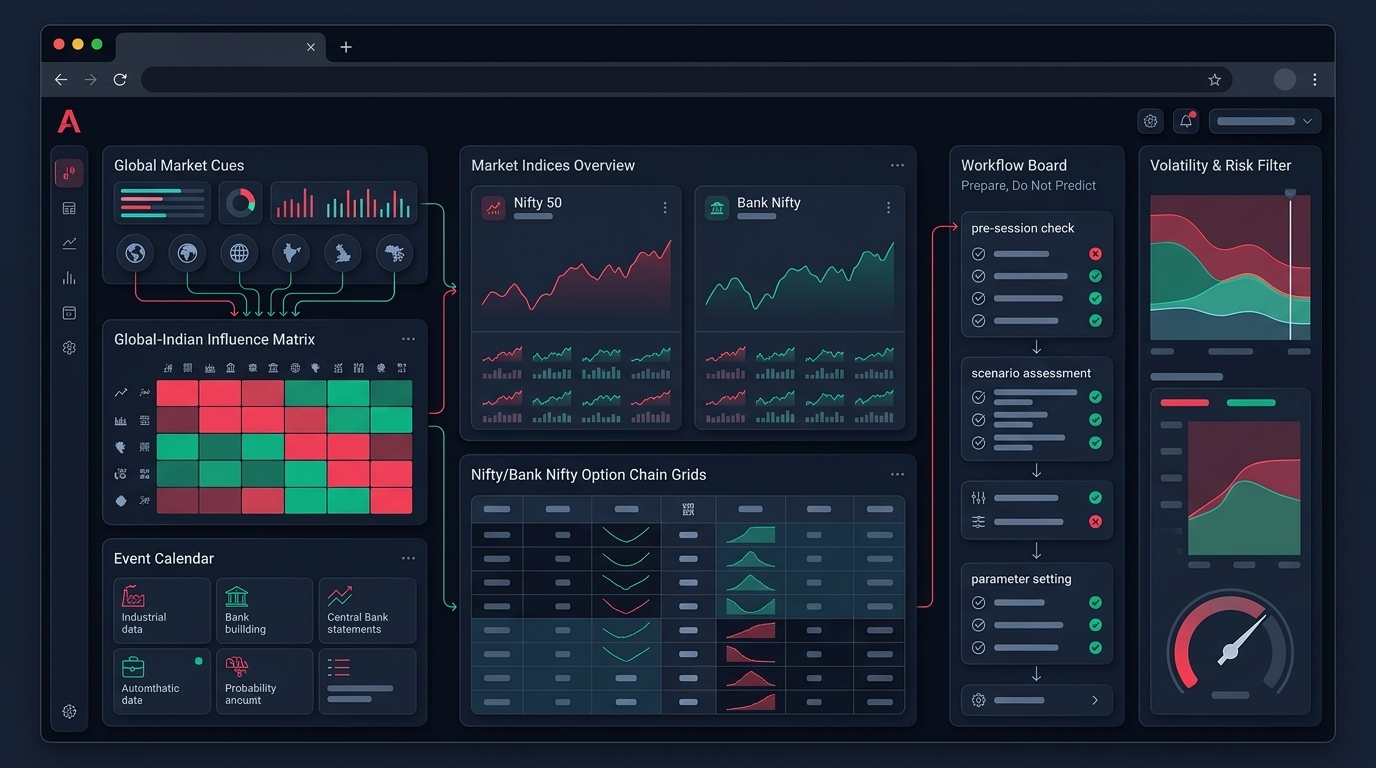
Here is how to convert that context into rules your system can actually check. These are process filters, not trade signals.
1. An overnight exposure flag. Decide, in writing, how your overnight risk changes when your regime flags are on — for example, crude above a threshold you define, the 10-year US yield rising week over week, and the rupee weakening. That might mean smaller overnight option-selling exposure, mandatory hedges on short legs, or no naked overnight positions at all. The specific rule matters less than the fact that it exists before the headline, not after.
2. A gap-size rule at the open. Compare the open against the previous close, scaled by recent average range. If the gap exceeds your threshold, delay fresh entries for a defined window and let levels re-form. Gap days are where "the backtest said enter at 9:16" quietly becomes your worst fills of the month. We covered pre-open gap process in detail in an earlier post on GIFT Nifty gap-ups; the same discipline applies to gap-downs.
3. Treat crude and rupee as regime inputs, not trade signals. The mistake is trading the news itself — shorting Nifty because crude rose overnight. Crude and USD-INR levels are better used as state variables that adjust position sizing, instrument eligibility, and strategy on/off switches. Your entry logic stays whatever it was; the regime decides how much of it runs.
4. Know which of your systems fits a streak-and-snap tape. Seven down sessions, one sharp bounce, then a flat day is a hostile sequence for both trend-followers (whipsawed at the turn) and mean-reversion systems (run over during the streak). Pull up each live strategy and ask honestly: which regime was this built for, and is that the regime we're in? A daily loss limit at the account level is what keeps this question from becoming expensive while you figure out the answer.
5. Scheduled-event blackouts. You cannot schedule geopolitical headlines, but you can schedule around known events: US data releases, bond auction days, domestic policy announcements, and weekly index expiry sessions, which amplify intraday moves through dealer hedging. A simple time-based no-new-entries window around events you've listed in advance costs little and removes a whole class of bad fills.
What to review in your backtests this weekend
A stretch like the past two weeks is a gift for system evaluation, because it stress-tests assumptions that calm markets let you ignore.
Compare live behaviour to backtest assumptions. Pull your live or paper logs from the losing streak. Were your actual fills close to backtested prices, or did slippage widen on the weak sessions? If your backtest assumes fixed slippage, a stressed fortnight is where that assumption breaks first.
Re-examine stop distances against realized ranges. When daily ranges expand, stops calibrated to a quieter period get hit by noise that the original logic never intended to trade. Check whether your stop placement is volatility-scaled or fixed — and if fixed, what the last ten sessions did to your stop-out rate.
Audit your sector exposure. If your scanner kept surfacing IT longs on Friday while the sector booked profits, that's worth knowing. Signals aren't wrong for existing — but your portfolio-level filter should know when multiple signals share one sector risk.
Resist the one-bad-week rewrite. The most dangerous instinct after a losing streak is re-optimising the strategy until the last two weeks look good. That's overfitting to a fortnight. Proper backtesting means testing any proposed change across multiple regimes — trending, rangebound, and stressed — before it touches live capital. If a tweak only improves the recent window, it's a patch on noise.
Workflow checks: from signal to execution
Regime awareness has to survive contact with your actual daily workflow. A few checks that matter more than usual right now:
Signal freshness. In a gap-and-headline tape, a signal's age is part of its quality. A breakout your scanner flagged at 10:15 may be meaningless by 13:40 if crude headlines have moved the tape. This is why Anadi's Action Center tracks signal freshness and stage explicitly, and marks entries as blocked when price has run too far from the level — a "chase distance" block is annoying in the moment and protective over a hundred trades. Whatever platform you use, the principle stands: an entry rule without a staleness rule is half a rule.
Option chain validation before acting. If your workflow routes signals into options, the chain deserves a look before the order goes out. Elevated macro stress usually shows up in implied volatility, and the same short strangle at high IV versus low IV is a genuinely different trade with different margin, different theta, and different gap exposure. Check IV context, bid-ask spreads on your strikes, and open interest before the basket, not after. Anadi keeps chain inspection, basket preview, and margin estimation in one flow for exactly this reason — but the checklist matters more than the tool.
Margin headroom. Volatile regimes are when margin requirements shift and when you least want a surprise. Preview margin with existing positions considered before adding legs, and keep deliberate headroom rather than running near the ceiling.
Written manual-override rules. Decide now, on a quiet Sunday, what would make you flatten or pause an algo mid-session this week — a defined loss level, a specific type of headline, a data-feed anomaly. Overrides decided during a live drawdown are emotional decisions wearing a process costume.
If you're still validating a system, this is also a strong argument for running it in paper trading through a stressed stretch before going live. A strategy that has only seen calm markets is an incomplete experiment.
Respect the calendar, not the noise
The honest summary of the current setup: crude near $94, yields grinding higher, a pressured rupee, and an equity market that has stopped falling but hasn't found a reason to rally. Any of those can change on one headline, and none of them are predictable.
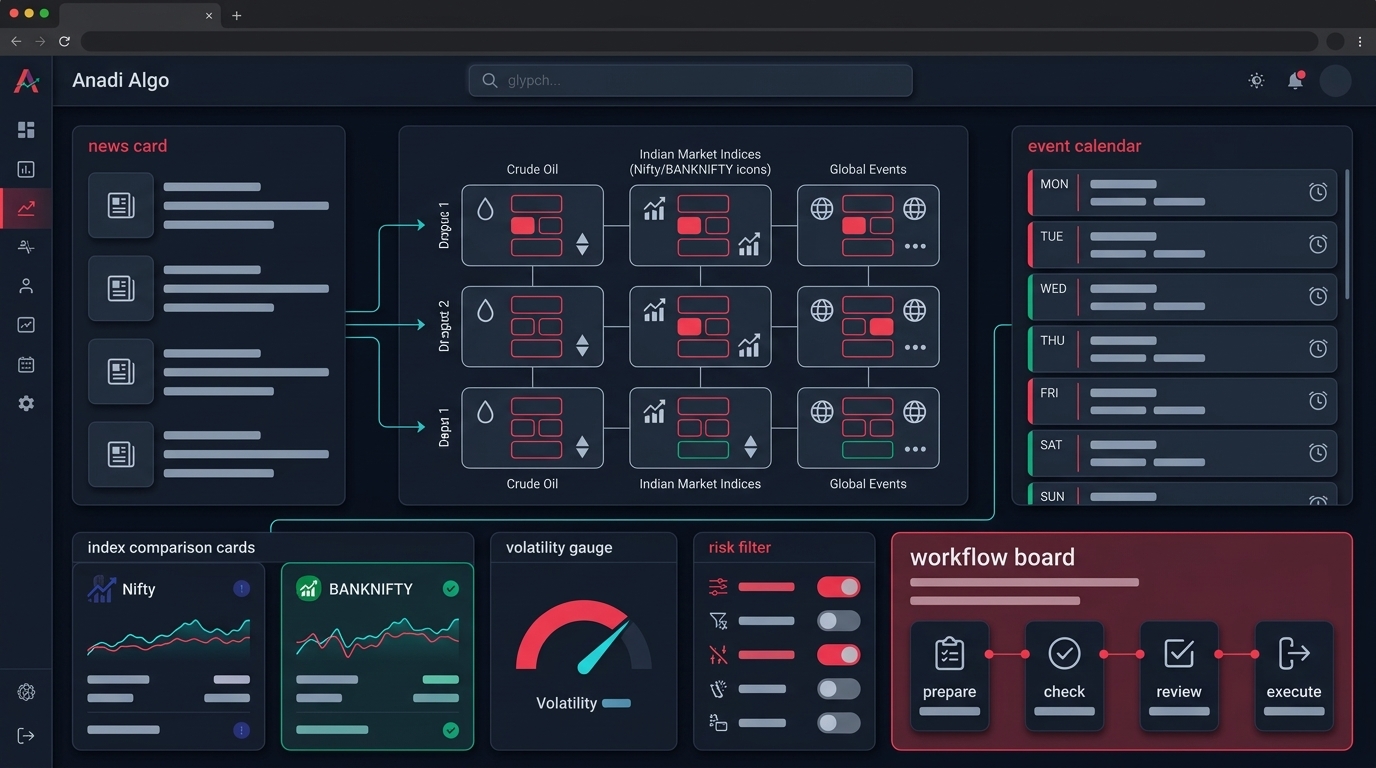
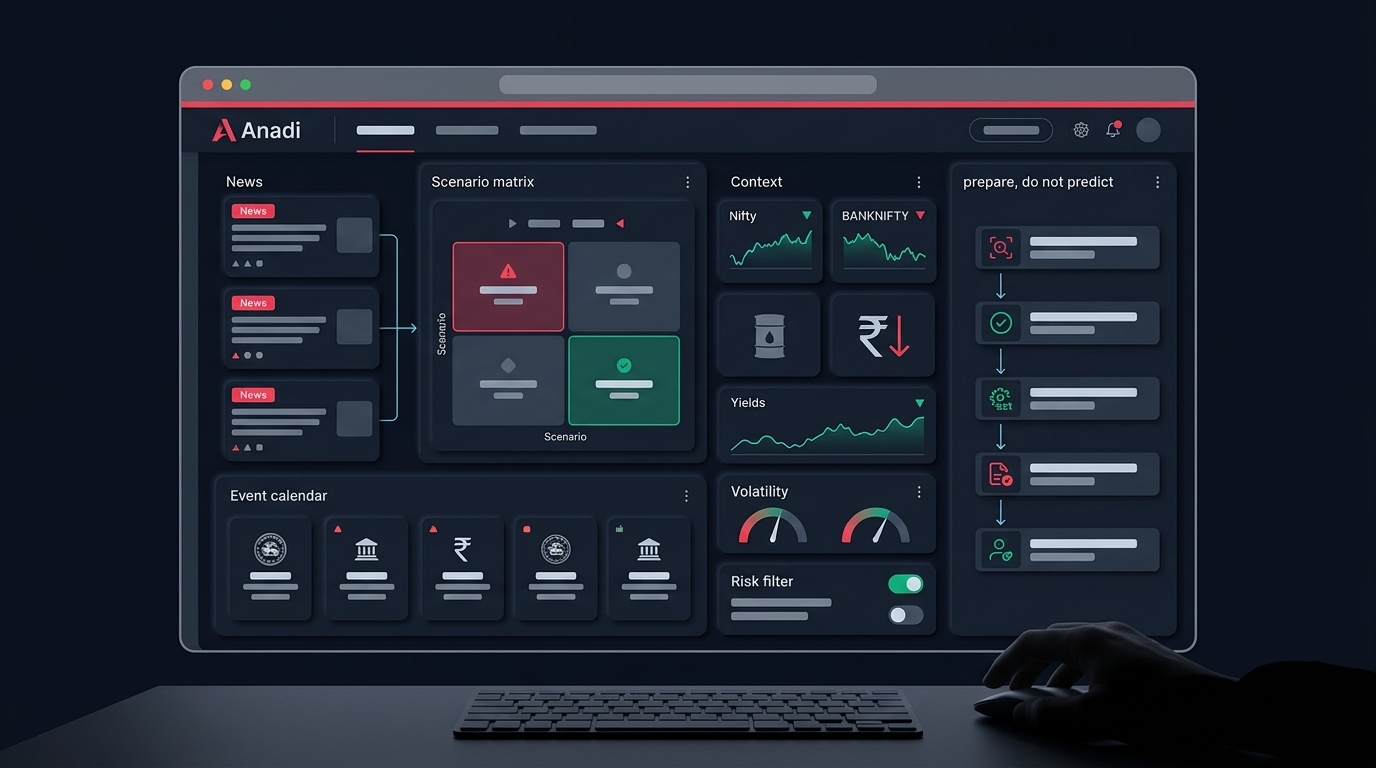
What is predictable is the calendar. Keep a written event map for the week — domestic data, global bond events, expiry days — and let it drive your exposure schedule. That's the entire philosophy behind our weekly market outlook: use market context to prepare your process, not to chase noisy trade calls.
If you want that preparation built into your daily workflow — regime-aware scanning, blocked-entry protection, chain validation, margin preview, and paper-first execution in one place — you can request early access to Anadi Algo and test it against your own process.
Monday pre-open checklist
Before the 9:15 bell, run through this:
- Overnight scan — where did crude, US yields, and USD-INR close relative to your regime thresholds?
- Gap check — compare GIFT Nifty and the expected open against Friday's close; if the gap exceeds your rule, delay fresh entries.
- Regime flags — are your crude/yield/rupee flags on, and did your sizing adjust accordingly, automatically?
- Event map — list this week's scheduled events and expiry days; confirm your blackout windows are set.
- Strategy fit — confirm which systems are enabled and that each one belongs in a streak-and-snap, headline-driven tape.
- Stop audit — are stops volatility-scaled to the last ten sessions, not last month's calm?
- Sector concentration — check whether today's signals cluster in one sector before deploying all of them.
- Override sheet — your manual-pause rules, written, visible, decided in advance.
The traders who get hurt in weeks like this are rarely the ones with the worst strategies. They're the ones whose process assumed the market owed them a normal week. Prepare for the regime you're in, size for the gap you haven't seen yet, and let the checklist — not the headline — decide what runs.