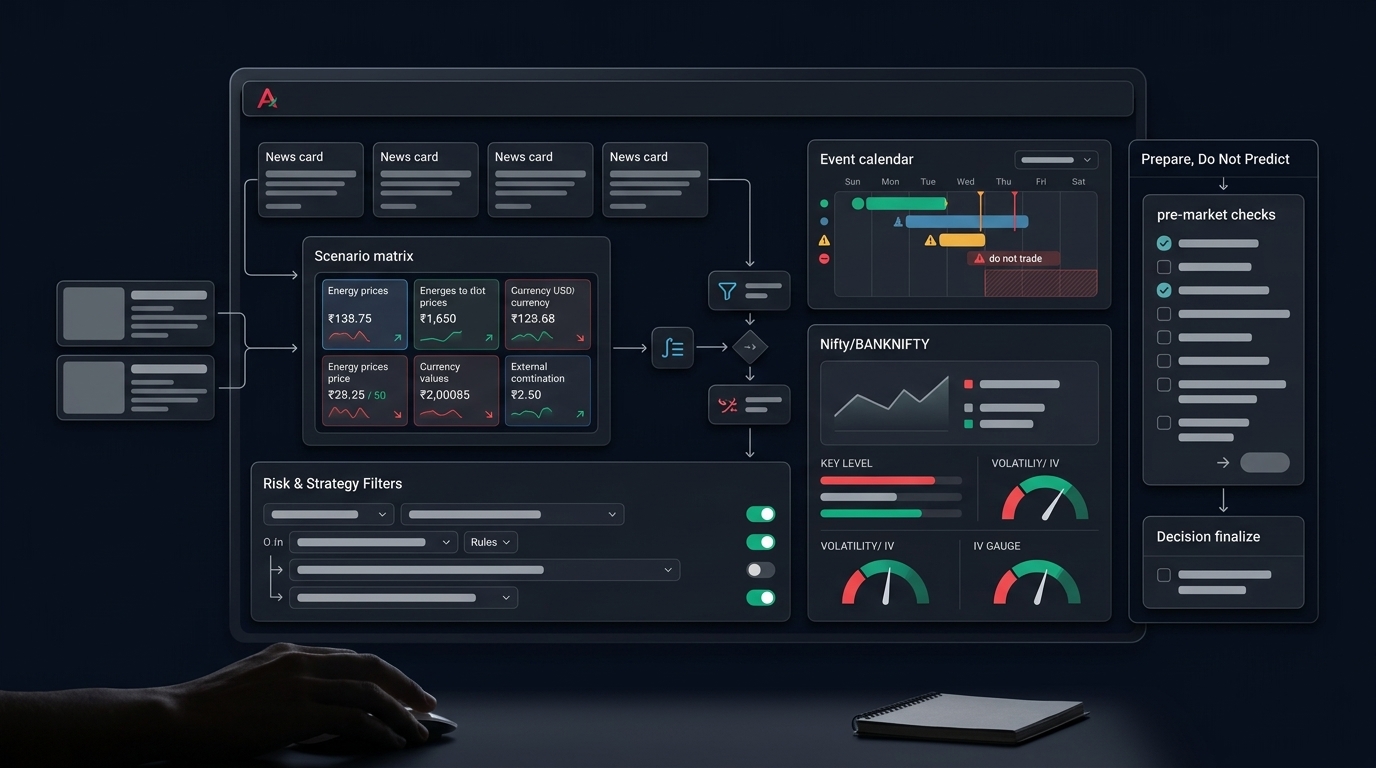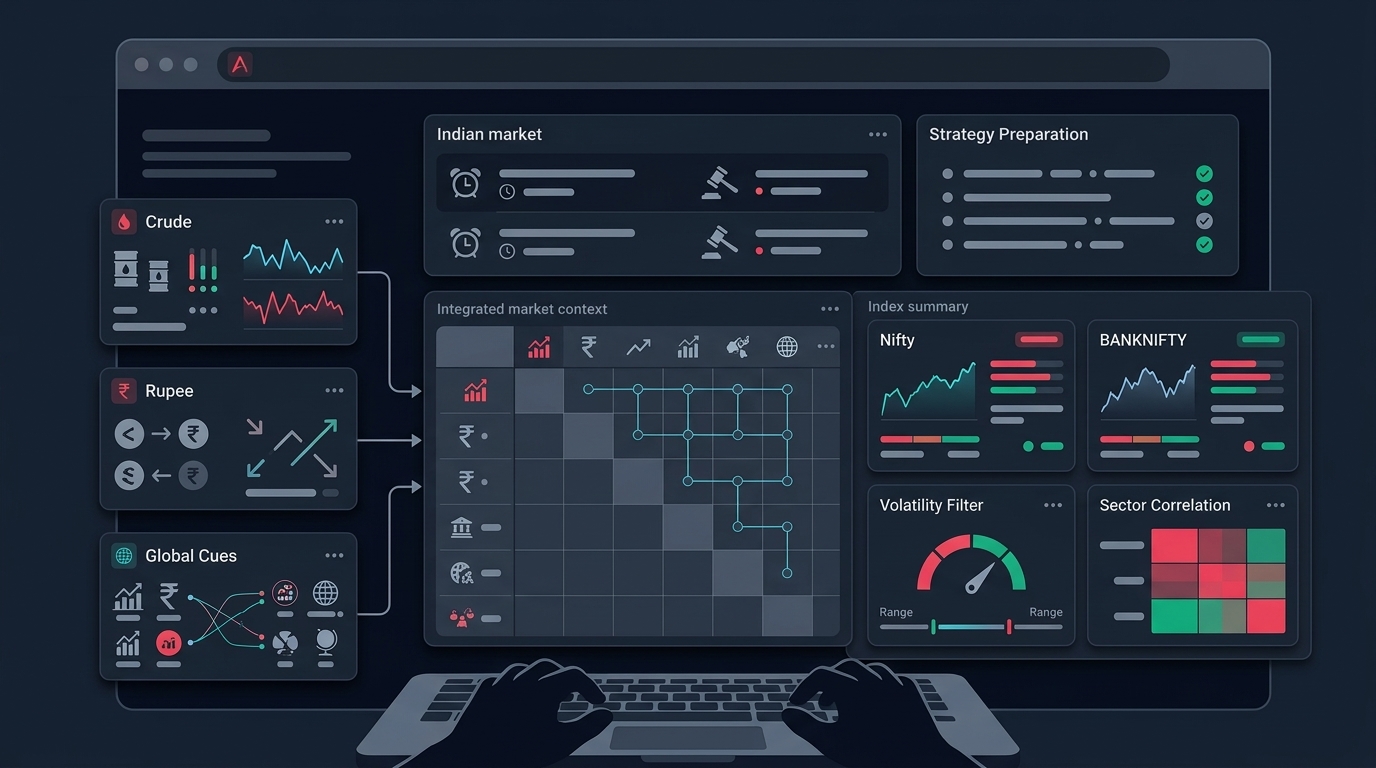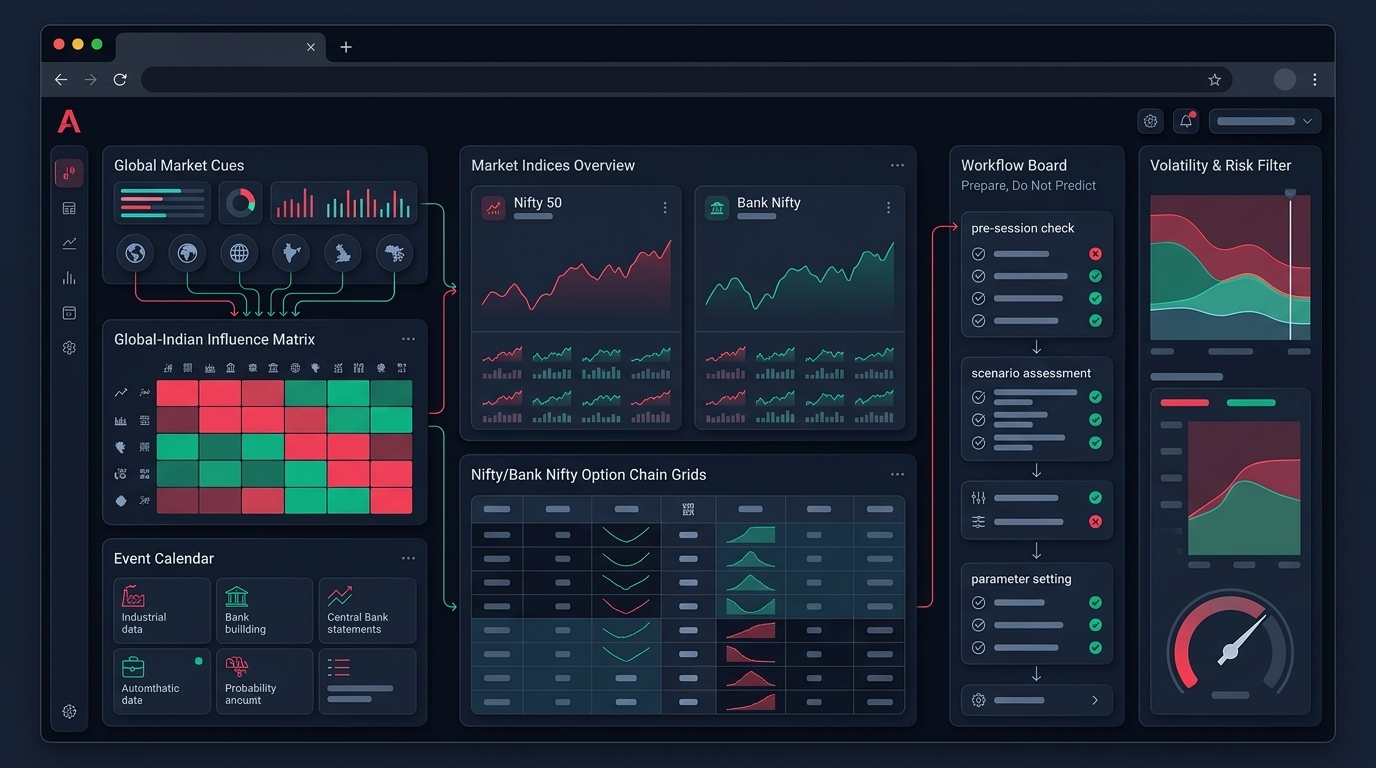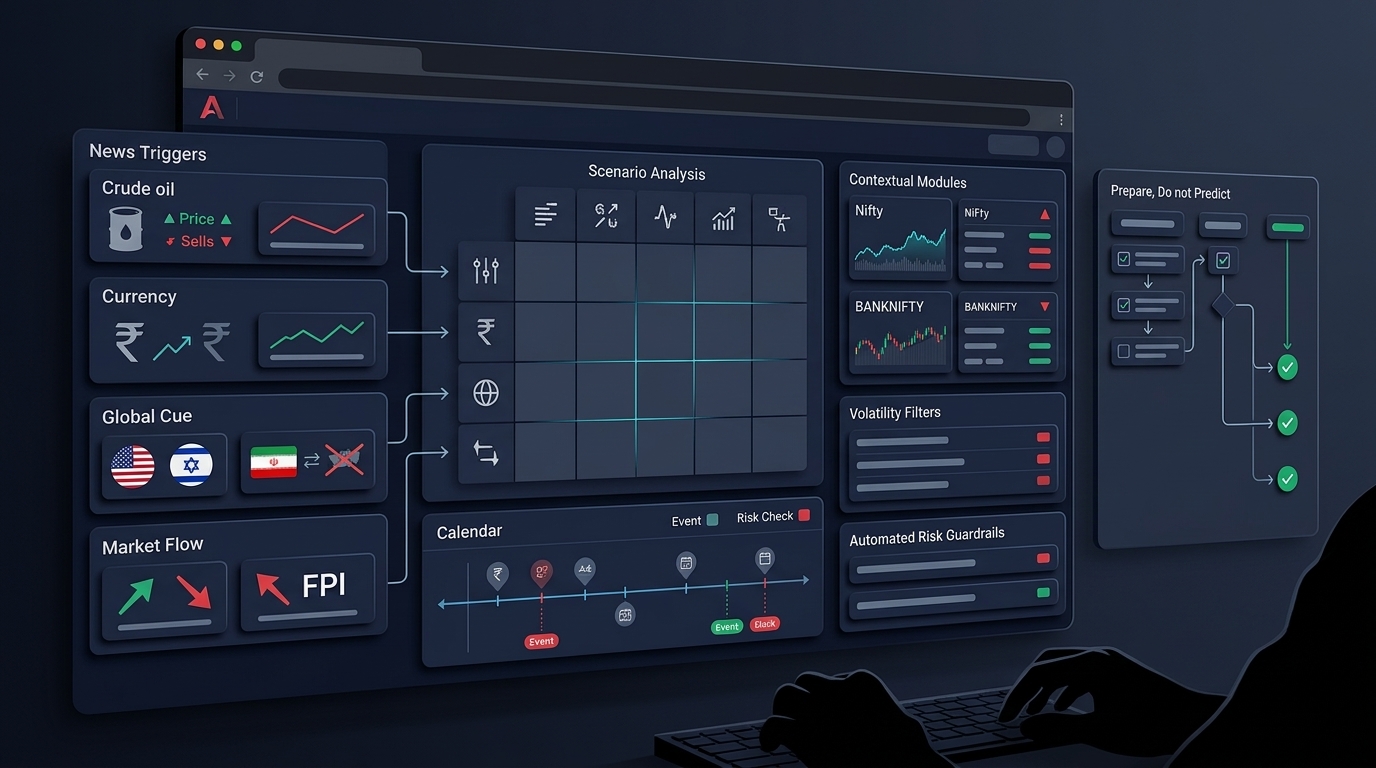
It is Sunday, September 6, 2026, and the market dashboard does not agree with itself.
Crude is sitting near $96 after a roughly 7% weekly surge, with the US–Iran conflict now in its seventh month and fresh strikes reported in early September. That is the textbook risk-off setup for India, which imports somewhere between 85% and 90% of its crude. Yet the rupee just closed its sixth straight session of gains at around 94.49 against the dollar. Foreign portfolio investors poured more than $3 billion into Indian equities in August — reportedly their strongest month since September 2024. And still, the Sensex dropped 417 points on Thursday, with the Nifty closing below 23,900.
Half your screen says stand down. The other half says business as usual. That disagreement — not the war headlines themselves — is the actual problem an algo trader has to solve before Monday's open. This post walks through a process for it. No predictions, no trade calls; just how to convert a contradictory macro picture into rules your system can follow.
The September 2026 picture: triggers pulling in opposite directions
The classic pre-open framework tracks a handful of triggers: crude, the rupee, bond yields, foreign flows, safe-haven demand, sectoral impact, and global market cues. Normally these cluster. In a clean risk-off episode, crude spikes, the rupee weakens, FPIs sell, gold rallies, and equities fall together. Right now the cluster has broken apart.
Pointing risk-off: crude near $96 with fears around the Strait of Hormuz, through which nearly a fifth of the world's oil trade passes. Gold rising at Indian retailers, which usually signals safe-haven demand. Bond yields pressuring equities. The Sensex and Nifty ending Thursday lower despite a strong morning.
Pointing risk-on: the rupee firming for six consecutive sessions, supported by foreign buying. FPI inflows above $3.2 billion in August — and selectively placed, with reported buying in consumer services, financials, and healthcare while telecom and power saw outflows. India's refineries reportedly running near peak and exporting fuel, which complicates the simple "high crude is bad for India" story.
Ambiguous: global cues, with traders watching US non-farm payroll data for the next directional push.
None of these facts cancel the others out. They coexist. That is what a genuinely mixed regime looks like, and it deserves different handling than a cleanly bad one.
Why mixed signals are harder to trade than bad news
Unambiguously bad days are, oddly, easy for disciplined traders. When everything screams risk-off, most systematic traders reduce size or stand aside, and the decision feels obvious.
Mixed days invite cherry-picking. A trader leaning bullish quotes the FPI inflows and the firming rupee. A trader leaning bearish quotes $96 crude and rising gold. Both are quoting real facts. Both are building a narrative around a position they already wanted to take. Your algo does not have this bias problem — until you hand it one through a discretionary override at 9:20 AM.
The practical danger in mixed regimes is not a crash. It is chop: gap-ups that fade by 10:30, breakdowns that reverse on flow support, intraday moves that trigger entries and then invalidate them within the hour. The recent sessions showed exactly this shape — Thursday's market erased all its morning gains before closing lower. Backtests built mostly on trending samples tend to underestimate how expensive this kind of tape is for breakout-style systems.
So the first process decision is this: stop trying to net the signals into one directional view. Treat the disagreement itself as the regime.
A three-state risk model for conflicting cues
A workable structure is three explicit states — normal, caution, and stand-down — with measurable inputs deciding which one you are in. The inputs should be numbers your system can read, not headlines you interpret.
Reasonable inputs for Monday:
- Overnight crude move, as a percentage, above a threshold you chose in advance (many traders use something like 3%).
- USDINR opening level versus Friday's close, outside a band you defined.
- India VIX level and its change versus the prior close.
- Nifty opening gap measured against recent average true range, not in absolute points.
- An event flag: US payroll fallout still digesting, proximity to the next weekly or monthly expiry.
Then the mapping, written down before Monday, not improvised after the bell:
- Normal: all inputs inside bands. Run the standard playbook.
- Caution: inputs disagree — for example, crude beyond its band but USDINR calm, or a large gap with VIX barely moving. Trade, but at reduced size (half is a common convention), with tighter basket-level stops, skipping the first 15 minutes, and demanding fresher signals than usual.
- Stand-down: a small set of hard, unambiguous conditions — say, a gap beyond a fixed multiple of ATR combined with a VIX spike beyond your threshold. No new entries until the state clears.
The key property of this model: a mixed picture defaults to caution, not to a directional bet. You are not asking "will crude win or will flows win?" — nobody can answer that, and current-market content that claims to is noise. You are only deciding how much risk your system is allowed to express while the market argues with itself. A written risk management framework is exactly where these bands and multipliers should already live.
Weekend checklist: what to verify before Monday's open
A Sunday like this one is useful precisely because markets are closed. Two more days of geopolitical headlines can land before Indian equities trade again, which makes weekend gap risk the first item on the list.
Positions and margin
- Walk through every position carried over the weekend. For option sellers: what does the margin picture look like if Monday opens with a gap in either direction? Estimate it now, not at 9:14.
- Check hedges. A hedge that made sense at Friday's IV may be mispriced against Monday's, in either direction.
Calendar and events
- Confirm where Monday sits relative to weekly and monthly expiries. Elevated-volatility weeks that also contain an expiry deserve their own handling; that overlap changes both liquidity and gamma behaviour.
- Note pending macro prints — the US payroll reaction is still working through global markets, and Indian data releases stack on top.
Plumbing
- Verify broker API sessions and tokens will be valid Monday morning. Session expiry is a boring failure mode that becomes an expensive one on a volatile open.
- Confirm your data feed's health checks. A stale quote on a gap day is worse than no quote, because your system acts on it confidently.
The plan itself
- Write the three-state mapping down with numbers filled in. If your caution state says "half size," compute what half size actually is in lots for each strategy, now.
What your scanner and signal queue should do differently in caution mode
Signal freshness matters far more on gap-risk days. A breakout candidate generated on Friday afternoon has two days of world events between its setup and your entry. If your scanner workflow surfaces signal freshness explicitly, use it: in a caution state, stale signals should be discarded rather than "checked quickly on the chart and taken anyway."
This is also where entry-blocking logic earns its keep. In Anadi's Action Center, candidates carry blocked reasons like chase distance or invalidated price. On a gappy Monday, those blocks will fire more often than usual — and that is the system protecting you from paying Monday's panic price for Friday's setup, not the system malfunctioning. The urge to override a chase-distance block is strongest exactly when the block is most valuable.
For options traders, one extra layer: before reusing your normal strike-selection habits, look at what elevated IV has done to premiums across the chain. A short strangle at Friday-normal deltas is a different trade at Monday-elevated IV — different premium, different margin, different gap exposure. Validate the basket's margin estimate with existing positions considered before firing anything. The chain is an inspection point, not a shortcut.
Automate the response, not the narrative
The tempting move after reading war headlines is to encode the narrative: "if crude spikes and conflict escalates, short Nifty." The last few months are a standing argument against that rule. The conflict began at the end of February; through its seventh month, FPIs delivered their biggest monthly inflow in nearly two years, and the rupee strengthened for six straight sessions while crude held above $90. Whole weeks exist in this sample where equities and crude rose together.
Headlines are not a directional signal. They are a regime marker. The durable lesson from this stretch is that geopolitics should change your exposure parameters — size, filters, stop width, stand-down conditions — while your entries and exits stay with the tested rules of your strategy builder logic. Systems that let news pick direction end up trading the loudest story instead of the measured edge.
Backtest your caution rules — with humility about the sample
A three-state model is itself a testable hypothesis. Before trusting it live, run your strategies through historical days that matched each state: sessions where crude had moved more than 3% overnight, where VIX sat above its 80th percentile, where the open gapped beyond one ATR. Compare drawdown, slippage, and win behaviour in those subsets against the full sample. Proper options backtesting with realistic gap and IV assumptions matters more here than anywhere, because these are exactly the days naive backtests flatter.
Two honesty checks while you do it:
- Genuinely mixed geopolitical regimes are rare. Your subset might be a few dozen days. Do not tune thresholds to the third decimal on that sample — prefer blunt rules (half size, skip the open) that do not depend on precision.
- If a caution filter helps in backtests mainly by dodging two or three historical disasters, treat it as insurance, not edge. Insurance is still worth holding; just price it as insurance.
And before any new caution logic touches real money, run it through paper trading across at least a few live sessions of this regime. Paper fills on a choppy tape teach lessons a backtest cannot.
The Monday checklist
A compressed version to work through before the open:
- State check: crude overnight move, USDINR gap, India VIX, Nifty gap versus ATR — which of your three states is active?
- Default to caution when inputs disagree. Mixed signals are a regime, not a puzzle to solve directionally.
- Positions: margin under a two-sided gap scenario, hedges repriced at current IV.
- Calendar: expiry proximity, pending macro prints.
- Plumbing: broker sessions valid, data feed healthy.
- Signals: discard stale ones; respect chase-distance and invalidation blocks instead of overriding them.
- Options: re-read the chain's IV and margin picture before reusing normal strike habits.
- No narrative trades: headlines set your risk state, never your direction.
Context like this is meant for preparation, and that is exactly how we treat it in the weekly market outlook — as input to a process, not a stream of calls to chase. If you want to build these risk states, scanner filters, and caution-mode rules into a system you can actually test and run, you can request early access to Anadi Algo and set them up before the next mixed-signal Monday arrives.