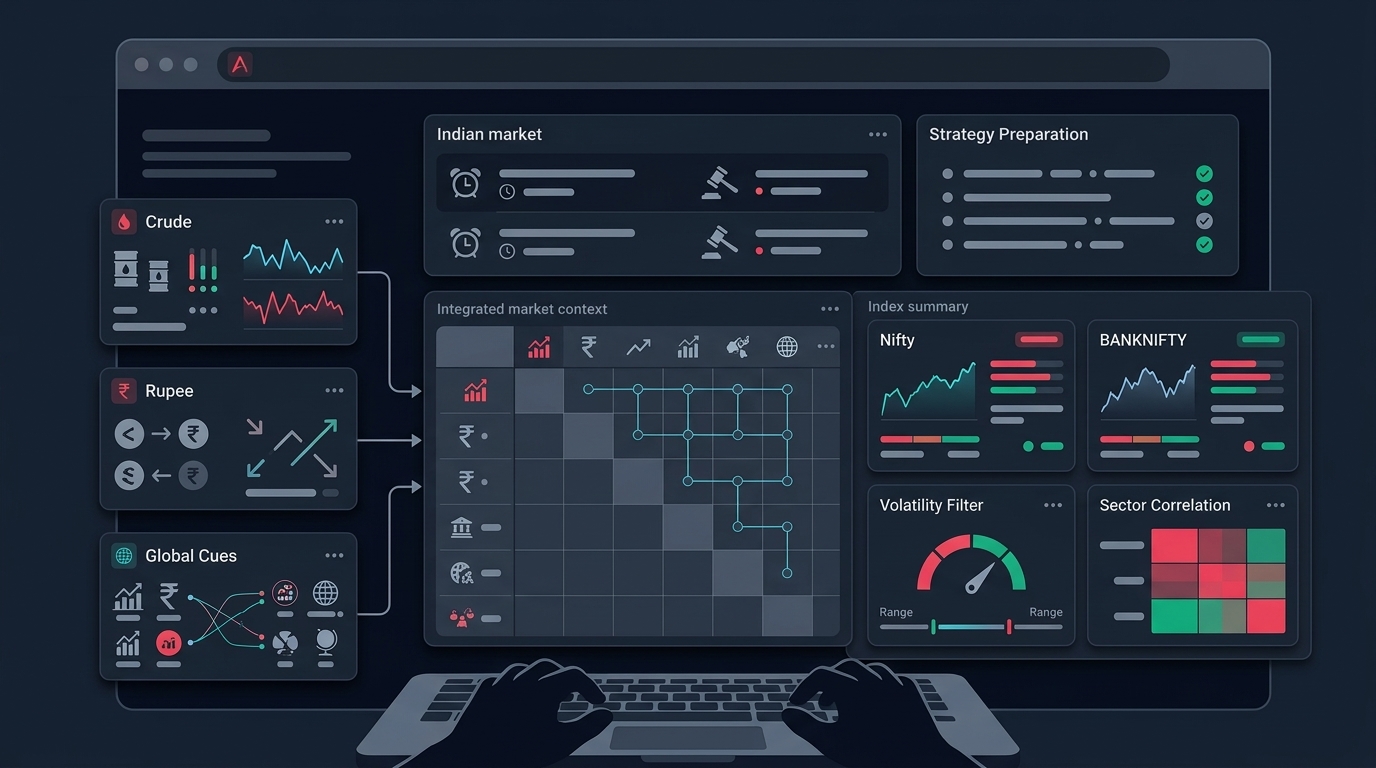
This week ended with an odd combination in the morning notes: Gift Nifty pointing to a positive start near 24,260, while the same reports described sentiment as "lacklustre" and warned of profit-booking at higher levels. Green open, weak mood.
Most retail algos only encode direction. The open is up, so long setups fire. But direction and conviction are two different pieces of data, and the days where they disagree are exactly the days that quietly drain a strategy's monthly P&L. This post takes the current context — crude off its peak but still elevated, a firmer rupee, flat global cues — and turns it into a process for trading low-conviction sessions. No predictions, no calls. Just filters.
What the week actually looked like
Strip the headlines down to facts worth encoding:
- Crude did a round trip. WTI fell more than 6% over two sessions mid-week into the $80–81 range, then stabilised around $83–84. Reports credited diplomatic progress between Iran and Oman on Strait of Hormuz traffic for easing some of the supply-risk premium. So crude is off its peak but still elevated — neither a clean tailwind nor an active shock.
- The index opened green and struggled to stay green. Nifty opened above 24,100 on Friday, but the previous session had already shown the pattern: early gains given up, close in the red. Analysts flagged profit-booking at higher levels as the expected behaviour.
- The rupee opened stronger, which removed one source of pressure without adding a fresh driver.
- Global cues were mixed but flat. Wall Street closed largely unchanged. Supportive, but lending no momentum.
None of this tells you what happens next session. It tells you what state the market is in right now — and state is something an algo workflow can actually use.
Direction versus conviction: why they are separate inputs
A positive opening print answers one question: where did the index start relative to yesterday? It says nothing about whether buyers will defend that level for six hours.
The tells of a low-conviction tape are all present in this week's coverage:
- The prior session faded — early gains sold into, weak close.
- Commentary explicitly expects profit-booking at higher levels, which means rallies run into willing sellers.
- Global cues are mixed, so there is no borrowed overnight momentum to lean on.
- Crude is in an ambiguous state — easing, but elevated — so there is no clean macro narrative pushing risk appetite either way.
On days like this, the trades that hurt are not the obviously wrong ones. They are the late ones: the breakout chased 0.4% above the trigger, the momentum long taken after the move already ran, the second entry after the first one stopped out. Low-conviction days punish chasing far more than they punish direction.
This is not a forecast that Friday-style sessions will fade. It is base-rate awareness: when the tape has recently shown fade behaviour and the narrative says "selective, profit-booking," your process should demand more confirmation before committing size, not less.
Turning crude, rupee and cues into state variables
The mistake is treating these inputs as signals — "crude fell, so buy." The better frame is treating them as state variables that gate how your strategies behave.
Crude: direction and distance, not level. WTI at $83 after easing from a spike is a different state than WTI at $83 on the way up. The first means supply-risk premium is bleeding out; the second means it is building. An algo workflow doesn't need to predict which continues — it needs a rule like: when crude has moved more than a set percentage in either direction over two sessions, reduce position size for index strategies or disable the aggressive strategy family. Crude gates behaviour; it doesn't generate entries.
Rupee: volatility, not level. A stronger rupee open is mildly supportive context, but the actionable variable is rupee movement. A quiet currency means one less thing destabilising FPI flows intraday. A fast-moving currency, either way, usually accompanies choppier index behaviour. Encode it as a regime flag, not a trade reason.
Global cues: momentum on loan. When Wall Street closes flat, gap-continuation strategies lose their most common fuel. A gap-up powered by strong overnight US moves has different follow-through odds than a gap-up on flat cues. This week is the second kind. That doesn't ban gap strategies — it argues for demanding local confirmation (breadth, opening-range hold) before treating the gap as tradable.
If you want the longer treatment of separating news feeds from trading rules, the core idea stays the same here: context prepares you; rules execute. That's also the spirit of a weekly market outlook — use it to know which regime you're in, not to collect trade calls.
A first-hour conviction checklist
Direction shows up in the first print. Conviction shows up in the first hour. Here is what to actually check.
Breadth and sector participation
A green Nifty carried by two heavyweight banks is a very different market than a green Nifty with broad sector participation. Before acting on any long signal on a "positive open, weak sentiment" day, look at the sector heatmap and advance-decline picture. If the index is up but most sectors are flat or red, the move is narrow — and narrow moves are the ones that get sold into when profit-booking is the expected behaviour.
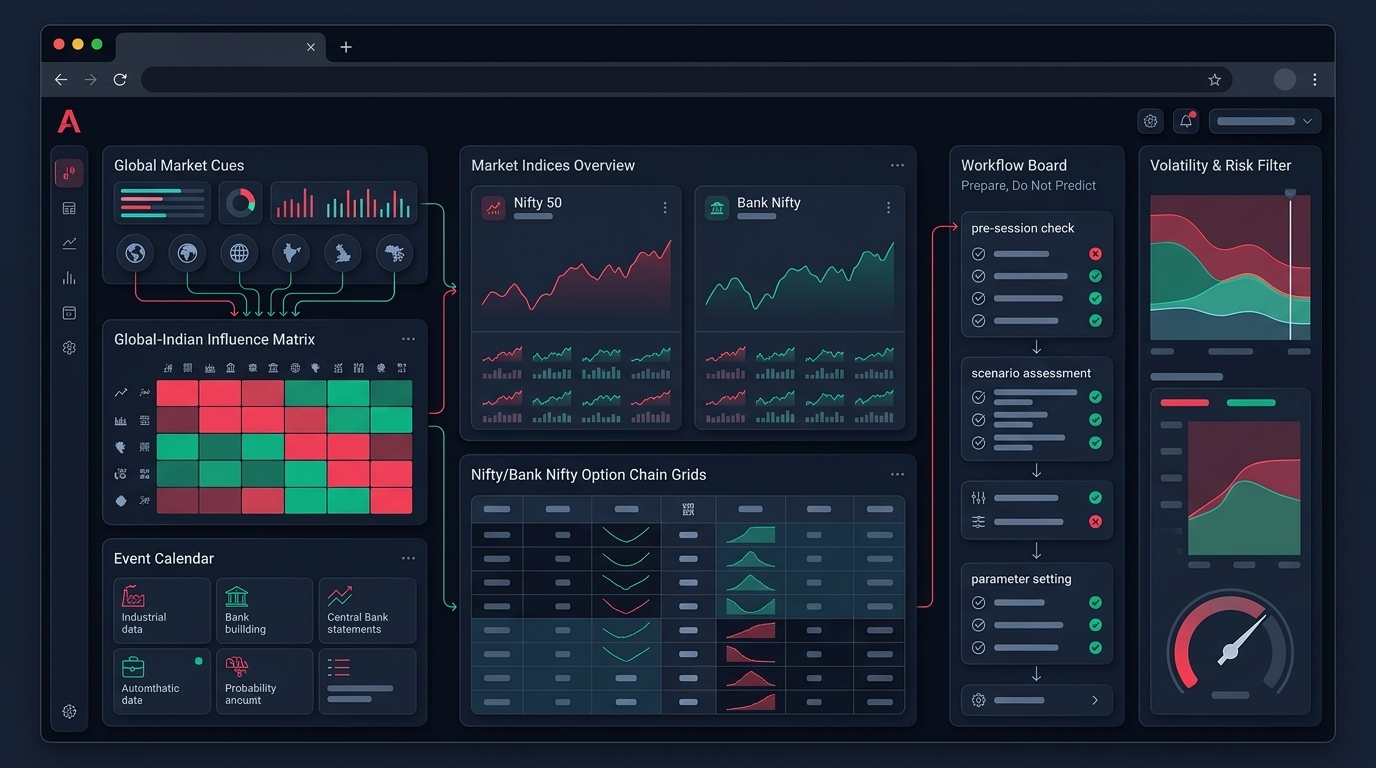
This is exactly why index and sector context should sit before the scanner in your workflow, not after. In Anadi, the Indices view exists for this: index cards and the sector heatmap as a context gate before you touch scanner output.
Follow-through over the print
Define an opening range — first 15 or 30 minutes — and watch what happens on the first retest. A green open that holds its opening range low on a pullback is showing real demand. A green open that knifes back through the range within the hour has already told you the fade pattern from the previous session may be repeating.
You don't need to predict which happens. You need a rule that waits for the answer before full-size entries fire. "Pehle range hold hone do, phir entry" is a legitimate system rule, not hesitation — as long as it's written down and applied every day, not just when you're nervous.
Signal freshness and chase distance
On fade-prone days, the single most valuable filter is refusing late entries. A breakout signal that fired twenty minutes ago at a price 0.5% below current levels is not the same trade anymore — the risk-reward has silently rotated against you.
Encode this: signals expire, and entries beyond a defined distance from the trigger are blocked. Anadi's Action Center does this structurally — signals carry freshness, and entries get blocked with explicit reasons like chase distance or invalidated price. Whether you use that or your own implementation, the principle is the same: on low-conviction days, the scanner should be feeding you a filtered queue, not a firehose, and the filter that matters most is "is this still fresh, or am I chasing?"
Overhead supply awareness
"Profit-booking at higher levels" has a mechanical meaning: recent swing highs are where sellers are waiting. For process purposes, that means longs taken near those zones should expect slower progress and deeper adverse moves before targets. If your strategy's stop placement assumes clean trending behaviour, this is the regime where that assumption gets tested. Reviewing where your stops sit relative to obvious supply zones is a risk management exercise, not a market view.
Options checks when conviction is low
Low-conviction sessions tempt option sellers — if the market is going to drift and fade, why not collect premium? Sometimes that works. But this specific week has a wrinkle: the geopolitical premium in crude has eased, not vanished. Strait of Hormuz headlines have moved prices sharply in both directions within days. Short gamma into an environment that has recently produced 6% two-session crude moves is not automatically the safe trade it feels like.
Practical checks before any options position on a day like this:
- Validate the chain, not just the idea. Bid-ask spreads at your chosen strikes, open interest depth, and how IV is behaving relative to the last few sessions. A strategy that backtests well with mid-price fills can bleed badly in strikes with wide spreads. In Anadi, the option chain workflow connects chain rows to a basket preview and margin estimate precisely so this validation happens before orders, not after.
- Prefer defined-risk structures when the narrative is ambiguous. Hedged spreads cost some premium capture but cap the damage if the "easing" crude narrative reverses on a headline. What hedging changes in your numbers is a backtest question — measure it, don't guess it.
- Set the stop at basket level. Multi-leg positions on choppy days can show individual legs whipsawing while the structure is fine, or vice versa. A basket-level loss limit reflects what you actually risk.
What this means for your backtests
Here is the part most traders skip. "Positive open, weak close" is a taggable regime. If you log or reconstruct enough history, you can answer a concrete question: how does my strategy family perform specifically on days where the index opened green and closed red, versus trending green days?
Many intraday long strategies show acceptable overall stats that hide terrible performance in exactly this regime — because the regime produces the maximum number of triggered-then-faded signals. Finding that out in a backtest costs nothing. Finding it out live costs real money. If you're testing options structures, options backtesting with honest fill and slippage assumptions is where this regime analysis belongs.
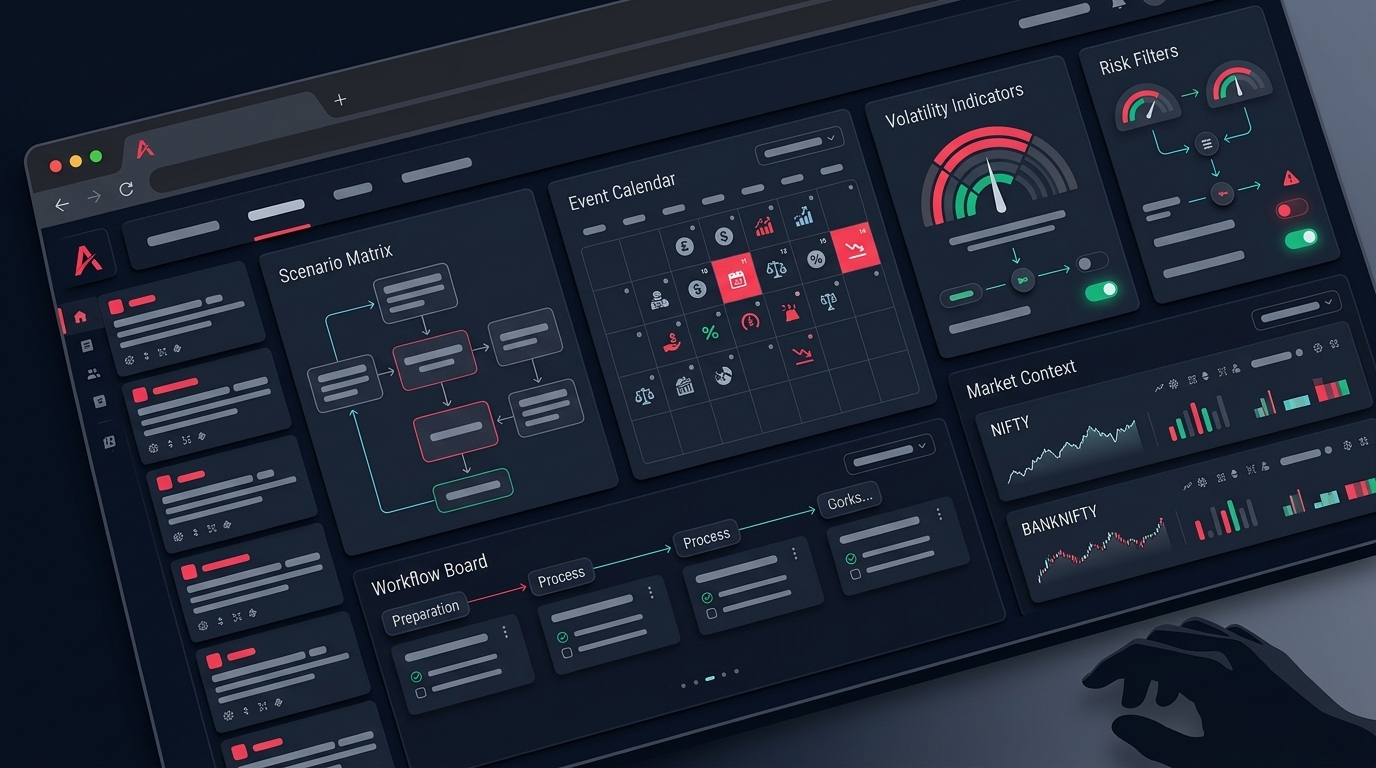
And if this week's context tempts you to tweak rules — tighter stops, a new fade filter, a conviction gate — change them in the strategy builder, then run the modified version in paper trading before it touches live capital. Mid-week rule changes deployed straight to live are how one ambiguous news cycle turns into two problems.
The takeaway checklist
For sessions where the open is positive but the sentiment commentary reads lacklustre:
- Name the state. Crude direction and distance from its recent extreme, rupee stability, overnight cue strength. Write it down before the open.
- Check breadth before signals. Sector heatmap and participation first; a narrow green index is a warning, not an invitation.
- Demand follow-through. Opening range defined, first retest observed, then entries — as a written rule.
- Refuse stale signals. Freshness windows and chase-distance blocks on every scanner-driven entry.
- Respect overhead supply. Expect slower, messier progress on longs near recent highs when profit-booking is the stated regime.
- Don't treat drift as free premium. Recent crude volatility means defined-risk options structures and basket-level stops.
- Tag the regime in your backtest. Measure your strategy on green-open, red-close days specifically.
- Paper-test any rule change born from this week's news before it goes live.
The market will keep producing weeks like this — a supportive open sitting on top of a hesitant tape. You can't predict which mornings hold and which fade, and you don't need to. You need a workflow that asks for proof of conviction before it commits your capital. If you'd rather run that workflow on a platform built around these gates — scanner freshness, blocked-entry reasons, chain validation, basket risk — you can request early access to Anadi Algo and pressure-test it in paper mode first.