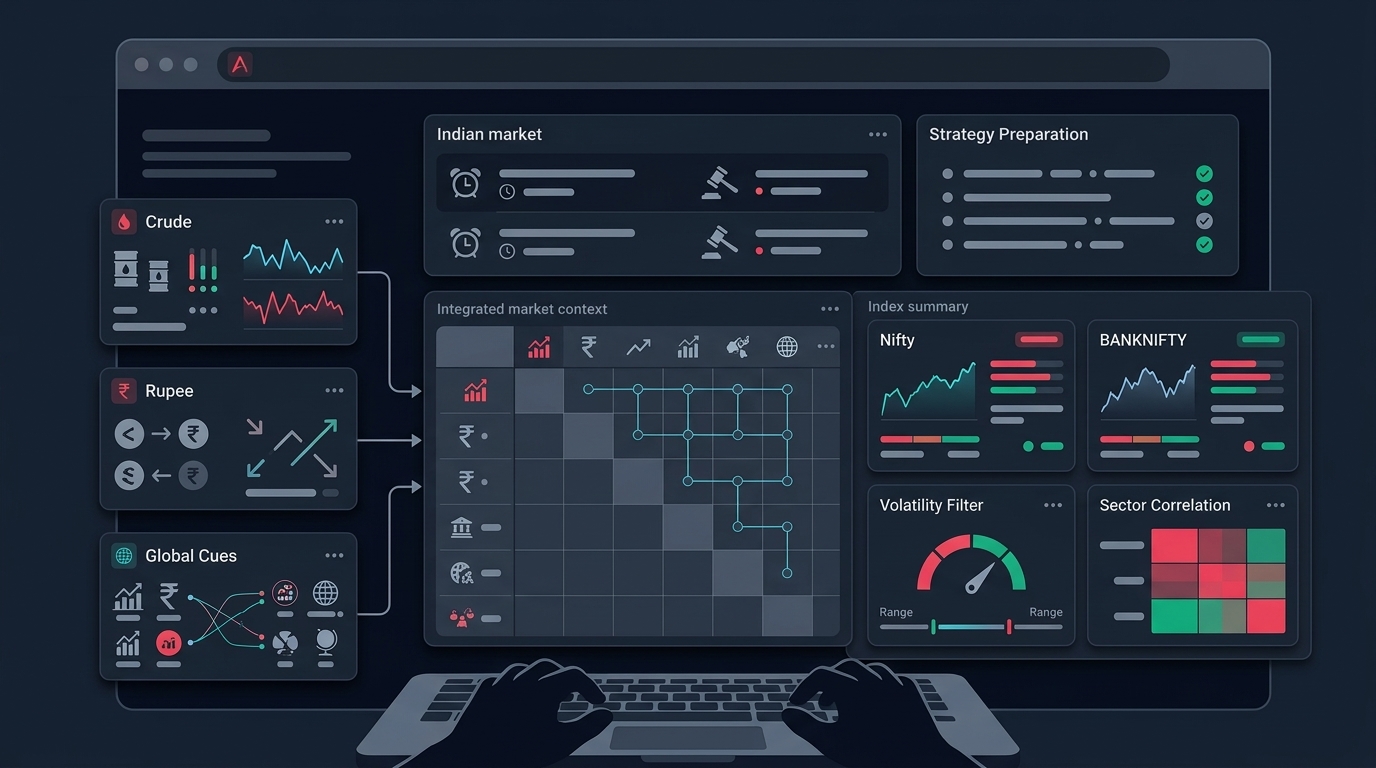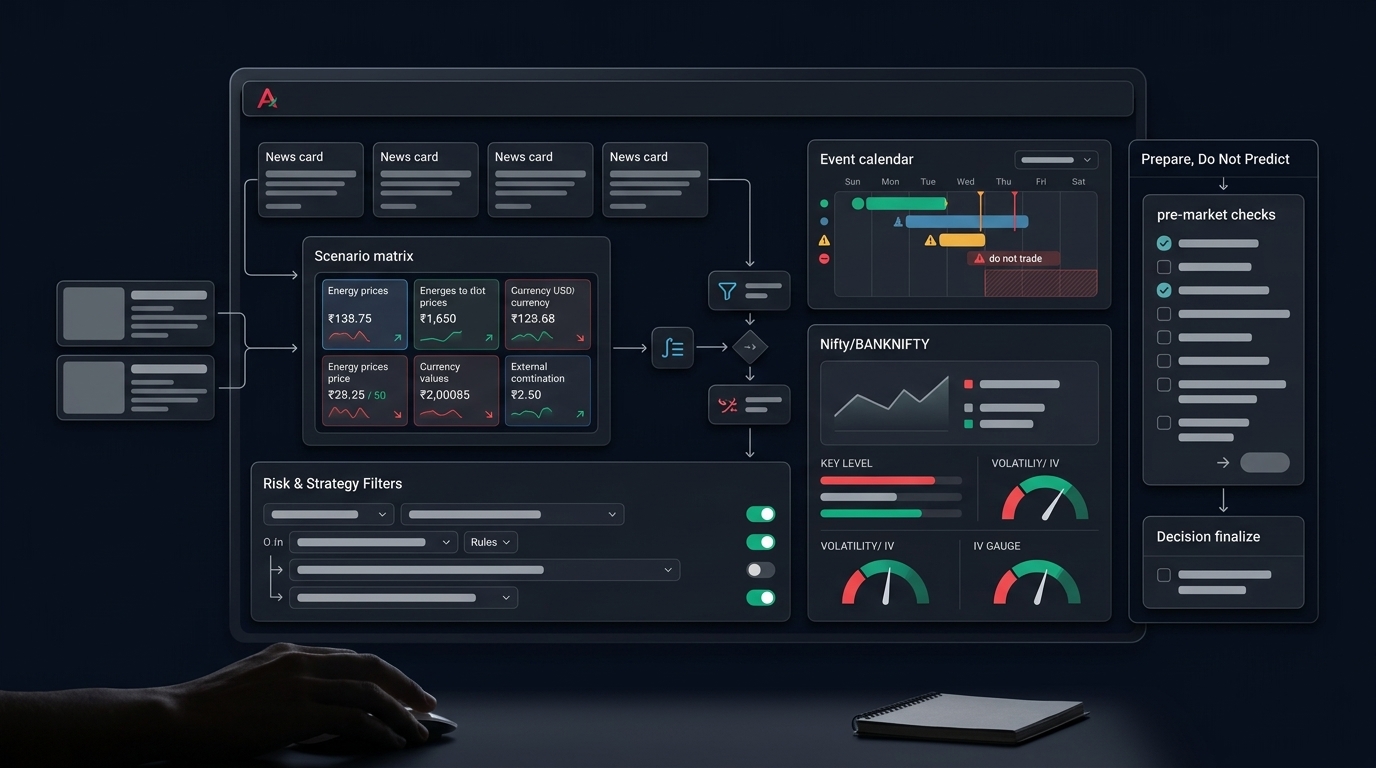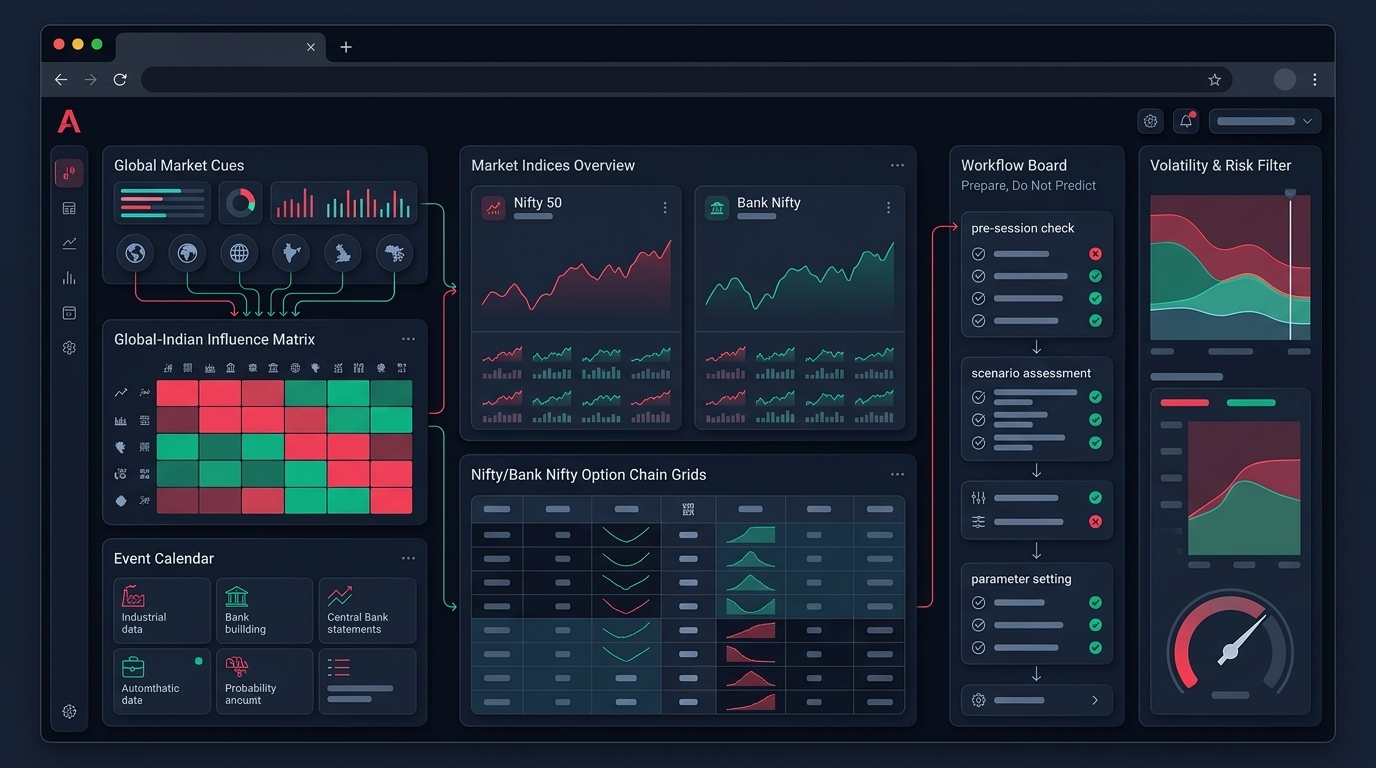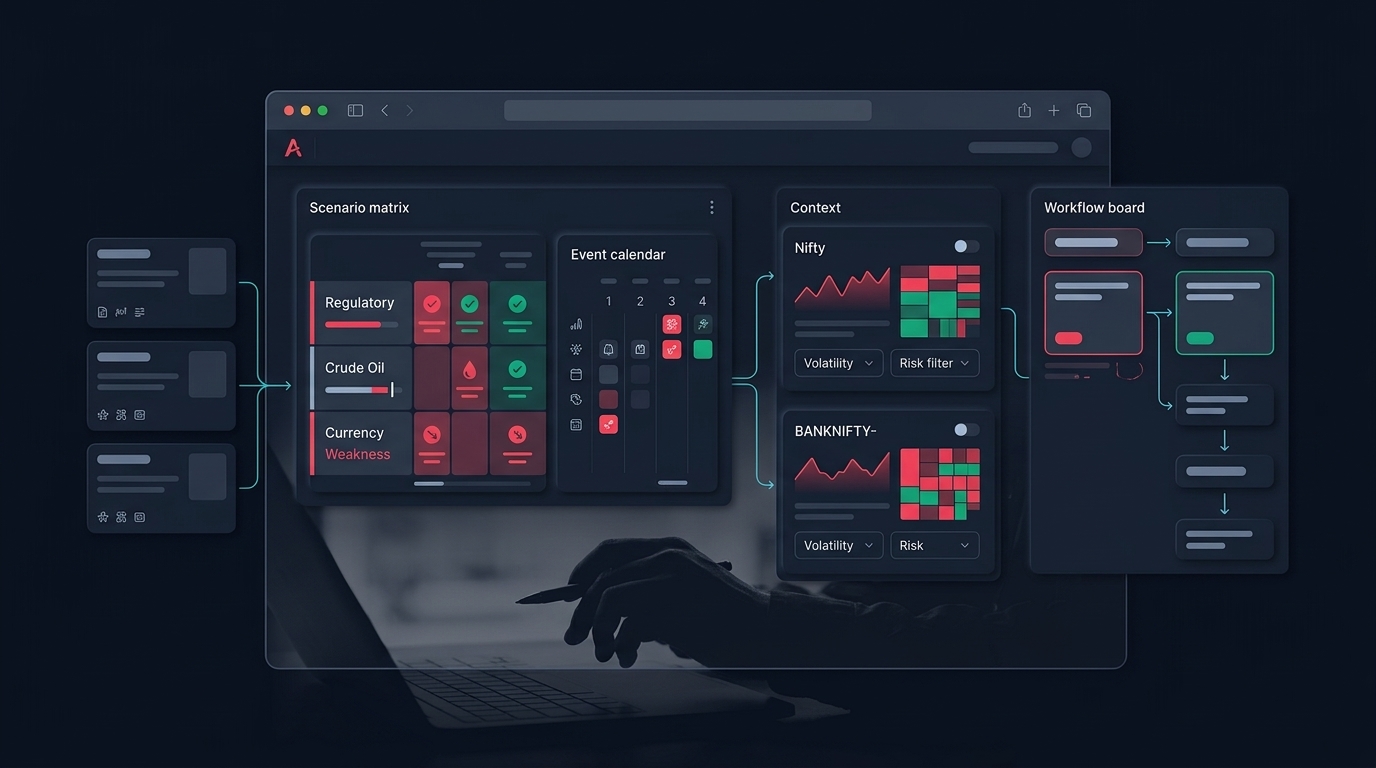
Two sessions, three different kinds of risk, one tape. That is the honest summary of September 24 and 25, 2026 for Indian markets.
On Thursday the Sensex fell 1,247.71 points, or 1.67%, to close at 73,580.54. The Nifty 50 ended at 23,063.10, down 383.70 points or 1.64%. On Friday the same indices went the other way: Sensex up 315.20 points to 73,895.74, Nifty up 77.40 points to 23,140.50, reportedly as crude eased on hopes of a US-Iran truce. Somewhere inside that, Hero Motors moved up around 20% and PB Fintech had already fallen about 30% the previous day.
If your algo traded both sessions with the same position size, the same stop distance, and the same entry filters, you were not running a strategy. You were running a coin flip with extra steps.
This post is not a view on where the index goes next. It is a breakdown of what these two sessions expose about process: which risks are regime-level, which are single-name, and which ones you should refuse to trade at all.
What actually moved, in numbers
Thursday, September 24:
- Sensex opened 74,272.40, closed 73,580.54. 29 of 30 Sensex constituents ended lower.
- Nifty 50 opened 23,221.80, closed 23,063.10. 14 of 16 major sectoral indices were lower.
- Financials led the fall: Bajaj Finance down 5.47%, Axis Bank down 4.67%, Bajaj Finserv down 4.06%, M&M down 2.31%, Trent down 2.75%.
- Insurance distribution names cracked after reports that the insurance regulator proposed changes to commission and distribution payouts. PB Fintech, the Policybazaar parent, fell around 30%; Max Financial also dropped.
- Brent crude moved back above $102 a barrel after slipping under $99 on Wednesday, amid continued differences between Iran and the US.
- The rupee weakened 23 paise to settle around 95.96 (provisional), after opening at 95.84 and touching 95.98. It had closed at 95.73 on Wednesday. Traders quoted in reports described a persistent 95.60-95.95 zone.
- US bond yields climbed and US mortgage rates hit a multi-year high. FII selling remained a backdrop.
- India VIX rose 9.90% to 11.37.
- Broader market held up better than the headline: Nifty Midcap 50 down 1.41%, Midcap 100 down 1.19%, Smallcap 100 down 0.76%.
Friday, September 25:
- GIFT Nifty was around 23,130, up about 35 points, pointing to a mildly positive start. The Sensex opened up 109.36 points.
- At noon the recovery was thin: Sensex up 138.11 points, Nifty up just 12.05 points at 23,075.15.
- Close: Axis Bank up 2.82%, M&M up 2.24%, Asian Paints up 1.93%, Bajaj Finance up 1.21%, HCL Tech up 1.17%. Trent down 1.41%, Infosys down 0.81%, Kotak Mahindra down 0.47%, ICICI Bank down 0.41%.
- Sector split: Nifty Auto up 0.89%, FMCG up 0.40%, IT down 0.17%, Pharma down 0.10%.
- Breadth did not confirm the bounce: Midcap 100 still down 0.14%, Smallcap 100 up only 0.15%.
One number worth writing on a sticky note: Friday's 77-point Nifty gain recovered roughly 20% of Thursday's 384-point fall. A green day is not the same thing as a repaired tape.
Three risks got blended into one price move
The mistake most retail algo traders make on days like these is treating the whole move as one thing called "market fell." It was not one thing.
Policy and regulatory risk is single-name and gappy
The insurance distribution story is the cleanest example. A proposal on commissions and distribution payouts does not move the Nifty by an equal amount across all constituents. It re-prices the specific business model. A roughly 30% single-day fall in one name and 4-5% falls in lenders with insurance distribution income is not something a stop-loss percentage handles gracefully.
Practical implication: regulatory risk is not a volatility input, it is an exposure input. You manage it by capping how much of your book sits in one theme, not by tightening stops. A 2% stop on a stock that gaps 30% intraday pays you nothing for your discipline.
Macro risk changes the regime, not the trade
Crude above $100, a rupee near 96, and rising US yields are regime variables. Higher crude raises the import bill and pressures inflation, the currency, and corporate margins. None of that tells you what Nifty does on Monday. What it does tell you is that the distribution of outcomes is wider than it was when crude was in the eighties and the rupee was stable.
Wider distribution means one thing for systems: smaller size, or fewer trades, or both. Not a different direction.
Headline reversal risk is the one you should not trade
Friday's recovery was attributed to hopes of a truce. Hope is not a signal you can encode. There is no rule set that reliably front-runs "differences between Iran and the US narrowed slightly overnight." If your system's edge depends on guessing the next geopolitical headline, it does not have an edge; it has exposure.
The honest response is to build rules that survive both directions of a headline, which usually means avoiding the first minutes after the open on days when overnight gaps are driven by news rather than flows.
Why a VIX of 11.37 did not mean a calm market
India VIX jumped 9.90% and still sat at 11.37. In absolute terms that is a low reading. The index fell 1.64% the same day and one stock lost close to a third of its value.
That gap matters if your option-selling rules use index implied volatility as the gate. Index IV is a measure of expected index-level movement. It does not price single-name regulatory risk, and it does not price the dispersion you get when one sector is re-rated while autos and FMCG hold up.
Two checks worth adding:
- Separate your volatility gate from your event gate. A low VIX can allow a premium-selling setup and a scheduled or live policy event can still block it. Those are two independent conditions, not one.
- Track realised versus implied. If the index moves 1.6% on a day when the vol index implies a much smaller daily range, your short-gamma assumptions were wrong that day. Log it. Three such days in a month is a regime signal.
For option structures specifically, this is where an actual chain read beats a rule of thumb: what the OI distribution, the IV skew, and the margin requirement look like together, before you commit. A structure that looks fine on premium collected can look very different once you price the basket's worst-case move.
Risk filters that would have helped, written as rules
Vague intent ("be careful when crude is high") does nothing at 9:16 AM. Rules do. Here is the shape they should take.
A pre-open regime state, computed before the first candle
Build a small, boring pre-open check that outputs a state, not an opinion:
- Overnight gap in GIFT Nifty, in points and in percent. Friday's 35 points, or 0.15%, is noise. A 250-point gap is a different session.
- Crude change over one and five sessions. A move from under $99 to above $102 inside two days is a regime change flag, not a level flag.
- Rupee level and daily change. The 23-paise move to 95.96 is more informative than the absolute number.
- India VIX level and percent change, tracked separately.
- Whether there is a known policy, regulatory, or macro-data event in the session.
Then map states to actions you decided in advance: normal size, half size, entries only after the first 15 minutes, or no new entries. Write the mapping down before the week starts. That is the entire point of a weekly market outlook — it is preparation, not prophecy.
Theme caps, not just per-trade stops
On Thursday, a scanner tuned to momentum in financials could easily have surfaced four or five correlated candidates. Each with a "reasonable" 1.5% risk. Total book risk: not 1.5%, closer to 6-7%, because they were all the same trade.
Cap exposure at the theme level: a maximum number of open positions per sector, and a maximum combined risk per theme. This is the single most underused control in retail risk management, and it costs nothing to implement.
Freshness and chase distance
Friday's noon reading is the useful lesson here. The Nifty was up 12 points at 12 PM and up 77 by close. A breakout signal generated at 9:20 and acted on at 11:45 is not the same trade. Distance from the trigger price, and time since the signal fired, should both be able to block an entry.
This is why a stock scanner that only lists matches is half a tool. What you need alongside each row is: how fresh is this, how far has price already run, is the level still valid, and does the broader index or sector agree. On Friday, midcaps were still red while the Sensex was green — a breadth check would have downgraded a lot of long candidates automatically.
Single-name event exclusion
A 20% single-day move, like Hero Motors, is usually corporate-action or news driven. Generic technical rules are not built for that distribution. Maintain an exclusion list: names in the news, names with pending corporate actions, names whose average daily range has doubled recently. Let them trade without you.
Fix it in the backtest, not in the live algo
The tempting response after a day like Thursday is to change live parameters. Resist it. Two sessions of data is not evidence.
Do this instead:
- Re-run your strategy with a filter that blocks entries when the overnight gap exceeds a threshold. Compare not just returns but maximum adverse excursion and the number of trades removed. If the filter removes 40% of trades to improve drawdown by 5%, it is probably overfitting to a handful of days.
- Test a theme-concentration cap. This usually reduces headline returns slightly and reduces the worst month substantially. That trade is almost always worth taking.
- Check whether your backtest assumes fills at prices that existed on a 1.6% down day with gapping single names. Slippage assumptions that hold in calm tape break exactly when you need them.
- For premium-selling systems, isolate the days when realised range exceeded implied and check what those days did to your equity curve. That is your true tail, not the average.
Honest options backtesting here means accepting that your worst day is the number that decides whether the system survives, and modelling it properly rather than averaging it away.
Then, and only then, translate the surviving rule into your live logic. A no-code strategy builder is useful precisely because the same condition you tested becomes the condition that runs, without a hand-coded reinterpretation in between.
Where these checks sit in a workflow
The reason most traders skip these steps is friction: index context is in one tab, sector breadth in another, the chain in a third, margin in a fourth, and positions somewhere else. By the time you have checked everything, the setup is stale.
That is the workflow problem Anadi Algo is built around. Index cards and a sector heatmap give you the regime read before you act on anything. The Action Center takes scanner candidates and shows signal freshness, entry-blocked reasons such as chase distance or invalidated price, F&O eligibility, VWAP gate, and OI pulse — so a noisy list of matches becomes a short, reviewable queue. The option chain, basket preview, and margin estimate sit in the same place as the trade ticket, so risk appears before execution rather than after it.
None of that predicts the next crude headline. It just means your process does not degrade on the days when it matters most.
If you want to build these filters and test them against days like September 24 before risking capital on them, you can request early access and start with paper mode.
Checklist for the next volatile stretch
- Compute a pre-open regime state daily: GIFT Nifty gap, crude one- and five-day change, rupee level and change, VIX level and change, known events. Map each state to a size or entry rule in advance.
- Keep the volatility gate and the event gate separate. Low VIX does not cancel a policy event.
- Cap positions and total risk per theme, not just per trade. Correlated candidates are one trade.
- Block stale and chased entries using signal freshness and distance from trigger.
- Require breadth or sector confirmation before taking index-aligned longs. A green Sensex with red midcaps is a downgrade, not a confirmation.
- Exclude single names with news, corporate actions, or a recently doubled daily range.
- Log realised versus implied range daily. Count the exceedances; do not average them.
- After a rough session, write down what you would change, test it on history, and only then touch live parameters.
The market gave two very different sessions in 48 hours. Systems that survive stretches like that are rarely the cleverest ones. They are the ones where somebody decided in advance what "do not trade today" looks like.