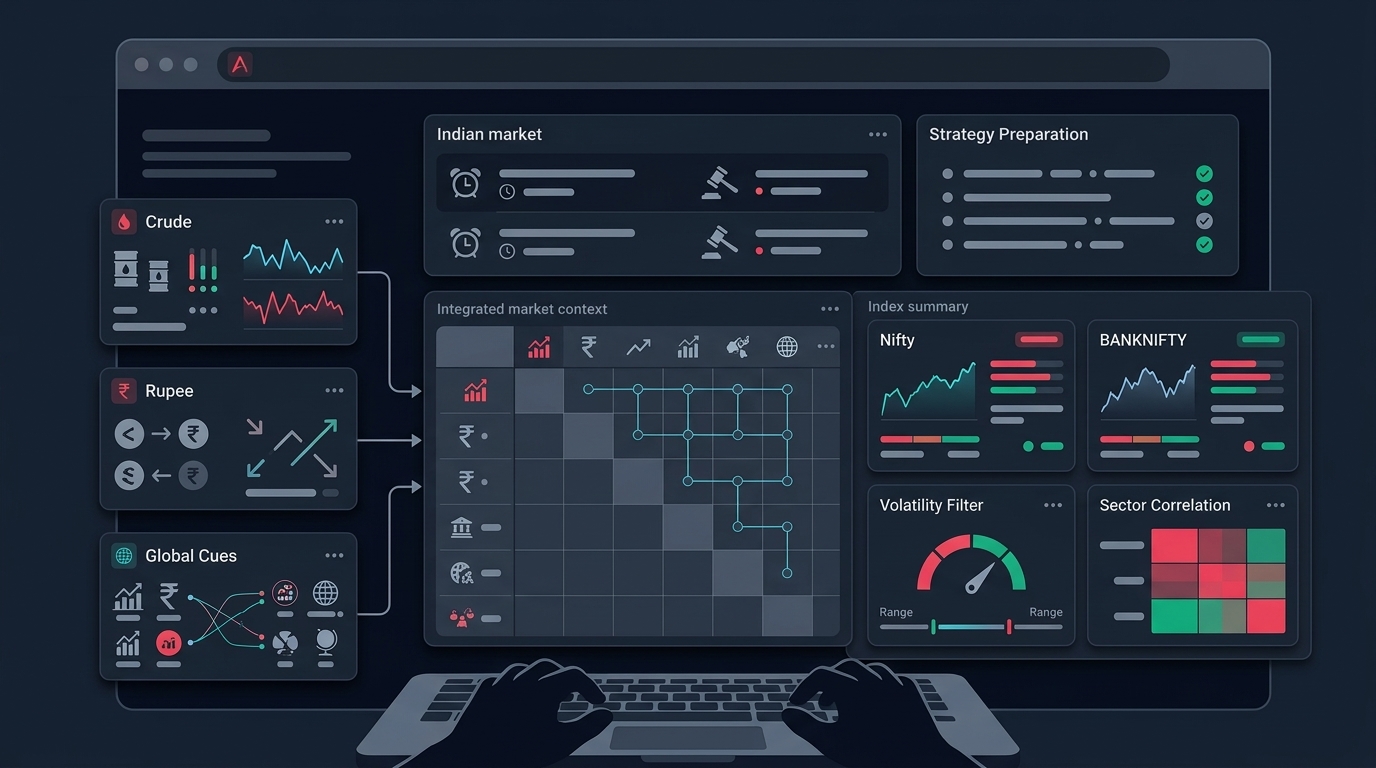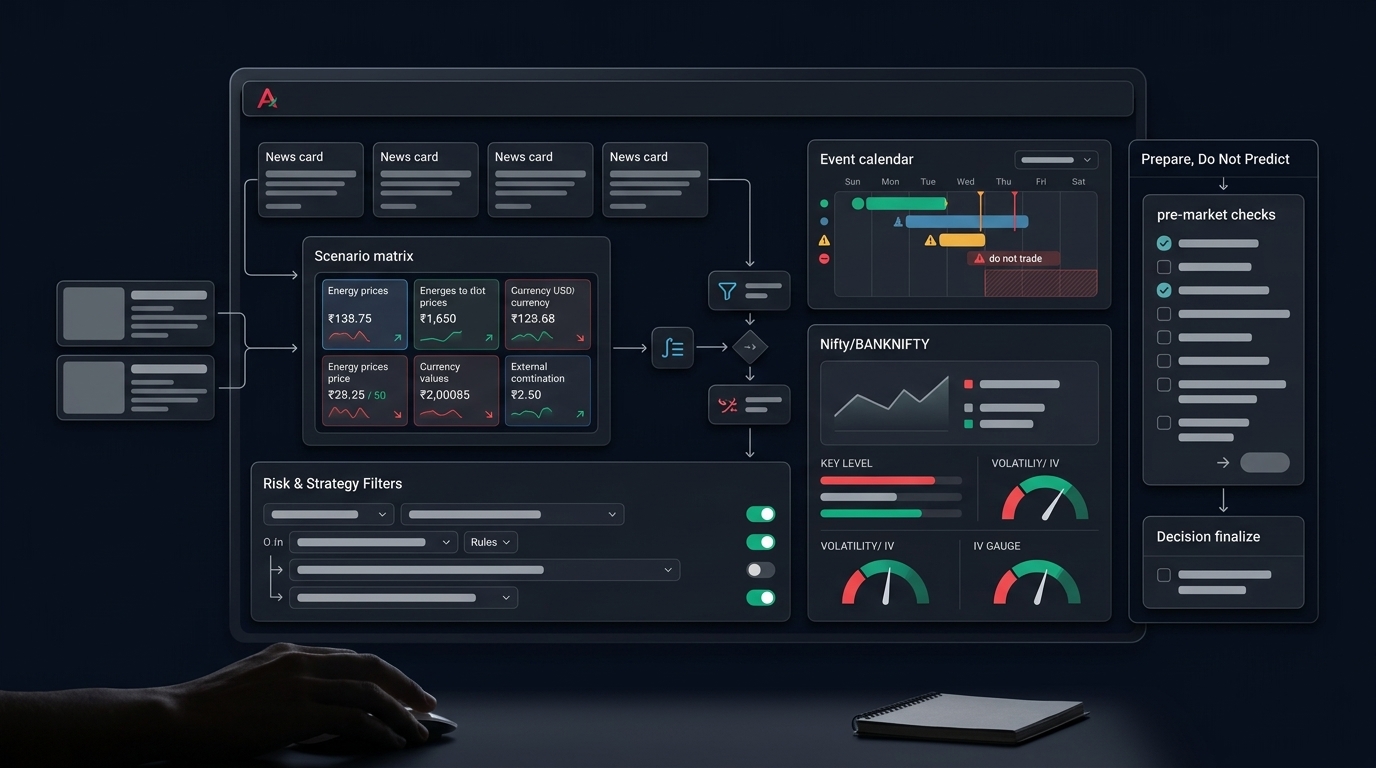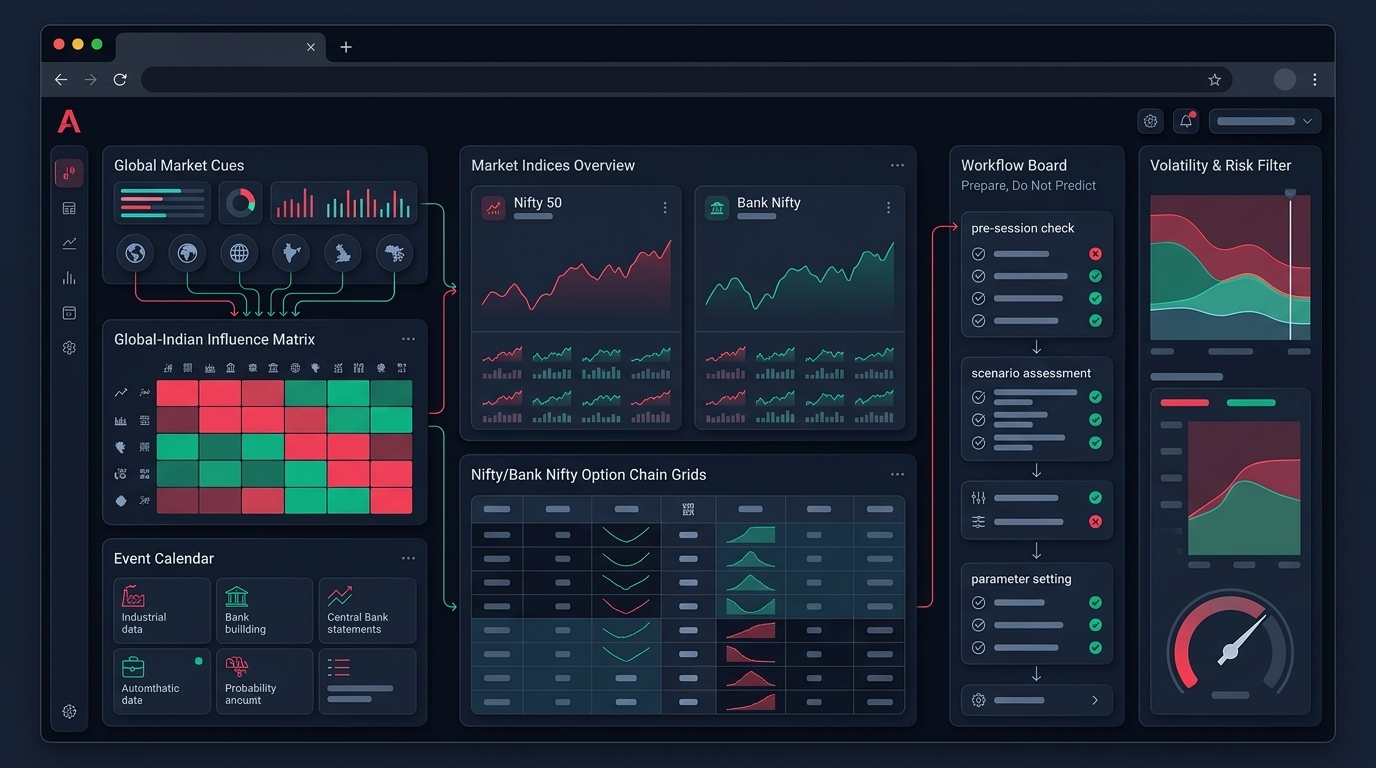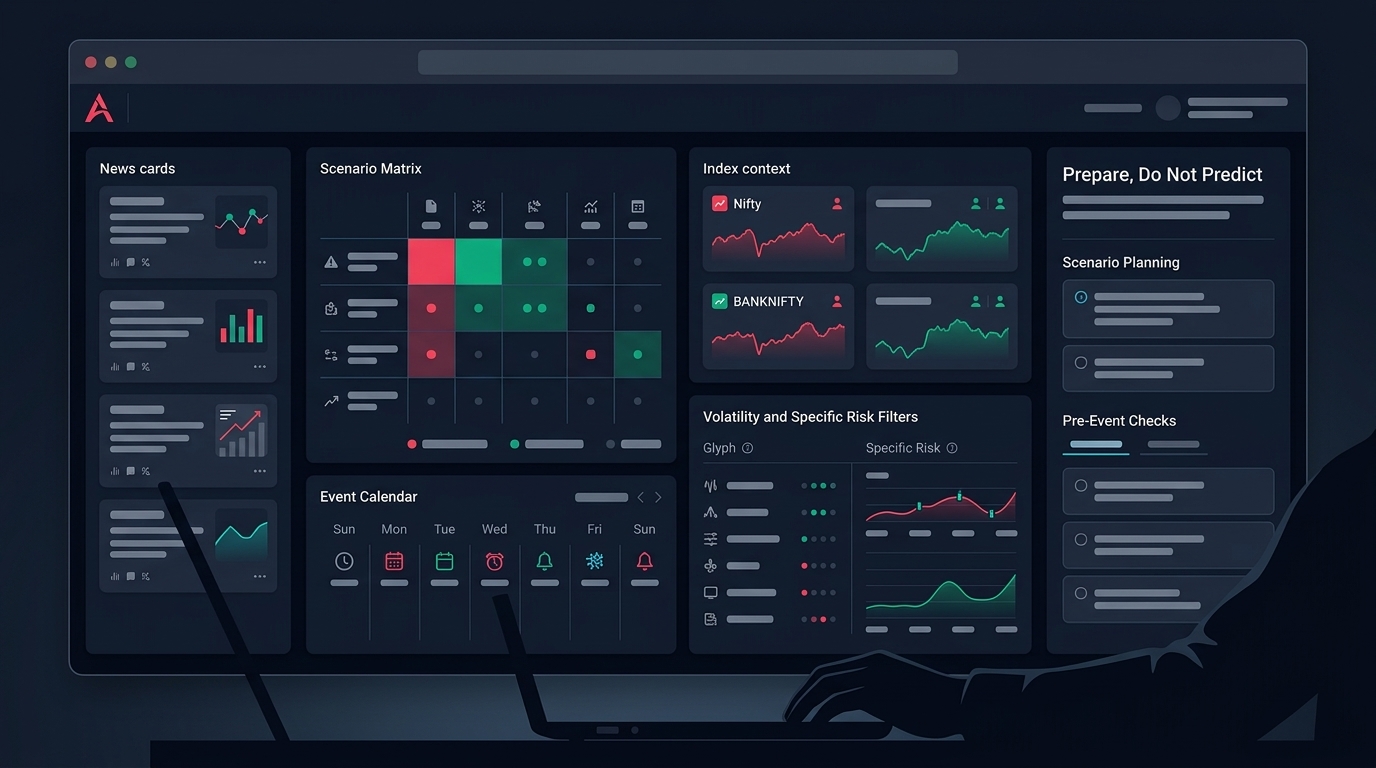
The Indian market just absorbed three overlapping triggers in one week: the US Federal Reserve's first rate hike in more than three years, crude oil holding above the $100 mark, and a rupee trading around 96 to the dollar. Add a busy primary market headlined by the NSE IPO, and you have exactly the kind of week where retail algo traders either follow their process or start improvising.
This post is not a forecast. Nobody knows whether Nifty rises or falls from here, and any algo built on someone else's guess deserves what it gets. What we can do is separate the facts from the noise, and turn the facts into risk filters, preparation steps, and workflow checks you can actually encode.
What changed this week: facts before noise
Before touching any strategy, write down what is actually known. As of this week, per reporting from India Today, Livemint and others:
- The US Fed raised rates by 25 basis points in a unanimous decision — its first hike in more than three years. Updated projections showed 16 of 18 policymakers expecting at least one more 25 bps increase by year-end.
- Indian benchmarks opened flat with a negative bias the morning after. The Sensex slipped around 0.2% to the 74,200 zone at open, and the Nifty 50 eased about 0.1% to around 23,195, after closing at 23,217.60 the previous day. GIFT Nifty had signalled a largely flat start.
- Eight of the sixteen major sectoral indices logged losses at the open. Nifty IT fell around 0.5%, with higher US borrowing costs seen as a risk to software spending in Indian IT's largest market.
- Crude oil has been trading above $102 a barrel, a level that keeps inflation, the trade balance, and the rupee in focus.
- The rupee has been under pressure against the dollar, trading around the 96 mark.
- FII selling has continued, with DII buying providing the counterweight — a tug-of-war, not a one-way street.
- The NSE IPO opened, pulling attention and liquidity toward the primary market.
That is the tape. Everything beyond this list — "markets will stay under pressure", "this is the bottom", "IT is finished" — is interpretation, and your algo should not be consuming interpretation as if it were data.
Why a first-hike-in-three-years is a process event, not a signal
There is a temptation to treat a Fed hike as a directional input: rates up, so short something. That is not how a systematic trader should read it. The honest reading is different: the regime your recent data was generated in may have just changed.
For over three years, every backtest you ran, every scanner threshold you tuned, and every option-selling stat you collected came from a market that was not in a US hiking cycle. If the Fed follows through on the projected additional hike, the flow environment — FII behaviour, IT sector sensitivity, rupee pressure — could look different from the sample your rules were fitted on.
The backtest sample problem
This is the part most retail algo traders skip. Ask three questions of any strategy you are running live right now:
- What period was it validated on? If your backtesting window is 2024–2026, your strategy has essentially never seen a rising-US-rate environment paired with crude above $100 and a rupee near record-weak levels.
- How did it behave in the closest analogue you can find? You may need to go back to older hiking cycles. The market structure was different then (lot sizes, expiry schedules, liquidity), so treat those results as directional stress information, not precise expectancy.
- Which of its assumptions are regime-dependent? Mean-reversion entries, overnight holds, and short-volatility structures are all more regime-sensitive than they look in a calm-period equity curve.
None of this means "switch off your algo." It means the confidence interval around your backtested numbers just got wider, and position sizing should respect that.
Risk filters worth encoding this week
Context is only useful if it becomes a rule. Here are filters that map directly to this week's setup — each one is a process check, not a prediction.
The flat-open-after-a-big-event filter
A flat open after a major overnight event is its own regime. GIFT Nifty pointed to a muted start, and the cash market delivered one — but a flat open after a Fed decision is not the same as a flat open on a quiet Tuesday. The event is priced in slowly, through the session, as FII desks and option writers reposition.
A practical encoding: if a major global event occurred overnight and the index opens within a small band of the previous close, treat the first 15–30 minutes as observation time for intraday systems. Log what your strategy would have done in that window instead of executing it. If your edge survives skipping the open on event days, you have lost little. If your live slippage on event-day opens has been poor, you have gained a lot.
The sector exposure filter
This week's stress is not evenly distributed. IT is directly exposed to US rate expectations. Energy consumers, paint, aviation, and other crude-sensitive names carry the oil input-cost story. Importers wear the weak rupee; exporters may benefit from it. A stock scanner that ranks purely on price structure will happily serve you five IT breakouts on a morning when the entire sector is gapping down on macro news.
The fix is breadth and sector confirmation before entry. In an Anadi workflow, this is what the Indices page is for — index cards and the sector heatmap act as context before you act on a scanner or option setup. The rule version: only take scanner signals whose sector is not among the day's weakest, or at minimum, size those entries down. You are not predicting the sector; you are refusing to fight visible participation.
The event-day size and slot discipline
When triggers stack — Fed follow-through, crude, rupee, IPO flows — the correct response is rarely "do nothing" and rarely "do everything." It is usually "do the same things, smaller."
Concrete versions of that:
- Cut per-trade capital allocation on days following major policy events, and restore it only after a fixed number of normal sessions.
- Enforce a daily loss limit strictly. This is the single guardrail that converts a bad regime-transition week into an annoyance instead of a drawdown. If you have not formalised one, start with your risk management rules before your entry rules.
- Cap the number of concurrent positions. FII-selling-versus-DII-buying markets often produce choppy, correlated moves; five open intraday positions in such a tape are not five independent bets.
The IPO-week attention filter
A large IPO like NSE's does two quiet things: it absorbs funds from trading accounts as applications lock capital, and it absorbs trader attention. Neither shows up on a chart. If your own deployable capital is temporarily reduced by an IPO application, your position sizing inputs must reflect that today, not after allotment. An algo sized off last week's capital is silently over-leveraged this week.
Options workflow: what to validate before any structure
For options traders, a week like this changes the pre-trade checklist more than the strategy list. Whatever structure you prefer — spreads, condors, directional debit trades — the same validations apply, in order:
- IV context first. After a policy event, implied volatility can compress quickly or stay bid depending on how much uncertainty remains. With one more Fed hike projected by year-end, do not assume post-event IV crush is automatic. Compare current IV against your own logged history for the same underlying, not against a feeling.
- Liquidity at your strikes. Attention diverted to the primary market can thin out spreads in less-popular strikes. Check bid-ask before payoff.
- Margin with positions considered. A structure that looked fine in isolation can push your account past comfortable utilisation once existing positions are counted. This is why Anadi's options workspace puts basket preview and margin estimation — with existing positions considered — before execution rather than after. Whatever platform you use, the ordering principle stands: see the margin and risk picture, then place the order.
- Exit rules written down. Especially for short-volatility structures in a week where crude and currency can move overnight. A basket-level stop or maximum-loss number decided in advance beats a decision made while watching an adverse move.
If you are still building this discipline, run the full loop on paper first. Paper trading an options structure through an event week teaches you more about your own process gaps than a month of calm markets.
Turning this into a repeatable weekly routine
The deeper point is that this week is not special. Some version of "three triggers stacked at once" happens every few weeks in Indian markets — a Fed meeting, an expiry, a crude spike, an election, a mega IPO. Traders who re-derive their response from scratch each time burn energy and make inconsistent decisions. Traders with a routine just run the routine.
A workable weekly routine looks like this:
- Sunday/Monday: read a structured weekly market outlook and list the scheduled events — policy decisions, expiries, large IPOs, major data releases. Mark which days your systems should trade smaller or not at all.
- Daily pre-open: check GIFT Nifty, crude, and USD-INR against the previous close. You are not predicting the day; you are classifying it — normal, event-adjacent, or stacked-trigger.
- During the session: let filters do the talking. A signal blocked for chase distance or an invalidated level is your system protecting you from a late entry, not an opportunity missed. This is the exact job Anadi's Action Center does — ranking scanner candidates, surfacing blocked reasons, and showing F&O context before you pick a route.
- Post-session: log what the filters blocked and what they allowed. Over a quarter, this log becomes the evidence that either justifies the filters or refines them.
If you want to codify these rules without writing code, a no-code strategy builder lets you express conditions like sector confirmation, time-of-day restrictions, and size adjustments as explicit rules instead of intentions. Rules you can see are rules you can audit.
If you are setting up this kind of disciplined, context-aware workflow — scanner to filter to risk check to execution — you can request early access to Anadi Algo and build it on one platform instead of five browser tabs.
The takeaway checklist
For a week where the Fed has hiked for the first time in three years, crude sits above $100, and the rupee is near 96, here is the process summary:
- Write down the facts (rates, crude, currency, flows, IPO calendar) separately from anyone's interpretation of them.
- Treat the hike as a possible regime change: widen your uncertainty about backtested numbers, and check what period your live strategies were validated on.
- Encode an event-day open filter — observe or trade smaller in the first 15–30 minutes after major overnight events.
- Require sector and breadth confirmation before acting on stock scanner signals, especially in IT and crude-sensitive names this week.
- Reduce per-trade size and cap concurrent positions while triggers are stacked; enforce your daily loss limit without exceptions.
- Adjust sizing inputs if IPO applications have locked part of your capital.
- For options, validate IV context, strike liquidity, and margin with existing positions before execution — and write the exit rule first.
- Log everything: what you skipped, what was blocked, and why. That log is next quarter's edge.
Markets will resolve the Fed-crude-rupee question in their own time. Your job is not to guess the answer — it is to make sure your process survives every version of it.