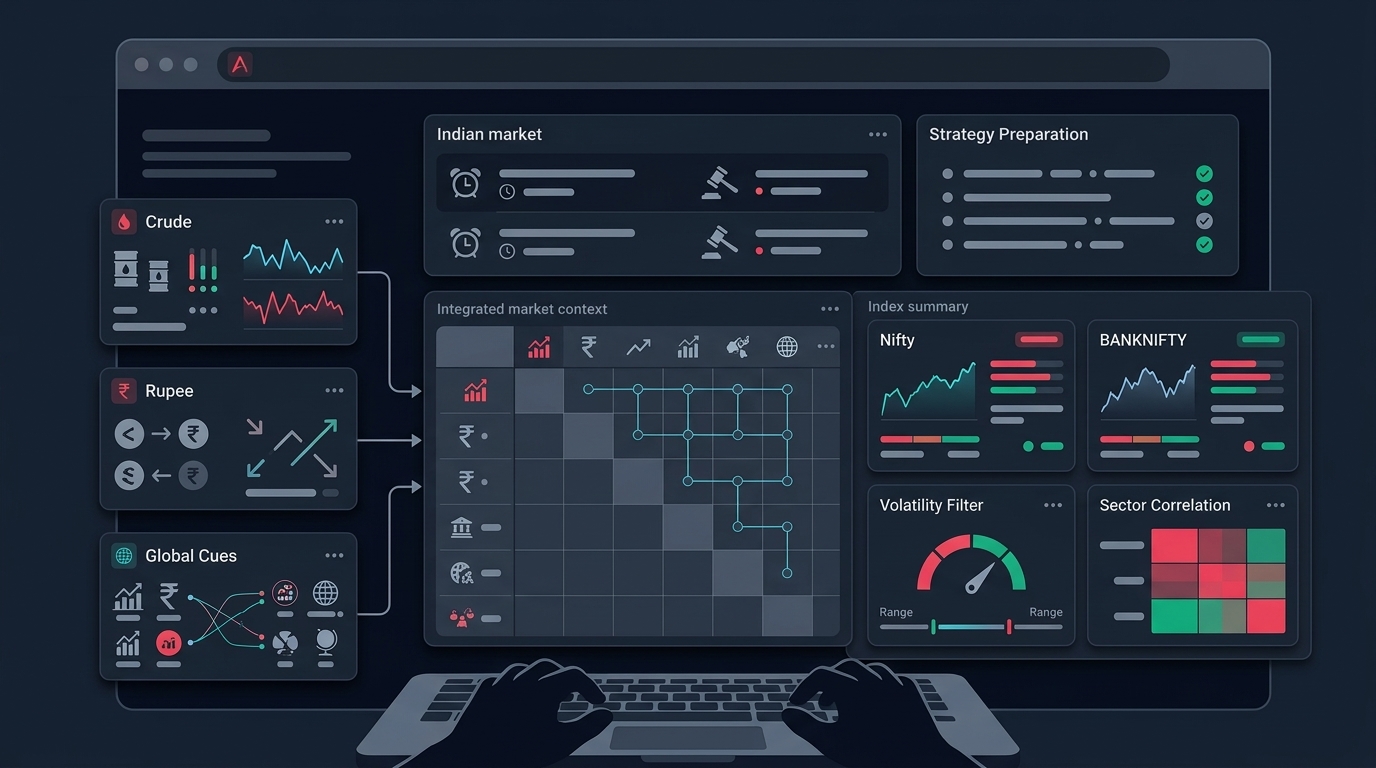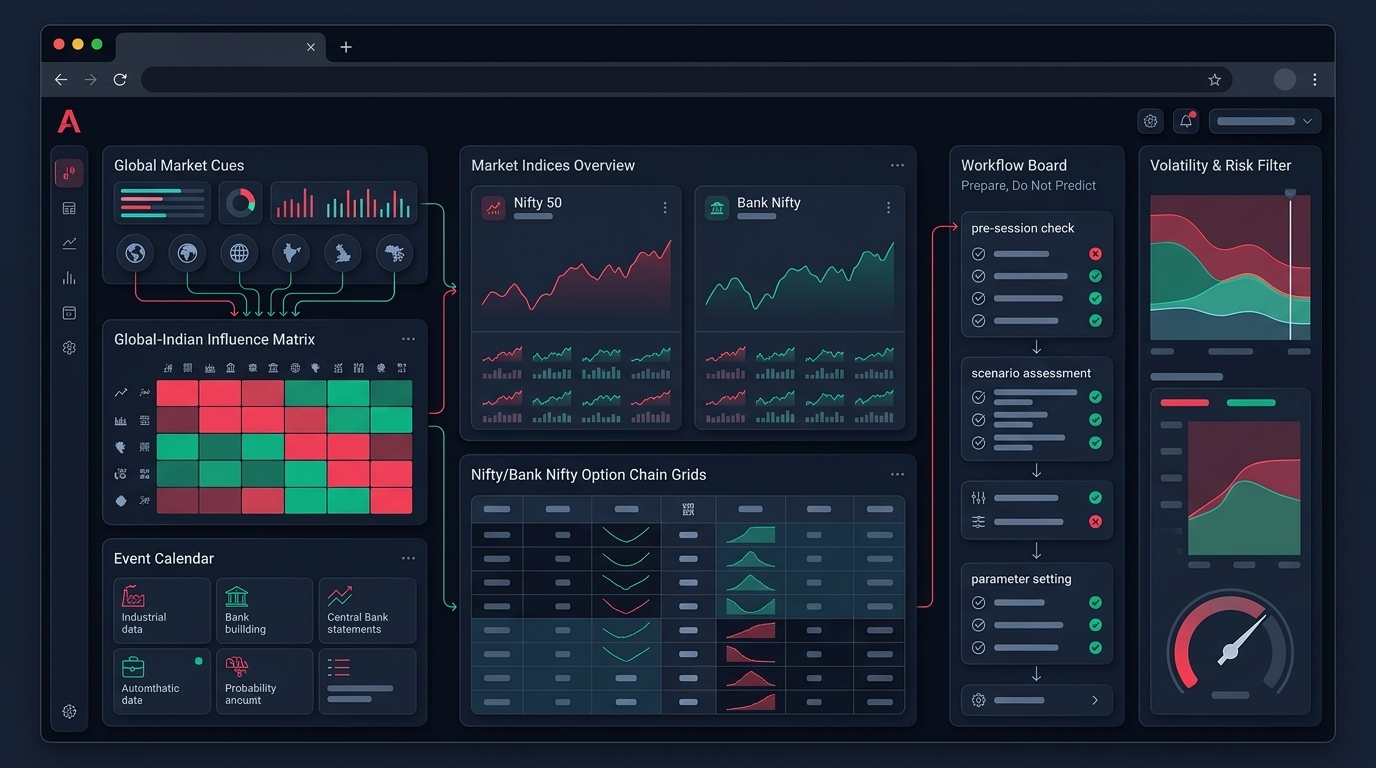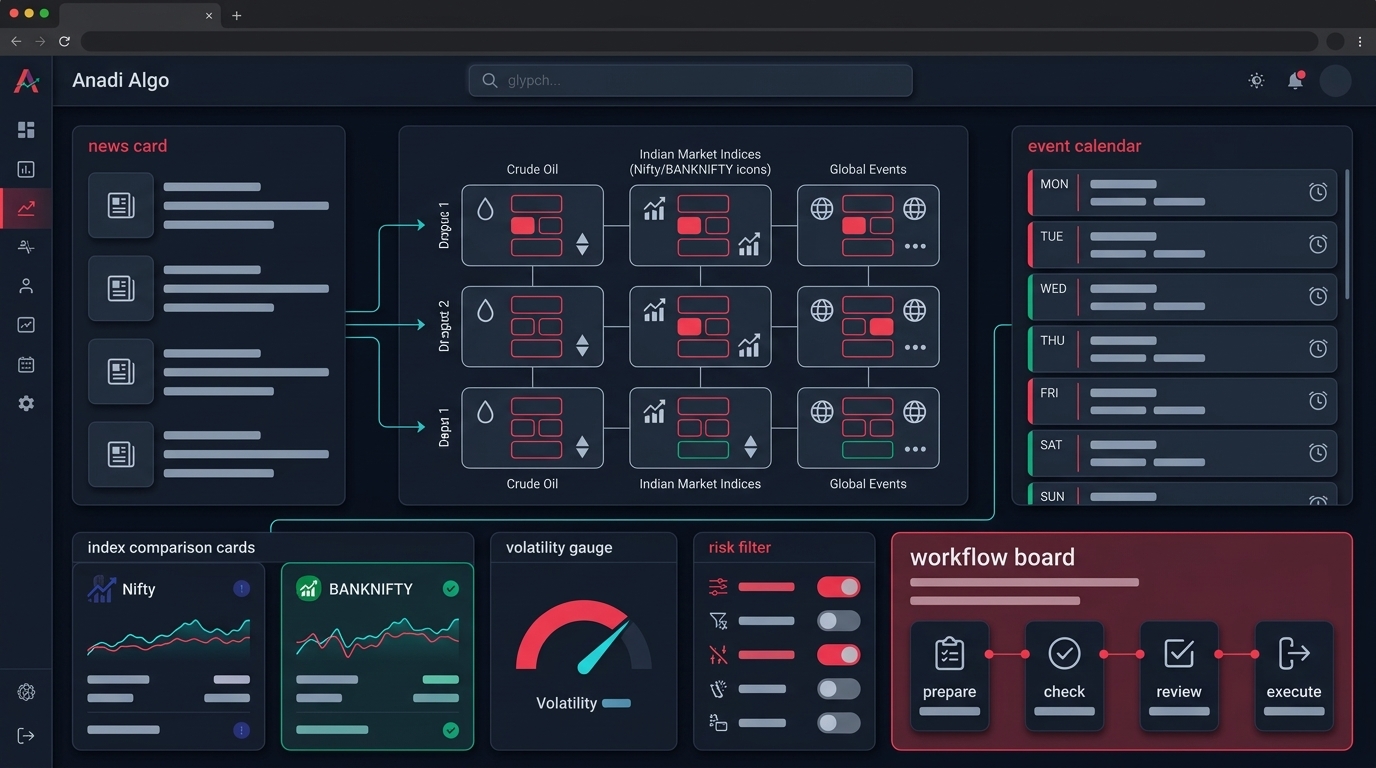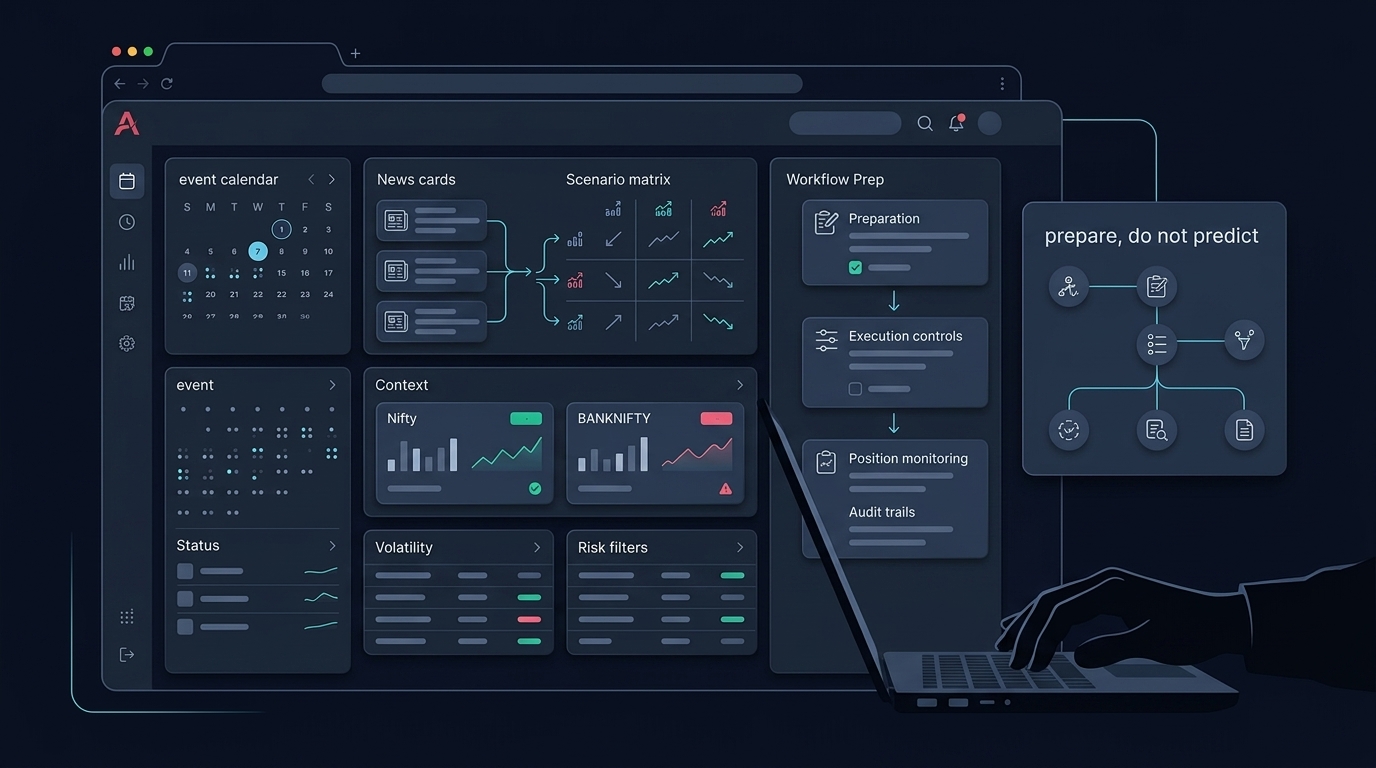
The last week of July 2026 gave Indian traders a textbook example of how overnight global news becomes a domestic market problem. On Thursday, July 30, benchmarks opened soft — Sensex around 77,540 and Nifty near 24,226 — with reports pointing to mixed global cues and firm crude. By Friday, July 31, the tone had flipped: GIFT Nifty was quoted around 24,400–24,450 against Nifty's previous close of 24,317, signalling a gap-up of roughly 100 points, helped by a Wall Street rally after strong technology guidance and a broad rebound across Asia.
Two sessions. Same market. Opposite openings.
If you trade discretionary, you absorb that as "sentiment". If you run systems — scanners, option baskets, intraday algos — you have to answer a harder question: which part of that overnight context is allowed to change your rules, and which part is just noise you should ignore?
This post is a process piece, not a market call. No targets, no levels to trade, no view on direction. The goal is to show how a retail algo trader can take a week like this one and convert it into filters, calendar rules, and risk checks that survive the next noisy open.
What the tape actually showed, and what it did not
Start with the reported facts, because most traders skip straight to interpretation.
Foreign portfolio investors turned net buyers, with one report citing roughly ₹3,624 crore of FII purchases. Sectoral participation was uneven on July 31 — auto and financial services led, realty, pharma and media saw buying, PSU banks outperformed private banks, and IT was the biggest drag, falling more than 2%. FMCG was also under pressure. Analysts quoted in the same coverage flagged support in the 24,040–24,140 zone and resistance near 24,530, alongside a view that derivatives data looked constructive.
Now the part traders rarely notice. Across four different reports in the same 48 hours, crude oil was described as WTI "near $84", WTI "holding firm in the $83–84 range", and crude "hovering near USD 90 per barrel on renewed military escalation in West Asia".
Those are not contradictions. They are different benchmarks, different timestamps, and in one case an unspecified contract. Brent and WTI do not print the same number. A quote from Wednesday afternoon is not a quote from Friday morning.
But if you wrote a rule that says "reduce size when crude is above $88", you have just built a system whose behaviour depends on which headline you happened to read. That is the first lesson of the week, and it has nothing to do with direction.
Rule one: name the instrument, the source, and the timestamp
Every external filter in your system needs three fields defined before it goes live:
- The exact instrument — Brent front month, WTI front month, USDINR spot, USDINR futures, DXY.
- The source of truth — one feed, not "whatever the news says".
- The read time — a fixed clock reference such as 08:45 IST, not "when I check".
Without those three, a crude filter is not a filter. It is a mood. The same applies to rupee levels and to global index moves. "Global cues were positive" is a sentence, not an input.
A gap-up signal is context, not a trigger
GIFT Nifty trading above the previous Nifty close tells you where an offshore contract is quoted. It does not tell you where your order fills.
Three practical gaps sit between that quote and your P&L.
First, the pre-open session. The NSE pre-open call auction discovers the opening price, and it can land meaningfully away from where GIFT Nifty was quoted minutes earlier. Your algo's first order does not execute at the indicated level.
Second, liquidity in the first few minutes. Option spreads are widest right at the open, especially on strikes away from the money. A backtest that fills you at the last traded price at 09:15:01 is describing a market that does not exist for retail size.
Third, the strike map moves under you. On a 100-point gap in Nifty, the strike that was at-the-money on Thursday's close is no longer at-the-money on Friday's open. Any strategy that selects legs by "ATM" at a fixed time is picking a different structure than the one you backtested — different delta, different premium, different margin.
What this does to your backtest
Most retail options backtesting setups underestimate gap days in three specific ways, and each one is checkable:
- Stop-loss assumption. If your stop is "premium up 30%" and the market gaps, your stop was breached before the first tick. A realistic engine either fills you at the open or marks the trade as gapped-through. Compare both.
- Entry price assumption. Test your strategy with entries at the open price versus 09:20 versus 09:30. If the equity curve only works at one of those, you do not have an edge — you have a timestamp.
- Cost assumption. Add wider slippage specifically to gap-day entries. Then check what percentage of your total return came from those days. If a meaningful slice of profit sits on days when the index opened more than, say, 0.5% away from the prior close, that is concentration risk, not skill.
Run those three variations before you argue about whether the strategy is any good. The answers usually settle the argument.
Turning crude, rupee and flows into regime filters, not entry signals
There is a strong temptation to trade the news. Crude spikes on West Asia escalation, so you short something. FPI flows turn positive, so you go long. That is a discretionary reflex wearing a systematic costume.
A better use of macro context is as a regime filter — something that changes how much you risk and which strategies are allowed to run, rather than something that generates entries.
A workable structure looks like this:
Regime inputs (measured, not read): index realised volatility over the last 5 and 20 sessions, India VIX level and its change, USDINR daily range, front-month crude percentage change over 5 sessions, and overnight gap magnitude.
Regime outputs (what actually changes): position size multiplier, maximum concurrent positions, which strategy families are enabled, and whether new entries are blocked in the first N minutes.
Notice what is missing. Direction. A regime filter should not tell you to be bullish. It should tell you whether the environment is one where your strategy historically behaved, and how much capital deserves to be at risk in it.
Test the filter before you trust it
Any filter you add must earn its place. Take your existing strategy, run it with and without the filter over the same period, and compare four numbers: total return, maximum drawdown, number of trades, and worst single day.
A filter that improves returns but only by removing 8 trades from a 400-trade sample has told you nothing statistically. A filter that cuts your worst single day materially while keeping most trades is doing real work. This is the kind of comparison a no-code strategy builder is meant for — toggling a condition and re-running, rather than rewriting logic each time.
Also check the filter's own stability. If "crude up more than 4% in five sessions" triggers three times in two years, you cannot evaluate it. Loosen the threshold until it fires often enough to be measured, or accept that it is a manual judgement call and label it as such.
The breadth problem: the index is not your position
July 31 is a clean illustration. Headline indices opened higher, but IT fell over 2% while autos and financials led. A trader running a momentum scanner on the full universe would have seen long signals and short signals firing in the same session, both technically valid.
This is where index-level context and stock-level signals must be reconciled before execution, not after.
Three checks worth building into your pre-open routine:
- Sector alignment. Is the stock's sector participating, or is the stock the lone green name in a red sector? Anadi's indices view exists for exactly this — index cards and a sector heatmap as context before you act on a scanner row, not as a prediction tool.
- Breadth confirmation. Advance-decline and the number of index constituents above their short-term average tell you whether a move is broad or carried by three heavyweights. A narrow move is a fragile move for trend-following logic.
- Signal-to-route matching. A stock scanner signal in an F&O-eligible name can be expressed as stock, future, or option. Those three have different margin, different gap exposure, and different behaviour on a volatile open. Anadi's Action Center surfaces F&O eligibility, entry quality, freshness, and blocked reasons such as chase distance, so a stale or extended signal does not quietly become an order.
That last point matters most on gap-up days. A signal generated on Thursday's close, acted on after a Friday gap, is often already extended by the time you trade it. "Chase distance" is not a fancy metric — it is the difference between the signal price and the current price, and it is the single most common way retail traders convert a decent setup into a bad entry.
Calendar and event hygiene
Global cues and crude are the visible risks. The scheduled ones are easier to manage and more often ignored.
Before the week starts, write down and check:
- Fed and central bank meeting dates, and whether any fall in your holding window. Reports through late July flagged a visible split within the US Federal Reserve on rates — a split committee tends to make outcomes less predictable, which is a volatility statement, not a direction one.
- Domestic policy and data dates that move rates and the rupee.
- Earnings dates for every single-stock position. Q1 results season was still running through this window. Holding a short option position through a result you did not diary is not a strategy, it is an accident waiting to be explained.
- Series and expiry mechanics. If a monthly series has just rolled, confirm your algo is referencing the correct expiry, that liquidity has actually migrated, and that any hardcoded expiry offsets in your logic still resolve correctly.
That last item breaks more live systems than macro ever does. An algo pointed at a stale expiry will place orders that either reject or fill in an illiquid contract.
Risk rules that survive a noisy open
The controls below cost nothing and remove most of the damage a surprise open can do:
- A hard daily loss limit enforced by the system, not by your willpower. Once hit, no new entries for the session. This is the core of any serious risk management setup.
- A first-N-minutes entry block on gap days. Many strategies do measurably better skipping the first 10–15 minutes. Test it on your own data rather than assuming.
- Size scaled to the gap. If the open is more than a defined percentage away from the previous close, reduce the size multiplier for that session automatically.
- Basket-level stops on multi-leg options, not just per-leg stops. On a gap, individual legs can each look survivable while the basket is bleeding.
- A margin check before submission. Estimate margin with existing positions considered, not in isolation. A basket that passes on its own can fail against your live book.
- Documented manual override rules. Decide in advance the exact conditions under which you are allowed to intervene, and log every time you do. If you cannot list the conditions, you do not have override rules — you have discretion.
Run any change to these in paper trading for a meaningful sample before it touches live capital. A week of paper on a quiet market proves nothing; you want it to have seen at least a few gap days and a volatility spike.
The weekend checklist
Use a market context week like this one for preparation, not for forming a view. That is the whole point of a structured weekly market outlook — it should end with rules, not opinions.
Before Monday's pre-open, confirm:
- Every external filter names its exact instrument, source, and read time.
- Your backtest has been re-run with open-price fills and wider gap-day slippage.
- You know what share of your historical return came from gap sessions.
- Regime filters change size and permissions only — never direction.
- Sector and breadth context is checked before any scanner signal is routed.
- Chase distance and signal freshness are enforced in code, not in your head.
- Every position has its earnings and event dates diaried.
- Expiry references and series rollover are verified against the live contract.
- Daily loss limit, basket stop, and margin-with-positions checks are all active.
- Manual override conditions are written down.
None of that predicts what happens next. That is the feature. A gap-up indication from GIFT Nifty, crude somewhere between $83 and $90 depending on which benchmark you read, and FPI flows that flipped positive are all context — inputs that should tune your risk, not generate your trades.
If you want to build and test these filters properly instead of holding them in your head, you can request early access and try the workflow end to end — scanner to backtest to paper execution — before any of it touches live money.