It's Thursday, August 20, 2026. If you opened a live Nifty option chain this morning — on NSE's website, NiftyTrader, Groww, or your broker terminal — you saw the usual furniture: call OI stacked at a round strike above spot, put OI stacked below it, a PCR reading, and IV numbers that look either calm or nervous depending on which strike you stare at.
Here is the thing most retail traders miss: with Nifty's weekly and monthly expiries now trading on Tuesday, a Thursday like today is no longer expiry day. It is early in a fresh weekly cycle. The chain you are reading right now is still being built — OI is rebuilding after Tuesday's settlement, and half the "walls" you see may not survive till Monday.
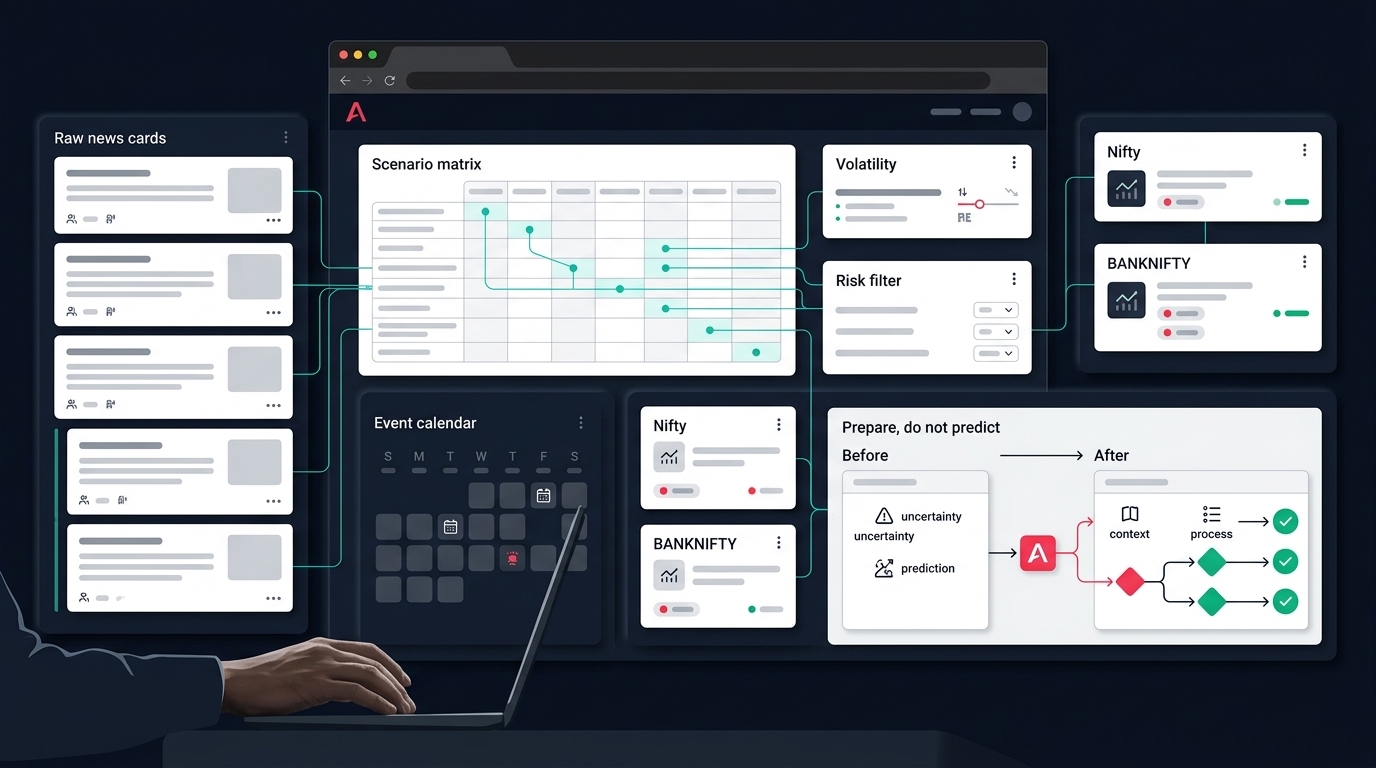
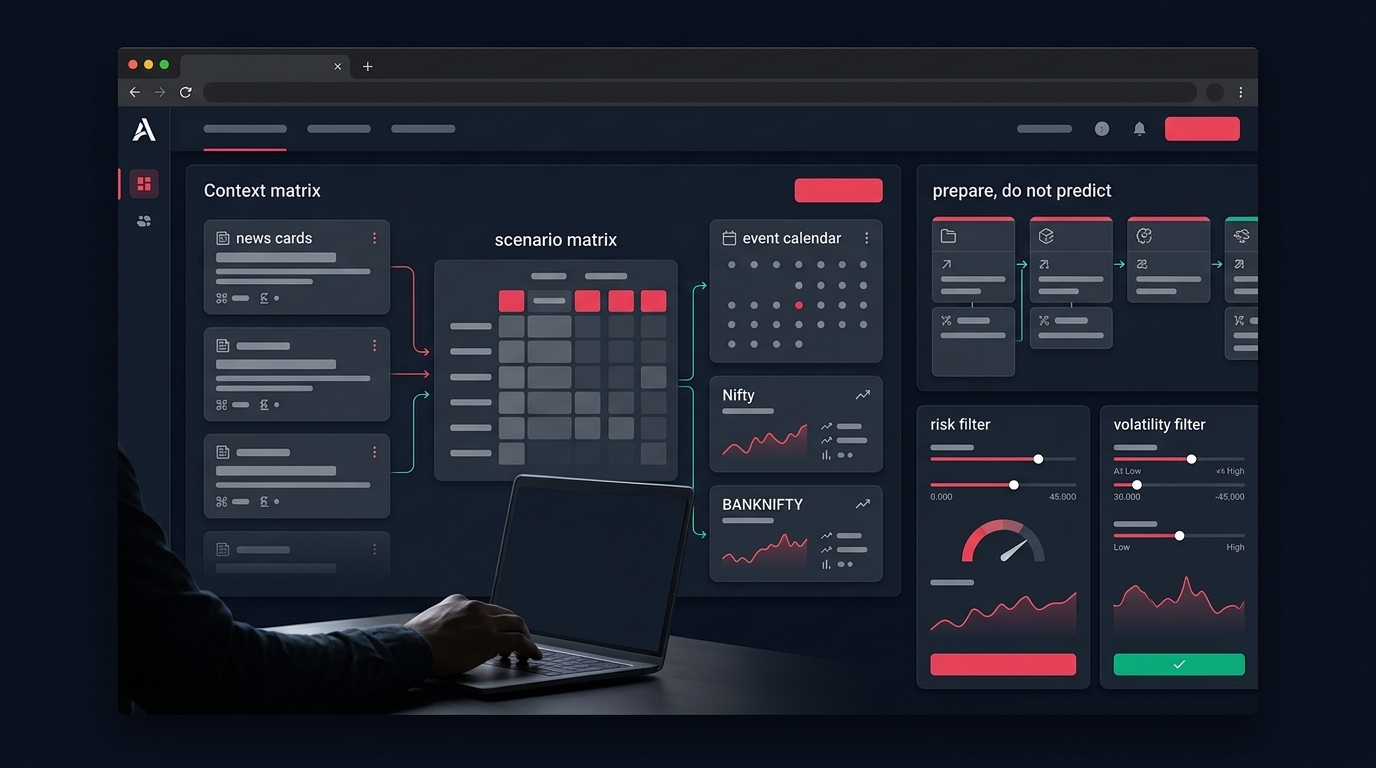
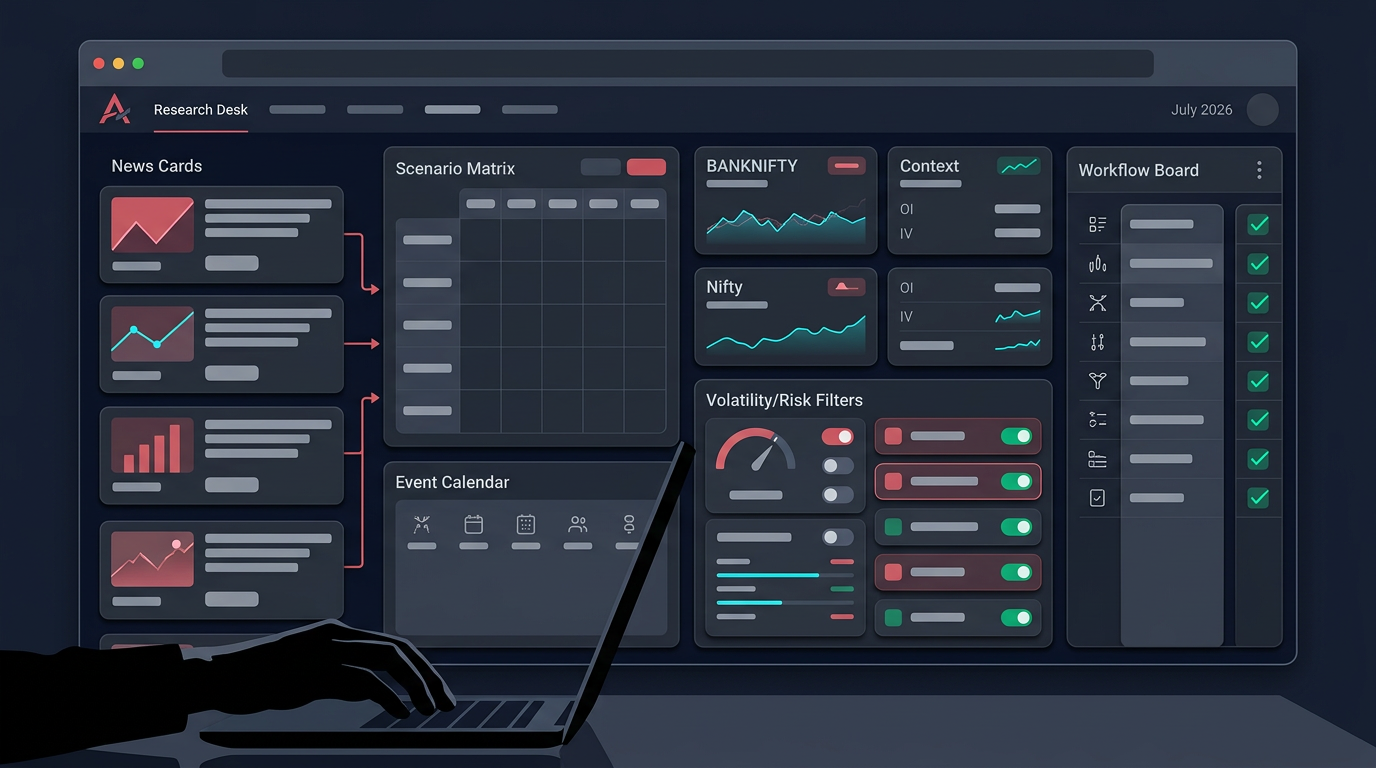
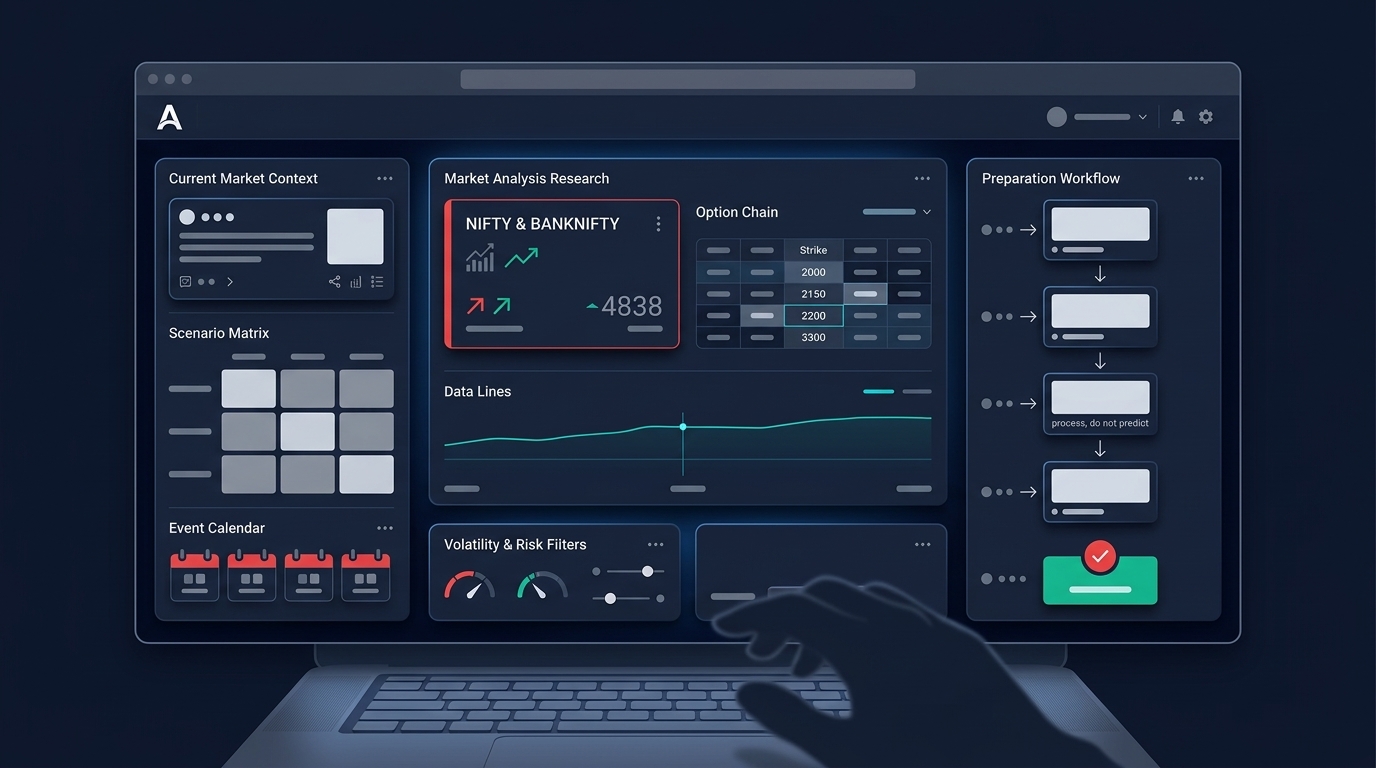
This post is not about what Nifty or Bank Nifty will do today. Nobody knows that, and any algo built on someone claiming to know it is already broken. It is about how to convert live chain numbers into process: risk filters, data checks, and structure decisions that hold up whether the market moves or sleeps.
What a live option chain actually tells you
A chain is a positioning report, not a forecast. Every number in it describes what other participants have already done, not what the index will do next.
The standard reading goes like this. The strike with the highest call OI is where option writers are selling most aggressively — the market's working resistance. The highest put OI marks the same on the downside — working support. Together they define the range sellers are currently defending. Public chain dashboards compute this live, along with put-call ratio and max pain for the expiry.
As an illustration, a recent public Nifty chain snapshot showed immediate OI resistance at 24,500, support at 24,000, and a PCR near 0.70 — heavier call writing than put writing, which readers usually label as a cautious or range-bound positioning. Note what that snapshot does not say: it does not say 24,500 will hold. Walls get defended until they get run over, and the run-over days are exactly the days that hurt short-gamma positions most.
For an algo trader, the honest translation is: the chain tells you positioning, prediction nahi. Positioning is still useful — it tells you where hedging flows may cluster, where liquidity is deepest, and which strikes the market considers "interesting" this week. That is context for sizing and structure, not a signal to reverse-engineer into a directional call.
The three checks worth doing before any options entry
Public chain guides converge on three checks, and they map cleanly to automatable rules:
- Fresh OI versus stale OI. A strike adding OI intraday matters more than one carrying old positions. The change-in-OI view isolates this. On a day like today — two days after a Tuesday expiry — this check matters double, because total OI figures are still thin and a modest absolute build can look dramatic in percentage terms.
- IV at your strike versus neighbouring strikes. Buying an option at inflated IV means the trade must overcome both direction and volatility decay. If your strike's IV sits well above its neighbours with no obvious reason, either the data is stale or you are paying up for someone else's urgency.
- LTP against intrinsic value at ATM strikes. Wide time premiums near expiry indicate the market expects movement; thin premiums indicate it does not. Early in the weekly cycle, premiums are naturally wider — do not read that as an event signal by itself.
Tuesday expiry changed the weekly rhythm — know where today sits
The move of Nifty weekly and monthly expiries to Tuesday quietly rewired the week's volatility texture. Under the old Thursday-expiry regime, Wednesday–Thursday was the gamma-heavy, theta-crush end of the cycle. Now Monday–Tuesday carries that character, and Wednesday–Thursday is the fresh-series build phase.
That has three practical consequences for algo workflows:
- Your old intraday backtests may be misaligned. A strategy tested on years of Thursday-expiry data learned Thursday behaviour that no longer exists. If your system has day-of-week logic — explicit or accidentally learned through parameter fitting — re-validate it on post-change data before trusting it. This is one of the sneakiest forms of regime drift because the calendar looks identical; only the microstructure changed.
- Don't compare today's PCR or OI with expiry-day readings. PCR at the start of a series and PCR on expiry day are different animals. A 0.70 PCR two days into a fresh weekly series, with OI still rebuilding, carries less information than the same number on Monday afternoon with the full series loaded. If your algo consumes PCR as an input, tag every reading with days-to-expiry and treat the series position as part of the feature, not noise around it.
- Verify the contract calendar programmatically. Indian expiry rules have changed more than once in recent years — weekly products discontinued, expiry days shifted. Any hardcoded "expiry = Thursday" assumption in a strategy, scanner filter, or position-sizing rule is a live bug waiting for a settlement day. Pull expiry dates from your data feed or broker API, never from a constant in your code.
Data hygiene: before your algo consumes chain numbers
This is the part most retail setups skip, and it is where "the strategy failed" often turns out to mean "the data lied."
Free public chains — NSE's own option chain page, broker dashboards, aggregator sites — are built for human eyeballs, not machine consumption. They are snapshot-based, refresh on their own cadence, throttle aggressive polling, and occasionally serve stale rows without any error flag. If your workflow uses chain-derived inputs (PCR gates, OI-wall proximity, IV rank), run these validations before the numbers touch a live order:
- Timestamp every snapshot and reject stale ones. If the data timestamp is more than a couple of minutes old during market hours, the derived PCR or OI figure should be treated as missing, not as truth. A missing input should push your system toward its conservative default, never toward "use the last value silently."
- Cross-check two sources on disagreement-prone fields. OI updates on NSE propagate on a delay; different platforms show different change-in-OI at the same moment. If two sources disagree beyond a tolerance, log it and fall back to the safer risk state.
- Handle missing and illiquid strikes explicitly. Far OTM strikes with a handful of contracts produce garbage IV. A single illiquid strike can distort an "average IV" or skew calculation badly. Filter by minimum OI and volume before computing anything aggregate.
- Sanity-check LTP against bid-ask. An LTP from twenty minutes ago on a dead strike is not a price. If your basket pricing uses LTP, cap it against the live quote or your margin and payoff estimates will be fiction.
None of this is glamorous. All of it decides whether your chain-based filter is a risk control or a random number generator.
Turning chain context into machine-checkable risk states
The useful move is converting chain observations into risk states — discrete modes your system can be in — rather than entry signals. Some examples of how that framing works (these are process patterns, not recommendations):
- Wall-proximity sizing. If spot is trading within a defined distance of the heaviest OI strike, a breakout strategy might run at reduced size or require extra confirmation, because that zone is where defended positioning and hedging flows collide. The rule doesn't predict whether the wall holds; it just acknowledges that outcomes near walls are noisier.
- IV-conditional structure choice. When IV at your target strikes sits high relative to its own recent range, naked buying carries a double burden — direction plus vol decay. The same directional view might route through a spread instead, trading capped payoff for reduced theta and vega drag. This is exactly why volatility and time-decay context belong beside the chain during setup, not in a post-trade review. In Anadi's options workspace, the IV & Theta tab sits next to the chain and OI analysis tabs for this reason — structure selection is a pre-trade decision.
- Fresh-OI confirmation gates. A scanner signal on a stock or index gains or loses conviction depending on whether the F&O positioning agrees. Requiring fresh same-direction OI build before routing a signal to an options trade is a filter you can define precisely and test — unlike "OI looked supportive," which is a story.
- The loss limit outranks everything. No chain reading, however clean, overrides a daily loss limit. Chain-based filters decide how you enter; your risk management layer decides whether you are still allowed to. Keep those layers separate in code so a clever filter can never argue its way past the guardrail.
If you build rules like these, define them in plain, testable language first — entry condition, filter condition, exit, size — the same discipline a strategy builder forces on you. Vague filters cannot be backtested, and untested filters are superstition with extra steps.
Backtest the filter before you obey it
Every chain-derived filter sounds intelligent. Most of them, tested honestly, add nothing — or worse, they filter out the trades that paid for the year.
Before a PCR gate, an OI-wall rule, or an IV-rank condition goes live, it needs the same treatment as a strategy: run it through options backtesting on data that includes the Tuesday-expiry regime, and measure what it actually changed. Did drawdown improve, or did you just trade less? Did the wall-proximity rule dodge losses, or dodge winners? A filter that only has anecdotes behind it ("that Tuesday it kept me out of trouble") is curve-fitting by memory.
Be especially suspicious of filters validated on pre-regime-change data. The expiry-day shift means the intraday distribution of gamma and theta effects moved within the week. A filter that worked because of old Thursday behaviour can silently invert.
Where this fits in one workflow
The failure mode this post is really about is fragmentation: chain on one tab, OI analysis on a second site, IV somewhere else, margin discovered only at order rejection, and risk checked never. Every hop between tools is a place where a stale number or a skipped check slips in.
The fix is structural, not motivational — keep discovery, chain inspection, volatility context, basket preview, margin estimate, and risk budget in one controlled sequence, so the checks happen because the workflow puts them in your path. That is the design idea behind Anadi's options workspace for NIFTY, BANKNIFTY, FINNIFTY, and MIDCPNIFTY, and behind Action Center's habit of showing blocked reasons — chase distance, invalidated price — instead of letting a late entry through quietly. Pair that with index and sector context before acting on any single-name setup, and with the weekly market outlook to prepare for the week rather than chase intraday noise.
If you want to build and test chain-aware rules in that kind of workflow, you can request early access here.
A working checklist for days like today
For a non-expiry Thursday early in a fresh Tuesday-to-Tuesday series:
- Confirm today's position in the expiry cycle from your data feed, not a hardcoded calendar.
- Treat total OI as still-building; weight change-in-OI over absolute OI.
- Timestamp-check every chain snapshot your system consumes; stale data routes to the conservative default.
- Compare IV at your strikes against neighbours and against its own recent range before choosing buy versus spread structures.
- Check LTP against live quotes on any strike entering a basket; verify margin before execution, not after rejection.
- Express any chain-based filter as a testable rule, and backtest it on post-regime-change data before it touches live orders.
- Keep the daily loss limit as a separate layer that no filter can override.
The chain is one of the best free positioning maps Indian traders have. Used as context with clean data and tested rules, it sharpens process. Used as a prediction machine, it is just a prettier way to gamble.