It is Monday, August 24, 2026, and if you trade Nifty or Bank Nifty options, the next two sessions sit in the most crowded part of the derivatives calendar: the run-in to a Tuesday expiry. Most traders will open the NSE option chain page today, stare at the OI columns, and form an opinion. Algo traders have a different job. The question is not "what does the chain say" — it is "how does chain data enter my system, which decisions is it allowed to influence, and can I trust it at the moment my rules fire?"
This post treats the NSE option chain as what it actually is for a systematic trader: a data source with specific strengths, specific blind spots, and a very specific role in an expiry-week risk process. No forecasts, no trade calls — just the process.
What the NSE option chain page actually gives you
The official NSE option chain lets you pick a symbol, filter by expiry date or strike, toggle streaming on or off, switch between today and the previous trade day, and download the chain as a CSV. That sounds complete. For a discretionary glance, it mostly is.
For an algo workflow, three characteristics matter more than the columns themselves.
First, it is built for human viewing. The page is a display layer, not a data contract. If your process depends on chain values, you need a proper data path — a broker or platform feed with timestamps you control — not a browser tab. Screen-scraping a display page into a live system is how traders end up acting on values that were stale, cached, or mid-refresh.
Second, the "previous trade day" view exists for a reason. Before Monday's open, the chain you are reading reflects Friday's positioning. Open interest is a settlement-cycle number, not a tick-by-tick one. A rule that reads "high put OI at a strike" at 9:05 AM is reading Friday's world, and Friday's world may have assumed a different global backdrop than the one that showed up over the weekend.
Third, the chain shows positioning, not intent. The often-quoted framing is right: spot tells you direction, the chain tells you where option writers and buyers have committed money. That is context. It is not a signal by itself, and on expiry eve it is context that can unwind within a single session.
Monday before a Tuesday expiry: why the calendar changes the read
Nifty currently trades its weekly and monthly expiries on Tuesday. That makes today, Monday, the last full session before those positions resolve. Two structural things happen to the chain in this window, and both matter for systematic traders.
Time value collapses toward intrinsic. Near-expiry options carry shrinking premium, which means small moves in the underlying produce large percentage swings in option prices. Any strategy that was backtested on mid-week behaviour — entry slippage, stop distance, premium decay assumptions — is now running in a different regime. If your options backtesting never separated expiry-adjacent sessions from ordinary ones, your live results this week will not match your test results, and that gap is a data problem, not bad luck.
Liquidity concentrates and thins at the same time. Volume piles into strikes near spot while OTM strikes see spreads widen and depth vanish. Index chains are deep and writer-dominated compared to stock chains, but "deep" is relative — a market order in a far OTM weekly option on expiry eve can fill far from where the screen suggested.
One process note that beats any market view: verify the actual contract calendar in your platform before Tuesday. Expiry days for Indian index derivatives have changed more than once in recent years. A hardcoded "expiry = Thursday" assumption sitting in an old strategy config is exactly the kind of silent bug that turns a hedged position into a naked one. Check it today, not tomorrow at 3:15 PM.
Chain fields your algo can use — as filters, not signals
The useful shift is from "the chain tells me where the market goes" to "the chain tells me which of my strategies should be allowed to run." Here is how the standard fields translate into machine-checkable filters.
OI walls and change in OI
The strike with the highest call OI marks where writers are selling most aggressively — working resistance. The heaviest put OI marks working support. Together they define the range sellers are defending. For an algo, this is not an entry trigger; it is a regime label. A mean-reversion strategy might only be enabled while spot trades inside the defended range. A breakout strategy might require the range to actually break, with confirmation, before it wakes up.
Fresh OI matters more than stale OI. A strike adding open interest intraday is telling you about today's positioning; a strike carrying large but unchanged OI is telling you about last week's. If your system reads OI at all, it should read change-in-OI alongside it, or it is averaging two different stories into one number.
IV at your strike versus its neighbours
Buying an option at inflated IV means the trade must overcome direction and volatility decay together. A simple, testable filter: compare IV at your candidate strike to the strikes around it. If your strike is priced meaningfully rich versus its neighbours with no structural reason, the entry quality is lower even if the directional setup is identical. This is the kind of check that is tedious manually and trivial for a system.
PCR and max pain — with a warning label
Put-call ratio and max pain summarize the chain in one number each, which is exactly why they get over-used. On the Monday before expiry, PCR can swing as positions unwind, and max pain describes where existing option positions would settle at maximum loss to buyers — it is a description of the current book, not a magnet with predictive force. Use them, if at all, as slow-moving context inputs, never as triggers. And log the values your system read at decision time, so a post-trade review can distinguish "the filter was wrong" from "the data was stale."
Expiry volatility: build scenarios, not forecasts
Nobody knows whether Tuesday pins to a heavy-OI strike or breaks through it. Both happen. The systematic response is to write down what each scenario does to your open strategies and pre-decide the response.
A pin scenario punishes long premium and rewards patience in short-premium structures — until it doesn't. A breakout scenario does the reverse, fast, because near-expiry gamma makes delta flip violently. The honest conclusion for a retail algo trader is that expiry-adjacent sessions deserve their own risk state, with tighter limits regardless of which scenario unfolds.
Practical adjustments that need no market view:
- Reduce position size for anything held into the expiry session, or exclude expiry day from the strategy's schedule entirely and measure the difference in backtest.
- Prefer defined-risk structures over naked short options when premium is thin and gamma is high. Basket-level stop-losses matter more than leg-level stops here, because legs can whipsaw individually while the structure is fine — or vice versa.
- Set a hard daily loss limit and a maximum order count. Expiry-day whipsaws are where runaway re-entry loops do real damage, and risk management at the account level is the guardrail that catches whatever the strategy logic misses.
- Decide your manual-override rule in advance: under what condition do you flatten everything, and who presses the button?
Data validation: five checks before the chain touches your system
If chain data feeds any automated decision, validate it the way you would validate any upstream dependency.
- Timestamp every read. Your system should record when it fetched chain data and refuse to act on values older than a threshold you chose deliberately. "The chain said X" is meaningless without "as of when."
- Know your OI refresh behaviour. OI on most feeds updates on a delay, not tick by tick. If a rule combines live price with delayed OI, the rule should be written knowing that, or it is comparing two different clocks.
- Sanity-bound IV. Fat-fingered or illiquid quotes produce absurd IV prints in far strikes. A filter that consumes IV needs bounds that reject junk instead of trading on it.
- Check strike and expiry mapping. Symbol construction for Indian options — expiry format, strike interval, weekly versus monthly identifiers — is a classic source of silent order errors. One mapping bug and your hedge sits on the wrong expiry.
- Reconcile against a second source. Before going live on any chain-driven rule, compare a day of your captured chain data against the exchange's end-of-day files. If they disagree, believe neither until you know why.
None of this is glamorous. All of it decides whether an expiry-week strategy behaves like its backtest.
Where the chain sits in a disciplined workflow
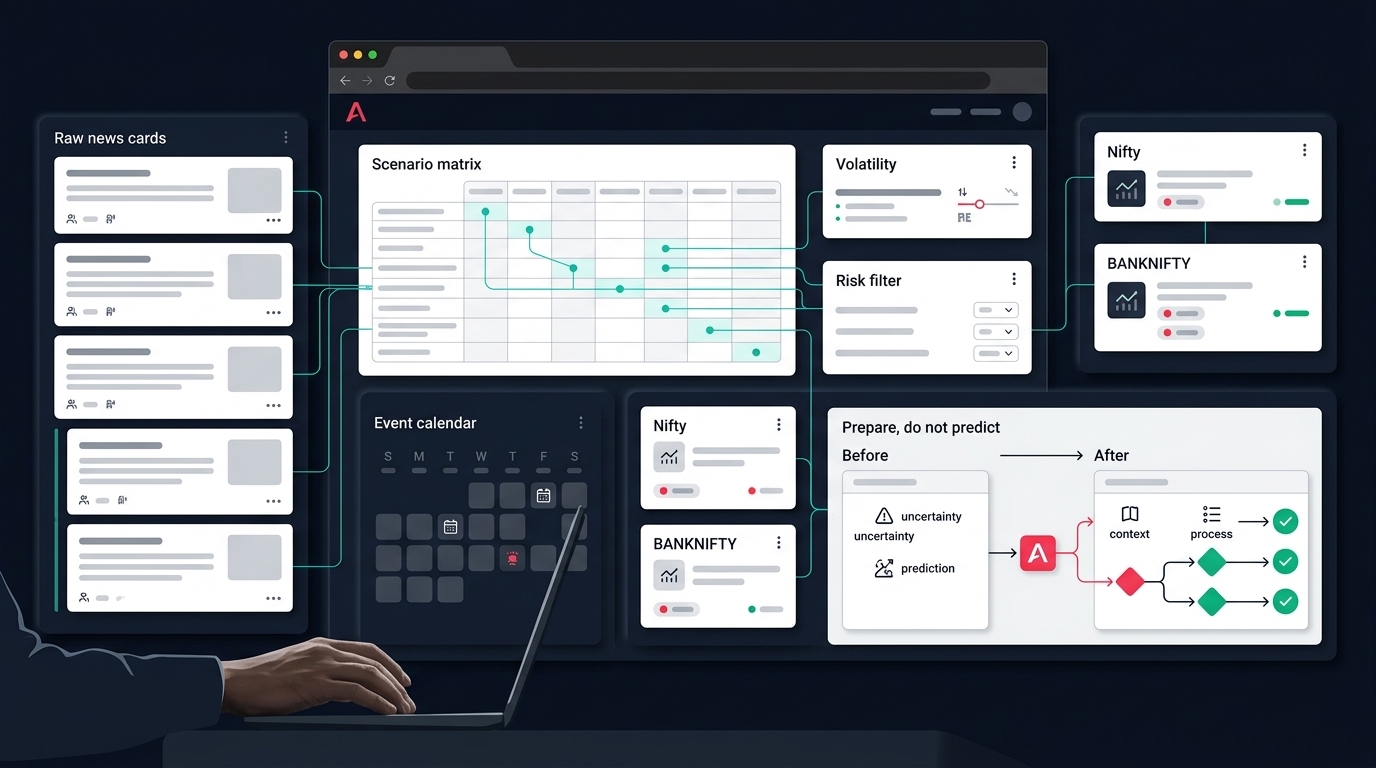
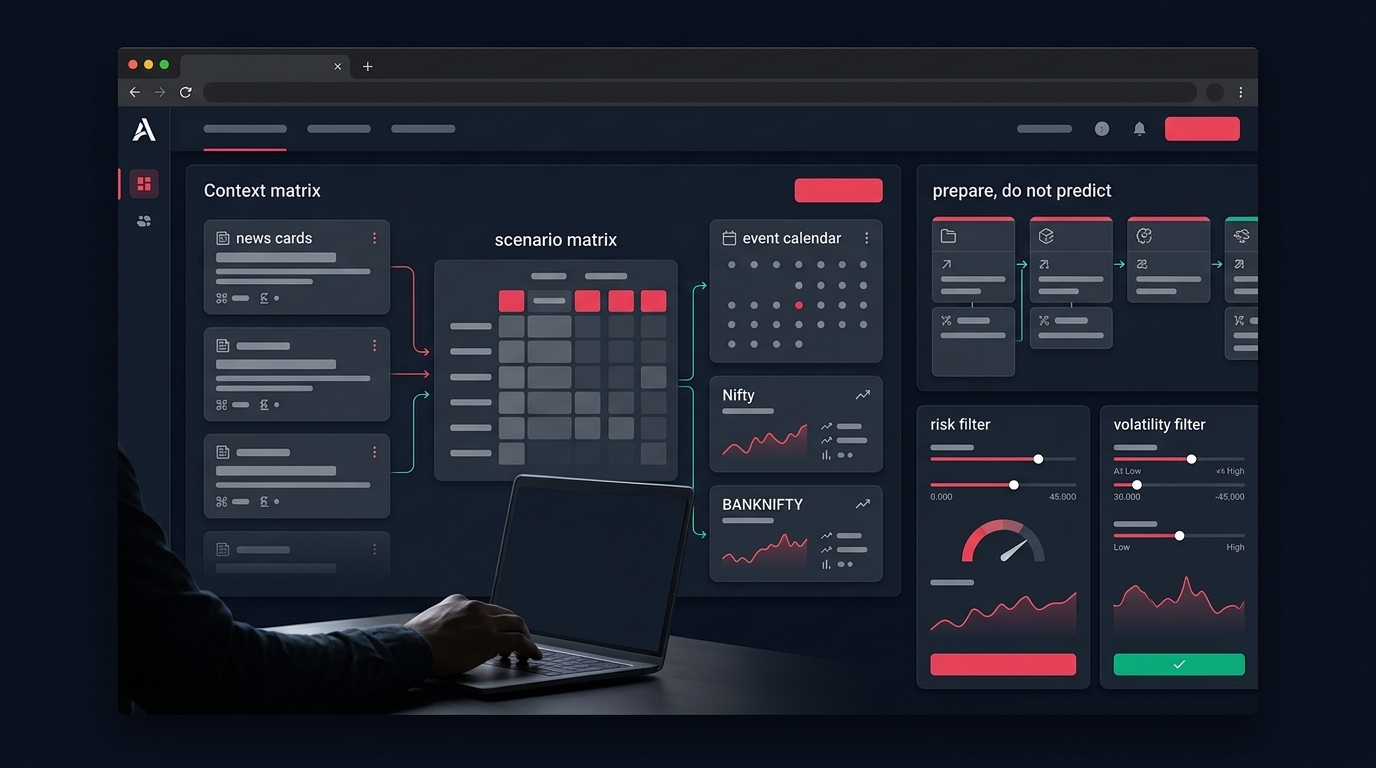
The failure mode the chain invites is inversion: staring at strikes first and back-fitting a view to justify a trade. A cleaner sequence runs the other way — context, then candidate, then chain, then risk, then execution.
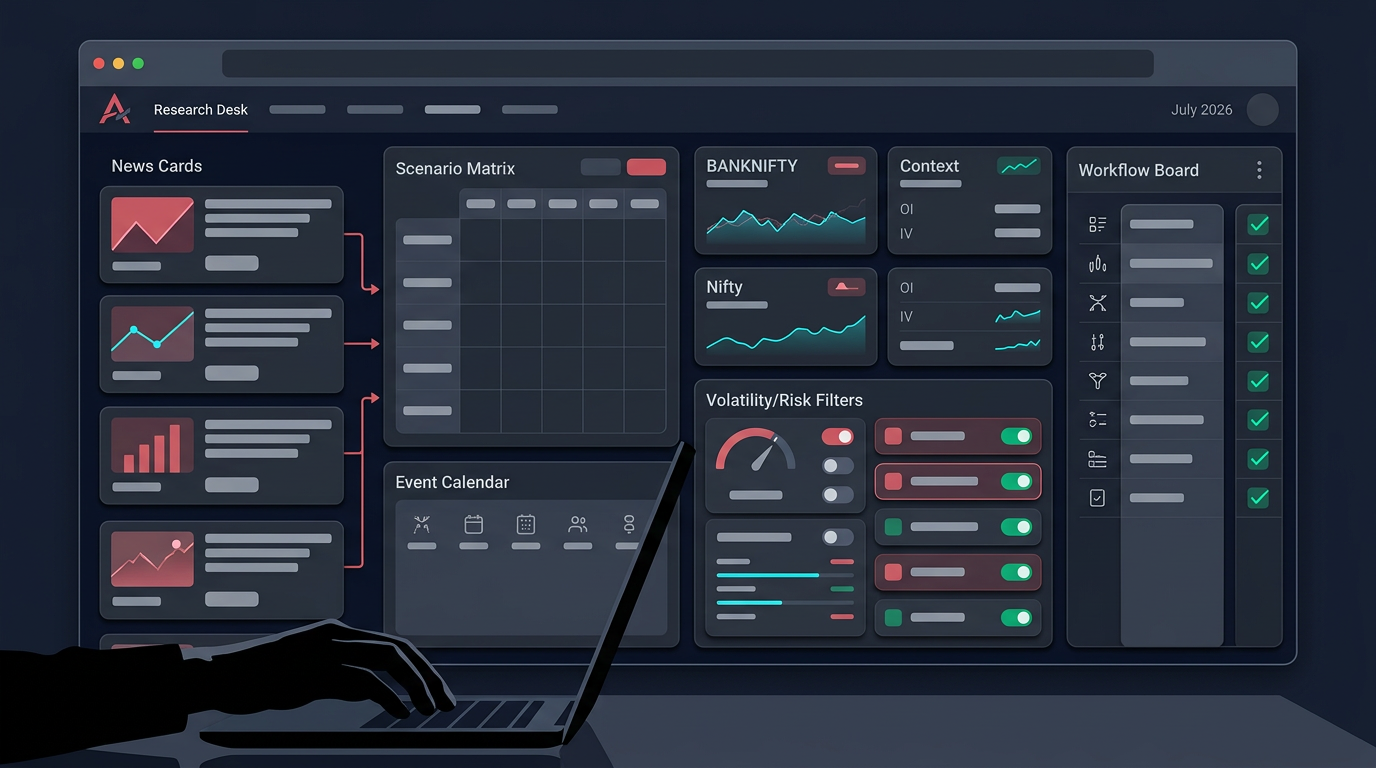
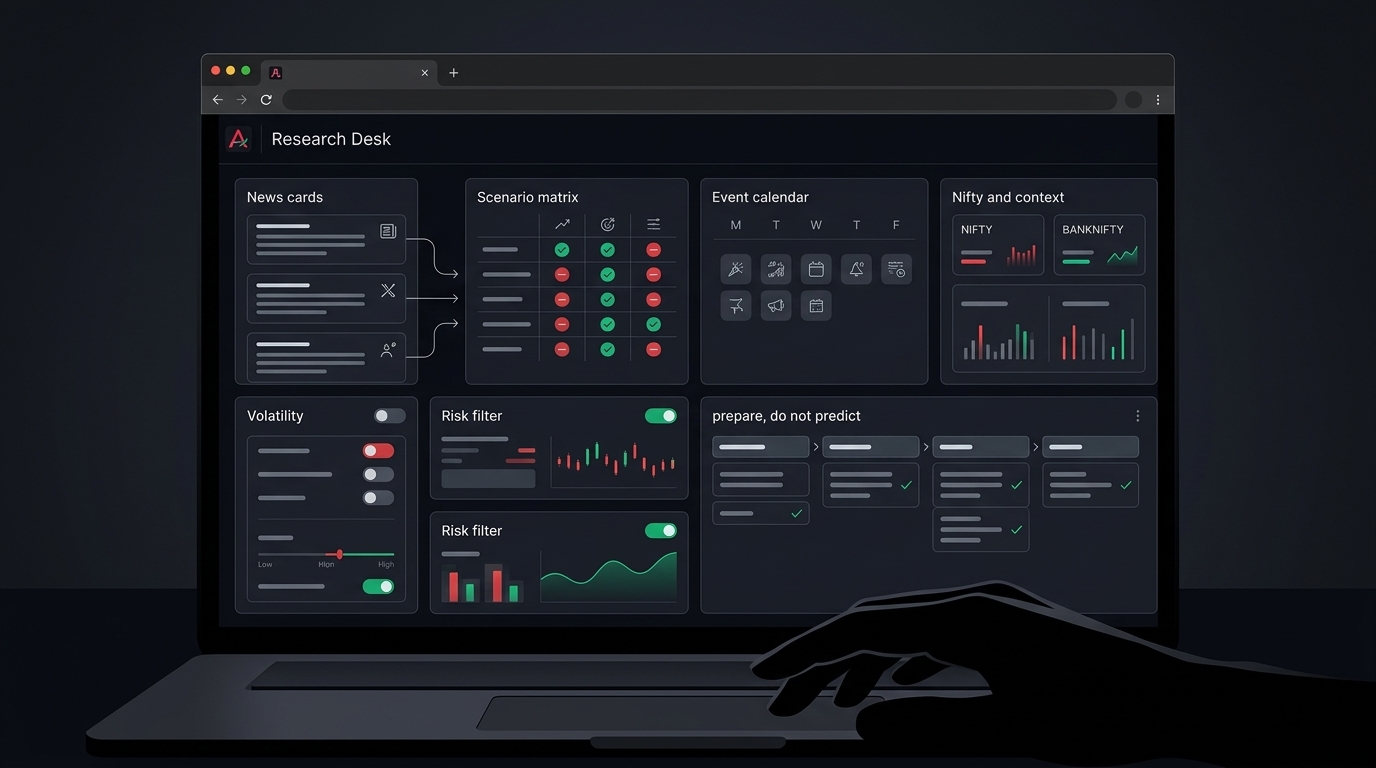
That ordering is how we built the options workspace in Anadi. Index and sector context frames the day before any strike is inspected. A scanner or watchlist produces candidates, and the Action Center marks entries as fresh, stale, or blocked — chase-distance and invalidated-price blocks exist precisely because expiry-week moves tempt late entries. Only then does the option chain come in, at /options#chain, where chain rows connect to leg actions, a basket preview, and a margin estimate before any order exists. If you start from a view rather than a signal, the Strategy Finder works from your stated market view, risk appetite, capital, and style — including an expiry-day style — and ranks structures by max loss and theta rather than by how exciting the name sounds. The point in every case is the same: risk and margin appear on screen before execution, not after.
If you prefer building rules yourself, the same sequence applies in any strategy builder: the chain supplies filter inputs, the risk layer supplies the limits, and the execution layer only fires when both agree. Our weekly market outlook exists for the same reason — market context is for preparing filters, not for chasing calls someone else made.
If you want this whole flow — chain inspection, risk-first strategy selection, basket-level stops, and backtesting that respects expiry regimes — in one place, you can request early access to Anadi Algo and pressure-test it on paper before any real capital is involved.
The Monday-before-expiry checklist
Run through this before tomorrow's open:
- Contract calendar verified — expiry dates and current lot sizes confirmed in the platform, not assumed from an old config.
- Chain data path known — you know where your system's OI and IV numbers come from, how often they refresh, and how staleness is handled.
- Expiry risk state on — reduced size or full exclusion for expiry-day sessions, decided now and written into the config.
- Defined-risk preference — thin-premium, high-gamma conditions favour structures with capped loss; basket stop set at the structure level.
- Account guardrails live — daily loss limit, max order count, and a pre-agreed manual-override condition.
- Decision log enabled — every chain value your system acts on gets recorded with a timestamp, so Wednesday's review works on facts.
The NSE option chain is one of the best free windows into positioning that Indian retail traders have. It rewards the trader who treats it as structured context and punishes the one who treats it as a prediction engine. Chain dekh kar trade nahi banta — process se banta hai. Prepare the filters today; let Tuesday be whatever it is.