Every two months, a 15-minute window reprices a large chunk of the Indian market. The Monetary Policy Committee statement lands, banking names move first, and a lot of retail algos discover — live, with real money — that their stop logic was never designed for that kind of tape.
It is October 1, 2026. Policy season is a permanent fixture of the Indian trading calendar, not a surprise. Which means there is no excuse for treating it as one.
This post is not about guessing what the RBI will do. It is about what a scheduled, high-variance, market-wide event does to the mechanics your system depends on — spreads, fills, gaps, margin, signal freshness — and the specific checks you can encode before the next one.
What monetary policy actually changes in your data
Monetary policy is the RBI's control over money supply, interest rates and inflation. Objectives: price stability, growth support, financial stability, adequate liquidity. That is the textbook part.
The part that matters to a systematic trader is narrower: which of your inputs physically change, and on what timescale.
The tools, mapped to what they touch
- Repo rate — the rate at which banks borrow from the RBI. Moves borrowing costs, which feed bank margins, rate-sensitive sector earnings expectations, and the discount rate the whole market applies to future profits.
- Reverse repo rate — the rate at which the RBI absorbs liquidity from banks. Shapes where short-term money parks.
- CRR (Cash Reserve Ratio) — the share of deposits banks must hold with the RBI. A change here is a direct liquidity lever, not a sentiment signal.
- SLR (Statutory Liquidity Ratio) — the share banks must hold in approved securities, mostly government bonds.
- OMO (Open Market Operations) — the RBI buying or selling securities to add or drain liquidity.
Notice what is common to all five: they operate on liquidity and cost of money. None of them changes your chart pattern. All of them change the conditions under which your orders get filled.
That distinction is the whole post. On a policy day, your edge does not usually break because the setup stopped working. It breaks because the cost of trading the setup tripled for 20 minutes and your system had no idea.
The decision is not the event — the path is
Here is the single most useful research finding for anyone building rules around policy days.
An RBI Working Paper (No. 03, Equity Markets and Monetary Policy Surprises) decomposed policy-day moves in Overnight Indexed Swap rates into two components:
- The target factor — the surprise in the actual rate action itself.
- The path factor — the surprise in the RBI's communication about the future trajectory of policy.
The empirical result, using daily data: equity returns on announcement days were impacted only by the path factor. Volatility in equity prices was impacted by both.
Read that twice. Expectations about the future trajectory moved returns. The rate number itself showed up mainly in volatility.
For a retail algo trader, three practical consequences follow:
- "No change in repo rate" is not "no event." A hold with a hawkish or dovish shift in tone is exactly the path-factor scenario. Systems that whitelist policy days as low-risk when the rate is unchanged are mis-specified.
- Volatility is the more reliable thing to plan around than direction. You cannot forecast the path factor. You can absolutely plan for a widening of realised volatility across a known window.
- The commentary window deserves its own rules. The statement and the Governor's press conference are not the same moment. The paper's intraday event study also found the path factor helped explain changes in equity prices in short windows around announcements — which is a strong argument for treating communication as a separate, tradeable-risk window rather than noise after the "real" news.
None of this tells you what will happen. It tells you where to put your guardrails.
Three windows, not one
Most event filters in retail systems are a single crude block: "no new trades on policy day." That is better than nothing and worse than it needs to be.
Break the day into windows and measure each one in your own historical data:
Window 1 — pre-announcement. Often a compression phase. Positioning thins out, ranges narrow, and breakout scanners start producing signals that look clean on the chart and die instantly because there is no participation behind them. This is the window where a momentum system gets quietly bled by false starts.
Window 2 — the announcement. Spreads widen, depth thins, and the gap between your signal price and your fill price stops being a rounding error. Index options can reprice faster than a 1-minute candle closes.
Window 3 — the commentary and the hours after. This is where the path factor does its work. A move that reverses the Window 2 direction entirely is a completely normal outcome, and a system that entered on the first spike with a tight stop will often be stopped out and then watch the move go its way without it.
Your job is not to pick which window to trade. Your job is to know which of your strategies has any tested evidence of surviving each one.
Risk filters you can actually encode
Vague advice like "be careful on policy day" does nothing for a rules-based trader. Here are filters that can be written as conditions.
Event-window position sizing
Reduce size as a function of the window, not of your conviction. A simple, auditable rule: standard size outside policy windows, a fixed fraction inside Window 1, and zero new entries inside Window 2. If you keep a daily loss limit — and you should — consider a tighter event-day variant of it, because the whole point of a loss limit is that it binds hardest exactly when the tape is least like your backtest.
Spread and liquidity gates
This is the check most retail systems are missing entirely. Before any entry, verify:
- Bid-ask spread as a percentage of the option premium is within your normal band. If your usual filter is a spread under some threshold, a policy window is where it will be breached — and where you most need the gate to actually fire instead of being advisory.
- Depth at the touch is sufficient for your intended quantity. A fill that needs three price levels is a different trade than the one you backtested.
- For options, check whether your strike is still in the liquid zone. Fast underlying moves push your chosen strike away from the active band quickly.
In Anadi's Action Center, this is the role played by blocked reasons — chase distance, invalidated price, stale structure. The useful mental model is that a signal is not actionable just because it fired; it is actionable only if the entry conditions that justified it still hold. Policy windows invalidate entry conditions faster than any other scheduled event.
Stop logic that assumes a spike, not a drift
A stop sized for a normal session is a donation during a repricing window. Two options, both testable:
- Widen the stop and shrink the size so rupee risk stays constant. This keeps you from being stopped by noise, at the cost of needing the trade to be genuinely wrong before you exit.
- Hold the stop and don't take the trade in that window. Also perfectly valid, and far more honest than pretending a 0.2% stop will be respected on a policy print.
What you should not do is keep your usual stop distance and your usual size and hope. On the options side, slippage on the exit leg of a basket is where multi-leg positions quietly lose their hedge. If you run spreads, preview the basket and check the margin estimate with existing positions considered before the window, not during it.
Index versus single-stock routing
Policy reaction is not uniform. The pattern reported across market commentary is that banking names tend to react first and fastest, with financials, auto, realty, infrastructure and consumer-facing sectors following depending on the policy outlook. Treat that as a reason to tier your universe, not as a forecast.
If your scanner universe is heavy on rate-sensitive names, your effective exposure on a policy day is far more correlated than your position count suggests. Five independent-looking long signals in banks and NBFCs is one trade, sized five times.
What a policy day does to your backtest
This is where good intentions meet a small-sample problem.
Roughly six scheduled MPC announcements a year. Five years of data gives you about 30 policy days. If you then split by "hike / cut / hold" and by "hawkish / dovish tone," you are optimising on a handful of observations per bucket.
Any "policy-day strategy" tuned on that sample is almost certainly fitted to noise. The honest use of that data is the opposite direction: use it to measure costs and dispersion, not to find an edge.
Concretely, when you run options backtesting across policy days, measure:
- Realised slippage per leg, policy-day versus baseline. If your engine assumes mid-price fills, this number is the size of your self-deception.
- Maximum adverse excursion on winning trades. If winners on policy days routinely dip far deeper before working than on normal days, your stop is the problem, not your signal.
- Gap behaviour into the next session. Overnight positions through a policy day carry a different distribution than overnight positions through a quiet Tuesday.
- Trade count collapse. How many of your signals would have been blocked by your own liquidity gate? If the answer is "almost all of them," your strategy does not trade policy days — and that is a finding, not a failure.
Treat a policy-day result with 30 observations as a volatility measurement, not a performance claim. The sample is good enough to tell you that conditions differ. It is nowhere near good enough to tell you how to profit from the difference.
A policy-week workflow audit
Run this before the window, not during it.
- Confirm the date and time from the RBI's published MPC calendar. Not from a news tweet, not from memory. Put it into your event calendar as a hard blackout, the same way you handle expiry.
- Check broker session health. An event window is the worst possible place to discover an expired API token. Refresh and verify well before the open.
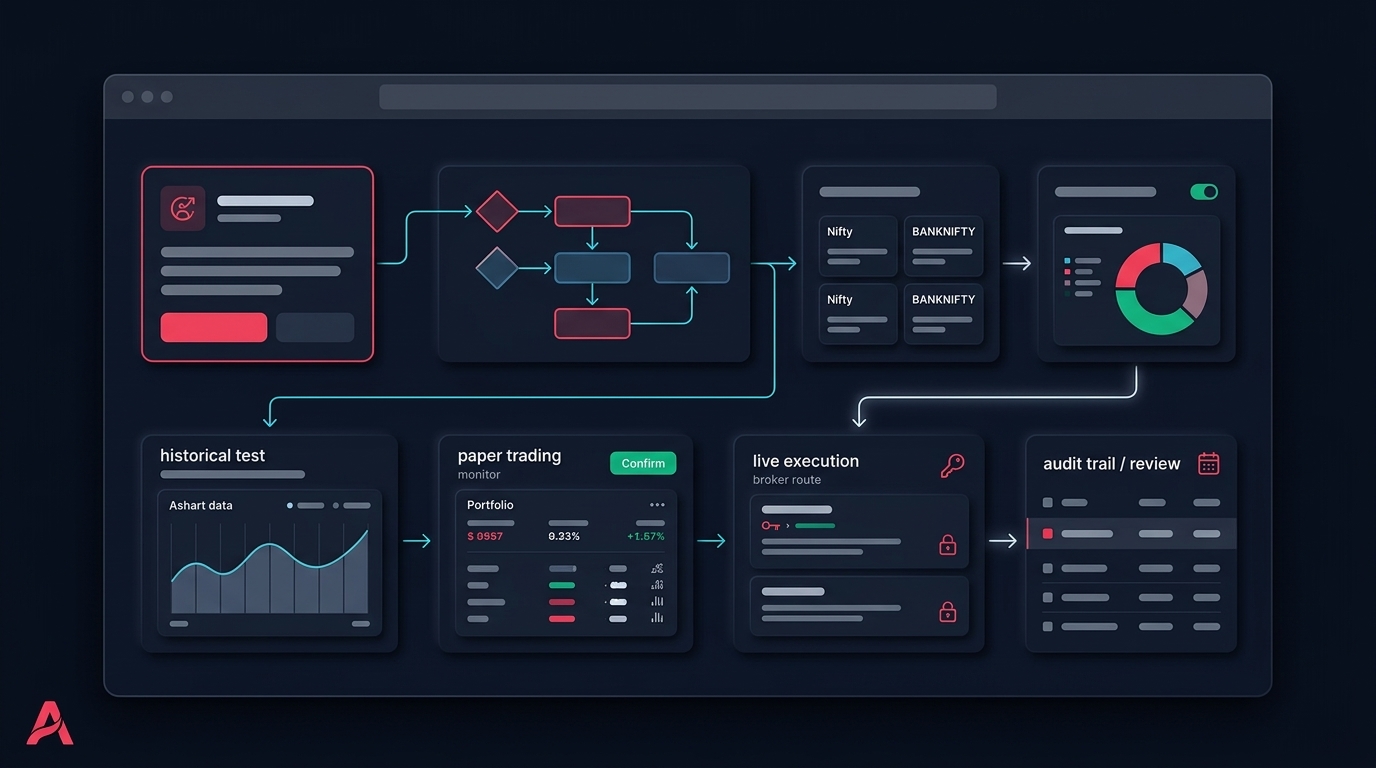
- Verify your event filter actually fires. Paper-trade the window, or replay it. A filter you have never seen trigger is a filter you do not have. Running the day in paper mode once costs you nothing and tells you whether your blackout logic, sizing override and liquidity gate all behave as written.
- Reconcile open positions against the window. Anything you would not deliberately open inside Window 2 is something you should have a plan for if you are already holding it.
- Set your manual override rule in advance. "I will intervene if X" written beforehand is risk management. The same decision made at 10:04 with a position moving against you is not.
- Decide your re-entry condition. Most systems have a block rule and no un-block rule, so they resume on a fixed clock rather than on evidence that spreads and depth have normalised. Make resumption conditional on your liquidity gate passing, not on the minute hand.
- Log the day. Timestamps, spreads, fills, slippage, what your filters did. Six data points a year means every single one is valuable, and nobody will collect them for you.
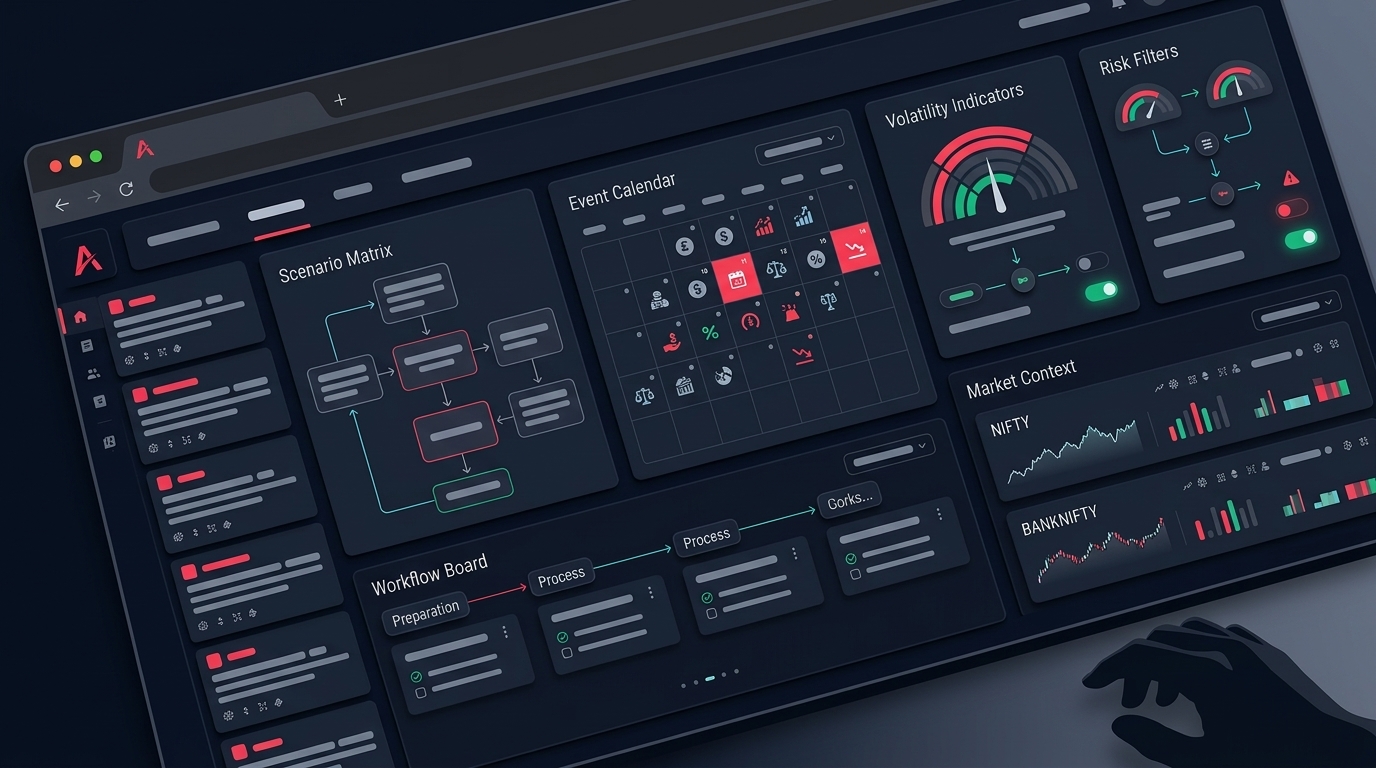
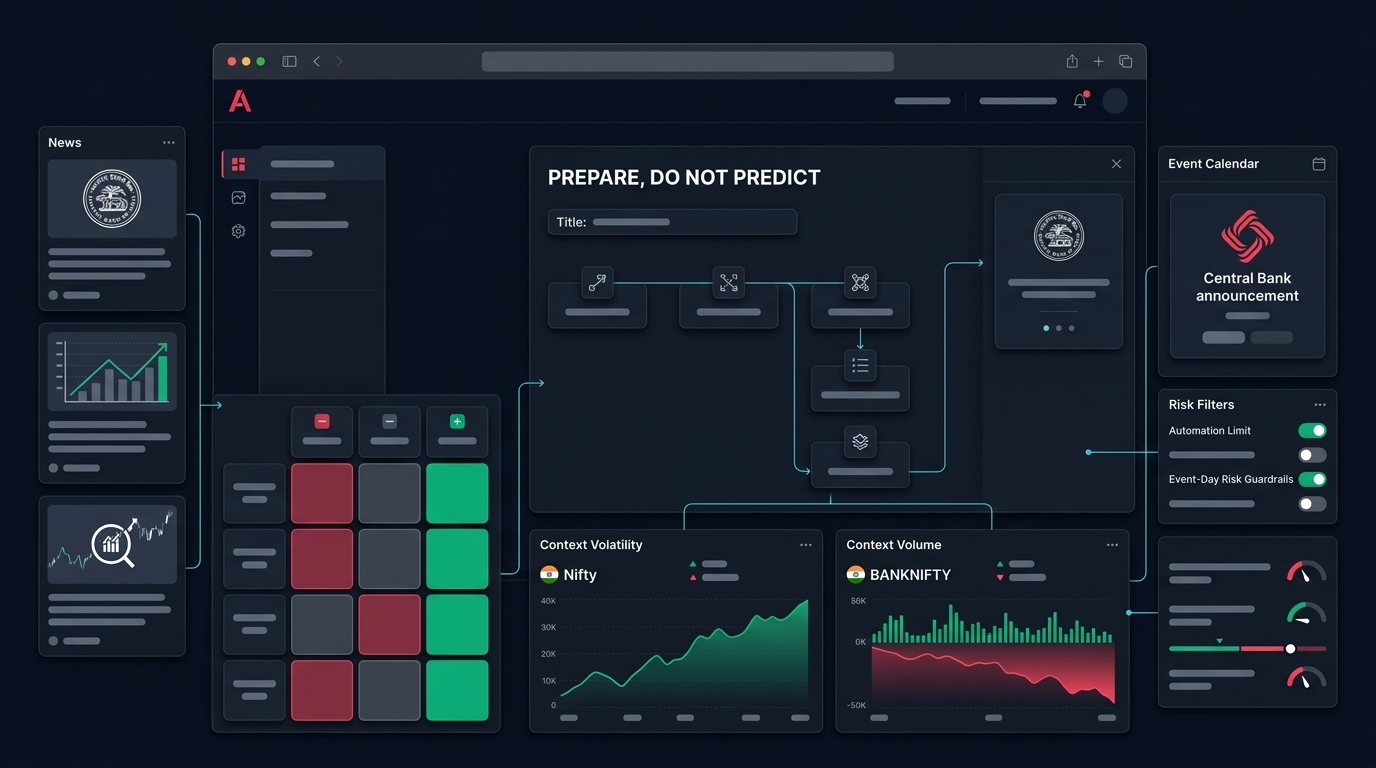
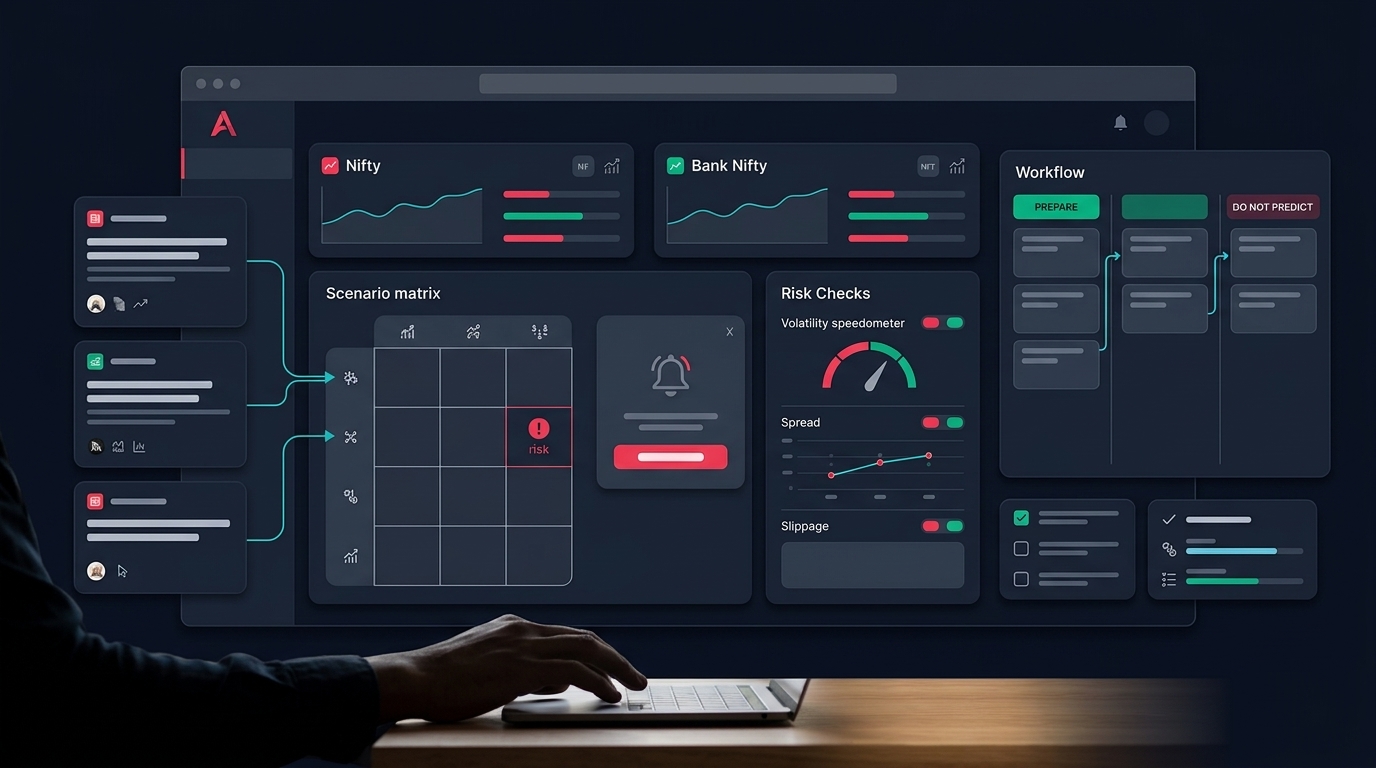
Market context is for preparing your process, which is the whole idea behind a structured weekly market outlook — know what is scheduled, know which of your rules it stresses, and have the override decided before the candle prints.
If you want to build, test and paper-run these event filters as explicit rules rather than as things you remember under pressure, you can request early access and set them up inside a workflow that enforces them for you.
Takeaway checklist
- Policy days change liquidity and cost of trading, not your chart patterns. Guard the mechanics.
- A hold is still an event. Research suggests the communicated future path, not the rate number, is what moved announcement-day equity returns — and both moved volatility.
- Split the day into pre-announcement, announcement, and commentary windows. Measure each separately.
- Gate on spread, depth and strike liquidity before entry. Make the gate blocking, not advisory.
- Keep rupee risk constant: wider stop with smaller size, or no trade. Never wider risk.
- Watch correlated exposure — several rate-sensitive signals are one trade in disguise.
- With about six MPC days a year, use the sample to measure cost and dispersion, not to fit an edge.
- Verify your filter fires in paper mode before it matters, and define the re-entry condition, not just the block.
The goal is not to predict the policy. It is to make sure that whatever the policy turns out to be, your system behaves the way you designed it to — including, quite often, by doing nothing at all.