Most retail traders think "market context" means knowing where Nifty might go next week. For an algo trader, it means something much less glamorous and far more useful: knowing which conditions your system is allowed to trade in, and which conditions should switch it off.
As of mid-November 2026, Indian retail algo traders are operating inside a context that has two layers. One is regulatory — SEBI's retail algo framework became mandatory for brokers on April 1, 2026, and the operational habits it forces are now simply part of how automation works here. The other is the usual market layer: volatility state, expiry cycle, event calendar, liquidity, and global cues.
This post is about converting both layers into rules. No forecasts, no trade calls — just the filters, checks, and workflow steps that decide whether your strategy should be live today.
The regulatory layer is now part of your system design
SEBI's framework came from a February 2025 circular titled "Safer Participation of Retail Investors in Algorithmic Trading," and it became mandatory for all stock brokers from April 1, 2026. Before that, retail automation through broker APIs sat in a grey zone — technically allowed, but with no formal structure around responsibility or standards. Institutions had a clear process; retail did not.
The important thing for a working trader is not the circular's language. It is the fact that four of its provisions now shape how you should build and run a strategy.
Every automated order carries an identity
Under the framework, automated orders are tagged with a unique identifier so exchanges can trace which algo placed what. In practice this means your system is no longer anonymous order flow. If a strategy misbehaves — duplicate orders, a modify loop, a runaway retry — it is attributable.
The workflow consequence: your own logs need to match what the exchange sees. Keep a per-order record of strategy name, signal ID, timestamp, intended leg, and the broker's order ID. When something goes wrong at 09:16 on an expiry morning, you want to reconstruct the sequence in two minutes, not two hours.
The 10 orders per second threshold
The framework uses a threshold of 10 orders per second to distinguish ordinary retail automation from flow that needs heavier registration and oversight. Most retail strategies never come close — until they do, accidentally.
Here is how a well-behaved strategy crosses the line without anyone intending it:
- A scanner-driven system fires at 09:15:00 across 40 symbols. That is 40 entry orders in roughly the same second, plus 40 stop-loss orders.
- A four-leg options basket with a stop and a target per leg is 12 messages for one decision.
- A trailing stop that modifies on every tick can generate hundreds of modify messages per minute per leg.
Exchanges also care about message-to-trade ratios, not only raw order counts. So the fix is engineering, not legal:
- Stagger multi-symbol entries by a few hundred milliseconds instead of firing the whole basket at once.
- Debounce trailing stops — modify on a candle close or on a fixed rupee step, not on every tick.
- Cap modifies per leg per minute in code, and log rejections when the cap bites.
- Count messages per decision when you design a strategy, the same way you count margin.
Your broker is the actual compliance counterparty
The framework treats brokers as principals and algo providers as agents, and requires providers to work through registered brokers. For you, that means your practical regulatory relationship runs through your broker: they enforce API rate limits, conduct due diligence on connected platforms, and are the ones who will throttle or disable access if something looks wrong.
So before you scale capital, read your broker's API policy rather than a generic blog. Ask three concrete questions: what is my per-second and per-day order limit, what happens when I breach it, and is the platform I am using an approved connection? If you are evaluating connectivity options, our page on the NSE algo trading API and the supported brokers list are a starting point, but the broker's own current documentation is the authority.
Static IP and where your code runs
The framework also brings requirements around static IPs and Indian server locations for certain automated setups. If you are running a Python script from a laptop on a home connection with a dynamic IP, that is worth checking with your broker before you treat it as a production setup.
There is a reliability argument here too, independent of compliance. A strategy that dies because your Wi-Fi dropped at 14:45 with naked short legs open is not a regulatory problem — it is a loss. Fixed infrastructure, a watchdog that alerts on heartbeat loss, and a documented manual-override path all belong in the same checklist.
One caution: specifics in this area evolve, and implementation details differ by broker. Treat the above as the shape of the framework, not as a substitute for your broker's current circulars.
The market layer: context as a filter, not a forecast
Now the part most traders get backwards. Market context is not there to tell your algo what will happen. It is there to tell your algo whether to participate.
The useful mental model: every strategy has a regime it was built for. Your job is to detect when you are outside that regime and reduce exposure, not to predict the next move.
Volatility state
Write down, in numbers, the volatility band your strategy was tested in. A short-premium system validated in a calm band behaves very differently when India VIX jumps by a third in two sessions. A breakout system tuned for wide ranges will get chopped in a compressed one.
Practical filters that do not require any prediction:
- A VIX band gate: trade normally inside the band, halve size outside it, stand down beyond a hard ceiling.
- A realised-vs-implied check on index options — if the gap has moved far from your backtest sample, treat the day as out-of-sample.
- An opening-range width check: if the first 15 minutes is materially wider or narrower than the recent median, flag the day as a different regime.
The number matters less than the fact that it is written down before the session.
Event calendar and avoidance windows
Mid-November sits in the tail of the Q2 FY27 earnings cycle, with the monthly expiry window ahead and the usual rolling calendar of global rate decisions, inflation prints, crude moves, and rupee behaviour. You do not need a view on any of them. You need avoidance windows.
Build a simple event table your system reads before each session:
- Scheduled macro prints and policy decisions — block new entries in a window around them.
- Stock-specific events for anything in your F&O universe — results, board meetings, corporate actions, ban-period entries.
- Expiry days and the sessions on either side, which deserve their own rules rather than your default parameters.
- Contract-level changes — lot size revisions, new series, strike availability — because these quietly break hardcoded assumptions.
An event filter is the cheapest risk control available. It costs you some opportunity and removes a category of losses you cannot model.
Liquidity and spread checks
Context shows up in the order book before it shows up in the chart. Three checks worth automating:
- Bid-ask spread as a share of premium on the exact strike you intend to trade, not the ATM you backtested.
- Depth at your intended size — a strike that looks liquid in the chain can be thin two ticks away.
- Slippage logging per trade in basis points, compared against the fill assumption in your backtest.
That last one is the honest feedback loop. If your median live slippage on index options is running well above what your backtest assumed, the edge you think you have is partly an accounting artifact. This is where options backtesting discipline pays off — the backtest is only as good as its fill and cost model.
A pre-market routine that fits both layers
Fifteen minutes, same order, every day:
- Infrastructure. Broker session valid, token refreshed, data feed live, heartbeat monitor green. Session expiry is one of the most common silent failures in retail automation.
- Order budget. Check yesterday's order and modify counts against your broker's limits. If you were near the line, fix the code before adding capital.
- Regime read. Volatility band, overnight global cues, currency and commodity moves — recorded as a state label (normal, elevated, stand-down), not as an opinion.
- Event check. Anything scheduled today that triggers an avoidance window for your universe.
- Risk budget. Daily loss limit set, per-strategy caps set, max open positions set. These should be enforced in code, not in willpower.
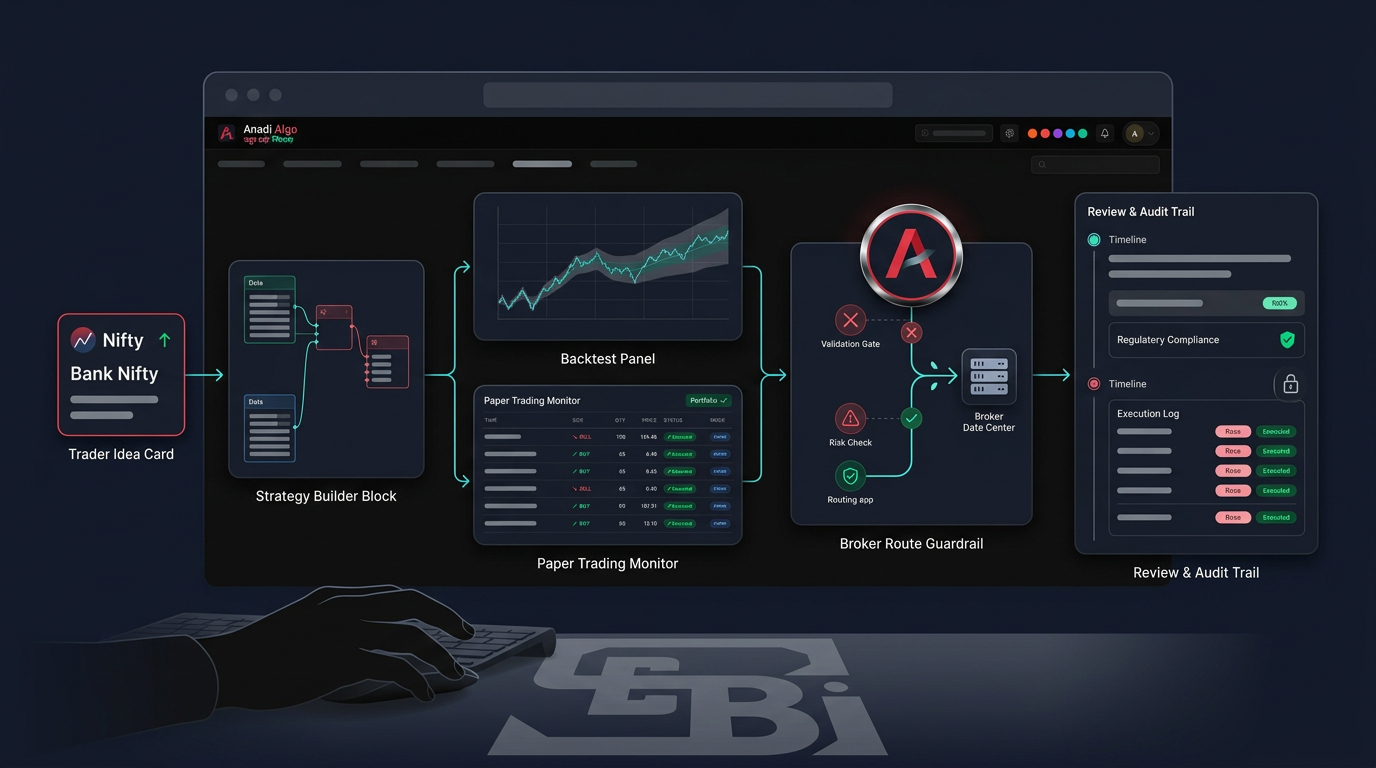
- Candidate review. Run your scanner and look at what actually survived the filters. In Anadi, Action Center is the step between a long scanner list and execution — it ranks candidates, shows signal freshness and stage, flags blocked reasons like chase distance or invalidated price, and tells you whether the symbol is F&O eligible and which route makes sense. The point of that layer is subtraction: fewer, cleaner candidates.
- Pre-trade risk. For options, inspect the chain, build the basket, and look at the margin estimate with existing positions considered before anything goes live. Risk and margin belong on screen before execution, not after a rejection.
If you want a structured version of step 3, our weekly market outlook exists for exactly this use — prepare with context, do not chase it.
Backtest hygiene when the ground has shifted
A subtle problem: if your backtest sample spans 2023 to 2026, it crosses a regulatory and microstructure boundary. Order-rate behaviour, expiry structure, and contract specifications have all changed in that window.
Three defensive habits:
- Segment your results by period. If a strategy's performance is concentrated before a structural change, you are looking at history, not edge.
- Re-run on the recent sample only. A shorter, more honest window beats a long flattering one.
- Model costs at today's levels, including charges, spreads, and realistic slippage. A strategy with an edge of a few basis points per trade lives or dies in the cost model.
And the evergreen one: if your rule set contains a word like "breakout" without an exact definition, it is not testable. Converting fuzzy language into exact entry, exit, sizing, and universe rules is the whole job — Anadi's chat wizard and strategy builder exist to force that specificity, and whatever tool you use, the discipline is the same. Then run it in paper trading long enough to see it meet a real expiry and a real volatility spike before capital goes in.
Where this usually breaks
Honest failure modes, in rough order of frequency: expired broker sessions mid-session; duplicate orders from retry logic without idempotency; trailing-stop modify storms; hardcoded lot sizes after a contract revision; no daily loss limit; and manual overrides taken in the middle of a drawdown with no written rule for when overriding is allowed.
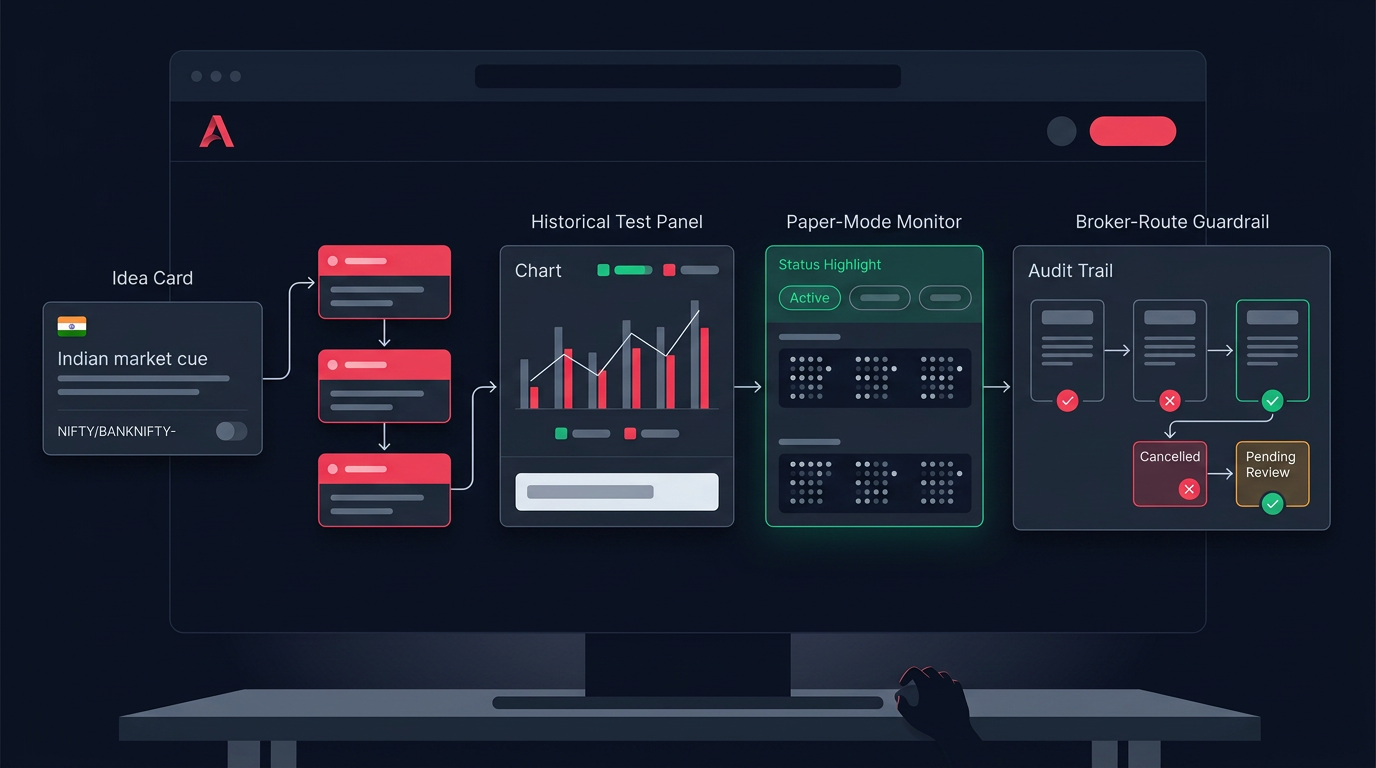
None of those are strategy problems. They are workflow problems, and they are the ones that actually cost retail traders money. Our notes on risk management go deeper on the guardrail side, and if you want to see this whole pipeline — scanner to filtered candidates to chain to margin to paper execution — in one place, you can request early access and walk through it with your own rules.
The checklist
Keep this where you can see it before the open:
- Order and modify budget known, enforced in code, and reviewed weekly against broker limits.
- Every order logged with strategy, signal ID, timestamp, and broker order ID.
- Broker API policy read directly from your broker, including rate limits and connection approval.
- Infrastructure checked: session validity, static IP where required, heartbeat alerting, documented kill switch.
- Volatility band written as numbers, with size reduction and stand-down thresholds.
- Event table loaded, with avoidance windows for macro prints, results, expiry, and ban periods.
- Spread, depth, and slippage checks on the actual instrument you trade.
- Daily loss limit, per-strategy cap, and max-position cap enforced automatically.
- Backtest segmented by period, costed at current levels, validated on a recent-only sample.
- Manual override rules written down in advance, not invented during a drawdown.
Market context will not tell you what happens next. Used properly, it tells you when to stand aside — and in automated trading, that is usually the more valuable output.
This post is educational and reflects publicly available information on SEBI and exchange rules as of November 2026. Rules evolve and implementation differs by broker; confirm current requirements with your broker or a SEBI-registered advisor before running any strategy with real capital. Nothing here is investment advice.